FOUR CENTURIES: Monnoyer’s Mark

Still life attributed to Jean-Baptiste Monnoyer- Matthews Gallery blog

We discovered this still life at the preview of a Santa Fe estate sale. It was tucked in a dark upstairs corner of the house, far from the Picasso print and treasure trove of art books on prominent display in the living room. Lawrence lingered for a while to take in the flamboyant bouquet with its rich rosy tones. There was an excited glint in his eye.

A few months later, the painting has found a home under the glowing lights of our European art room. We know a lot more about it now than when it first caught Lawrence’s fancy. It’s attributed to Jean-Baptiste Monnoyer (1636-1699), a 17th century Franco-Flemish painter who wielded his brush for Louis XIV. Its siblings hang in some of France and England’s most famous estates.

Our adobe art abode is a very different venue, but this 300-year-old artwork gives us the opportunity to transport gallery visitors across the sea and through the ages. Look below to chase Monnoyer through the palaces where he left his mark, and don’t miss the painting’s debut at our opening for FOUR CENTURIES: European Art from 1600 to 1950 on Friday, June 13 from 5-7 pm.

Hôtel Lambert- Site of artwork by Jean-Baptiste Monnoyer- Matthews Gallery Blog

Our first stop is the Hotel Lambert on the Ile Saint-Louis, site of Monnoyer’s first Parisian commission in 1650. The artist grew up in Lille, France and trained in Antwerp, but it was the lavish estates in and around Paris that claimed his considerable interior decorating talents. Monnoyer’s floral designs in the grand mansion would delight its many owners and guests for centuries to come, from a famous Polish political salon to Voltaire, Chopin, Balzac, Delacroix and Dali. Unfortunately, the Hotel Lambert was badly damaged in a 2013 fire and is under renovation.

Chateau de Marly- Site of artwork by Jean-Baptiste Monnoyer-  Matthews Gallery Blog


Artist Charles Le Brun, who painted a series of renowned ceiling frescoes at the Hotel Lambert, brought Monnoyer along for a commission at Louis XIV’s Chateau de Marly. The (relatively) small country estate was the king’s escape from the more rigid world of Versailles, and aristocrats fiercely battled for a chance to stay there. Alas, the twelve pavilions that flanked the water and their intricately adorned interiors are long gone, but the commission launched Monnoyer into a new stratosphere.

Palace of Versailles- Site of artwork by Jean-Baptiste Monnoyer- Matthews Gallery Blog

Monnoyer worked with Le Brun once again on the ornamentation of the Palace of Versailles. For this and other high profile royal projects, he developed a style that was far removed from his training in the subdued still life painting techniques of the Low Countries. The bold, ornamental approach is in full force in our still life, recalling the spectacular garlands of flowers he painted on the ceiling of the Queen’s pavilion at the Chateau de Vincennes. Monnoyer also made reference sketches and etchings for French tapestry workshops, greatly influencing European decorative styles for years to come.
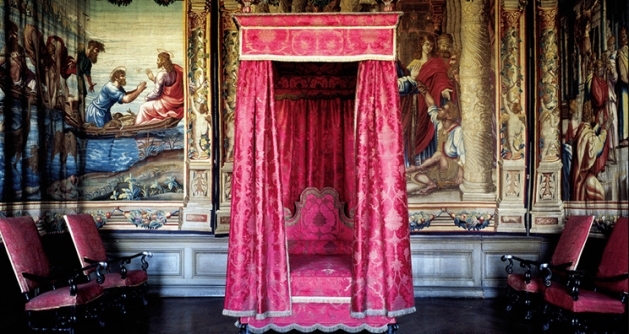
Boughton House- Site of artwork by Jean-Baptiste Monnoyer- Matthews Gallery Blog

A commission from the Montagu House in London drew Monnoyer away from Paris in 1690. He adorned dozens of panels with fruits and vegetables and painted several portraits, some of which now reside in the state rooms of Northamptonshire’s Boughton House. The artist remained in England until his death in 1699, but his distinctly French style lived on in the artwork of two of his sons.

Make sure to attend the opening of our FOUR CENTURIES exhibition on Friday, June 13 from 5-7 pm, and follow us on Facebook, Twitter and Tumblr for daily gallery news.
ONE WORK OF ART: Jean-Pierre Jouffroy

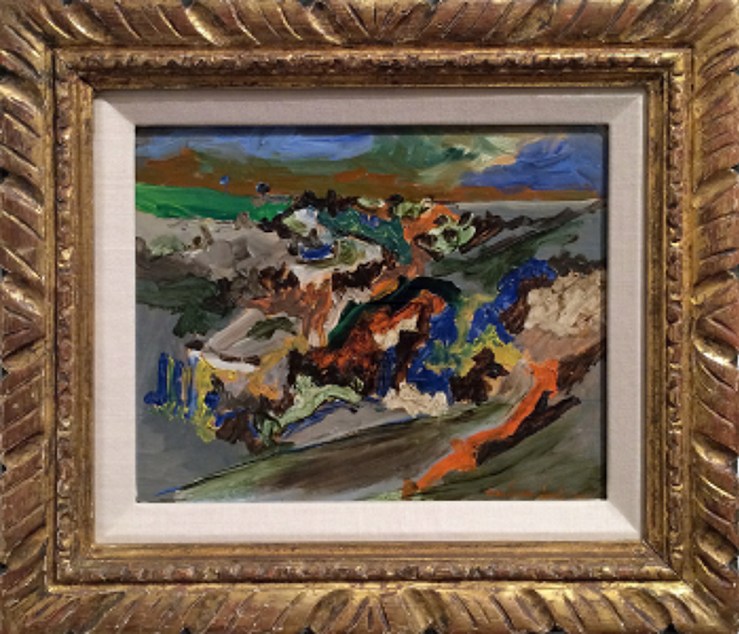
Jean-Pierre Jouffroy- Untitled Modernist Landscape- Matthews Gallery Blog
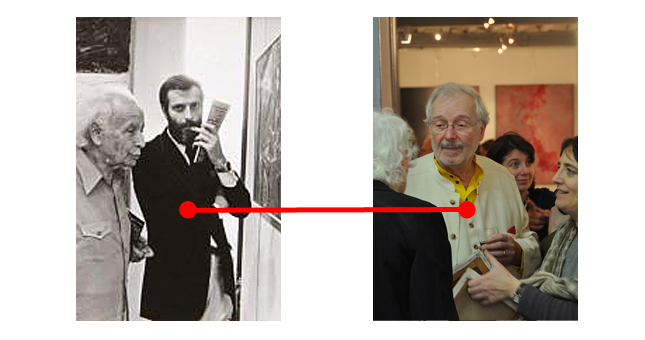
Two photographs.

Jean-Pierre Jouffroy - Matthews Gallery BlogOne shows a young artist with a determined look in his eyes, and the other an older gentleman at the opening of an 80-year retrospective of his artwork. What happened in the span between the shots?

Sometimes art by Picasso or Gauguin finds its way to our gallery, but other times we get our hands on an exquisite work that bears a name we’ve never heard before. Such was the case with this lovely 1940’s painting by a man named Jean-Pierre Jouffroy, which reminded us of the artwork of James Brooks and other lyrical abstractionists.

Thank goodness for Google. An image search of the artist’s name brought up these two photos, and some French-to-English translating revealed the fascinating story behind them.

Jean-Pierre Jouffroy was born in Paris in 1933. When he was 11 years old, he saw the work of Wassily Kandinsky and Nicolas de Staël in a gallery and fell in love with modernism. “As a young boy, I dreamed of covering the surface of the earth in paint,” Jouffroy recalls.

Early in his career, the artist created purely abstract work that was heavily influenced by Staël. Then, in the late 1950’s, Jouffroy had an artistic epiphany.

“An abstract painting always shows something, like it or not,” he explains. “The painting is the image of an internal battle. This fight is itself a metaphor for our relationships in the social sphere.” Based on this realization, Jouffroy decided to incorporate the visual vocabulary of abstraction into representational work.

The shift sent the artist on a journey that traced the innovations of modernists like Picasso and Cezanne in reverse. Just like those artists, Jouffroy was experimenting with abstracted figures and landscapes, but he was coming from a wholly nonrepresentational world that his predecessors never explored. In tributes to Cezanne, Gauguin, Manet and Braque, he brought great artists of the past into harmony with a movement they all, in one way or another, helped to inspire.

Jouffroy’s new explorations caught the eye of the art world, and he exhibited at Paris’ Museum of Modern Art, the Art Institute of Chicago and other renowned institutions. Though he was focused on figurative work, he was often associated with lyrical abstraction (as we suspected) because of his background, his loose brushwork and his inventive use of color.

Our Jouffroy painting represents an interesting phase in the artist’s evolution. Though it predates his representational work, it has undeniable elements of landscape. Perhaps it’s the first sign of the transformation that would send Jouffroy’s career in a spectacular new direction. You can see echoes of the work’s palette and brushwork throughout the artist’s retrospective at the Place du Colonel Fabien that opened in November.

Check out Jean-Pierre Jouffroy’s “Untitled (Modernist Landscape)” on our website, and connect with us on Facebook and Twitter for more gallery news.

SALON 669: A Historical, Hysterical Salon Glossary

Salon de Madame Geoffrin, where all the good parties went down in 18th century France - Matthews Gallery blog

Ever heard of a ruelle, a visit card or les bas-bleus? In preparation for SALON 669, we’ve compiled a glossary of weird and wonderful terms from literary and art gatherings of the past. Don’t worry though, you don’t have to be a noble, a French speaker or dressed in blue stockings to attend our Oct. 18-27 event series. Just bring a healthy helping of the last term on the list…

  • Age of Conversation: Spans the height of the salon’s popularity, from the 16th to 18th centuries in Italy, France and across Europe.  Some scholars say the intellectual meetings helped spark the French Revolution.
  • Enlightenment: A cultural movement that was spurred in part by the salon, which created an even playing field of ideas that elevated the growing bourgeois class to the level of the nobility. Mme Geoffrin was a pretty powerful lady in 18th century France. Find out why on the Matthews Gallery blog.
  • The Great-Woman: The hosts of salons were commonly women of the bourgeois and noble classes, who threw the gatherings to educate themselves and wield social and political power. Historians have called the most influential of these salonnieres “great-women”, using their stories to reframe misogynistic historical narratives.
  • Greek Symposium: The Athenians invited artists and intellectuals to their homes, providing a safe political space for different classes to mingle. The symposium inspired the Roman banquet, which inspired Italian Renaissance gatherings, which inspired the French to coin the term “salon”.
  • Horace: Roman lyric poet who said his craft aimed “either to please or to educate”.  The salons often followed Horace’s motto, aspiring to foster delightful, stimulating conversation.
  •  Je Ne Sais Quoi: French for “I don’t know what”, a popular way to describe the harmonious feeling of the salons in 17th century France.
  •  Lane: Or, in French, ruelle. Describes the space between the bed and the wall in a lady’s chambers, where 17th century French salon goers sat while their hostess lounged. Not all salons were so intimate though. At Louis XIV’s petit lever (literally “a little lift”), no one was allowed to sit down. Madame Recamier was a "literary lion" and political power player. Find out why on the Matthews Gallery blog.
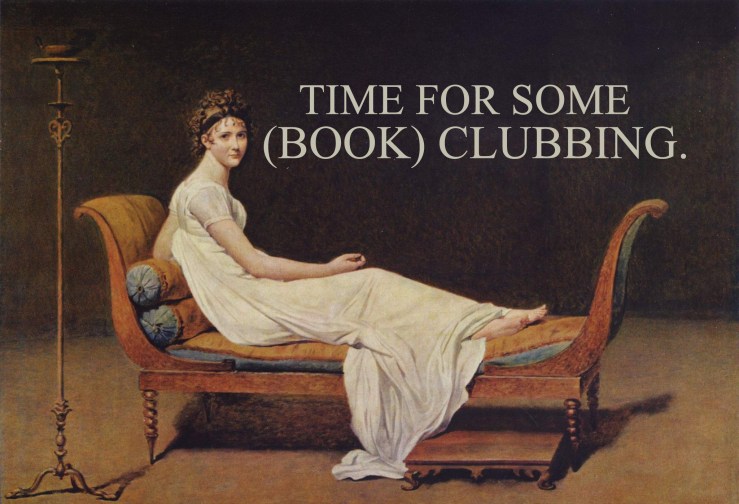
  • Literary Lion: Term for fierce literature enthusiasts who organized salons in the 19th and 20th centuries. Madame Recamier (1777-1849) helmed a powerful literary salon attended by intellectuals who were unpopular at court, snubbed a position as the Empress consort’s lady-in-waiting, and even started a tiff between artists Jacques Louis-David and Francois Gerard over a portrait commission. The hardly humble writer and salon host Gertrude Stein later used the title to describe herself.
  • Les Bas-Bleus: A term that has come to mean “female intellectual”. Madeline de Scudery founded the les bas-bleus (blue-stockings) salon in the 1600s. When salons sprung up across Europe in the 18th century, Elizabeth Montagu founded her own blue-stockings gathering in England. Montagu maintained such a rigid dress code that she once rejected the Duke of Wellington for having the wrong shade of socks.
  • Visit Cards: From the 1800s until the 1930s, visitors to upper class French salons would present a card with their name on it to a servant at the door. If the host didn’t recognize their name, they were booted from the premises.
  • Wit: Throughout the history of salons, cleverness was key. The two most important rules at a salon were that all guests were to be treated equally, and that everyone was expected to make points without provoking confrontation.

Stay tuned for more salon-themed posts, and make sure to attend SALON 669 at the Matthews Gallery from October 18-27.  Connect with us on Facebook, Twitter and Pinterest for more news from the Matthews Gallery!