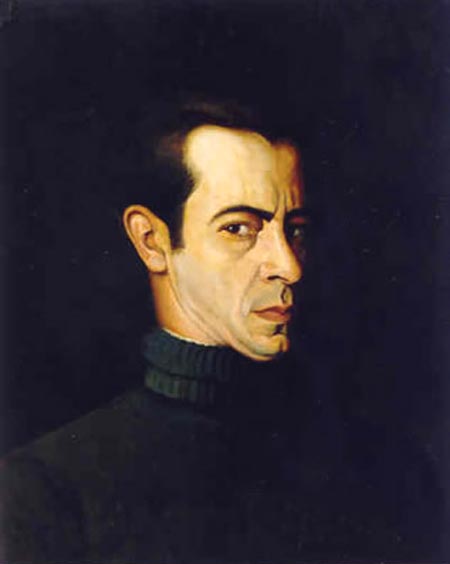
Jaime Colson (1901-1975) was a teenager when he left his homeland of the Dominican Republic to study art in Spain. The talented young painter landed smack in the middle of the Spanish avant-garde, rubbing elbows with Salvador Dali and befriending Rafael Barradas and other artists. Colson lived there for six years and developed a surrealist style. His next move was to perhaps the only place that could be stranger than España surrealisto: 1920’s bohemian Paris.
Colson arrived in the City of Lights in 1924, at the height of Gertrude Stein‘s reign as a powerful salonnière and premiere champion of modernism. In Paris, Colson met Picasso and Braque, Juan Gris and Fernand Leger. He soaked up modernist innovations—and quite a lot of absinthe—like a sponge. Four years later, as a full-fledged Parisian, Colson painted the latest addition to our collection:
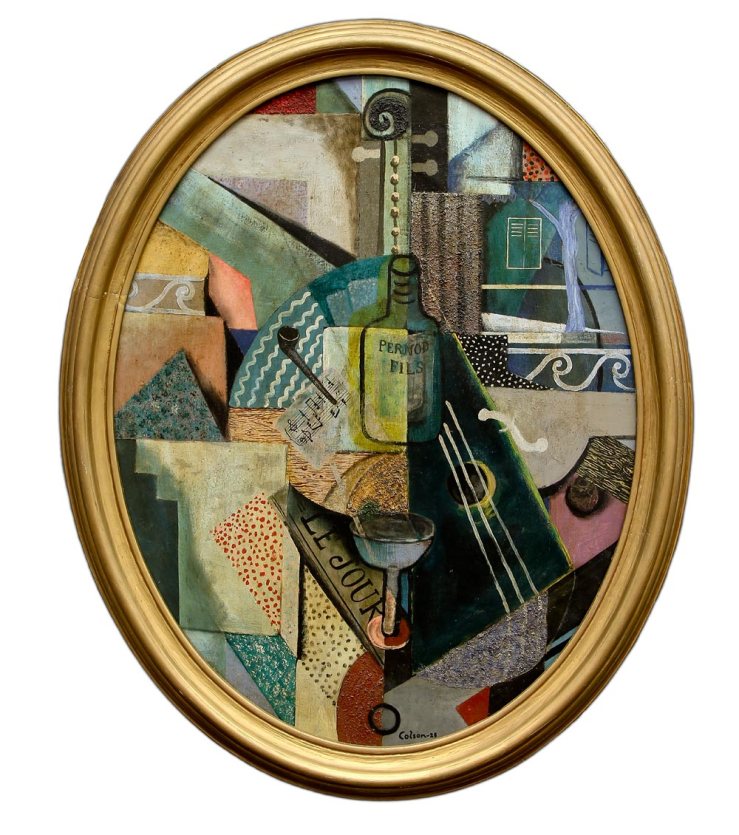
Colson’s Cubist Still Life offers an essential review of the original vie bohème, a painted guide to the colorful, booze-soaked existence of the Lost Generation. Its skewed lines and wild patterns capture all the dynamism of a moveable feast, and the pall of the “green fairy” hangs over its heart. Without further ado, here are seven details that set the roaring scene…
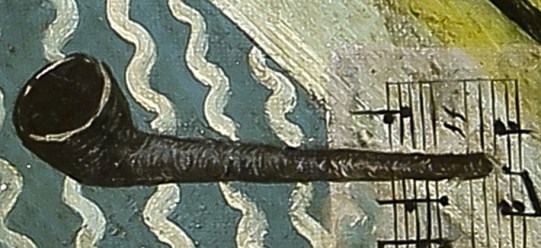
Colson painted Cubist Still Life in 1928, the same year Rene Magritte made his famous Ceci n’est pas une pipe. The pipe that appears near the center of the composition is at once an homage to Magritte’s French surrealism and a nod to Colson’s Spanish surrealist past.
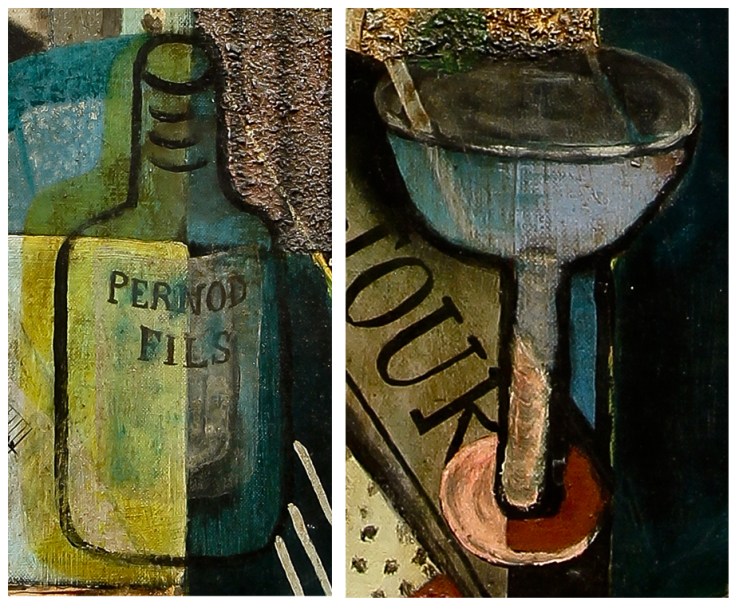
Pernod Fils was the reigning brand of absinthe in the late 1800s and early 1900s. The anise-flavored, bright green spirit was formulated in Switzerland, and its distillery in Pontarlier, France churned out as much as 30,000 liters of absinthe per day. Knock-offs abounded (Pernot, Perriot and Parrot among them), some of which contained toxic substances and were cheap enough to appeal to many a town drunk. In 1910, the French consumed 36 million liters of absinthe in a year, but by 1915 the drink had been demonized and banned.
After World War I, Pernod Fils introduced a new, lower-proof liqueur d’anise, which is the drink Colson would’ve encountered during his Paris years. However, the famous absinthe pictures by Picasso, Lautrec, van Gogh and the like hail from the golden age of the beverage, before the ban. Perhaps the ghostly bottle of Pernod Fils and the empty glass below it are Colson’s tribute to a madcap age that his contemporaries remembered with longing.
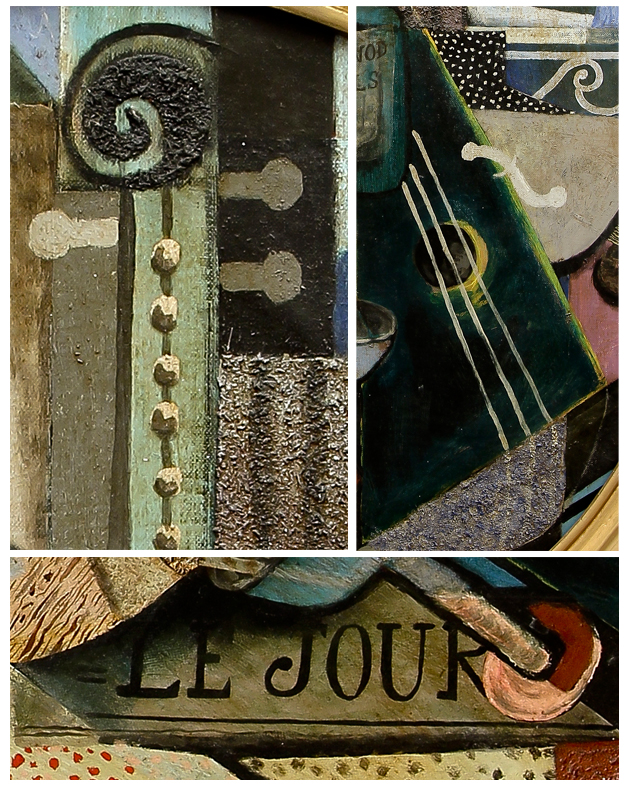
A cubistic guitar and a trompe-l’œil glimpse at the French newspaper Le Journal refer to modernist art forms Colson was exposed to in Paris. In 1912, Picasso began experimenting with collage, incorporating scraps of fabric and other materials into his oil paintings. Picasso’s Still Life with Chair-Caning, one of the first fine art collages ever made, is on an oval canvas and features a scrap of furniture material. Picasso’s close collaborator Braque soon followed suite, using glue to attach wood-grain papers to his cubist canvases. Colson replicates similar patterns and textures using oil paint in Cubist Still Life.
In late 1912, Picasso made artworks using clippings from Le Journal, and also created three dimensional collages called art assemblages, including a cardboard guitar. These are Colson’s strongest references to his modernist contemporaries in the painting, directly addressing Picasso’s tendency to weave real-world events into his works and distort objects in groundbreaking ways.
Colson lived in Paris until 1934. After a short stint in Cuba and another stay in Europe, he returned to the Dominican Republic with a head full of revolutionary ideas. He began blending his European influences with Dominican subject matter, creating images of the rich central American culture the likes of which had never been seen before. Along with Yoryi Morel and Dario Suro, Colson is known as one of the founders of the modernist school of Dominican painting, and is considered one of the great Latin American masters of the 20th century.
Learn more about Jaime Colson on our homepage, and connect with us on Facebook, Twitter and Pinterest for daily gallery news.

 MATTHEWS GALLERY BLOG