Over the next two weeks, we’re paying tribute to 10 painters who changed the course of art history. Our first five picks range from Il Divino to the “painter of light”. Who do you think we missed? Connect with us on Facebook, Twitter and Pinterest to join the discussion, and click here to read part 2!
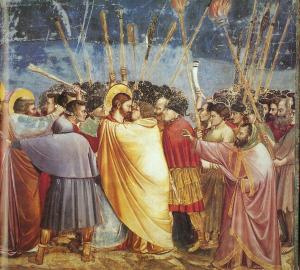
1. Giotto (1266/7-1337)
The Italian painter and architect was most likely born in Florence, the city where he would live and work for his entire life. Legend has it that the young Giotto was herding sheep and stopped to sketch the animals on a rock when famous Tuscan painter Cimabue strolled by and took him as an apprentice. One of art history’s most passionate debates centers on whether Giotto completed parts of Cimabue’s frescoes at Assisi. Regardless, it was Giotto’s break from the traditions of Cimabue and his contemporaries that helped spark the Italian Renaissance.
In Giotto’s frescoes at the Scrovegni Chapel, the stylized Byzantine figures that were popular at the time are nowhere in sight. His figures are solid and sculptural, their robes draping naturally from their frames. This is a painter who drew inspiration from what his eyes could see. 16th century biographer Giorgio Vasari wrote that Giotto started “the great art of painting as we know it today, introducing the technique of drawing accurately from life, which had been neglected for more than two hundred years.”
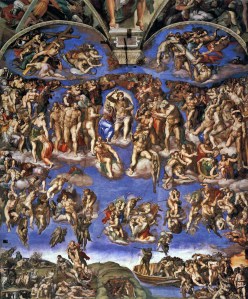
2. Michelangelo (1475-1564)
In contrast with Giotto, this prolific sculptor, painter, architect, poet and engineer left behind a paper trail that makes him one of the most well-documented artists of his time. Michelangelo completed the Pieta and David before he turned 30 and redesigned part of St. Peter’s Basilica at 74. In between, he completed the ceiling frescoes of the Sistine Chapel, spent 40 years creating Pope Julius II’s tomb and worked on a multitude of other projects. Even in his time he was known as Il Divino, “the divine one”.
The Last Judgment fresco on the altar wall of the Sistine Chapel, one of Michelangelo’s final works, is the fulfillment of Giotto’s artistic legacy. His massive figures seem to press from the wall with all of the terriblita (awe-inspiring grandeur) of living giants. Giorgio Vasari, who wrote a biography of Michelangelo during his lifetime, called the artist’s works the apex of the Renaissance. They also inspired Mannerism, the movement that proceeded the Renaissance in Western art.
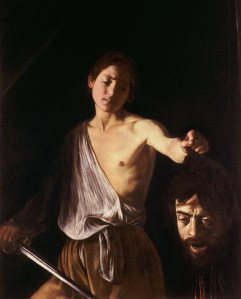
3. Caravaggio (1571-1610)
It’s no secret that Caravaggio was an unpleasant guy. A public notice from 1604 accused him of crashing gatherings armed with a sword, “ever ready to engage in a fight or an argument, so that it is most awkward to get along with him.” Perhaps that’s why he was swiftly forgotten after his death in 1610 and wasn’t recognized for his great influence on art history until three centuries later.
The artist was born in Milan and grew up in the city of Caravaggio. His parents were both dead by his teen years so he started an apprenticeship with painter Simone Peterzano, who was Titian’s pupil. He moved to Rome in 1592 and rose to fame as he developed the style that would come to define Baroque painting. His figures were incredibly realistic, their skin pocked, their feet dirty and their faces full of emotion. They were illuminated by high key chiaroscuro lighting. Caravaggio fearlessly placed the common people in the spotlight, a coup that would serve the Counter-Reformation well.

4. Velazquez (1599- 1660)
Diego Velazquez’ oeuvre mostly consists of pompous portraits of the Spanish royal family and other powerful and privileged Europeans. It was a twisty play on this genre that would secure his place in art history. Velazquez was born in Seville and educated well. He worked his way up the ranks of painters in his hometown and then hopped to Madrid, where a connection with the king’s chaplain and the timely death of the Spanish royal court painter helped him land the coveted position in 1624.
Four years before his death, Velazquez painted his masterpiece Las Meninas. The painting shows Spanish princess Margaret Theresa standing next to the painter himself, who’s working on a large canvas. In a mirror behind them are the faces of the king and queen. The sophisticated work’s bifurcating viewpoints throw its true subject into question and place Velazquez far ahead of his time. More than two hundred years later the painter’s work would inspire the Realists, the Impressionists and the Modernists.
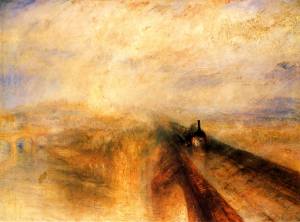
5. Turner (baptized 1775-1851)
JMW Turner was known as the “painter of light”, but the artist with the ethereal subject matter had a very solid impact on art history. The Romantic landscape painter was born in London to a barber and wig maker. He showed his drawings in his father’s shop as a young boy, and studied under architects and a draftsman before enrolling in the Royal Academy of Art as a 14-year-old. His reputation swiftly grew, and he had his own studio by 18. However, when he verged away from picturesque landscapes in favor of stormier subject matter, Protestant society was shocked.
In his famous oil Rain, Steam and Speed, Turner depicts a locomotive as a surging pillar of tumbling air with a black smokestack as its only identifying characteristic. As details melted away and Turner focused on the continuous flux of air and light, critics started turning against the artist. An 1802 review called his works “too indeterminate and wild”, and writers were keen to tie his chaotic paintings to radical new political and social movements. Turner became increasingly isolated from society and often refused to sell his paintings, but his work had an undeniable influence across Europe, inspiring Claude Monet and other French artists in their steps toward Impressionism.
Sound off on Facebook, Twitter and Pinterest and tell us who we missed, and click over to part 2 for our last five picks.
 MATTHEWS GALLERY BLOG