NEW IN THE GALLERY: The evolution of David Grossmann

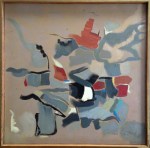
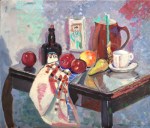
David Grossmann, Matthews Gallery
“Almost” by David Grossmann

David Grossmann always knew he wanted to be an artist. Even before his first painting lessons with his grandmother at 10 years old, he was an avid sketcher, filling notebooks with intricate drawings of dragons and the floor plans of medieval castles. By 16, David was taking portrait commissions and doing book illustrations for a publishing company. Still, he couldn’t quite discern a path that would turn his passion into something more.

“I didn’t know how to get there as far as making a living as a professional artist,” the 29-year-old says. Finding that bridge would take a while, but it’s safe to say that he’s officially crossed it. We’re proud to be the first gallery to represent David and his work. It’s just the latest high point in an already impressive artistic career.

David was born in the United States and moved to Chile when he was two years old. It’s a place of stunning, harsh natural beauty that would inspire in David a lifelong passion for the outdoors. His grandmother was a landscape painter who lived in El Paso, Texas. When they saw each other, she would teach him oil painting techniques with a brush and palette knife.

When David was 14, the family decided to relocate to Colorado. It was a move that the teenager fiercely resisted.

“When we left, I didn’t say goodbye because I hadn’t accepted that we weren’t going back,” he says. “I’m sure for anyone, being 14 is probably a tough age. On top of that, adjusting to a new culture and new everything was really difficult.”
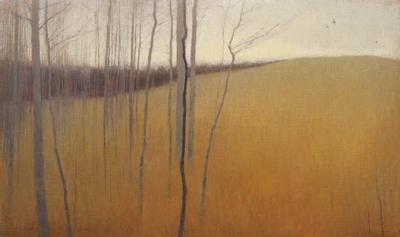
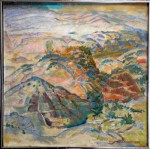
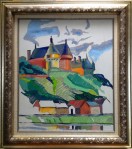
David Grossmann, Matthews Gallery
“Away” by David Grossmann

The move marked a big shift in David’s art. Not long after he arrived the young artist started receiving requests for commissions, and he enrolled in his first formal drawing classes with artist Valorie Snyder. His grandmother was an art director of a Christian publishing company and gave him a job illustrating Bible study curriculums.

“It became more of an outlet for me than it had been before,” David says. “It was a lot more serious, a lot more figurative works. I also started drawing more landscapes at that point.”

Despite his early success, David still didn’t see art as a viable career. In college he studied business and Spanish, focusing primarily on his studies instead of his artwork. During his last year at university, struck by the fear of being trapped in a cubicle, he finally committed to giving art school a shot.
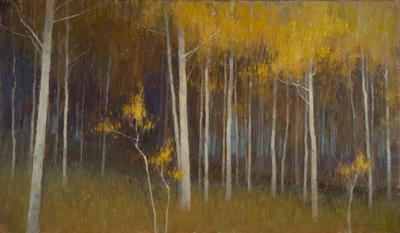
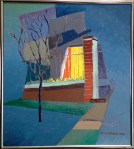
David Grossmann, Matthews Gallery
“When Leaves are Falling”, David Grossmann

At the Colorado Academy of Art, David learned classical painting techniques and took his first plein air painting class.

“I’ve always loved the outdoors, but until I took that class I felt like I couldn’t contain the landscape. It’s so huge, and I didn’t know how to make it into a composition,” he says. After he learned how to capture the beauty of nature on canvas, he knew that he’d be doing little else in his work. “That combination of being outdoors and painting, which were two of my favorite things, were just perfect for me,” he says.

Three years after David enrolled at the art academy, it abruptly closed. The artist once again found himself full of doubt; he’d learned a lot about painting, but he wasn’t sure how to sell his work. That’s when he started an apprenticeship with artist Jay Moore.

“In art school, my training was very much based on technique but not a lot on the professional side of things,” David says. Being in Moore’s studio gave him a window into the life of a working artist, and showed him that a fine art career was possible. “I didn’t know how long it would take to get there, but I knew that I could get there,” he says. “I remember being so excited. I’d been thinking about and dreaming about this for most of my life.”
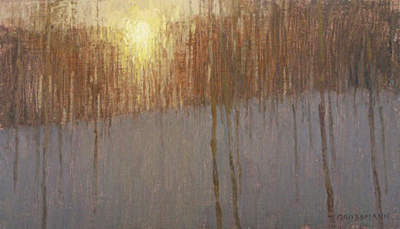
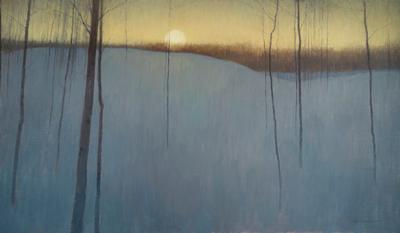
David Grossmann, Matthews Gallery
“Over the Aspens”, David Grossmann

Since then, David has developed a unique style that the artist calls “visual poetry”. Using a gentle, glowing palette, he paints abstracted visions of forests that are melodic in their focus on rhythm and symmetry. Sprawling swaths of landscape transform into flat, smooth planes while scattered trees lend a profound sense of depth. These contrasting perspectives set the works slightly off-balance, sending the eye on an endless quest to consolidate them. The compositions may seem serene, but they contain the same mysterious kinetic energy that tugs our eye from one stanza of a poem to the next.

“I think both poetry and paintings can capture an essence of something and stir emotion and imagination at a very deep level,” David says. “In some ways it’s very simplified and thought out, but hopefully it reaches to that level that connects with someone’s heart.”

David has since shown his work in many exhibitions, including national shows sponsored by Oil Painters of America, the American Impressionist Society, and Salon International. Southwest Art Magazine featured him as an “Artist to Watch” and his work has been featured in Plein Air Magazine and American Art Collector Magazine.

The artist is also an avid traveler, and has journeyed with sketchbook in hand through the Western United States, Eastern Europe, Africa and Central America. In 2011, he finally had the chance to return to Chile. He saw old friends and spent 11 days backpacking through Patagonia in Southern Chile. It was the first time he’d brought along a full painting set on a trip.

“It’s very rugged country and I was carrying a backpack that weighed over 60 pounds,” David says. “Having to paint under those circumstances where there’s just forceful gusts of wind nonstop, it really made me appreciate that every painting is a miracle. It brought out a new level of confidence in my work.”

David had come full circle. He left Chile as a child and returned as an artist.

Click here to see more of David Grossmann’s work, and follow us on Facebook, Twitter and Pinterest for subsequent updates.
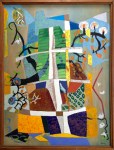
The Architect’s Secret

If you’ve spent any time in Santa Fe, you’ve probably seen something John McHugh made. The young architect was passing through Santa Fe on a cross-country road trip in 1946 when his Ford broke down.

He took a job at a local architecture firm so he could earn enough to fix it. Ten years and several cars later, he started his own company with Van Dorn Hooker and won commissions for the first Santa Fe Opera House, the remodeling of the parish hall at St. Anne’s Church and the Kearny School, among many others.

While John’s largest works are still viewed by thousands of people each year (save the opera house, which burned down and was reconstructed), some of his most colorful creations have been hidden away since his death in 1995.

“Come in, come in,” says John’s widow Gillian when she opens the door to the home they shared. She points me past the living room where a Gustave Baumann painting hangs and down a hallway that leads to a sprawling room. Leaning against every vertical surface are dozens of canvases that will soon grace the walls of the Matthews Gallery.

“When we first moved here, he converted the garage into his studio right away,” Gillian says. There are still traces of the artist all around the room. Tins full of brushes sit on a tabletop, a near-empty cigar box is perched on the mantle and one painting is still on its easel. Hidden in a stack of dusty pictures next to the window is an old invitation to an exhibition of John’s work at St. John’s College, one of the only shows he ever had. Most of the paintings in our exhibition of his work, starting Friday, March 15, have never been seen by the public.

“I felt that it was extremely important to have a show,” Gillian says. “These paintings shouldn’t just be gathering dust.”

John’s path was always architecture, but art naturally came along with it. He was orphaned at 7 years old and spent the rest of his childhood under the care of his aunts in Springfield, Ohio. Though money was tight, he used his earnings as a paperboy to plant a garden in his yard. He graduated cum laude in architecture from the University of Notre Dame in the 1941, and took an apprenticeship in Ohio before serving in the Air Force.

When John returned, he taught in the art department at Notre Dame for two years before heading off on the fateful road trip that would land him in Santa Fe. Gillian and John met in 1953 and married a year later. She’s an acclaimed pianist who was born in Great Britain and traveled to Santa Fe with the International Scouting organization in the early 1950s. While Gillian practiced for hours at her piano, she remembers John spending every spare moment with brush or pencil in hand.

“He would come back from the office and go in the studio. It was very simple,” she says. “He loved painting. He would stand there the entire evening at his easel. He loved the shapes and patterns and colors.”

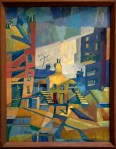
John’s oeuvre is captivating in its diversity. As I explore his studio, I find landscapes and abstract paintings, a work that was inspired by cubism and another that looks to have been done with Cezanne in mind. One dramatic landscape is signed Baumann-McHugh, and was started by the former and finished by the latter. The thread that ties it all together was John’s strong emphasis on the framework of whatever he was portraying. You can see the hand of an architect in the bold patterns he employed again and again.

“I think the architecture does enter into his paintings a good deal, because of the form and shape that he was always working with, and the fascination with that,” Gillian says. “It could be from anything. It could be something growing by the wayside or it could be a giant building.”

On drives around New Mexico, John would often park the car and pull out his sketchbook. “He’d stop in the middle of nowhere,” Gillian remembers. “If there was a telephone pole that he liked, he’d get out and say, ‘Do you mind if I just draw this?’ All of a sudden half an hour later… something really wonderful would come out of the shape or color.”

All of John’s creative endeavors came to an abrupt halt in 1985, when he suffered a severe left hemisphere stroke. “After the stroke, he was trying to come back to being whole again. He would work in very small ways,” says Gillian.

John could see Sandia Mountain from the windows of St. John’s Hospital, and he challenged himself to learn to draw it again. “Sandia was really his lifeline. The mountain called to him. He was eventually able to draw the whole thing, which took a long, long time. This was a lovely beginning to his route back to health.” Later on, John did a lecture series on art at St. John’s College that further built his confidence. He continued painting and sketching until the very end of his life.

Gillian folds up her walker and takes a seat in the living room next to her piano. One of John’s aspen paintings hangs above her head. She’s 89 years old, but when Gillian talks about John’s upcoming retrospective at our gallery, she seems full of energy. The works are close to her heart, as is the cause that the show will be supporting.

“When I heard about the wonderful work that the Bob Woodruff Foundation was doing for soldiers returning from Iraq and Afghanistan, I was fascinated,” she says. “My brother had been a prisoner of war under a different situation. I thought perhaps…. some of the paintings that John did could be used, and some of the proceeds could be given to this foundation.”

I ask Gillian something I’ve been wondering the whole time I’ve been there: how did John have the time and energy to accomplish all of this?

Gillian shakes her head and smiles. “It wasn’t really hard work, you see. It was total love,” she says. “Architecture and art were his life.”

The Matthews Gallery will present an exhibition of the art of John McHugh from March 15th through March 28, 2013. Gillian McHugh will be in attendance during the opening reception on Friday March 15th from 5-7 pm. A portion of the proceeds of the sales of the artwork will be donated to the Bob Woodruff Foundation. Click here for more information, and follow our Twitter and Facebook feeds for updates.

Hannah Holliday Stewart (1924 – 2010) A Sculptor Who Forged The Way

Hannah Holliday Stewart (1924 – 2010) had her sculpture exhibited in over 40 venues including The Smithsonian, Washington, DC; the San Francisco Museum of Art; the High Museum of Art, Atlanta, Georgia; the Dallas Museum of Fine Arts and others. Her work and her career were instrumental to the increased recognition of women sculptors in the United States. The International Sculpture magazine wrote :

“(She) forged the way for serious women sculptors. Uniting Greek mythology and contemporary energy concepts … (her) work fuses both primitive and futuristic sensibilities.”

At a time when the art world marginalized women artists, she chose to create her own world from metal and stone and helped lead the way for a generation of women sculptors. Though she had achieved a high level of success and recognition, she eventually turned her back on the art establishment and continued to work in isolation for the last twenty years of her life. After her death in 2010, sculptures, consisting of work that spanned her entire career, were discovered in her studio – from pieces that are only a few inches tall to one bronze that is over nine feet.

A written statement discovered in one of her notebooks eloquently records her own thoughts on the origins and principles underlying her art work:

When I was eight years old, I asked my mother what the wind really looked like. I remember spending hours … days … sitting with my hands open wide or running with my lightning-bug jar, hoping to catch the wind. I wanted to SEE the wind, that magical force that could bend the huge oak tree in a summer storm, gently caress me on a hot summer day or sing to me as it played through a tree or around the house.

This early interest in natural forces has sustained me throughout my life as a sculptor. My goal is to render visible the hidden realities of pent-up contained energy. The direct fields of reference are Sacred Geometry, Astronomy, Myth & Physics … Each Sculpture is an energy form, the movement arrested in space, a form sustaining an energy. My work is a response to these patterns and delineations and communicates with viewers through the universality of symbolism and form.

The Matthews Gallery is pleased to show this pioneering artist and reacquaint the world with her work. If you would like to learn more about Hannah Holliday Stewart, we have created a website dedicated to her life and work which includes a 163 page online catalog of her work. Click Here to visit the site.