David Grossmann always knew he wanted to be an artist. Even before his first painting lessons with his grandmother at 10 years old, he was an avid sketcher, filling notebooks with intricate drawings of dragons and the floor plans of medieval castles. By 16, David was taking portrait commissions and doing book illustrations for a publishing company. Still, he couldn’t quite discern a path that would turn his passion into something more.
“I didn’t know how to get there as far as making a living as a professional artist,” the 29-year-old says. Finding that bridge would take a while, but it’s safe to say that he’s officially crossed it. We’re proud to be the first gallery to represent David and his work. It’s just the latest high point in an already impressive artistic career.
David was born in the United States and moved to Chile when he was two years old. It’s a place of stunning, harsh natural beauty that would inspire in David a lifelong passion for the outdoors. His grandmother was a landscape painter who lived in El Paso, Texas. When they saw each other, she would teach him oil painting techniques with a brush and palette knife.
When David was 14, the family decided to relocate to Colorado. It was a move that the teenager fiercely resisted.
“When we left, I didn’t say goodbye because I hadn’t accepted that we weren’t going back,” he says. “I’m sure for anyone, being 14 is probably a tough age. On top of that, adjusting to a new culture and new everything was really difficult.”
The move marked a big shift in David’s art. Not long after he arrived the young artist started receiving requests for commissions, and he enrolled in his first formal drawing classes with artist Valorie Snyder. His grandmother was an art director of a Christian publishing company and gave him a job illustrating Bible study curriculums.
“It became more of an outlet for me than it had been before,” David says. “It was a lot more serious, a lot more figurative works. I also started drawing more landscapes at that point.”
Despite his early success, David still didn’t see art as a viable career. In college he studied business and Spanish, focusing primarily on his studies instead of his artwork. During his last year at university, struck by the fear of being trapped in a cubicle, he finally committed to giving art school a shot.
At the Colorado Academy of Art, David learned classical painting techniques and took his first plein air painting class.
“I’ve always loved the outdoors, but until I took that class I felt like I couldn’t contain the landscape. It’s so huge, and I didn’t know how to make it into a composition,” he says. After he learned how to capture the beauty of nature on canvas, he knew that he’d be doing little else in his work. “That combination of being outdoors and painting, which were two of my favorite things, were just perfect for me,” he says.
Three years after David enrolled at the art academy, it abruptly closed. The artist once again found himself full of doubt; he’d learned a lot about painting, but he wasn’t sure how to sell his work. That’s when he started an apprenticeship with artist Jay Moore.
“In art school, my training was very much based on technique but not a lot on the professional side of things,” David says. Being in Moore’s studio gave him a window into the life of a working artist, and showed him that a fine art career was possible. “I didn’t know how long it would take to get there, but I knew that I could get there,” he says. “I remember being so excited. I’d been thinking about and dreaming about this for most of my life.”
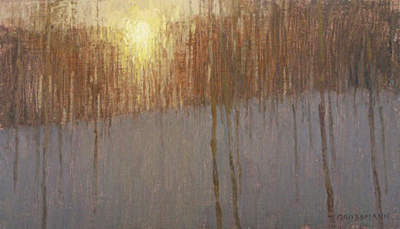
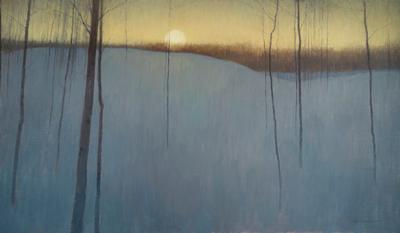
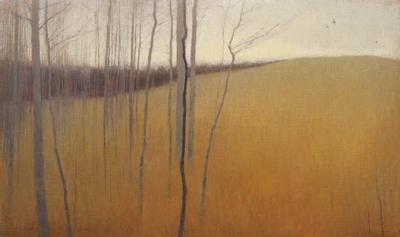
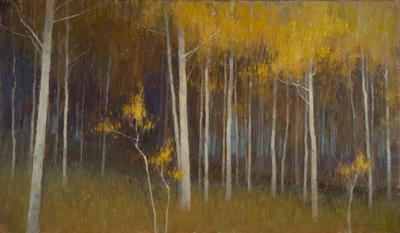
Since then, David has developed a unique style that the artist calls “visual poetry”. Using a gentle, glowing palette, he paints abstracted visions of forests that are melodic in their focus on rhythm and symmetry. Sprawling swaths of landscape transform into flat, smooth planes while scattered trees lend a profound sense of depth. These contrasting perspectives set the works slightly off-balance, sending the eye on an endless quest to consolidate them. The compositions may seem serene, but they contain the same mysterious kinetic energy that tugs our eye from one stanza of a poem to the next.
“I think both poetry and paintings can capture an essence of something and stir emotion and imagination at a very deep level,” David says. “In some ways it’s very simplified and thought out, but hopefully it reaches to that level that connects with someone’s heart.”
David has since shown his work in many exhibitions, including national shows sponsored by Oil Painters of America, the American Impressionist Society, and Salon International. Southwest Art Magazine featured him as an “Artist to Watch” and his work has been featured in Plein Air Magazine and American Art Collector Magazine.
The artist is also an avid traveler, and has journeyed with sketchbook in hand through the Western United States, Eastern Europe, Africa and Central America. In 2011, he finally had the chance to return to Chile. He saw old friends and spent 11 days backpacking through Patagonia in Southern Chile. It was the first time he’d brought along a full painting set on a trip.
“It’s very rugged country and I was carrying a backpack that weighed over 60 pounds,” David says. “Having to paint under those circumstances where there’s just forceful gusts of wind nonstop, it really made me appreciate that every painting is a miracle. It brought out a new level of confidence in my work.”
David had come full circle. He left Chile as a child and returned as an artist.
Click here to see more of David Grossmann’s work, and follow us on Facebook, Twitter and Pinterest for subsequent updates.


 MATTHEWS GALLERY BLOG