MEMORY IN BLUE: Jan van Leeuwen

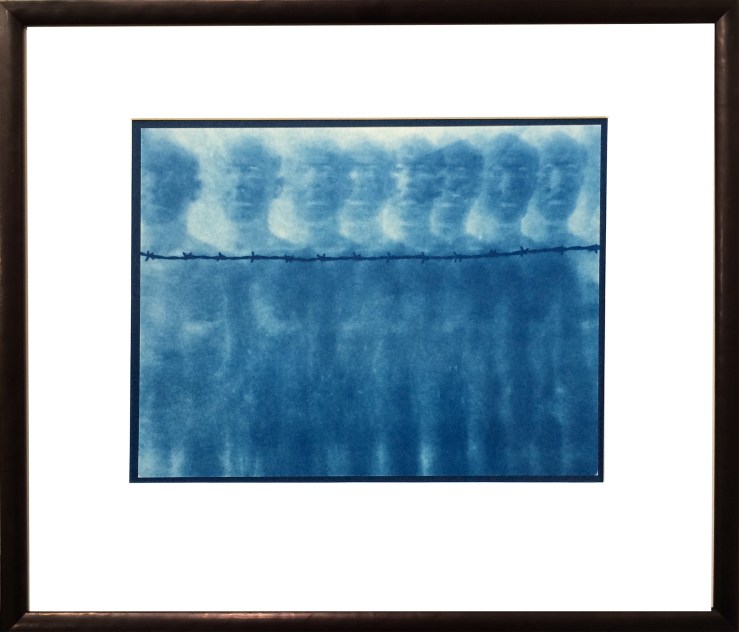
Jan van Leeuwen- Barbed Wire Number 1- Matthews Gallery Blog

Jan van Leeuwen, Barbed Wire No. 1 (Cyanotype), Matthews Gallery

What color is memory? Is the human soul tinted by life’s great joys and sorrows?

Jan van Leeuwen‘s darkest recollections are a deep blue tide. His self-portraits take shape much like memories do. It’s a long process with details fading in and out of focus, projecting visions of the self that never feel quite complete. It took a lifetime for the photographer to discover his medium, but when he did the images came spilling out.
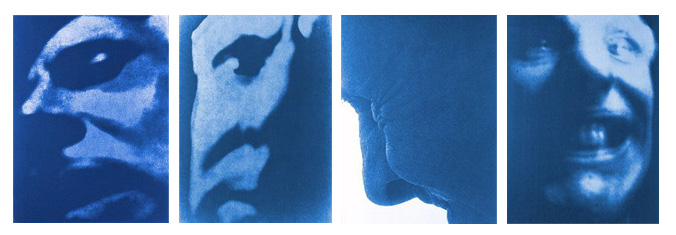
Jan van Leeuwen- Cyanotype Portraits- Matthews Gallery Blog

Leeuwen was born in Amsterdam in 1932. In 1940, when the artist was 8 years old, the Dutch surrendered to the Nazis and Leeuwen watched as his community fell apart. Jewish neighbors and schoolmates fled or were taken. Over the course of the four-year occupation, the young boy’s confusion turned to anger, frustration and guilt.

Leeuwen’s first career was as a kitchen wares distributor, and he learned how to work a camera by photographing the products. He took his first serious stab at the medium in 1986 when he was in his 50’s, mostly so he’d have something to do when he retired.
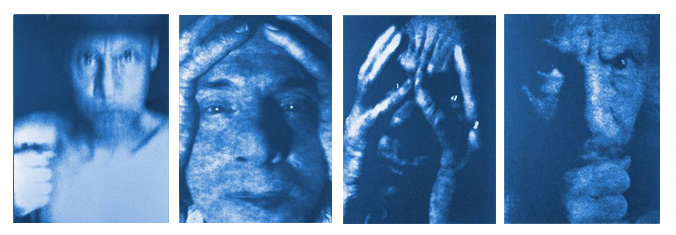
Jan Van Leeuwen- Cyanotype Portraits- Matthews Gallery Blog

Drawing inspiration from the innovative spirit of the Dutch Renaissance masters, Leeuwen developed his own method of producing photographs. He uses a 100-year-old wood camera to capture an image on resin-coated paper, creates a negative and then makes a contact print using a UV-B lightbox.

The process of capturing and transferring the images echoes the artist’s struggles with the trauma he experienced in his youth and the impact it has had on his identity. For the cyanotype in our collection, the artist used a long exposure to fracture himself into eight meshed figures. The only thing starker than their furrowed brows is the strand of barbed wire that stands in their way.

Jan Van Leeuwen- Cyanotype Portraits- Matthews Gallery Blog

Leeuwen created Barbed Wire No. 1 in 1993. A year later he quit his job to pursue photography full-time. Since then he’s had a stellar contemporary art career, with shows across the world and artwork in The Photo Review, Art in America and many other publications.

The artist’s success hasn’t dampened the intimacy of his self-portraits, or lightened the burden of his memories. However, Leeuwen reminds us that sadness is accompanied by beauty, and creation always surmounts the pain of destruction.

Learn more about Jan van Leeuwen’s art and life on the Matthews Gallery homepage, and connect with us on Facebook, Twitter and Pinterest for more gallery news.
FOCUS ON THE FIGURE: The good, the bad and the body

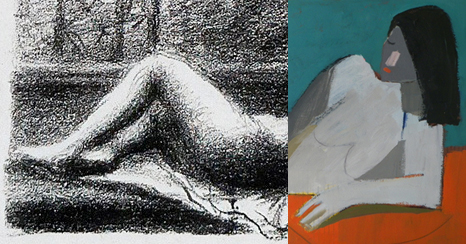
Two Odalisques by Pierre-Auguste Renoir and Jamie Chase- Matthews Gallery blog

Two Odalisques by Pierre-Auguste Renoir (left) and Jamie Chase (right)

No matter their preferred medium or subject matter, one of the first things young art students are challenged to do is pick up a pencil and draw from life.

“It’s only by drawing often, drawing everything, drawing incessantly, that one fine day you discover to your surprise, that you have rendered something in its true character,” said Camille Pissarro, mentor to the Impressionists.

Of course, Pissarro had a different idea of what it meant to evoke something’s “true character” than, say, Paul Gauguin. As we discussed in our last post, Vermeer and de Kooning painted female figures in oil to highly divergent ends.

Our FOCUS ON THE FIGURE survey show, running now through the end of December, has us pondering the artist’s eye for the human body. History’s verdict on the success or failure of a particular depiction is often entirely based on the culture that first viewed it. Even in the hands of the most technically talented artists, the human body has a unique capacity to spark fiery controversies. Here are some notorious offending body parts:

SKIN

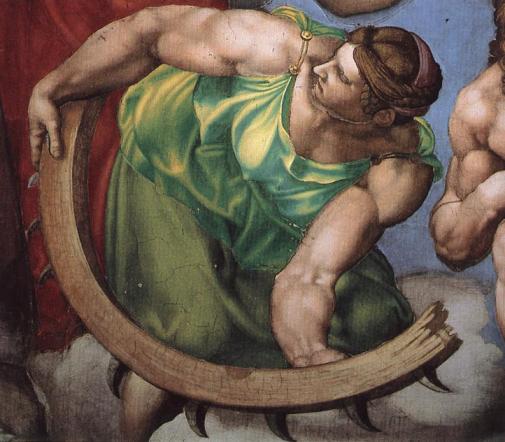
Michelangelo- The Last Judgment detail- Matthews Gallery blog

The Last Judgment (detail), Michelangelo

Believe it or not, that’s a woman in the image above. Michelangelo (1475-1564) had a hard time depicting feminine grace, probably because he used massive body builders as models. That’s not the reason the artist’s Last Judgment mural in the Sistine Chapel drew the ire of the church, though. Michelangelo left many of his buff bodies unclothed and the clergy was afraid they would provoke sinful titillation. After the artist’s death, fig leaves were swiftly deployed.

TEETH

Elisabeth Vigee Le Brun- Self Portrait- Matthews Gallery

Self portrait, Elizabeth Vigee Le Brun

As chronicled in our blog series 10 Women Who Changed Art History Forever, even fully clothed models (with frilly collars) could show too much. When Marie Antoinette’s court painter Elisabeth Vigee Le Brun (1755-1842) dared to flash a smile for this self-portrait she was roundly condemned for diverging from the style of “the Ancients”. Read what one gossip columnist had to say about it here.

EARS

John Singer Sargent- Madame X- Matthews Gallery blogMadame X, John Singer Sargent

Top Paris socialite and legendary beauty Virginie Amelie Avegno Gautreau couldn’t resist John Singer Sargent’s (1856-1925) offer to paint her portrait in 1883. When conservative viewers at the Paris Salon were scandalized by Gautreau’s bare white shoulder and bright red ear in the painting, Sargent attempted some damage control by painting in a shoulder strap and renaming the painting Madame X. Alas, Gautreau’s reputation was forever damaged.

FACES

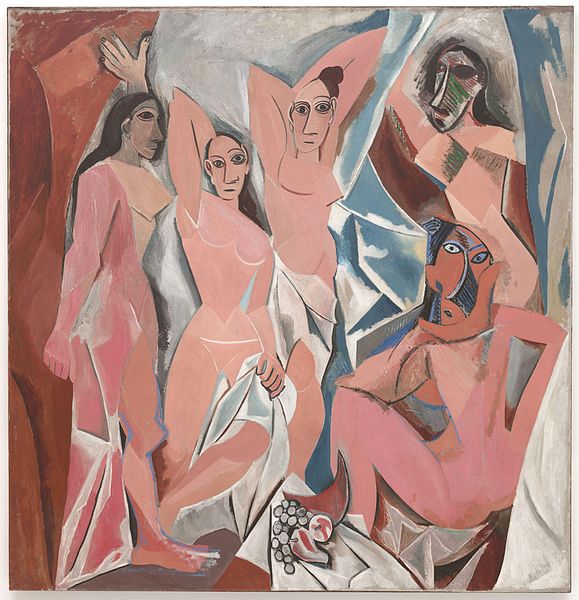
Pablo Picasso- Les Demoiselles dAvignon- Matthews Gallery blog

Les Demoiselles d’Avignon, Pablo Picasso

Pablo Picasso (1881-1973) always referred to his seminal painting of a group of Spanish prostitutes as The Brothel of Avignon. The canvas sat in his studio for years before he exhibited it under the title Les Demoiselles d’Avignon (The Young Ladies of Avignon) in 1916. Even after its rebranding, the painting caused a stir because the women’s faces—influenced by traditional Iberian art, African tribal masks and the art of Oceania—were considered savage and their postures barbaric and aggressive.

After the show, the work was rolled up and stored away for years. It wouldn’t be recognized for its visual innovations until later, when designer Jacques Doucet bought it for 25,000 francs in 1924. “It is a work which to my mind transcends painting; it is the theater of everything that has happened in the last 50 years,” Doucet said.

Our FOCUS ON THE FIGURE show features art by Jamie Chase, Kate Rivers, Eric G. Thompson, Pierre-Auguste Renoir, Harold Frank, Pablo Picasso and more. Connect with us on Facebook, Twitter and Pinterest for more news about the exhibition.