The 10 Artists Who Changed Art History Forever, Pt. 1

Over the next two weeks, we’re paying tribute to 10 painters who changed the course of art history. Our first five picks range from Il Divino to the “painter of light”. Who do you think we missed? Connect with us on Facebook, Twitter and Pinterest to join the discussion, and click here to read part 2!
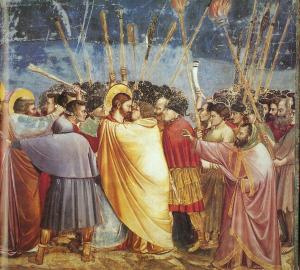
Giotto, "The Kiss of Judas"
Giotto, The Kiss of Judas

1. Giotto (1266/7-1337)

The Italian painter and architect was most likely born in Florence, the city where he would live and work for his entire life. Legend has it that the young Giotto was herding sheep and stopped to sketch the animals on a rock when famous Tuscan painter Cimabue strolled by and took him as an apprentice. One of art history’s most passionate debates centers on whether Giotto completed parts of Cimabue’s frescoes at Assisi. Regardless, it was Giotto’s break from the traditions of Cimabue and his contemporaries that helped spark the Italian Renaissance.

In Giotto’s frescoes at the Scrovegni Chapel, the stylized Byzantine figures that were popular at the time are nowhere in sight. His figures are solid and sculptural, their robes draping naturally from their frames. This is a painter who drew inspiration from what his eyes could see. 16th century biographer Giorgio Vasari wrote that Giotto started “the great art of painting as we know it today, introducing the technique of drawing accurately from life, which had been neglected for more than two hundred years.”
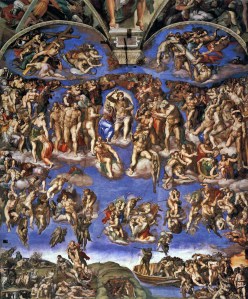
The Matthews Gallery, Michelangelo
Michelangelo, The Last Judgment

2. Michelangelo (1475-1564) 

In contrast with Giotto, this prolific sculptor, painter, architect, poet and engineer left behind a paper trail that makes him one of the most well-documented artists of his time. Michelangelo completed the Pieta and David before he turned 30 and redesigned part of St. Peter’s Basilica at 74. In between, he completed the ceiling frescoes of the Sistine Chapel, spent 40 years creating Pope Julius II’s tomb and worked on a multitude of other projects. Even in his time he was known as Il Divino, “the divine one”.

The Last Judgment fresco on the altar wall of the Sistine Chapel, one of Michelangelo’s final works, is the fulfillment of Giotto’s artistic legacy. His massive figures seem to press from the wall with all of the terriblita (awe-inspiring grandeur) of living giants. Giorgio Vasari, who wrote a biography of Michelangelo during his lifetime, called the artist’s works the apex of the Renaissance. They also inspired Mannerism, the movement that proceeded the Renaissance in Western art.
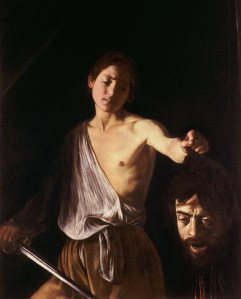
The Matthews Gallery, Caravaggio
Caravaggio, David with the Head of Goliath

3. Caravaggio (1571-1610) 

It’s no secret that Caravaggio was an unpleasant guy. A public notice from 1604 accused him of crashing gatherings armed with a sword, “ever ready to engage in a fight or an argument, so that it is most awkward to get along with him.” Perhaps that’s why he was swiftly forgotten after his death in 1610 and wasn’t recognized for his great influence on art history until three centuries later.

The artist was born in Milan and grew up in the city of Caravaggio. His parents were both dead by his teen years so he started an apprenticeship with painter Simone Peterzano, who was Titian’s pupil. He moved to Rome in 1592 and rose to fame as he developed the style that would come to define Baroque painting. His figures were incredibly realistic, their skin pocked, their feet dirty and their faces full of emotion. They were illuminated by high key chiaroscuro lighting. Caravaggio fearlessly placed the common people in the spotlight, a coup that would serve the Counter-Reformation well.

The Matthews Gallery, Velazquez
Velazquez, Las Meninas

4. Velazquez (1599- 1660) 

Diego Velazquez’ oeuvre mostly consists of pompous portraits of the Spanish royal family and other powerful and privileged Europeans. It was a twisty play on this genre that would secure his place in art history. Velazquez was born in Seville and educated well. He worked his way up the ranks of painters in his hometown and then hopped to Madrid, where a connection with the king’s chaplain and the timely death of the Spanish royal court painter helped him land the coveted position in 1624.

Four years before his death, Velazquez painted his masterpiece Las Meninas. The painting shows Spanish princess Margaret Theresa standing next to the painter himself, who’s working on a large canvas. In a mirror behind them are the faces of the king and queen. The sophisticated work’s bifurcating viewpoints throw its true subject into question and place Velazquez far ahead of his time. More than two hundred years later the painter’s work would inspire the Realists, the Impressionists and the Modernists.
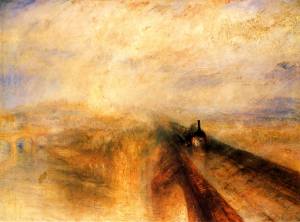
The Matthews Gallery, JMW Turner
JMW Turner, Rain, Steam and Speed

5. Turner (baptized 1775-1851) 

JMW Turner was known as the “painter of light”, but the artist with the ethereal subject matter had a very solid impact on art history. The Romantic landscape painter was born in London to a barber and wig maker. He showed his drawings in his father’s shop as a young boy, and studied under architects and a draftsman before enrolling in the Royal Academy of Art as a 14-year-old. His reputation swiftly grew, and he had his own studio by 18. However, when he verged away from picturesque landscapes in favor of stormier subject matter, Protestant society was shocked.

In his famous oil Rain, Steam and Speed, Turner depicts a locomotive as a surging pillar of tumbling air with a black smokestack as its only identifying characteristic. As details melted away and Turner focused on the continuous flux of air and light, critics started turning against the artist. An 1802 review called his works “too indeterminate and wild”, and writers were keen to tie his chaotic paintings to radical new political and social movements. Turner became increasingly isolated from society and often refused to sell his paintings, but his work had an undeniable influence across Europe, inspiring Claude Monet and other French artists in their steps toward Impressionism.

Sound off on FacebookTwitter and Pinterest and tell us who we missed, and click over to part 2 for our last five picks.
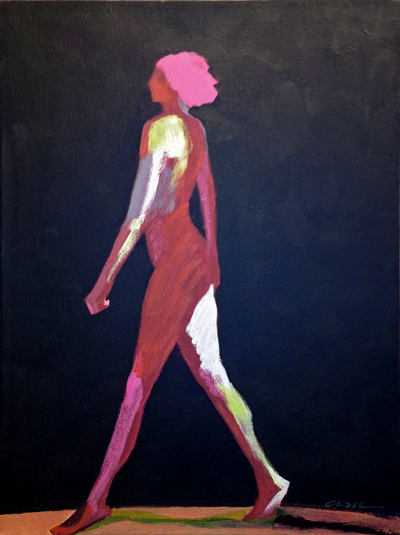
THE MATTHEWS GALLERY: Arc of Art History

"Stride", Jamie Chase, Matthews Gallery
“Stride”

When Santa Fe visitors step into the Matthews Gallery, they often mention that something feels different. Our gallery location is in a historic adobe on Canyon road just like many of the other galleries so we have a hunch that the novelty they’re sensing is our devotion to carefully curating every wall of our gallery.

We show work from the 19th, 20th and 21st centuries. Our curatorial direction is to exhibit a variety of work from these eras that relate to the artistic development from impressionism to contemporary art. Here are some of the names that you won’t see anywhere else on Canyon Road—or even elsewhere in Santa Fe:

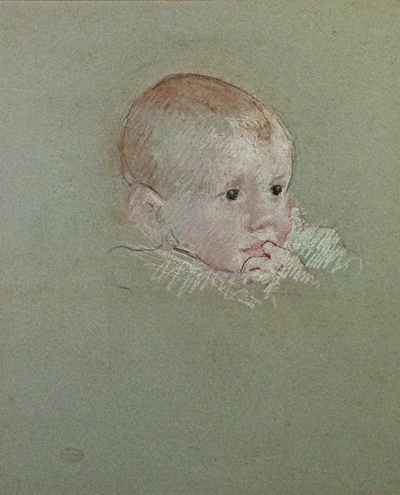
Head of Baby with Finger in Mouth, Mary Cassatt, Matthews Gallery
“Head of Baby with Finger in Mouth”, Mary Cassatt

Mary Cassatt (1844-1926) ~ The American painter and printmaker was refused entry to the Ecole des Beaux-Arts, so she studied the masters on her own at the Louvre. She would become a master herself, named one of “les trois grandes dames” of Impressionism by Gustave Geffroy.

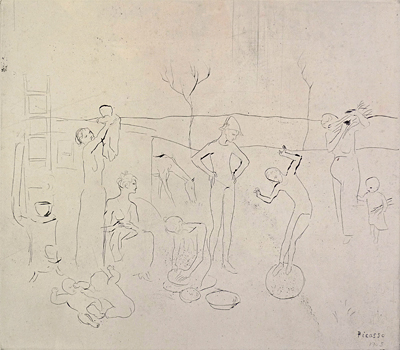
"Les Saltimbanque", Pablo Picasso, Matthews Gallery
“Les Saltimbanque” by Pablo Picasso

Pablo Picasso (1881-1973) ~ Several works by the most influential artist of the 20th century have passed through the Matthews Gallery. Our most notable current work by Picasso is “Les Saltimbanque”. The drypoint etching the artist created as a teenager shows the harlequin, a personal symbol that would recur in his work throughout his career.

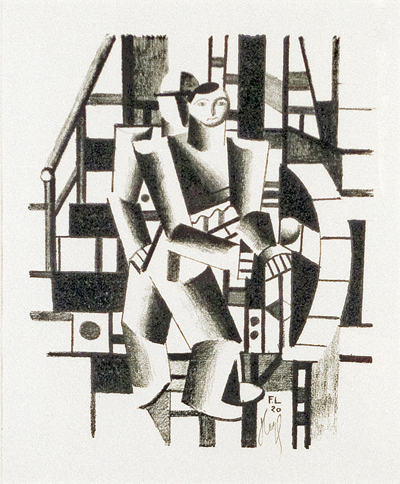
"Composition aux deux Personnages", Fernand Leger, Matthews Gallery
“Composition aux deux Personnages” by Fernand Leger

Fernand Leger (1881-1955) ~ The painter, sculptor and filmmaker’s lithograph “Composition aux deux Personnages” marked a shift in his oeuvre from Cubism to bold figurative works that would later identify him as a forerunner of Pop Art. As is the fate of all art movements, Picasso and Braque’s Cubism were irrevocably fractured.

"Blue Nude", Harold Frank, Matthews Gallery
“Blue Nude” by Harold Frank

Harold Frank (1917-1995) ~ Born in Southampton, England, Frank’s family moved to New York when he was a child. You can see influences from both shores in his colorful canvases that take cues from modernism and abstract expressionism.

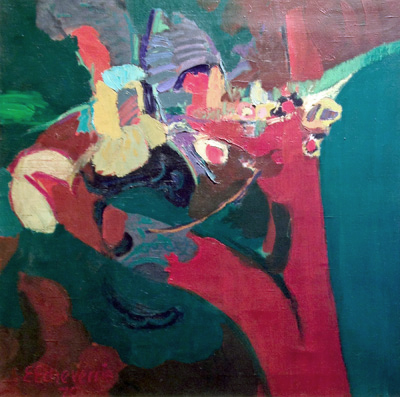
"Alic", Enrique Echeverria, Matthews Gallery
“Alic” by Enrique Echeverria

Enrique Echeverria (1923-1972) ~ Echeverria and his contemporaries brought the ideas of modern European art movements to Mexico and subverted the traditional figurative painting style. They became known as the Generacion de la Ruptura, the Rupture Generation.

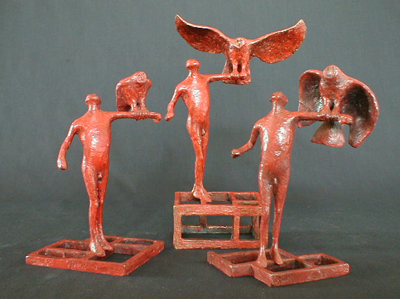
"Avian Keepers", Robert W. Hinds, Matthews Gallery
“Avian Keepers” by Robert W. Hinds

Robert W. Hinds (1924- present) ~ This World War II veteran was born a year after Echeverria. He had a successful graphics career for years before moving to Europe to study casting techniques in Italy and Bologna. Now he produces figurative bronze sculptures that are collected throughout the world.

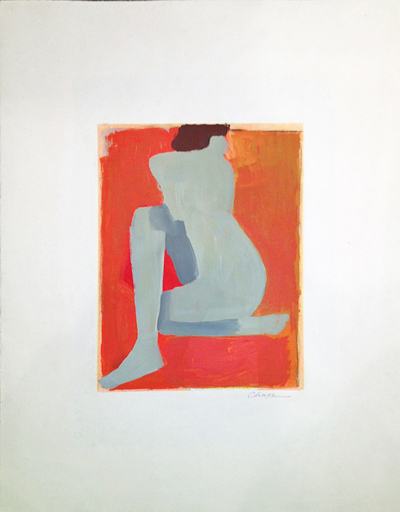
"Untitled Grey Nude on Orange", Jamie Chase, Matthews Gallery
“Untitled Grey Nude on Orange” by Jamie Chase

Jamie Chase (1954- present) ~ The painter and graphic novelist was born in California, and traveled to Europe to educate himself on the work of the masters. He moved to Santa Fe in 1980, where he’s now known for his non-objective paintings, abstract landscapes and abstracted figurative paintings.

Browse all of the artists we represent here, and follow our Facebook and Twitter accounts for updates on their work. 

The Architect’s Secret

If you’ve spent any time in Santa Fe, you’ve probably seen something John McHugh made. The young architect was passing through Santa Fe on a cross-country road trip in 1946 when his Ford broke down.

He took a job at a local architecture firm so he could earn enough to fix it. Ten years and several cars later, he started his own company with Van Dorn Hooker and won commissions for the first Santa Fe Opera House, the remodeling of the parish hall at St. Anne’s Church and the Kearny School, among many others.

While John’s largest works are still viewed by thousands of people each year (save the opera house, which burned down and was reconstructed), some of his most colorful creations have been hidden away since his death in 1995.

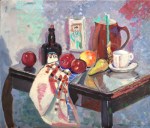
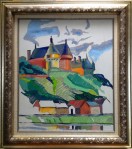
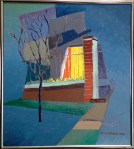
“Come in, come in,” says John’s widow Gillian when she opens the door to the home they shared. She points me past the living room where a Gustave Baumann painting hangs and down a hallway that leads to a sprawling room. Leaning against every vertical surface are dozens of canvases that will soon grace the walls of the Matthews Gallery.

“When we first moved here, he converted the garage into his studio right away,” Gillian says. There are still traces of the artist all around the room. Tins full of brushes sit on a tabletop, a near-empty cigar box is perched on the mantle and one painting is still on its easel. Hidden in a stack of dusty pictures next to the window is an old invitation to an exhibition of John’s work at St. John’s College, one of the only shows he ever had. Most of the paintings in our exhibition of his work, starting Friday, March 15, have never been seen by the public.

“I felt that it was extremely important to have a show,” Gillian says. “These paintings shouldn’t just be gathering dust.”

John’s path was always architecture, but art naturally came along with it. He was orphaned at 7 years old and spent the rest of his childhood under the care of his aunts in Springfield, Ohio. Though money was tight, he used his earnings as a paperboy to plant a garden in his yard. He graduated cum laude in architecture from the University of Notre Dame in the 1941, and took an apprenticeship in Ohio before serving in the Air Force.

When John returned, he taught in the art department at Notre Dame for two years before heading off on the fateful road trip that would land him in Santa Fe. Gillian and John met in 1953 and married a year later. She’s an acclaimed pianist who was born in Great Britain and traveled to Santa Fe with the International Scouting organization in the early 1950s. While Gillian practiced for hours at her piano, she remembers John spending every spare moment with brush or pencil in hand.

“He would come back from the office and go in the studio. It was very simple,” she says. “He loved painting. He would stand there the entire evening at his easel. He loved the shapes and patterns and colors.”

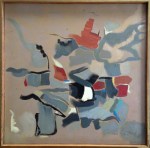
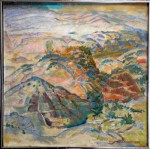
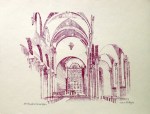
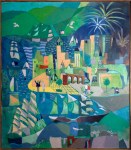
John’s oeuvre is captivating in its diversity. As I explore his studio, I find landscapes and abstract paintings, a work that was inspired by cubism and another that looks to have been done with Cezanne in mind. One dramatic landscape is signed Baumann-McHugh, and was started by the former and finished by the latter. The thread that ties it all together was John’s strong emphasis on the framework of whatever he was portraying. You can see the hand of an architect in the bold patterns he employed again and again.

“I think the architecture does enter into his paintings a good deal, because of the form and shape that he was always working with, and the fascination with that,” Gillian says. “It could be from anything. It could be something growing by the wayside or it could be a giant building.”

On drives around New Mexico, John would often park the car and pull out his sketchbook. “He’d stop in the middle of nowhere,” Gillian remembers. “If there was a telephone pole that he liked, he’d get out and say, ‘Do you mind if I just draw this?’ All of a sudden half an hour later… something really wonderful would come out of the shape or color.”

All of John’s creative endeavors came to an abrupt halt in 1985, when he suffered a severe left hemisphere stroke. “After the stroke, he was trying to come back to being whole again. He would work in very small ways,” says Gillian.

John could see Sandia Mountain from the windows of St. John’s Hospital, and he challenged himself to learn to draw it again. “Sandia was really his lifeline. The mountain called to him. He was eventually able to draw the whole thing, which took a long, long time. This was a lovely beginning to his route back to health.” Later on, John did a lecture series on art at St. John’s College that further built his confidence. He continued painting and sketching until the very end of his life.

Gillian folds up her walker and takes a seat in the living room next to her piano. One of John’s aspen paintings hangs above her head. She’s 89 years old, but when Gillian talks about John’s upcoming retrospective at our gallery, she seems full of energy. The works are close to her heart, as is the cause that the show will be supporting.

“When I heard about the wonderful work that the Bob Woodruff Foundation was doing for soldiers returning from Iraq and Afghanistan, I was fascinated,” she says. “My brother had been a prisoner of war under a different situation. I thought perhaps…. some of the paintings that John did could be used, and some of the proceeds could be given to this foundation.”

I ask Gillian something I’ve been wondering the whole time I’ve been there: how did John have the time and energy to accomplish all of this?

Gillian shakes her head and smiles. “It wasn’t really hard work, you see. It was total love,” she says. “Architecture and art were his life.”

The Matthews Gallery will present an exhibition of the art of John McHugh from March 15th through March 28, 2013. Gillian McHugh will be in attendance during the opening reception on Friday March 15th from 5-7 pm. A portion of the proceeds of the sales of the artwork will be donated to the Bob Woodruff Foundation. Click here for more information, and follow our Twitter and Facebook feeds for updates.