Prehistoric handprints on a cave wall, a Sumerian cylinder seal from ancient Mesopotamia, a woodblock print from the Chinese Diamond Sutra, a page of the Gutenberg Bible, a woodcut from the Ars moriendi, an etching by Albrecht Durer, a stencil print on silk from the Japanese Edo Period, an intaglio print by Rembrandt, a lithograph of Aloys Senefelder, an etching by Whistler, an offset lithograph by the New York Times company and an aquatint and etching by Pablo Picasso!
What does it all mean? Come to Matthews Gallery’s ART ON PAPER: Fine Art Prints reception on Friday, October 25 from 5-7 pm to find out.
“Love is when the desire to be desired takes you so badly that you feel you could die of it,” said Henri de Toulouse-Lautrec. It’s a strange perspective on the matter, but not a surprising one when you consider the artist’s difficult life. His parents were nobles and first cousins, a pairing that probably gave Lautrec a rare congenital abnormality called osteogenesis imperfecta. He was particularly prone to bone fractures and broke both of his legs as a teen. Bedridden and bored, Lautrec’s only way to escape his misery was drawing.
By the time Lautrec moved to Paris to study art at 18, his legs had stopped growing and he struggled to support his regularly sized torso. He battled deep insecurities about his appearance, but never dropped an abrasive air of superiority. His first relationship with 17-year-old model Marie Charlet was short and tumultuous, and his second serious lover Suzanne Valadon attempted suicide.
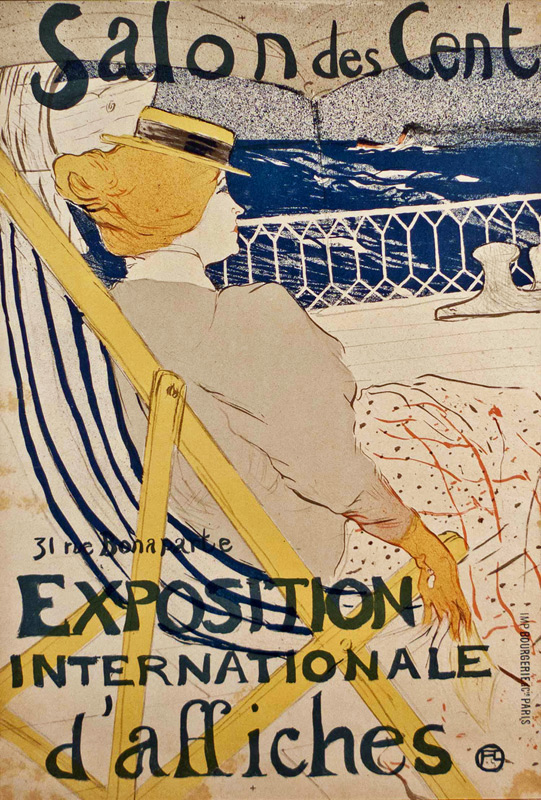
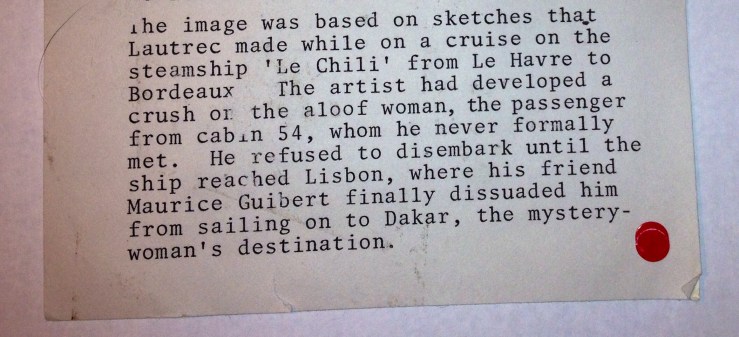
Lautrec immersed himself in the booze-soaked world of Paris’ cabarets and brothels to numb his pain, where he was inspired to produce some of the era’s most innovative images. Many of his works tell tales of longing and lost love, including our lithograph La Passagere du 54. Here’s a sad story from our archives about the 1895 boat voyage that inspired the print:
No wonder the woman on the poster is giving the viewer the cold shoulder. Most of Lautrec’s sketches must have been completed from this angle, as his haughty subject never gave him a second glance.
Lautrec’s artistic career only lasted a little over a decade, and though he gained considerable fame for his work, his romantic prospects never improved. He died at 36 from alcoholism and syphilis, but left behind a body of work that eternally capture the spirit of the City of Lights.
Do you agree with Lautrec’s definition of love? Sound off in the comments below, or through our Facebook, Twitter or Pinterest profiles.
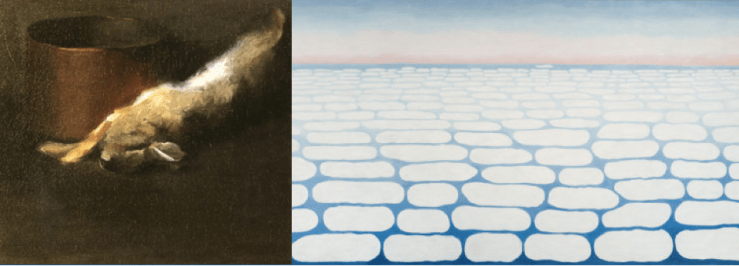
“When I look over the photographs Stieglitz took of me—some of them more than sixty years ago—I wonder who that person is,” said Georgia O’Keeffe. “It is as if in my one life I have lived many lives.”
Look through O’Keeffe’s diverse body of work, and you’ll see just what she meant. “Untitled (Dead Rabbit with Copper Pot)” is a humble realist work she painted as an art student in her early 20s. She completed the abstracted, ephemeral landscape “Sky Above Clouds IV”, which is over 20 feet long, when she was almost 80. When they’re side-by-side it’s hard to believe that one artist created both.
The same is true for works that bookend any great artist’s career. Constant evolution is perhaps the most important ingredient to genius, as you’ll see in the images below. While you browse the early and late works of four legendary artists, ponder their differences. Does youthful enthusiasm and bold experimentation move you, or do you prefer a sure hand and a fully realized aesthetic? Join the conversation in the comments section below, or on our Facebook and Twitter pages.
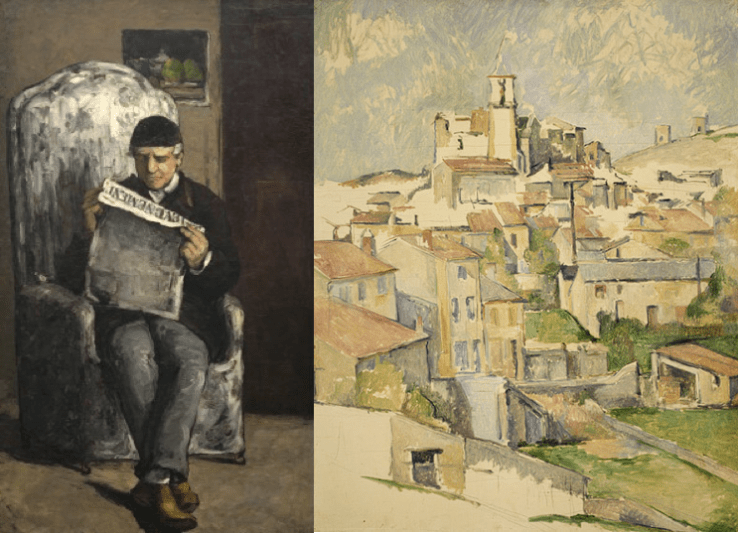
Paul Cezanne painted “Artist’s Father, Reading ‘L’Événement'” when he was in his early 20s and still partially under the thumb of his disapproving parent. The paper his father is reading—a liberal publication that the old man wouldn’t have deigned to open—and the still life painting hanging in the background hint at the artist’s growing confidence in his chosen path. Flash forward to the radical perspectival experimentation of “Gardanne”, completed when Cezanne was in his late 40s. The multi-layered cityscape would later inspire Picasso and Braque in their development of Cubism.
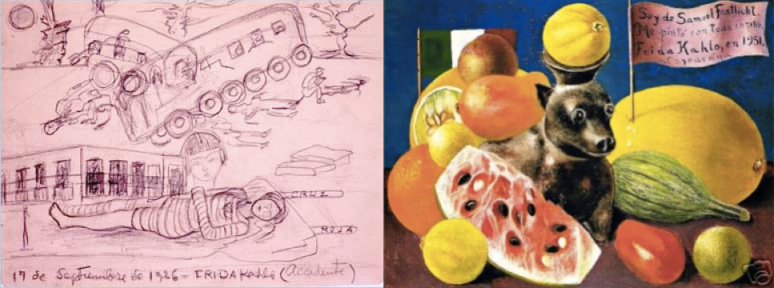
When Frida Kahlo was 19 years old she was in a trolley crash that left her in a full body cast. A year after the accident she created the pencil sketch on the left, drawing from the tradition of Mexican ex-voto paintings that blend text and images. A lifetime later, Kahlo was still suffering from chronic pain caused by the accident and drawing influences from folk art, but she’d discovered a subtler way to express her suffering. She painted “Still Life 1951” just three years before her death, when her body was giving out and she no longer favored self portraiture. The fleshy, congealing watermelon nestled among fresh fruits says it all. “I hope the exit is joyful — and I hope never to return,” she wrote just before her death.
“Les Saltimbanques” is a drypoint that Pablo Picasso created in his early 20s. The group of frolicking figures are characters from an opera-comique about a circus troupe. Countless artistic transformations later, Picasso etched out “Untitled (From the 156 Suite)“, an image that shows a tangle of prostitutes engaged in a very different acrobatic routine. Innocence is lost, but genius found.
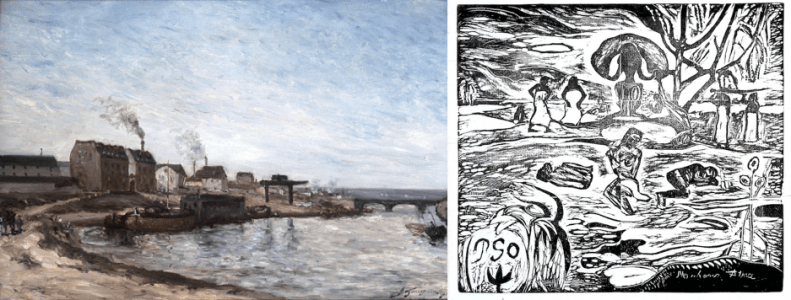
Paul Gauguin was a 27-year-old family man working as a stockbroker and hanging out at the Impressionists’ favorite cafes when he painted “La Seine au Pont de Grenelle”. By his mid-40s, he’d abandoned his family and job and exiled himself to Tahiti, where he drew inspiration for woodblock print “Mahana Atua (The Day of God)“. The artist learned from one revolutionary movement and then struck off on his own to inspire several others, from Primitivism to Symbolism.
How many lives can one artist live? What do you like better, the earlier or later work? Connect with us on Facebook, Twitter or Pinterest and sound off!
The world’s oldest auction house opened in Stockholm, Sweden in 1674. Art auctions in Great Britain gained popularity a few decades later when the Earl of Oxford’s collection appeared on the block in 1742. That particular sale featured the full range of odd and valuable items you might find in a dusty old castle, from a bust of an unknown bishop (five shillings) to a series of van Dyck paintings (165 guineas).
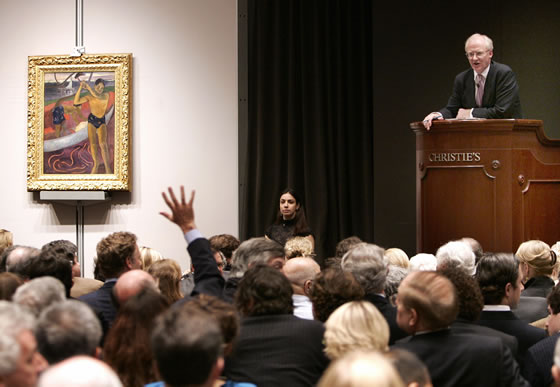
The beat of the auction mallet has marked the rhythm of the secondary market ever since. It’s a tradition that’s full of strange pageantry and heart pumping excitement. Auction kingpins Christie’s and Sotheby’s, which were both founded in mid-18th century England, often draw the ire of art world players for their tightly controlled sales. “They know exactly how many people will be bidding on a work and exactly who they are,” wrote art critic Jerry Saltz in 2012 after a version of Edvard Munch’s The Scream sold at Sotheby’s for $119.5 million. “In a gallery, works of art need only one person who wants to pay for them.”
Online auctions have meanwhile been swiftly democratizing the centuries-old process, and that’s where the Matthews Gallery decided to jump in. We launched the EUROPEAN MASTERS, AMERICAN AND SOUTHWESTERN ART AUCTION on July 25 and it runs through July 29. Come browse our virtual auktionsverk of art and, if you’re inspired, make a bid. You’ll find art by European modernists such as Pablo Picasso and Joan Miro, Southwestern legends including Emil Bisttram and Alfred Morang, and notable contemporary artists like Jamie Chase, Eric G. Thompson and Kate Rivers among the lots. Here are some notable pieces from the catalogue:
We’re very excited to announce the European Masters, American and Southwestern Art Auction, an online-only Matthews Gallery event running July 25-29. It’s our very first auction, and we’ve been working on it for more than a year. Of course, the works we’re putting on the block have stories behind them that are much older than that. Click here to browse the diverse catalogue, and read on to learn the legends behind four of the lots.
La Passagere du 54, Henri de Toulouse-Lautrec
Lautrec was on a steamship cruise from Le Havre to Bordeaux when a beautiful woman who was staying in cabin 54 caught his eye. He became infatuated with her but she was so aloof that he never got a chance to introduce himself. Lautrec refused to disembark until the ship reached Lisbon, where his friend Maurice Guibert finally dissuaded him from sailing on to Dakar, the mystery woman’s destination. The sketches he made of her on the boat would inspire La Passagere du 54.
Lithograph, on wove paper, Wittrock’s third (final) state, the full sheet, with green lettering.
This lithograph has one of the longest titles of any of Miró’s art works. In french it is: “Le chien aboyant à la lune reveille le coq le chant du coq picote le crane du fermier Catalan posé sur la table à coté du pourron”. In English: “The dog barking at the moon wakes the cock, the song of the cock pecks at the head of the Catalan farmer resting on the table by the flask of wine”. Joan Miró (1893-1983) was a leading pioneer and proponent of surrealism. His work has a childlike style that at its heart is a sophisticated play of color, line and forms. Miro was a consummate master printmaker and over his lifetime he completed more than 1,000 fine art prints.
Lithograph in colors, number 12 from the edition of 80.
Gauguin sailed from France to Tahiti in 1891 and didn’t return home until two years later. He went there in search of an untouched beauty far away from “everything that is artificial and conventional”. Upon his return to Europe, he carved a series of ten woodblocks to illustrate a written account of his travels called Noa Noa. The prints, which were only his second attempt at printmaking, are considered some of his most innovative work. “Gauguin’s current effort will tomorrow provoke a complete revolution in the art of printmaking,” wrote critics Julien Leclerq and Charles Morice. This is presumed to be a proof apart from the signed and numbered edition of 100 published by the artist’s son, Pola Gauguin in Copenhagen in 1921.
Paul Gauguin’s memoir chronicling his first trip to Tahiti is called Noa Noa, which means “fragrant scent”. It’s a reference not to the sweet smell of flowering tropical flora, but the “mingled perfume, half animal, half vegetable” of the Tahitian women.
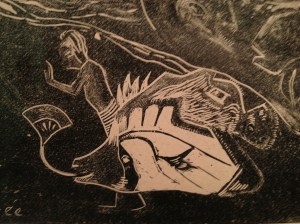
Fish-man
Gauguin embarked on his famous voyage in 1891, fleeing from financial ruin and harsh criticism of his art. He put 30 of his works up for sale to pay for the trip and set off in search of an untouched beauty far away from “everything that is artificial and conventional.”
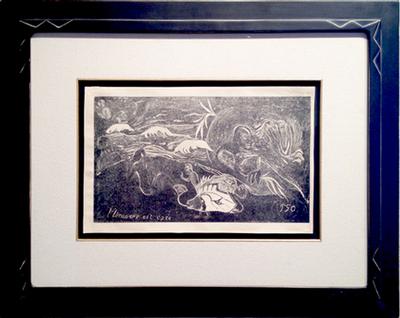
Upon his return to France in 1893 the artist finished writing Noa Noa and illustrated it with ten woodblock prints, including l’Univers est Cree(The Creation of the Universe). The journal tells largely fictional stories of an idyllic island life, but its title hints at the true nature of Gauguin’s odyssey. In Tahiti, the wandering artist found a culture shattered by colonialism, and couldn’t shake an all-consuming sexual desire that would eventually kill him. There’s more than a hint of this darkness in the print that hangs on our wall.
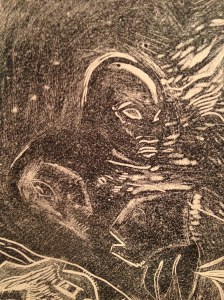
Gauguin and his son produced multiple versions of l’Univers, a primordial beach scene featuring a bizarre cast of creatures: a male torso, a distorted female figure, a fish-man and a levitating cluster of monstrous faces. The Noa Noa series was the artist’s first try at woodblock printmaking, and he was determined to approach the medium in as primitive a manner as possible. He used needles and sandpaper to etch the block and applied it to the paper by hand.
Monstrous heads
The facture of l’Univers is so rough that authors Alastair Wright and Calvin Brown said that Princeton’s version “hovers at the edge of illegibility”, but the Matthews Gallery’s print was pulled with a more delicate touch. From the tumbling waves to the lines that mark out fierce winds, each feature of the strange landscape stands starkly from the black ink.
Even with Gauguin’s creation story spread so clearly before us, it’s difficult to guess at the meaning behind it. “It’s a surrealist work before surrealism,” Lawrence likes to say. Perhaps this subconscious sandbox, built from dreams and nightmares, sits on the line between the artist’s high hopes for life in Tahiti (rebirth, beaches, beautiful woman) and the reality that he faced when he got there (tumult, deformation, death).
The artist never would have let this tension slip into his fanciful writing or his sunny paintings of Tahiti, but something more ominous emerged when faced with the challenge of hacking his utopian scenes into wood. Gauguin’s paradise was as ephemeral as a fragrant scent.
To learn more,check outour other print from the Noa Noa series and read about it in this blog post. For daily gallery news, connect with us on Facebook, Twitter and Pinterest.




 MATTHEWS GALLERY BLOG