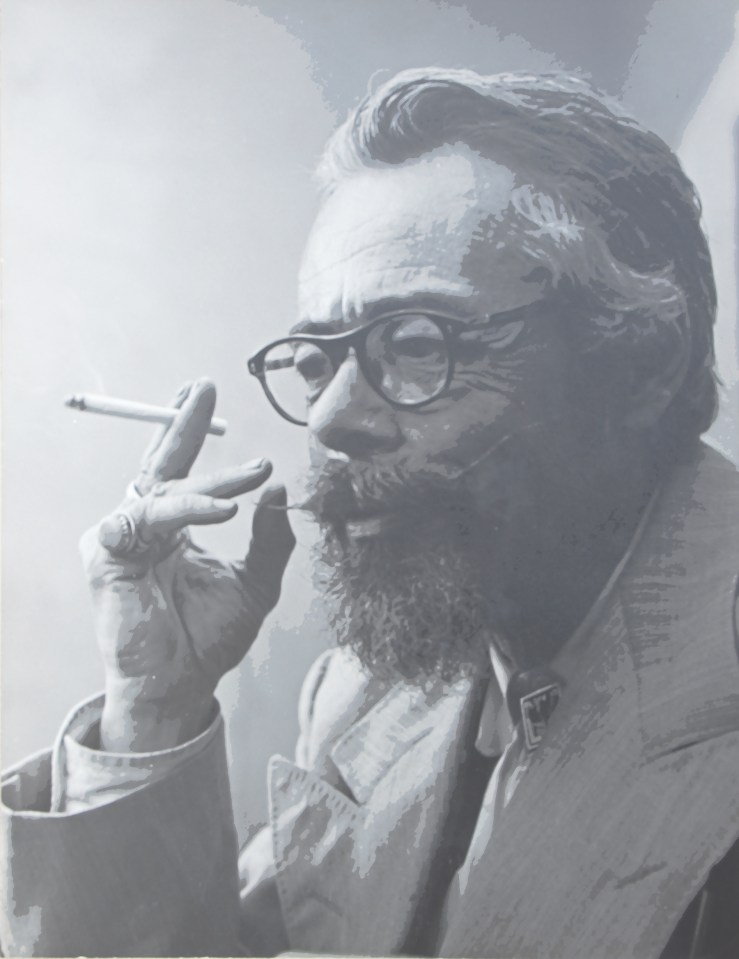
Alfred Morang’s life ended with a fire. That’s where the story of our upcoming exhibition begins.
It was a frigid January evening in 1958, and Morang was up late at Claude’s Tavern. The saloon was on Canyon Road’s 600 block, just down the street from Matthews Gallery. Its owner Claude was a burly woman known for ejecting unruly patrons by slinging them over her shoulder. She presided over a wild scene: legend has it someone once rode a horse straight through the bar.
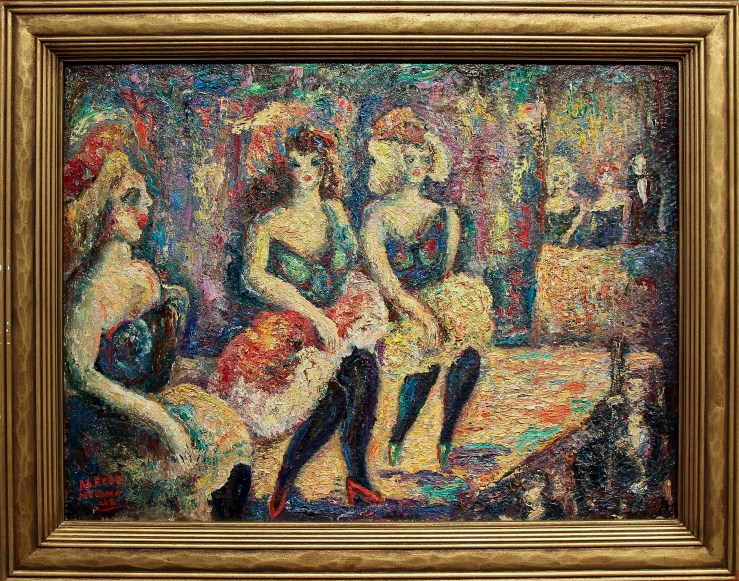
This was a fitting final evening for Morang. Claude’s was one of his favorite haunts, a place that still captured the dwindling spirit of his legendary house parties of the 1930’s and 40’s. Back then, he and his wife Dorothy were the toast of the Santa Fe art colony. Morang was a revered painter, art teacher, art critic and radio personality. His impressionistic paintings of colorful soirées filled with dancing ‘Ladies of the Evening’ and skeletal gentlemen had earned him the nickname ‘Santa Fe’s Toulouse’.
Morang’s studio apartment was directly behind Claude’s, and he returned there around midnight. It was a tiny space so packed with canvases that you could barely navigate it. Sometimes the heating broke, and when it snowed Morang would haphazardly pin a muslin cloth over the open skylight.
At around 1:30 am, smoke filled the air. Here’s Santa Fe artist Drew Bacigalupa‘s account of what happened next:
I was in the neighborhood bar the night his house caught fire. An old army buddy from Chicago had come to town and wanted to down cognac while viewing local color. There wasn’t much to view. It was a bitterly cold night, the streets deserted, the bar almost empty and quite cheerless. My bachelor friend dredged up memories of a thousand other cafes in France and Germany while my thoughts strayed to demands at home. Three weary women at the other end of the long bar seemed to be nowhere waiting for nothing.
The sound of sirens startled us all. Fire engines skidded past the door, we could hear them screeching to a halt in a compound behind the bar. I knew Alfred’s small adobe casita was there.
Nothing could be done. The roof had already crashed in and flames leaped high in the sky. I was thinking how very, very strange it was to be standing beside this war comrade watching helplessly, just as we’d done in Europe, as property and life were devoured by fire. And even stranger—later—when stretcher carriers fled the still-blazing ruin and rested their burden on the frozen ground. For firelight, like streaks of red and yellow pigment, crawled erratically over the sad tableau. And looking up from the bearded profile on the stretcher, I saw the women from the bar had joined us. Harsh, bright colors spiraled over their tawdry dress and hennaed hair, highlighting them against the black night. They were exactly like his painting […] his Ladies of the Evening.
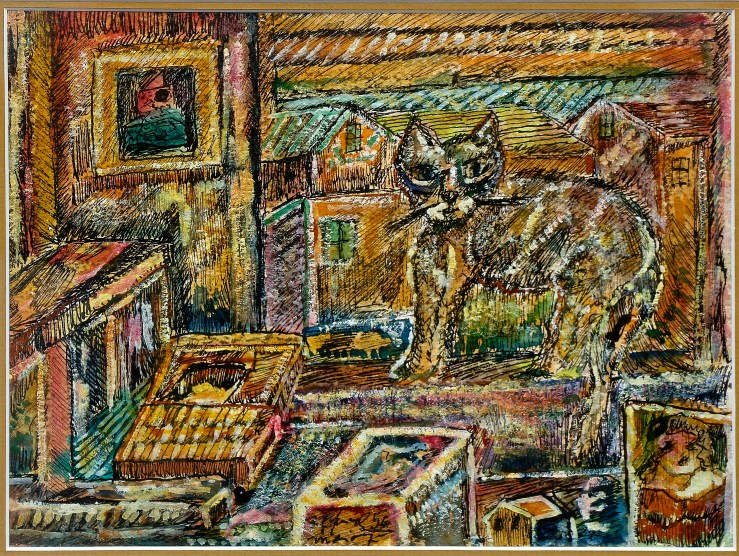
The next morning, the Santa Fe New Mexican printed a photo of one of Morang’s cats perched sadly atop a blackened mattress. The caption read, “Mourning For Her Master… this lonely cat was found wandering through the charred ruins of the home of her master Alfred Morang. The cat is on the bed where he died.”
The Santa Fe art community was distraught. There was a sense of guilt among Morang’s closest friends, a grave regret that the masterful artist had received only a fraction of the recognition he deserved. “Why shouldn’t Santa Fe be stunned by the loss of Alfred?” said one local artist. “After all, he taught half of us how to paint; the other half how to see.”
Art luminaries Randall Davey and Will Shuster helped escort the body to Albuquerque for the funeral, and Davey spoke at the Santa Fe memorial service in early February. “He was a great painter; many of you did not think so because he sold his art for a mere pittance through necessity,” said Davey. “Nevertheless it was great art and the happiest work I have seen in New Mexico. He had a love and delight for painting and I doubt that anyone will surpass him in his field.”
Meanwhile, the City of Santa Fe was having a hard time finding Morang’s heirs. He and Dorothy had divorced in 1950, and he wasn’t close to any of his relatives. Morang’s ashes sat in a closet in the New Mexico Museum of Art for two years before they were scattered over Canyon Road. Eventually, Dorothy helped locate a distant family member to send a box of Morang’s possessions that had been plucked from the ashes of the deadly fire.
Decades after Morang’s death, local art scholar Paul Parker conducted a national search for that box, which had passed down through the Morang family. The ephemera he discovered—including a charred violin, sketches and extensive writings—will appear alongside artwork by Morang and other New Mexico modernists of the period in our December 12-26 exhibition MORANG & FRIENDS.
As the show approaches we’ll tell the story of Parker’s treasure hunt, and recount colorful chapters from the life of Alfred Morang. Make sure to subscribe to our blog, and connect with us on Facebook, Twitter and Instagram for additional updates on this exciting project.
Source: Drew Bacigalupa’s tale first appeared in the 1979 book Alfred Morang: A Neglected Master by Walt Wiggins

 MATTHEWS GALLERY BLOG