ROCH HART: Mystery of the Petroglyphs

Roch-Hart-New-Mexico-Jeep-Tours Roch Hart’s jeep outside Matthews Gallery

Roch Hart is the first and only fine furniture maker in our stable, but he also has a pretty awesome day job. As the owner of New Mexico Jeep Tours, Hart takes visitors on rugged expeditions across a 20,000 acre private ranch between Santa Fe and Albuquerque. The property is home to wild horses and numerous petroglyphs left behind by ancient Pueblo cultures.

We first met Hart through the image sharing website Flickr, where he posts stunning photographs from his adventures. We had no idea that he was also a master craftsman until he reached out to us. Not long after, a big red jeep full of beautiful hand-carved benches appeared outside the gallery. When we saw how good Hart’s work looked in our Southwestern art room, we knew it was a perfect match.

It didn’t take long to realize that Hart’s adventurous occupation and his impressive hobby were connected. As chronicled in previous posts, many of his works feature symbols from the petroglyphs he discovers on the ranch. The ancient marks are part of a complex language, and their meanings are partly lost to history. Luckily, Hart is a passionate detective. We asked him to show us some of his photos and tell the stories of petroglyphs that have inspired his work.

Take it away, Roch:
New-Mexico-Flag-Roch-Hart

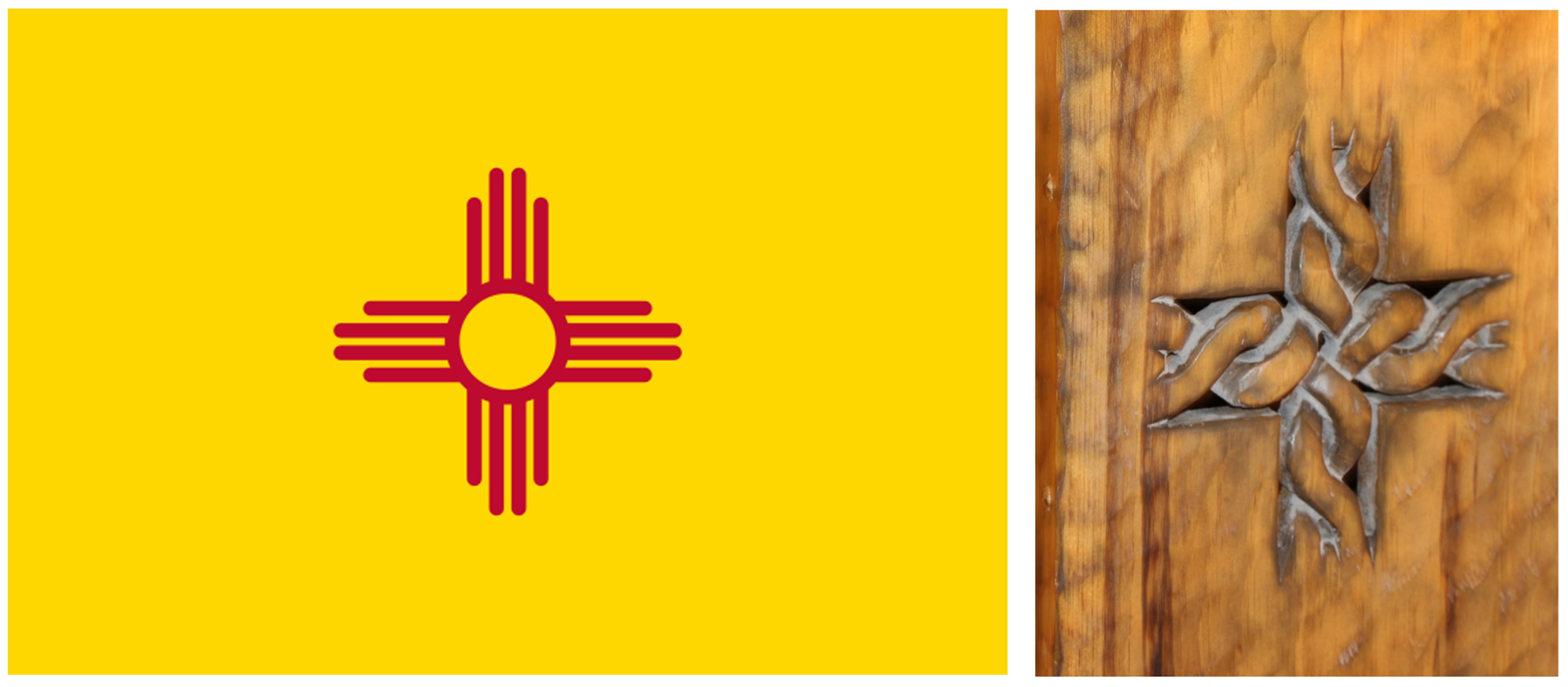
New Mexico state flag, and a cross from Roch’s pie chest ‘The Way

In petroglyphs, the same symbol can hold multiple meanings. Take for example the Zia symbol on our state flag. Our European or Western paradigms might lead us to interpret the Zia as a simple, decorative depiction of the sun, but in the Pueblo culture these symbols were a communication form rather than an art form.  The circle of the Zia represents the circle of life. The four rays radiating from the circle represent many different things: the four directions, the seasons, the elements or even four stages in a person’s life. In the Pueblo culture, the four is a sacred number. I have found petroglyphs with faces whose mouths are in a square shape, perhaps speaking of the fours.
Roch-Hart-The-Way-Petroglyphs

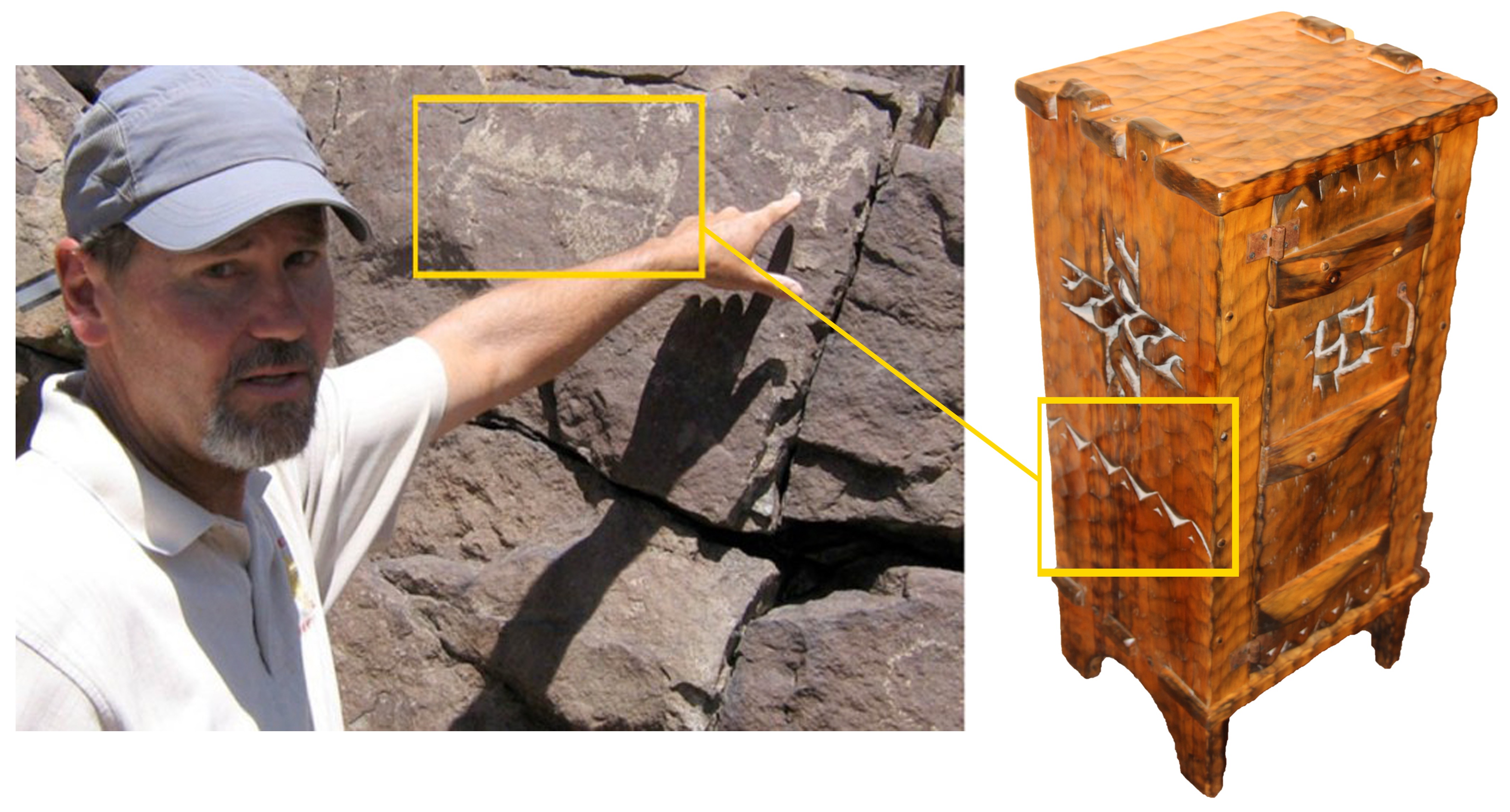
Roch Hart with New Mexico petroglyphs, a similar design on Hart’s pie safe ‘The Way

Sometimes petroglyphs mimic the lines and rhythms of nature. I’ve been told by a trusted, unnamed native source that the triangular petroglyphs in the photo above represent mountains. The straight lines below the mountains may represent mesas, and below that is a mark that resembles a body of water. This could be a map of sorts. Not far from this petroglyph, there is a small pond with a view of mesas and the Jemez Mountains. On my latest pie safe, ‘The Way, I carved a similar pattern to represent mountains.

Roch-Hart-Petroglyph-Shield-WarriorShield Warrior petroglyph, photo by Roch Hart

In the world of petroglyphs there is a common theme of anthropomorphism (I really just like saying that word). Humans will sometimes take on the form of an animal, insect, or warrior shield. In the simple petroglyph above, a circled cross with a head and eyes represents a Shield Warrior. If we were still doing petroglyphs, this one could have represented me during my days as a cop. As you can see, this little guy also has the cross in his shield, representing the fours or ‘the way.’

Roch-Hart-Bear-Claw-PetroglyphsBear claw petroglyphs with storyteller and listener faces, photo by Roch Hart


Another common theme in petroglyphs is the ‘yin and yang.’ For instance, every storyteller needs a listener. The images above show petroglyphs that represent bear tracks. The tracks come in pairs, and each track has a face inside it representing a storyteller or a listener.
Roch-Hart-Storyteller-Faces

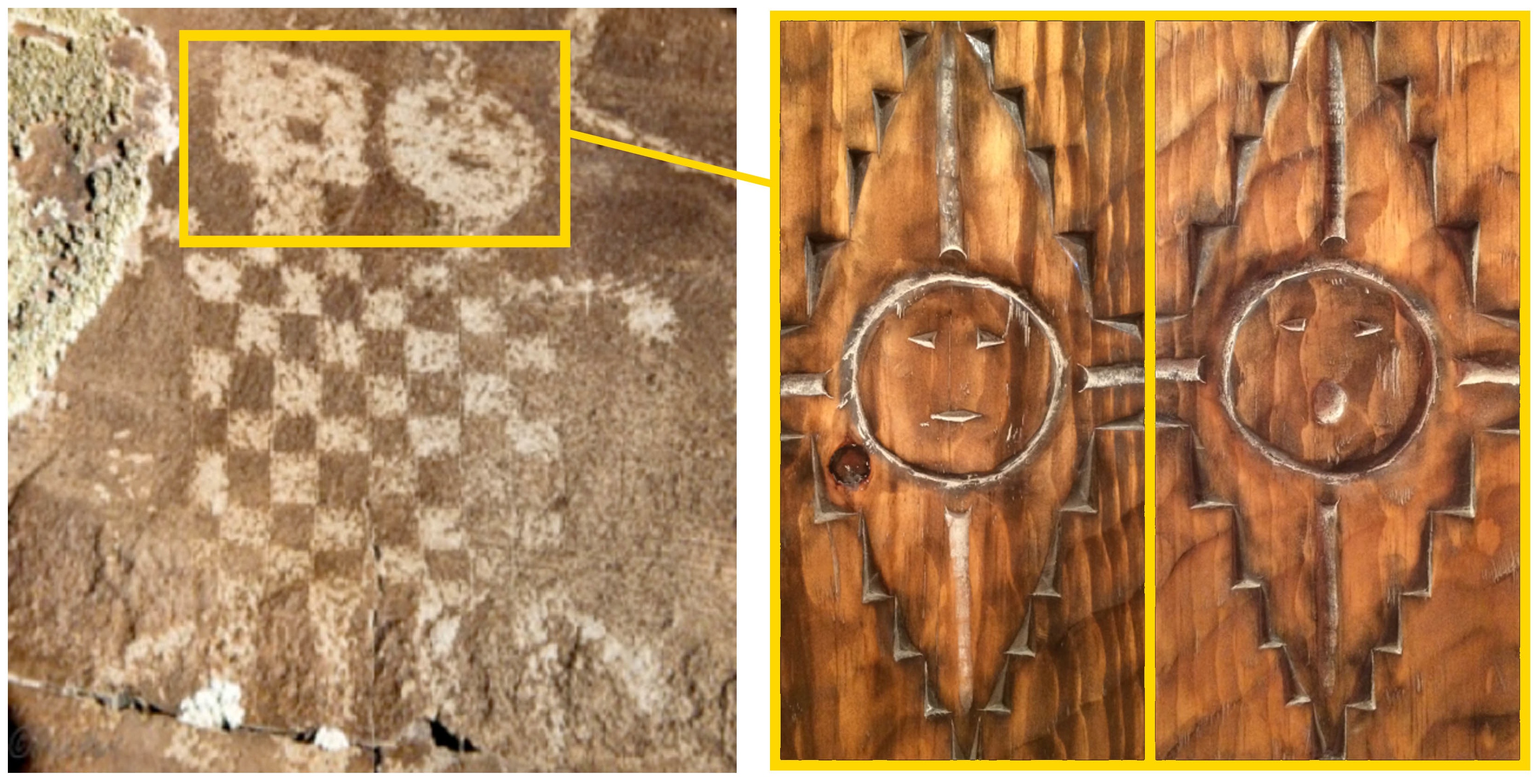
 ‘Marriage’ petroglyph, faces on Hart’s pie safe ‘The Storytellers

I call the petroglyph above ‘The Marriage.’ You can see two distinct people occupying one checkerboard body. If you look carefully, the square head appears to be speaking while the round head has its mouth closed. My pie safe called ‘The Storytellers‘ explores this theme of opposites. The listener and the speaker depend on each other.
Roch-Hart-New-Mexico-Petroglyphs

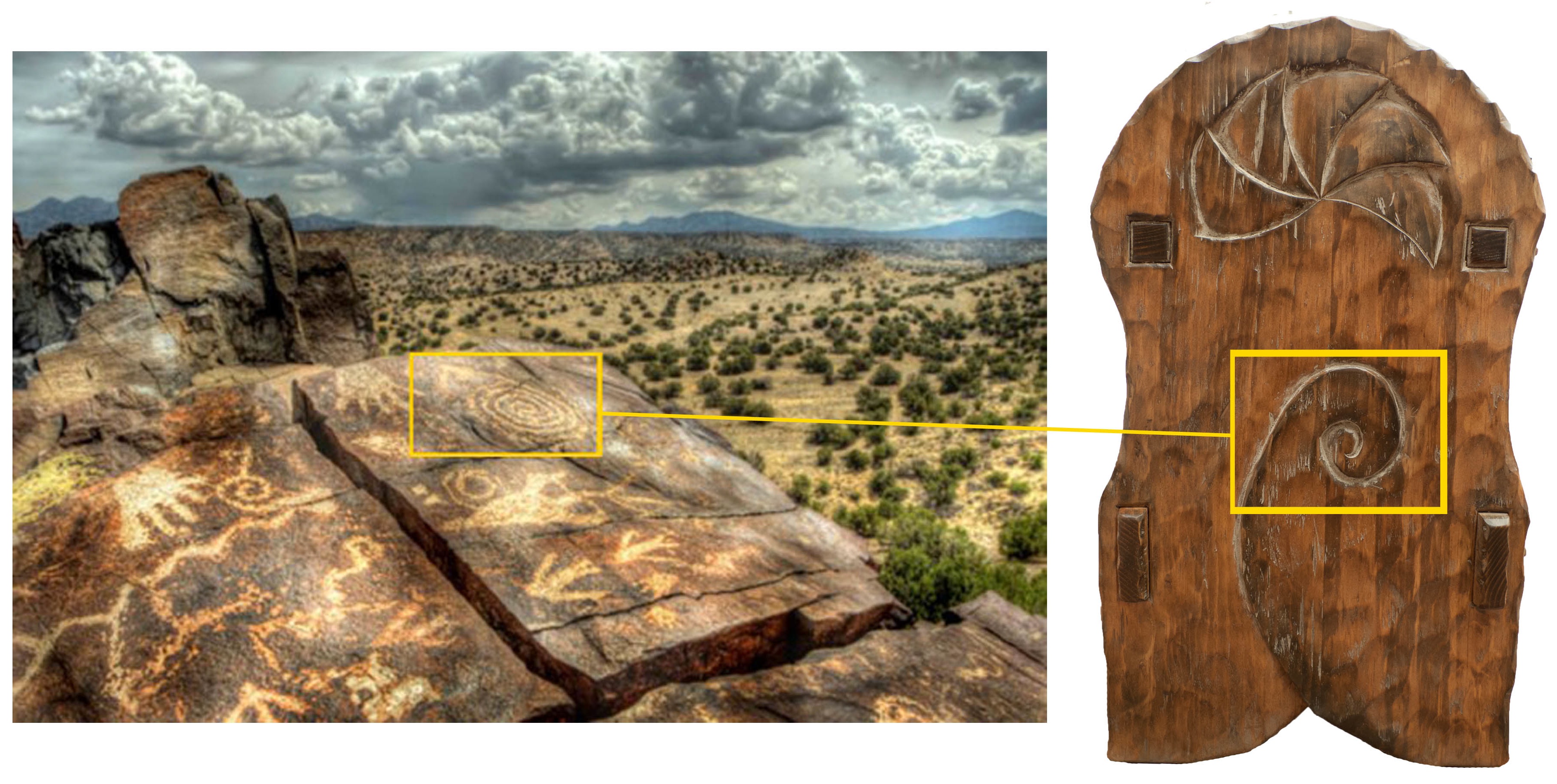
New Mexico petroglyphs, a spiral design on a bench by Roch Hart

Another common symbol is the spiral.  Spirals or concentric circles often represent time or travel.  I have found that cracks are often incorporated into these petroglyphs and I will find a spiral with the outer end going to or ending in a crack.  A common legend amongst the Pueblo natives is that they originated under the earth’s crust and made the journey to surface.  I believe these spirals convey that journey.  On one of my early pie safes, I placed a spiral on the door with the tail leading up to the middle joint of the door.

 Screen Shot 2014-09-11 at 6.22.02 PMNew Mexico petroglyphs

Petroglyphs are very complex and have multiple layers of meaning and legend.  This blog post just scratches the surface, so to speak.  We have lost much knowledge of petroglyphs because early Spanish priests saw them as spiritualism apart from Catholicism. Catholicism was the state religion and the only legal one, so petroglyphs were outlawed.  In fact we often find crucifixes etched into the stones near these sites, placed there by the early priests to exorcise the place of evil spiritualism and to remind the Pueblo natives that this was not longer an accepted practice.

While part of me is upset about how we lost the knowledge of these ancient symbols, I enjoy that I don’t completely understand the mystery.  I love the idea that in some respects it is open to the interpretation of the beholder. Only the maker knew.

To make my fine furniture, I blend influence from the native cultures with my knowledge of Spanish colonial carpentry laws. That’s how I arrive on how to make a piece down to the joinery. But that’s for another blog post!

To see more photos by Hart, make sure to check out his Flickr account. See all of his furniture on our website, and connect with us on Facebook, Twitter and Pinterest for daily gallery news.
 

FAMILIAR STRANGERS: Almost Lost

Familiar Strangers Found Photography Show- Matthews Gallery Blog

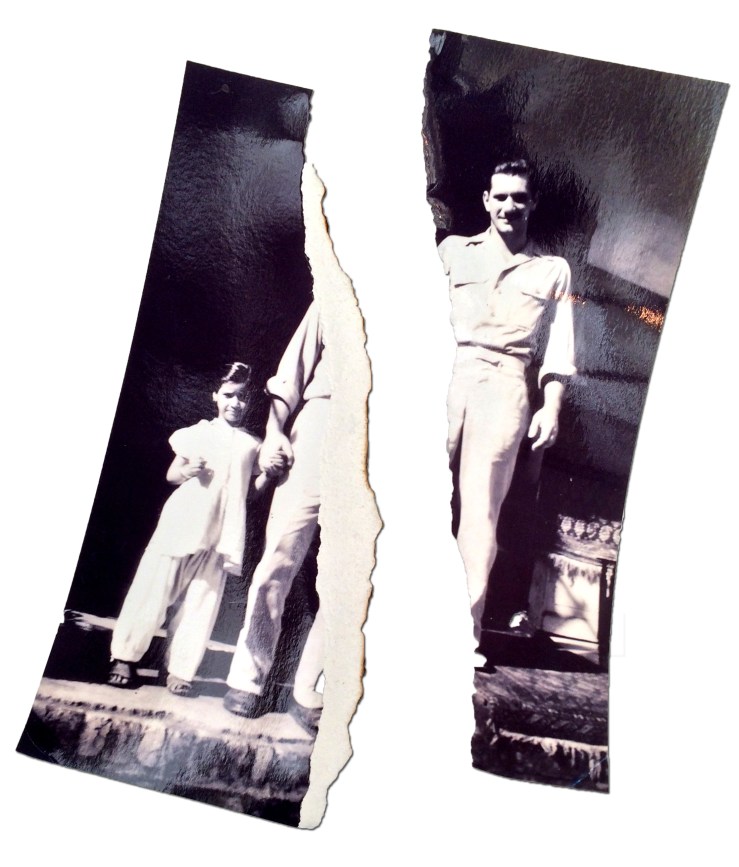
Editor’s Note: No original photographs were harmed in the making of this blog

The messages were all the same. “Why do found photographs hold allure for you?” we wrote to members of Flickr’s robust vernacular photography community. “What is it about anonymous photographers and their subjects that makes collecting these artworks special or important?” 

As we explained in our last blog post, we’ve been wearing many different hats as we prepare for the May 16 opening of FAMILIAR STRANGERS: Vernacular Photography. Judging by the diverse answers we received from this query, it seems longtime found photography fans follow a similar process.

“At the time they were taken, they meant something to the photographer,” writes Gary Moyer, who runs a Flickr Group called Found Photos. “It’s a shame to think they can’t live on in this digital age.” But although part of Moyer’s mission is to bring this ephemera to the virtual realm, he’s also charmed by the objects themselves. “The photos are real, something to hold in your hand,” he concludes. 

For John Van Noate, administrator of several vernacular photography groups, it’s more about the immediacy of the image. “They provide a slice of life unfiltered, unmediated,” he writes. “Life in the raw, so to speak.”

Dave Bass‘ interest in vernacular photography started with a childhood fascination for taking snapshots. “I still recall the anxiety felt when retrieving a processed roll from the drugstore and opening the package to discover my treasures,” he recalls. Hunting down “orphan” photos seemed like a natural extension of his passion, and over years of collecting he’s learned a lot about human nature from the pictures he’s found.

I truly believe that such photographs are authentic cultural artifacts that portray who we as humans were, who we have become, and where we will likely go,” Bass writes. He uses Flickr group Vernacular Photo to connect with like-minded folks across the world. 

All of these intrepid collectors’ answers did have one thing in common: a sense of loss, and a desire to subvert it. As Moyer puts it, “Each [photograph] represents a moment that is gone forever.” In a way, these collections preserve memories that would otherwise have vanished long ago. 

On that hopeful note, we leave you with an excerpt from Paul Jackson‘s correspondence. The UK resident runs the Flickr group Found Photographs, and has a lot to say about vernacular photos and the power of the online community to uncover their secrets. It’s enough to make you believe that nothing is lost forever. Attend our FAMILIAR STRANGERS exhibition, opening May 16 from 5-7 pm, to untangle more mysteries!

Familiar Strangers Found Photography Show- Matthews Gallery Blog

From Paul Jackson:

I went to art school here in the UK in the 1970s and my interest in vernacular photographs stems from then. In those days you could often buy old postcards and snapshots in charity shops for virtually nothing. Often just arranged in old shoe boxes. You can rarely do that now as these things have become very collectable.

I think it is a shame when dealers break up old photograph albums as all the clues that would help place these images in context get wiped away. You may be interested in some subsidiary groups we run on Flickr. One is called “What’s That Picture” where we invite people to post pre-1945 images that they want help identifying. Sometimes this is a tall order but the Flickr community acts a bit like a hive mind and we have had some astonishing successes. A lot of these can be found in another group “The Astonishing Power of Flickr“. Here many images that have been successfully identified have been posted and some other extraordinary events such as people recognising themselves or other serendipitous events have occurred. 

You ask what the allure is for me. Well, there is something awfully poignant about old snap shots/vernacular photographs. The lives of strangers’ births deaths marriages, love, hearth and home..all life is there and with the knowledge that all that life has probably by now slipped away. These things end up in sales almost always through a death and the death of someone who either has no remaining family, or a family that cannot or will not preserve these fragile family histories. It is a very sobering thought.

I am at a period in my life when I am beginning to realise that even my own family photographs and the ones of my parents and grandparents are going to be vulnerable to be “lost” when I die and it does make you dwell on the ephemeral nature of life, the impermanence of the structures we build around ourselves and how easily it can fade away.

One of my favourite quotes is the famous one in Blade Runner when Roy Batty the replicant is dying:

“I’ve… seen things you people wouldn’t believe… Attack ships on fire off the shoulder of Orion. I watched c-beams glitter in the dark near the Tannhäuser Gate. All those. moments will be lost in time, like tears in rain. Time… to die…”

Looking at so many old and found photographs I often think that “I’ve seen things you people wouldn’t believe” the person behind the camera has seen these things, lived that life..you know, we can sometimes almost taste it.


Familiar Strangers Found Photography Show- Matthews Gallery Show

BE OUR CURATOR: A Social (Media) Experiment

When we cooked up a full-fledged social media strategy for the gallery early last year, we had no idea what we were in for. Twelve months and countless posts, photos, tweets, likes and pins later, we’ve learned a lot. No offense to professors past, but engaging with our vibrant online community of aesthetes has been the best art course we’ve ever taken. It’s high time we thanked you for your passion, so pull out your CV and add “curator” to the list. Starting tomorrow, we’re giving you the opportunity to help us put together a very special show.

COLLECTOR’S CHOICE: 10 Artworks We Love will feature art chosen by online fans across all of our social media platforms. Keep an eye on Matthews Gallery’s Facebook, Twitter, Pinterest or other networks from Friday, January 17 through January 30 to vote on your favorite work in our collection. From January 31 through February 5, we’ll unveil your selections in the gallery and online.

Join us as we shatter the definition of an art curator and gallery show. There’s no one we’d rather collaborate with! Learn more about the show on the Matthews Gallery website.