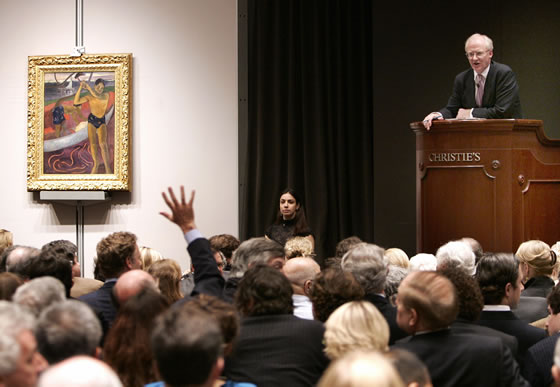
The world’s oldest auction house opened in Stockholm, Sweden in 1674. Art auctions in Great Britain gained popularity a few decades later when the Earl of Oxford’s collection appeared on the block in 1742. That particular sale featured the full range of odd and valuable items you might find in a dusty old castle, from a bust of an unknown bishop (five shillings) to a series of van Dyck paintings (165 guineas).
The beat of the auction mallet has marked the rhythm of the secondary market ever since. It’s a tradition that’s full of strange pageantry and heart pumping excitement. Auction kingpins Christie’s and Sotheby’s, which were both founded in mid-18th century England, often draw the ire of art world players for their tightly controlled sales. “They know exactly how many people will be bidding on a work and exactly who they are,” wrote art critic Jerry Saltz in 2012 after a version of Edvard Munch’s The Scream sold at Sotheby’s for $119.5 million. “In a gallery, works of art need only one person who wants to pay for them.”
Online auctions have meanwhile been swiftly democratizing the centuries-old process, and that’s where the Matthews Gallery decided to jump in. We launched the EUROPEAN MASTERS, AMERICAN AND SOUTHWESTERN ART AUCTION on July 25 and it runs through July 29. Come browse our virtual auktionsverk of art and, if you’re inspired, make a bid. You’ll find art by European modernists such as Pablo Picasso and Joan Miro, Southwestern legends including Emil Bisttram and Alfred Morang, and notable contemporary artists like Jamie Chase, Eric G. Thompson and Kate Rivers among the lots. Here are some notable pieces from the catalogue:
EUROPEAN MASTERS
Click to see the works on our auction site:
- Mahana Atua (The Day of God), Paul Gauguin
- L’univers est créé, Paul Gauguin
- Personnages Masques et Femme Oiseau, Pablo Picasso
- Odalisque, Pierre-Auguste Renoir
HISTORIC SOUTHWESTERN ART
Click to see the works on our auction site:
- Untitled (Landscape #1), Emil Bisttram
- Untitled (Landscape #2), Emil Bisttram
- Untitled (Landscape #3), Emil Bisttram
- Untitled (Santa Fe Landscape), Alfred Morang
- Riders at Sundown, Gene Kloss
- Return of the Wood Gatherers, Gene Kloss
CONTEMPORARY ART
- Nude in Blue, Eric G. Thompson
- Dreams of Spring, Roseta Santiago
- Reclining Column Blue, Frank Morbillo
- Lucky Guy, Kate Rivers
- Autumnal, Jamie Chase
- Easy to Love, Annie O’brien Gonzales
- River’s Course, Earl B. Lewis
See more lots from the auction here, and connect with us on Facebook, Twitter and Pinterest for auction updates all week!

 MATTHEWS GALLERY BLOG