FOUR CENTURIES: Monnoyer’s Mark

Still life attributed to Jean-Baptiste Monnoyer- Matthews Gallery blog

We discovered this still life at the preview of a Santa Fe estate sale. It was tucked in a dark upstairs corner of the house, far from the Picasso print and treasure trove of art books on prominent display in the living room. Lawrence lingered for a while to take in the flamboyant bouquet with its rich rosy tones. There was an excited glint in his eye.

A few months later, the painting has found a home under the glowing lights of our European art room. We know a lot more about it now than when it first caught Lawrence’s fancy. It’s attributed to Jean-Baptiste Monnoyer (1636-1699), a 17th century Franco-Flemish painter who wielded his brush for Louis XIV. Its siblings hang in some of France and England’s most famous estates.

Our adobe art abode is a very different venue, but this 300-year-old artwork gives us the opportunity to transport gallery visitors across the sea and through the ages. Look below to chase Monnoyer through the palaces where he left his mark, and don’t miss the painting’s debut at our opening for FOUR CENTURIES: European Art from 1600 to 1950 on Friday, June 13 from 5-7 pm.

Hôtel Lambert- Site of artwork by Jean-Baptiste Monnoyer- Matthews Gallery Blog

Our first stop is the Hotel Lambert on the Ile Saint-Louis, site of Monnoyer’s first Parisian commission in 1650. The artist grew up in Lille, France and trained in Antwerp, but it was the lavish estates in and around Paris that claimed his considerable interior decorating talents. Monnoyer’s floral designs in the grand mansion would delight its many owners and guests for centuries to come, from a famous Polish political salon to Voltaire, Chopin, Balzac, Delacroix and Dali. Unfortunately, the Hotel Lambert was badly damaged in a 2013 fire and is under renovation.

Chateau de Marly- Site of artwork by Jean-Baptiste Monnoyer-  Matthews Gallery Blog


Artist Charles Le Brun, who painted a series of renowned ceiling frescoes at the Hotel Lambert, brought Monnoyer along for a commission at Louis XIV’s Chateau de Marly. The (relatively) small country estate was the king’s escape from the more rigid world of Versailles, and aristocrats fiercely battled for a chance to stay there. Alas, the twelve pavilions that flanked the water and their intricately adorned interiors are long gone, but the commission launched Monnoyer into a new stratosphere.

Palace of Versailles- Site of artwork by Jean-Baptiste Monnoyer- Matthews Gallery Blog

Monnoyer worked with Le Brun once again on the ornamentation of the Palace of Versailles. For this and other high profile royal projects, he developed a style that was far removed from his training in the subdued still life painting techniques of the Low Countries. The bold, ornamental approach is in full force in our still life, recalling the spectacular garlands of flowers he painted on the ceiling of the Queen’s pavilion at the Chateau de Vincennes. Monnoyer also made reference sketches and etchings for French tapestry workshops, greatly influencing European decorative styles for years to come.
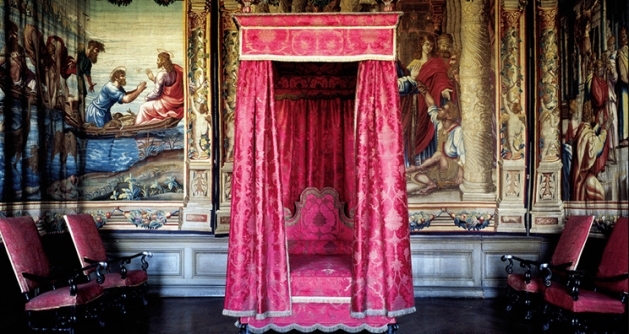
Boughton House- Site of artwork by Jean-Baptiste Monnoyer- Matthews Gallery Blog

A commission from the Montagu House in London drew Monnoyer away from Paris in 1690. He adorned dozens of panels with fruits and vegetables and painted several portraits, some of which now reside in the state rooms of Northamptonshire’s Boughton House. The artist remained in England until his death in 1699, but his distinctly French style lived on in the artwork of two of his sons.

Make sure to attend the opening of our FOUR CENTURIES exhibition on Friday, June 13 from 5-7 pm, and follow us on Facebook, Twitter and Tumblr for daily gallery news.

FAMILIAR STRANGERS: Be a Voyeur, Detective, Surrealist, Humanist!

Found Photograph- Familiar Strangers Show- Matthews Gallery

  Untitled, Unknown

“A photograph is usually looked at—seldom looked into,” said Ansel Adams. When it comes to the pictures in our upcoming show, there’s no other option but to dig a little deeper.

FAMILIAR STRANGERS: Vernacular Photography, opening Friday, May 16, is not your typical Matthews Gallery show. The artists who created our collection of found photographs never got the recognition that Picasso, Toulouse-Lautrec or Renoir did, but there’s no denying their aesthetic sensibilities.

That’s what has kept us digging through estate sales, thrift shops, antique stores and attics for years. We’ve amassed quite the collection of vernacular photographs, also known as “found” or “orphan” photos, and we’re not alone in our scavenging habits. Our friends on social media understand the great allure of the hunt.

Looking at so many old and found photographs I often think that, ‘I’ve seen things you people wouldn’t believe,'” writes Paul Jackson, who maintains the Flickr group Found Photographs.  “The person behind the camera has seen these things, lived that life..you know, we can sometimes almost taste it.” We asked several other photo finders what they love about the pursuit, and they all had equally passionate answers.

Vernacular photography presents unique challenges to the viewer, asking us to shift between different roles to grasp what we’re seeing. Our first impulse is often voyeuristic. We can’t resist a peek at someone’s intimate moment, and we swiftly draw conclusions about what’s going on. In the image above a baton girl gawks open-mouthed at a band boy, but he looks resolutely away. Is this a tale of unrequited love?

Society often slaps us on the wrist for our voyeuristic tendencies. In his brilliant essay on found photography Dr. Barry Mauer of the University of Central Florida says this instinct is something we should indulge.

“At first sight, most of these pictures are hilarious or tragic or both,” writes Mauer. “Voyeurism allows me to experience these reactions from a comfortable distance.” However, Mauer cautions against stopping there. Voyeurism often comes hand-in-hand with judgment and categorization. Stereotyping these mysterious individuals cuts us off from a rich world of visual mysteries. Time to pull out the magnifying glass.

Found Photograph- Familiar Strangers Show- Matthews Gallery


Untitled, Unknown

If we act as detectives, this simple portrait holds a lot of hints about the bicyclist and her photographer. Did you notice the bandages on her knee and arm? If those are recent wounds, perhaps she’s just learning how to ride. It’s difficult to tie a forearm bandage on your own. Maybe the person behind the camera is her teacher and medic? On the other hand, the bags on the handlebars hint at a different adventure. One of them looks like a canteen. Could the other hold snacks for a picnic?

Teasing out these details is invigorating. To take it one step further, note the composition of the photograph. The front wheel is cut off and part of the path is visible behind the girl. This perspective, when combined with the subject’s bent posture and excited face, lends the photo a sense of forward movement. Our mysterious photographer has imbued a picture of a static bike with surprising dynamism. Was that his or her intention?

Found Photograph- Familiar Strangers Show- Matthews Gallery

Untitled, Unknown

Of course, in the end we’ll probably never know if our inferences are correct. Who better to help us surmount our fear of the unknown than the surrealists? André Breton and his friends were inspired rather than daunted by impenetrable mysteries. They sought out fragments of culture, watching films from between their fingers to try to catch discreet details and writing stories based on dreams they had about real experiences.

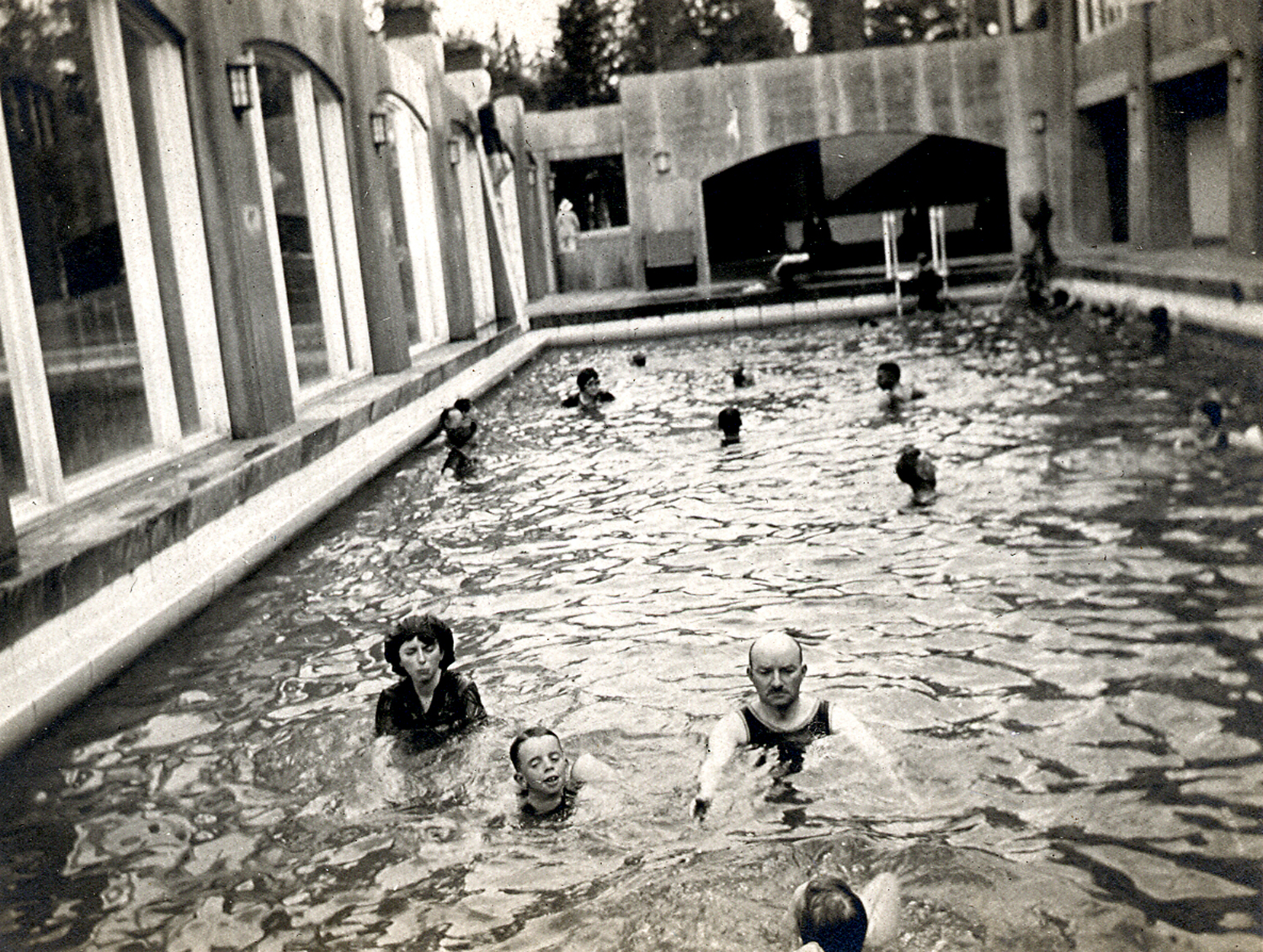
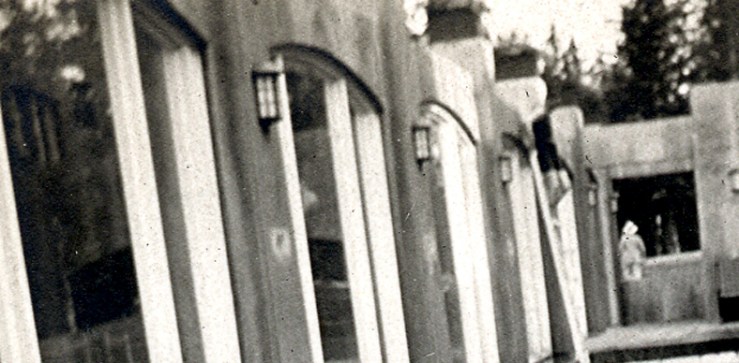
Both techniques allowed them to focus on details they otherwise would’ve ignored. In the photo above, our interest in the group in the foreground distracts from the odd figure standing in the far background. Cropping the photo brings up a whole array of new questions.

Found Photograph Detail- Familiar Strangers Show- Matthews Gallery

Detail of previous photo

In a broader context the entire photo is a fragment. The man in the foreground’s stern expression stands alone, isolated from what happened before or after. Perhaps he cracked a smile a moment later, but this short glimpse of his day at the pool has a foreboding air to it.

“The surrealists used fragmentation as a means to knowledge, discovering significance in the fragment that had been concealed in the contextualized whole,” Mauer writes. It’s not hard to trace the progression of this thinking to Marcel Duchamp’s use of found objects, or to the Dada artists’ repurposing of vernacular photos in collages (more on all of that in an upcoming blog post).

In the end analyzing and relating to the “characters” in these photographs helps develop our skills in another field: humanism. It’s amazing how connected we can feel to a person we’ll never meet, and how powerful our feelings of empathy and sympathy can be when we exercise them. Look long enough, and you’ll start to imagine that these familiar strangers are looking right back.

Step into the shoes of a voyeur, detective, surrealist and humanist at FAMILIAR STRANGERS: Vernacular Photography, opening Friday, May 16. Also, make sure to check out our fascinating interview with four found photography collectors and connect with us on Facebook, Twitter and Tumblr for more gallery news!

THE LUMPKINS LEGACY: Bill’s Last Request

William Lumpkins Jr- Matthews Gallery Art Opening

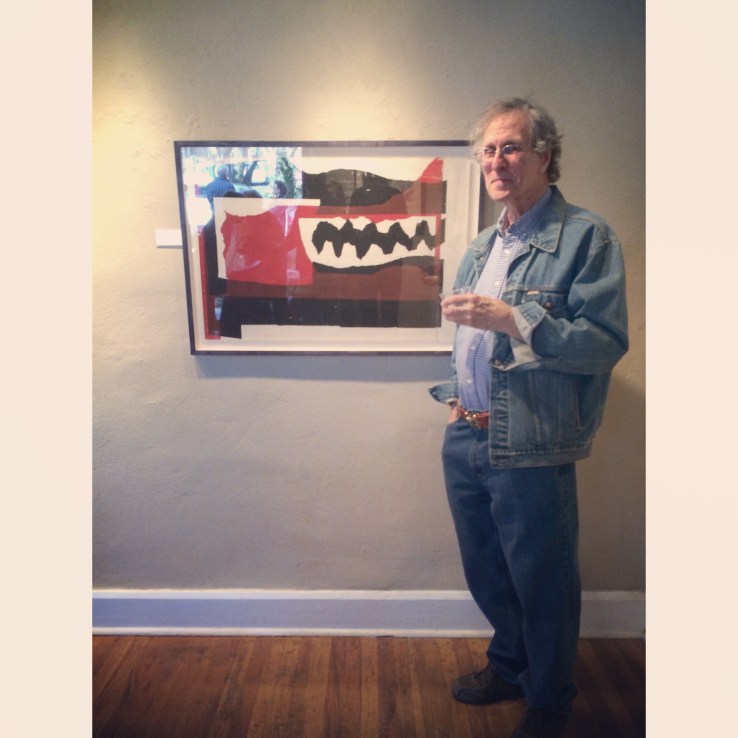
William Lumpkins Jr. next to his father’s serigraph “Abstract Landscape #3

At last Friday’s opening of NEW MEXICO MODERNS: The Lumpkins Files, William Lumpkins Jr. was a quiet presence. He stood to the side surveying his father’s work or chatted softly with visitors, many of whom were family friends. One woman had known his dad, who died in 2000, through an art discussion group that met at local coffeehouses. “Whenever Bill spoke, we all had to lean in. He was such a lovely, gentle man,” she said.

Will’s father may have passed down his mild temperament, but both men are also legendary for their fierce artistic passion. Will has carefully preserved the artwork in The Lumpkins Files show for years, and meanwhile has developed his own artistic style. The jacket he wore to the show was emblazoned with intricate celtic knots and a dragonfly.

When we asked about his dad, the more colorful side of Will’s personality emerged. Here’s William Lumpkins’ son on his father’s never-before-seen artwork, and why he decided to release it more than 15 years after Lumpkins’ death.

 What’s it like to see your dad’s work hanging in the gallery? 

Well, his work was all around us growing up, so it’s not that strange. The gallery did an excellent job though.

When did you first bring the work to Matthews Gallery?

About a year and a half ago. I had shopped around and didn’t relate to anybody until I met Larry.

Where did you keep it for all these years? 

I had it in a case between sheets of acid-free paper. When I was teaching at Virginia Commonwealth University, I was in charge of museology. It was a whole print and painting conservation training program. So my dad knew that I could take care of them. Watercolors in particular are a sensitive thing for archiving.

Why didn’t he want you to release them until now? 

It didn’t have to do with the work. He said to me, ‘Okay, you wait until after you’re 70 because by then your personal artistic statement will be you. You won’t have to mimic me.’ So at 70, my artwork was me and I brought these out again.

Were you ever tempted to release them before that? 

No, it just didn’t seem right until I started looking around recently. I trusted you guys.

One of the biggest surprises in this body of work was the watercolor from 1937. That’s one of the earliest Lumpkins pieces we’ve ever seen. Did you know it was in there?

I knew that the work spanned a lot of time. When Dad was closing down the studio, he picked these out because these were the ones that he really liked from different points in his career. He felt that they were significant, and that they weren’t typical. His typical work is pretty well-known, but these he wanted to hold out so that they’d be totally new.

What was your vision for this show? 

I gave the work to Larry and said, ‘Do you what you think is best.’ I just want them to be out in the open where they can be seen. If people want them enough, if people like them a lot, that’s good.

Hear more from Will Lumpkins in this week’s Pasatiempo, and visit the show at Matthews Gallery through Friday, April 25. For more images from the opening, check out our photos page and connect with us on Facebook and Instagram.

BE OUR CURATOR: A Social (Media) Experiment

When we cooked up a full-fledged social media strategy for the gallery early last year, we had no idea what we were in for. Twelve months and countless posts, photos, tweets, likes and pins later, we’ve learned a lot. No offense to professors past, but engaging with our vibrant online community of aesthetes has been the best art course we’ve ever taken. It’s high time we thanked you for your passion, so pull out your CV and add “curator” to the list. Starting tomorrow, we’re giving you the opportunity to help us put together a very special show.

COLLECTOR’S CHOICE: 10 Artworks We Love will feature art chosen by online fans across all of our social media platforms. Keep an eye on Matthews Gallery’s Facebook, Twitter, Pinterest or other networks from Friday, January 17 through January 30 to vote on your favorite work in our collection. From January 31 through February 5, we’ll unveil your selections in the gallery and online.

Join us as we shatter the definition of an art curator and gallery show. There’s no one we’d rather collaborate with! Learn more about the show on the Matthews Gallery website.