The selection process for our social media-curated show COLLECTOR’S CHOICE is underway, and fans on Facebook, Instagram, Twitter, Tumblr and other networks have placed their votes. It’s time for some tie breakers on WordPress! Check out the match-ups below and vote for your favorites in the comments section. From January 31 to February 5, we’ll unveil your selections in the gallery and online.
JAMIE CHASE
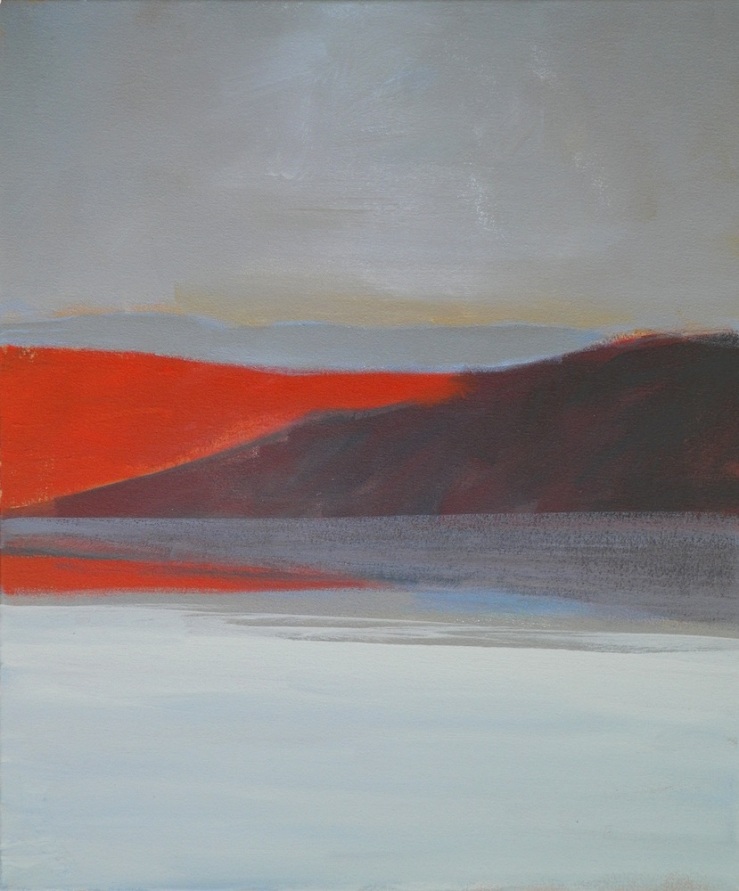
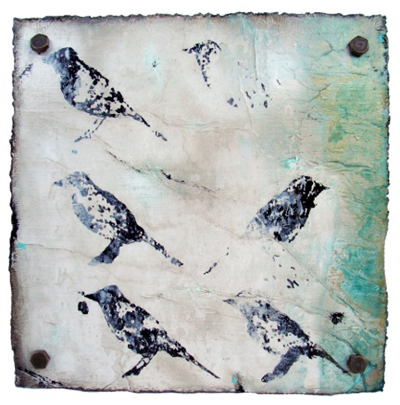
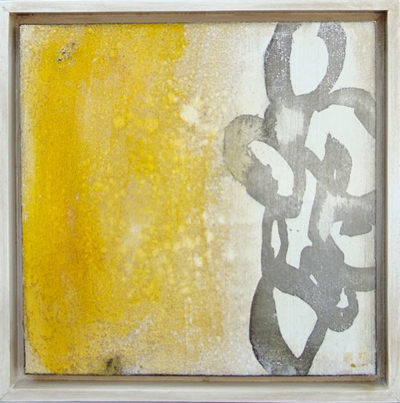
ROUND 1! Jamie Chase is known for his figurative work like image #1, and also his abstracted landscapes like #2. Which one should appear in the show? Take the curatorial reins!
WILLIAM LUMPKINS
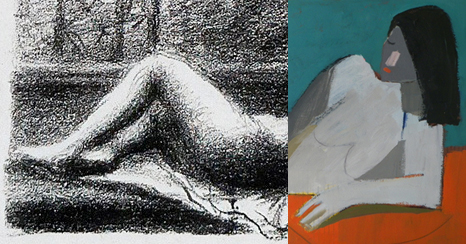
Do you prefer William Lumpkins‘ careful watercolor brushstrokes (#1) or experimental wild felt-tip pen marks (#2)? Read more about the influential Santa Fe modernist here before you decide…
KATE RIVERS
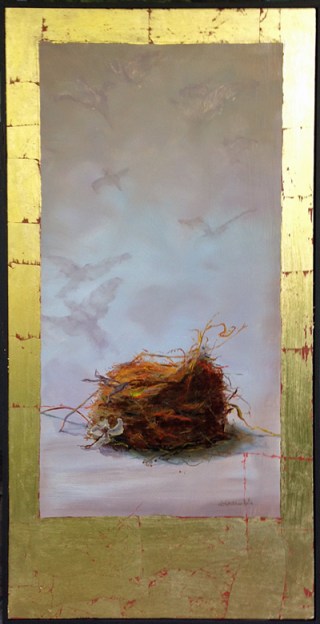
Curate this! Should we feature a Kate Rivers book collage in the show, or one of her nests? Read about her mixed media work in this blog post, and vote for #1 or #2 in the comments.
HANNAH HOLLIDAY STEWART
These tall, spindly bronzes might be very different, but they’re both by powerhouse feminist sculptor Hannah Holliday Stewart. Figurative or abstract? Curate that!
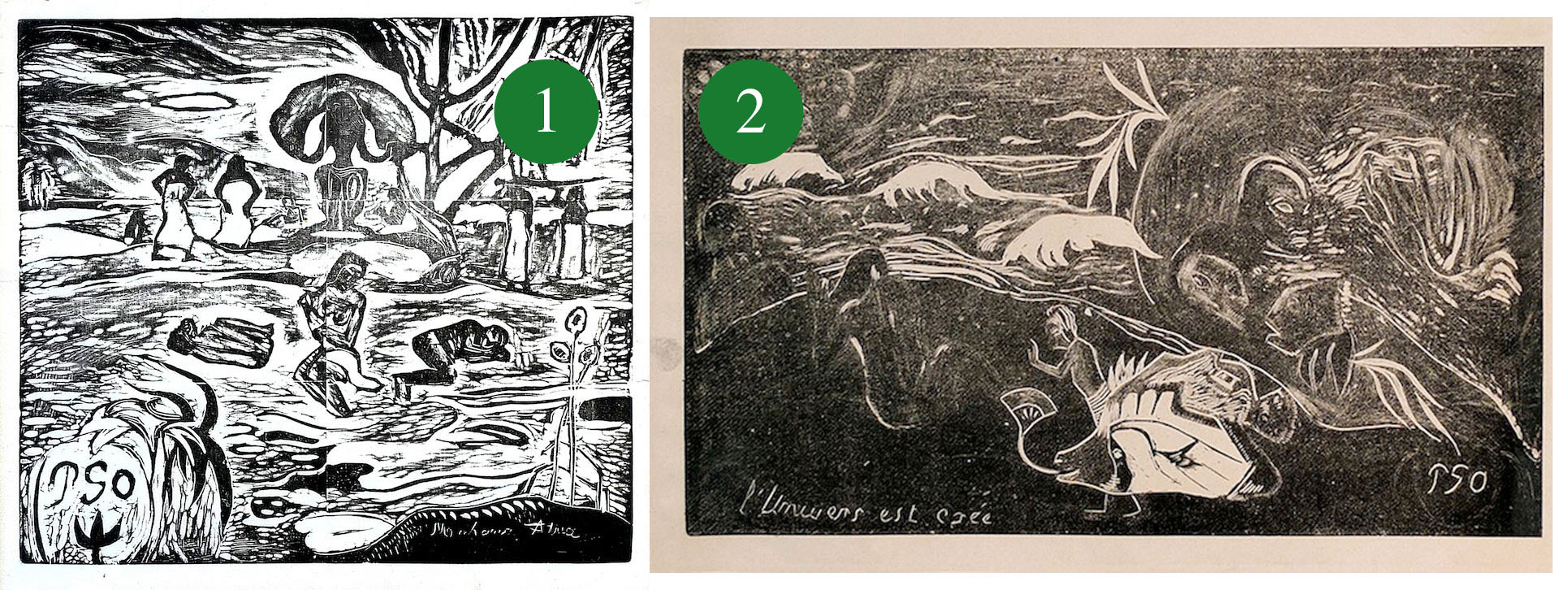
PAUL GAUGUIN
Two Tahitian myths inspired these woodblock prints by Paul Gauguin. Which do you prefer? Read about them in this blog post, and vote now!
Thanks for participating in COLLECTOR’S CHOICE! To place your vote on other social networks, connect with us through the links on our About Page.
No matter their preferred medium or subject matter, one of the first things young art students are challenged to do is pick up a pencil and draw from life.
“It’s only by drawing often, drawing everything, drawing incessantly, that one fine day you discover to your surprise, that you have rendered something in its true character,” said Camille Pissarro, mentor to the Impressionists.
Of course, Pissarro had a different idea of what it meant to evoke something’s “true character” than, say, Paul Gauguin. As we discussed in our last post, Vermeer and de Kooning painted female figures in oil to highly divergent ends.
Our FOCUS ON THE FIGURE survey show, running now through the end of December, has us pondering the artist’s eye for the human body. History’s verdict on the success or failure of a particular depiction is often entirely based on the culture that first viewed it. Even in the hands of the most technically talented artists, the human body has a unique capacity to spark fiery controversies. Here are some notorious offending body parts:
SKIN
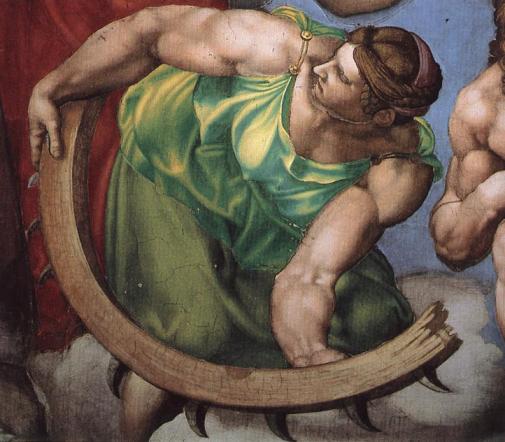
The Last Judgment (detail), Michelangelo
Believe it or not, that’s a woman in the image above. Michelangelo (1475-1564) had a hard time depicting feminine grace, probably because he used massive body builders as models. That’s not the reason the artist’s Last Judgment mural in the Sistine Chapel drew the ire of the church, though. Michelangelo left many of his buff bodies unclothed and the clergy was afraid they would provoke sinful titillation. After the artist’s death, fig leaves were swiftly deployed.
TEETH
Self portrait, Elizabeth Vigee Le Brun
As chronicled in our blog series 10 Women Who Changed Art History Forever, even fully clothed models (with frilly collars) could show too much. When Marie Antoinette’s court painter Elisabeth Vigee Le Brun (1755-1842) dared to flash a smile for this self-portrait she was roundly condemned for diverging from the style of “the Ancients”. Read what one gossip columnist had to say about it here.
EARS
Madame X, John Singer Sargent
Top Paris socialite and legendary beauty Virginie Amelie Avegno Gautreau couldn’t resist John Singer Sargent’s (1856-1925) offer to paint her portrait in 1883. When conservative viewers at the Paris Salon were scandalized by Gautreau’s bare white shoulder and bright red ear in the painting, Sargent attempted some damage control by painting in a shoulder strap and renaming the painting Madame X. Alas, Gautreau’s reputation was forever damaged.
FACES
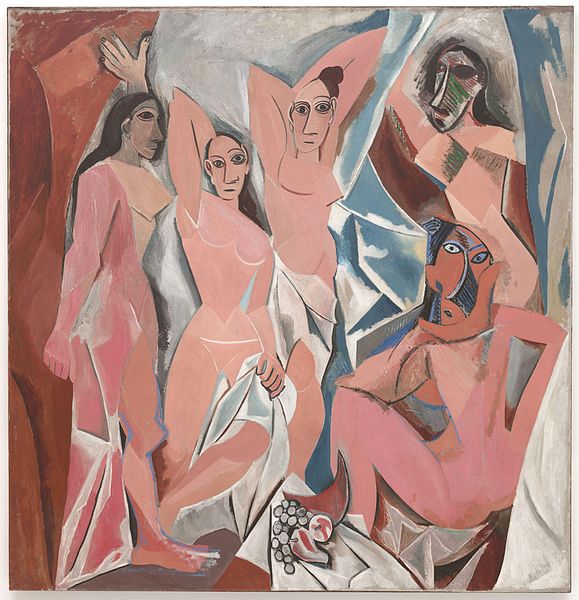
Les Demoiselles d’Avignon, Pablo Picasso
Pablo Picasso (1881-1973) always referred to his seminal painting of a group of Spanish prostitutes as The Brothel of Avignon. The canvas sat in his studio for years before he exhibited it under the title Les Demoiselles d’Avignon (The Young Ladies of Avignon) in 1916. Even after its rebranding, the painting caused a stir because the women’s faces—influenced by traditional Iberian art, African tribal masks and the art of Oceania—were considered savage and their postures barbaric and aggressive.
After the show, the work was rolled up and stored away for years. It wouldn’t be recognized for its visual innovations until later, when designer Jacques Doucet bought it for 25,000 francs in 1924. “It is a work which to my mind transcends painting; it is the theater of everything that has happened in the last 50 years,” Doucet said.
Our FOCUS ON THE FIGURE show features art by Jamie Chase, Kate Rivers, Eric G. Thompson, Pierre-Auguste Renoir, Harold Frank, Pablo Picasso and more. Connect with us on Facebook, Twitter and Pinterest for more news about the exhibition.
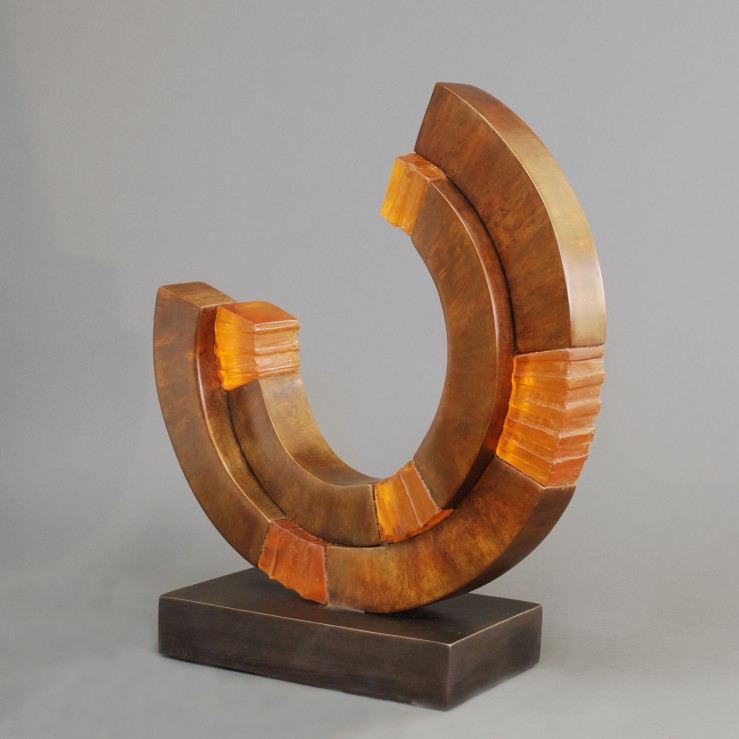
For our NEW HORIZONS: Focus on Landscapes show, running now through October 27, Tesuque sculptor Frank Morbillo‘s latest body of work engages with our diverse collection of contemporary landscape art. Throughout the exhibition, you’ll find observations by Morbillo and seven other artists, many of whom are inspired by the same severe desert expanses and infinite skies. Below is a selection of works and quotes from the show:
PATTERN
Frank Morbillo finds patterns wherever he looks in the natural world.
Kate Rivers uses manufactured patterns to form fractured reflections of nature.
“What’s a pattern? Something that might be predictable. When I observe things, that’s what I see. As an artist, you take all of these different things and see how they work together.”
-Frank Morbillo
“I’m using this history of text and image as something that is beautiful, and weaving the words together.”
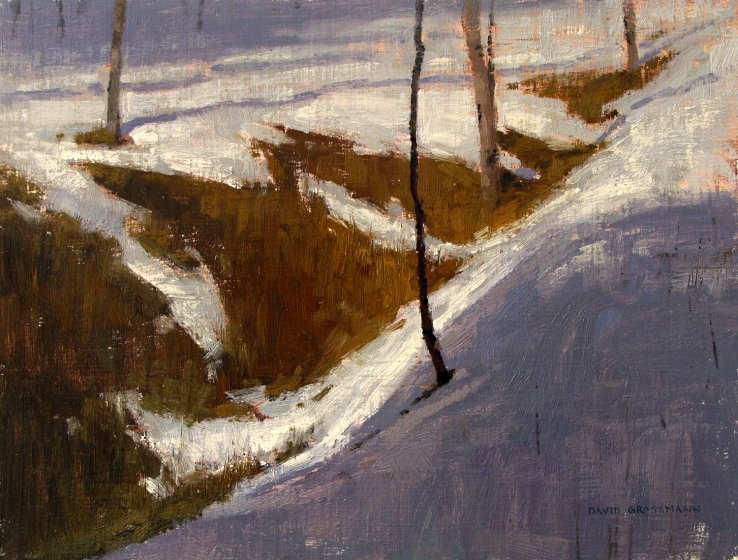
David Grossmann abstracts his landscapes to lay bare underlying rhythms.
Frank Morbillo traces the formation and disruption of natural rhythms.
“My paintings… are simplified rhythms of color, light, and shape. On the surface they are quiet whispers, but I hope that they convey a depth of emotion to anyone who takes the time to stop and listen.”
“Entropy is the introduction of chaos and disorder. That’s a root of what I’ve done over the years. You take something that could be highly organized, and understand that everything, all things, are subject to entropy. As much as we feel like we’ve created something that defies that, there’s no chance. Everything is subject to it.”
-Frank Morbillo
TEXTURE
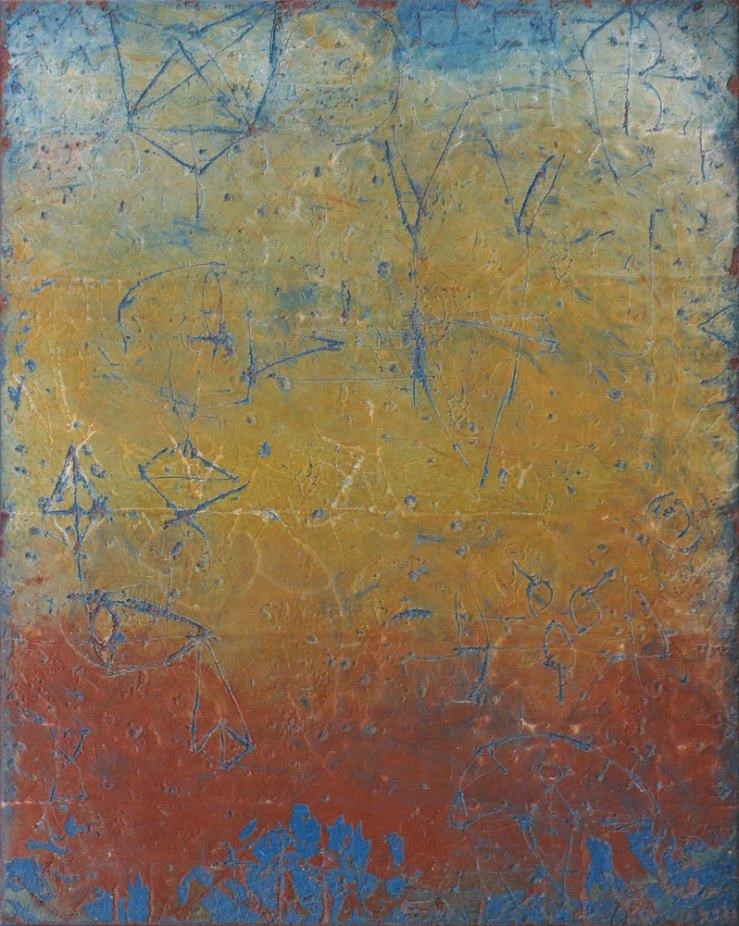
Terry Craig blends materials to mimic natural textures.
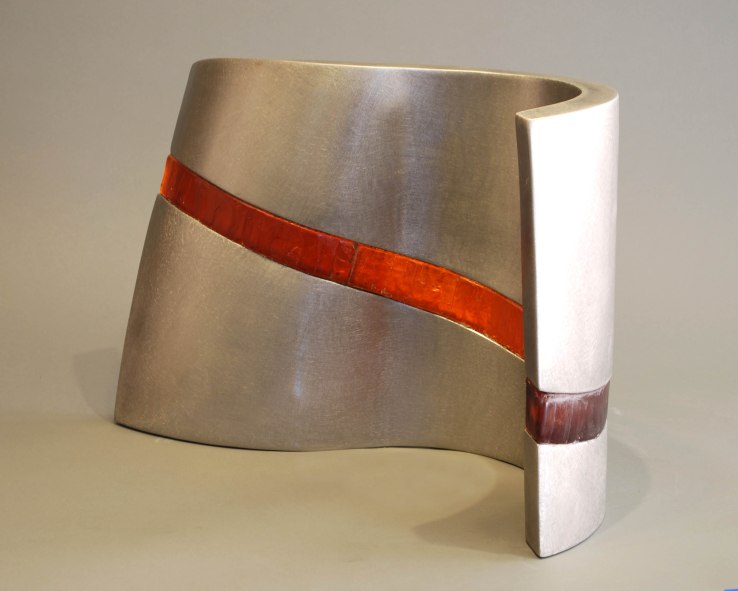
Frank Morbillo places materials with contrasting textures side-by-side.
“It took a long time… to develop the formulas and get the materials to do what I wanted them to do. You can scrape into it and get all sorts of these wonderful organic qualities.” -Terry Craig
“Glass is a beautiful material that sets up this nice contrast with the metal. If you add texture to it, it takes on a different color. The light behaves differently going through it.”
-Frank Morbillo
COLOR
Jamie Chase uses multiple layers of paint to reveal and obscure different hues.
Frank Morbillo relies on the properties of glass to enhance his palette.
“There are so many narratives underneath the final painting. It starts out as something really dark or really dramatic in contrasting colors, and by the end it’s almost neutral colors, but there’s something moving under the surface.” -Jamie Chase
“The glass introduced color into the work that really isn’t achievable in metal. The cobalt blues and reds and ambers have a quality that you can’t get with any of the metals.”
-Frank Morbillo
“When I look over the photographs Stieglitz took of me—some of them more than sixty years ago—I wonder who that person is,” said Georgia O’Keeffe. “It is as if in my one life I have lived many lives.”
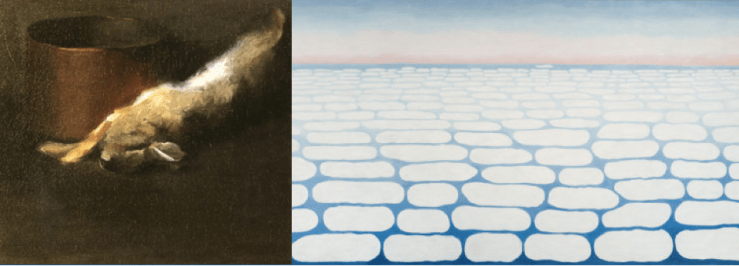
Look through O’Keeffe’s diverse body of work, and you’ll see just what she meant. “Untitled (Dead Rabbit with Copper Pot)” is a humble realist work she painted as an art student in her early 20s. She completed the abstracted, ephemeral landscape “Sky Above Clouds IV”, which is over 20 feet long, when she was almost 80. When they’re side-by-side it’s hard to believe that one artist created both.
The same is true for works that bookend any great artist’s career. Constant evolution is perhaps the most important ingredient to genius, as you’ll see in the images below. While you browse the early and late works of four legendary artists, ponder their differences. Does youthful enthusiasm and bold experimentation move you, or do you prefer a sure hand and a fully realized aesthetic? Join the conversation in the comments section below, or on our Facebook and Twitter pages.
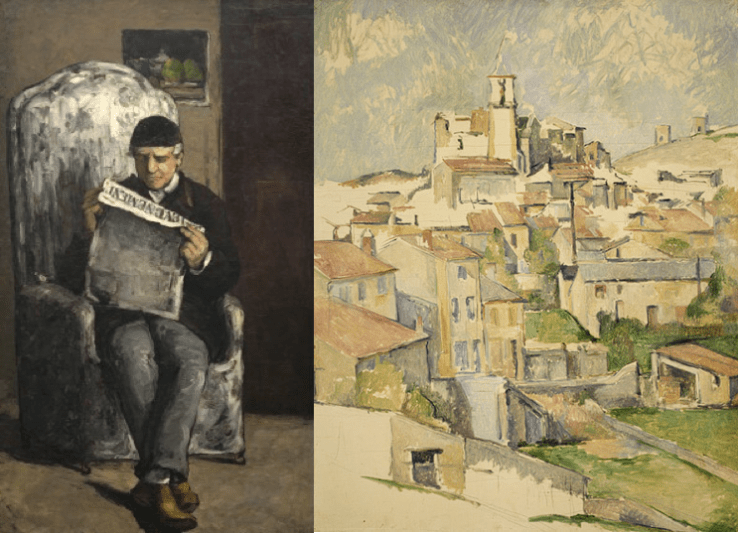
Paul Cezanne painted “Artist’s Father, Reading ‘L’Événement'” when he was in his early 20s and still partially under the thumb of his disapproving parent. The paper his father is reading—a liberal publication that the old man wouldn’t have deigned to open—and the still life painting hanging in the background hint at the artist’s growing confidence in his chosen path. Flash forward to the radical perspectival experimentation of “Gardanne”, completed when Cezanne was in his late 40s. The multi-layered cityscape would later inspire Picasso and Braque in their development of Cubism.
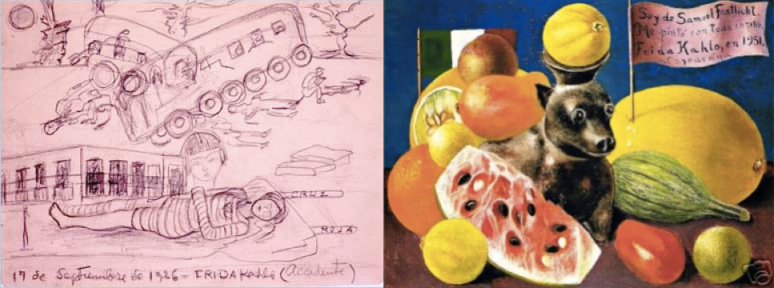
When Frida Kahlo was 19 years old she was in a trolley crash that left her in a full body cast. A year after the accident she created the pencil sketch on the left, drawing from the tradition of Mexican ex-voto paintings that blend text and images. A lifetime later, Kahlo was still suffering from chronic pain caused by the accident and drawing influences from folk art, but she’d discovered a subtler way to express her suffering. She painted “Still Life 1951” just three years before her death, when her body was giving out and she no longer favored self portraiture. The fleshy, congealing watermelon nestled among fresh fruits says it all. “I hope the exit is joyful — and I hope never to return,” she wrote just before her death.
“Les Saltimbanques” is a drypoint that Pablo Picasso created in his early 20s. The group of frolicking figures are characters from an opera-comique about a circus troupe. Countless artistic transformations later, Picasso etched out “Untitled (From the 156 Suite)“, an image that shows a tangle of prostitutes engaged in a very different acrobatic routine. Innocence is lost, but genius found.
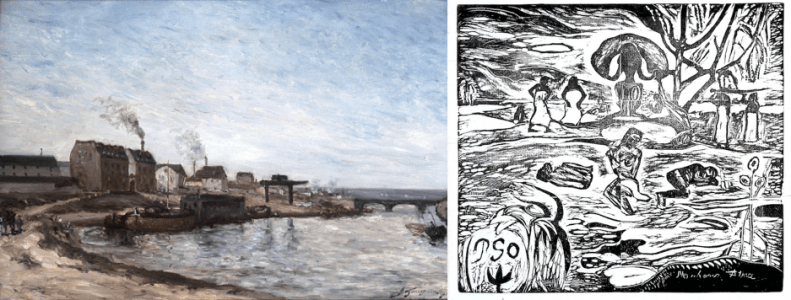
Paul Gauguin was a 27-year-old family man working as a stockbroker and hanging out at the Impressionists’ favorite cafes when he painted “La Seine au Pont de Grenelle”. By his mid-40s, he’d abandoned his family and job and exiled himself to Tahiti, where he drew inspiration for woodblock print “Mahana Atua (The Day of God)“. The artist learned from one revolutionary movement and then struck off on his own to inspire several others, from Primitivism to Symbolism.
How many lives can one artist live? What do you like better, the earlier or later work? Connect with us on Facebook, Twitter or Pinterest and sound off!
Click here to read the first part of this blog post.
How do you measure influence? It’s easy to focus on art’s brightest stars and most famous imagery, but zoom in on the tapestry of art history and you’ll see that its fibers are often woven from close personal relationships and direct channels of inspiration. We tend to remember names like Caravaggio, Picasso and Pollock and overlook the other fish in their schools. The following women might not have received as much attention as their male contemporaries, but that doesn’t mean they had a lesser hand in directing the grand flow of things. Check out our picks, and let us know who would be on your list in the comments.
6. Georgia O’Keeffe (1887-1986)
It was 1908, and a young O’Keeffe had just won a prize from the Art Students League for her still life Dead Rabbit with Copper Pot when she gave up painting all together. The artist was worried that she’d never truly distinguish herself in the realm of realism. Three years later she started fresh, enrolling in an art class taught by Arthur Wesley Down, who encouraged his students to let their emotions guide them.
“I found that I could say things with color and shapes that I couldn’t say any other way—things I had no words for,” O’Keeffe said. The artist created a series of innovative abstract charcoal drawings that caught the eye of her future husband, New York photographer and gallerist Alfred Stieglitz. She would continue throughout her career to build an emotional vocabulary of abstracted forms, strongly influencing her modernist contemporaries and later inspiring feminist artists like Judy Chicago. She’s now considered the Mother of American Modernism.
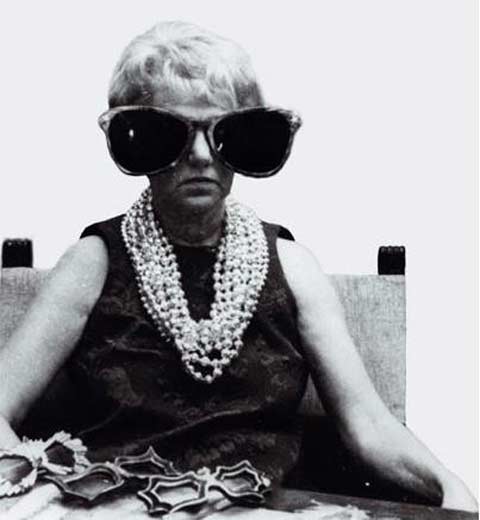
7. Peggy Guggenheim (1898-1979)
Guggenheim was born with the promise of a healthy inheritance. Her father died on the Titanic when she was a teenager, and at 21 she inherited more than $30 million in today’s currency. What to do with so much money? Guggenheim’s passion was art. Her first job was at the Sunwise Turn bookstore in New York, a bohemian hotspot that inspired her to move to Paris in 1920. There she met Man Ray, Constantin Brancusi, Marcel Duchamp and other influential modernists. By 1938 she’d opened a modernist gallery in London, where she showed the likes of Kandinsky, Calder, Ernst and Picasso.
The gallery got lots of attention from the public but lost money in its first year, so Guggenheim decided to open a museum instead. When World War II forced her to delay her plans, she focused on a buying “one picture a day” for her future museum collection. Ten Picassos, forty Ernsts, eight Miros, four Magrittes, three Dalis and one Chagall later, Guggenheim had one of the most important collections of 20th century art in existence. Her influence endures in the rich archives of the Solomon R. Guggenheim Foundation and the Peggy Guggenheim Collection.
8. Frida Kahlo (1907-1954)
Kahlo was born to a German father and Amerindian and Spanish mother in 1907, but she always claimed she was born in 1910 at the beginning of the Mexican Revolution. That might have been a slight distortion of the truth, but her life and art certainly mirrored the pain and the passion of Mexico’s modern rebirth. When she was a teenager, Kahlo was involved in a bus crash that left her in a full body cast. In the months afterward she took up painting to combat loneliness and boredom.
“I am the subject I know best,” Kahlo said. She drew influences from traditional Mexican folk art and American and European modernism in her colorful self portraits and still lifes, building new links between cultures and art movements but tightly focusing her subject matter on her own health and relationship struggles. During her lifetime, Kahlo was mostly known in Mexico as the on-again, off-again wife of muralist Diego Rivera, but in 1938 she had a solo show in the United States and a year later she exhibited in Paris, where the Louvre acquired one of her paintings.
Andre Breton called Kahlo a surrealist and others saw her work as Naive Art, but the artist defied labels. “I never painted dreams,” she said. “I painted my own reality.” Kahlo opened the door for women artists to openly explore their most personal experiences in their work, something that surely influenced the next artist on our list.
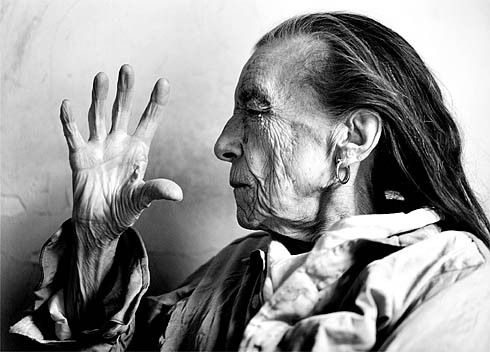
9. Louise Bourgeois (1911-2010)
Bourgeois’ artistic journey began in 1924 when she discovered that her father and her English tutor were having an affair. Her mother turned a blind eye, but Bourgeois spent the rest of her life staring the betrayal full in the face. A born and raised Parisian, she started studying art after her mother’s death in 1932 and met Fernand Leger soon after, who told her she was more of a sculptor than a painter.
After gaining some notoriety in Europe, Bourgeois moved to New York City in 1938 and hit a wall. Though she was respected among artists like Willem de Kooning, Mark Rothko and Jackson Pollock, her work wasn’t well known outside avante-garde circles. She was brutally honest in her explorations of memory, sexuality and family power dynamics, erecting monstrous spiders in sculpture gardens and immersing her viewers in scenes of violent patricide.
In 1982 the 70-year-old artist mounted her first retrospective at the Museum of Modern Art and finally told the story of her father’s infidelity to the public. She identified her body of work as the genesis of a genre called “confessional art”. Every piece in her oeuvre is autobiographical, a retelling of the trauma she’d experienced as a child and the effect it’d had on her life thereafter. By the time she died in 2010, she’d captured the imagination of a new generation of artists and scholars.
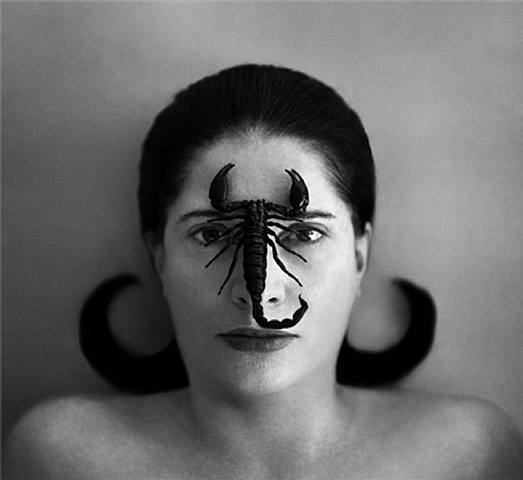
10. Marina Abramovic (born 1946)
Considering the ephemerality of Abramovic’s work, the performance artist’s rise to become one of the contemporary art world’s most notorious and polarizing figures is a remarkable story. Abramovic was born and raised in Belgrade, Serbia. Her mother kept tight control over her life through her early 20s, and she completed some of her first performance art pieces before her curfew at 10:00 pm. In her early work, she explored consciousness and the limits of the body within the context of performance art, pushing herself to exhaustion in various endurance tests.
Abramovic moved to Amsterdam in 1976, where she began a close relationship and artistic collaboration with performance artist Ulay Laysiepen. The duo continued to test their psychic limits, and also explored the idea of combining their identities into a single entity. They separated in 1988.
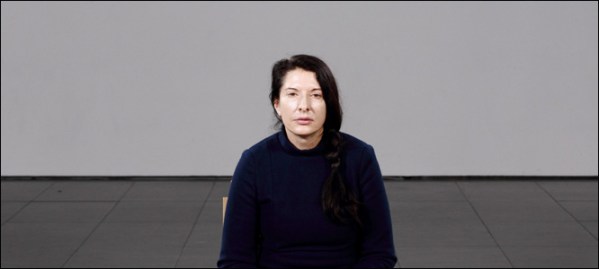
In 2005, Abramovic did a series of performances at the Guggenheim, and in 2010 she mounted a retrospective at the Museum of Modern Art. There she performed a 736-hour piece called The Artist is Presentthat was the subject of a documentary and received global attention.
Abramovic has been accused of chasing fame and creating a cult of personality. No matter her motives, the artist is a thought-provoking figure who’s impossible to ignore. She’s not a part of art history just yet, but she certainly makes a good future candidate.
Check out the first part of this blog post here, and follow us on Facebook, Twitter and Pinterest for more art news.
As the reception for Diane White’s “Magical Realism” show begins, the artist stands alone in the middle of the Matthews Gallery’s front room, her shoulders squared and her hands clasped together. She looks around at the paintings she’s created over the past year and gives a little smile, but her posture doesn’t waver. She’s ready to greet her visitors.
One of the first folks through the door is Diane’s husband Steve, who’s just taken a stroll along Canyon Road and has something clutched in his hand. He presents it to Diane and she looks down inquisitively. It’s a small grey rock in the shape of a heart.
“Oh, thank you! Oh, that’s wonderful,” she says, beaming and leaning back to rest for a minute in Steve’s arms. “He’s my man.”
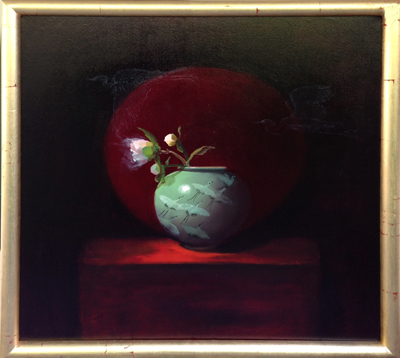
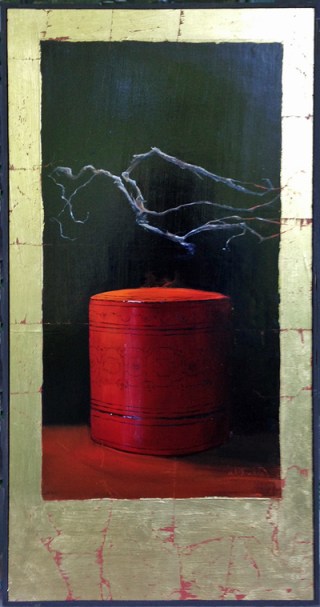
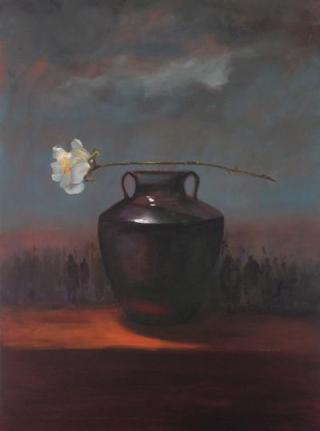
The moment reminds me of Diane’s work, which is imbued with equal measures of brave composure and romantic tenderness. The classically trained painter is inspired by magical realism, a literary genre that is rooted in the real world but incorporates magical characters and occurrences. In her impeccably detailed still lifes, glowing flowers hover above ceramic pots and ghostly birds rise from empty nests. The objects’ histories unfold around them, at first as subtle as a distant memories and then as vivid as a dreams.
With the heart rock pressed to her chest, Diane answered some questions about her new work, her process and her message:
What drew you to magical realism?
I had a traditional still life that I was working on, and I was struck with the desire to do something else with it. It was steam coming out of a teapot with a dragon on it, and I made the steam into a dragon as well. Larry and Linda went, ‘What’s that?’ And I said, ‘Well, it just happened.’ That was five or six years ago.
What were you thinking about while you were working on this show?
I don’t start with one thought process, I start with one piece that I’m painting and I focus on that. I don’t concentrate on a body of work. When you look at my work, they’re all very different. Some of them are aggressive with warriors in the background, and others have some angels. I just take it one painting at a time, and try to have them tell a story. Usually it’s an uplifting story—a lot of flight, a lot of action.
Several of the paintings show intricate nests. What inspired you to use them in your work?
I have done nests before, but probably not for three years. I have horses now at my farm in Vermont, and I was out in this area with huge pine trees where they hang out when I found a nest that was made of horse hair. It had twigs and things too, but inside I could see the hair of the different horses. I thought, “I have to paint a nest.” It was so magical for me to find that.
How do you strike a balance between the real elements in your paintings and the magical ones?
I don’t want it to hit people in the face. I don’t want it to be Salvador Dali with a melting clock. I want it to be fairly subtle, and maybe something that the person looking at the painting discovers. On second glance you say, “Well, wait a minute. That’s not just steam. There’s something in there.” You kind of get involved with the painting.
Sometimes you paint groups of figures in the backgrounds of your still lifes. Who are they?
They’re the warriors in all of us, the strength. There’s usually beauty in my paintings—perhaps a flower—and there’s strength. I don’t make it try to be pretty, but I want it to be strong. They’re warriors, and that’s what we all have in us, this strength.
Learn more about Diane White’s August 16-29 “Magical Realism” exhibition here, and check out more photos from the opening reception here. Connect with us on Facebook, Twitter and Pinterest for more art news.
Click here to read the second part of this blog post.
Let’s be honest, the art establishment has always been a boy’s club, and women are most often honored in art history for overcoming gender-related cultural and societal obstacles. It’s easy to look past the artistic innovations of female artists when we’re sorting their work into a different category from that of their male contemporaries, or focusing solely on the glass ceilings they broke.
Of course, ignoring the gargantuan efforts of female creatives to gain respect and recognition in a male dominated world is a mistake as well, as is looking at innovation as a competition between artists of different genders.
Art history is an elaborate web of influence, and analyzing any artist’s place in it is a balancing act. One thing’s for sure: many women have formed vital links in the chain. Here’s why 5 female artists deserve recognition.
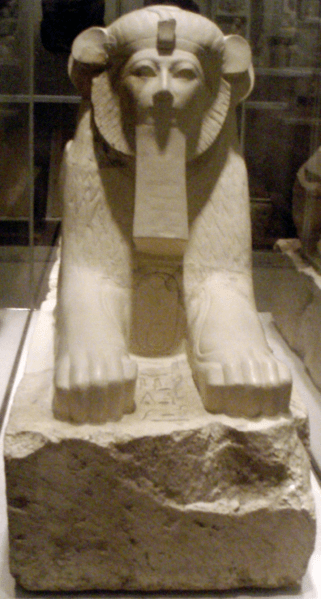
Sphinx of Hatshepsut
1. Queen Hatshepsut (1508-1458 BC)
The fifth pharaoh of Ancient Egypt’s 18th dynasty probably wasn’t an artist herself, but as one of the most successful Egyptian rulers ever, she had a huge influence on art history. In her 22-year reign Hatshepsut brought great wealth to the empire through new trade networks and expeditions, and she was very good at promoting her accomplishments through art. Her many building projects were the envy of her successors, and statuary from her reign abounds.
Statues representing Hatshepsut sometimes sport the ceremonial attire of a pharaoh (including a traditional false beard), but she’s most often depicted in the feminine clothing that she probably wore at court. As a skilled warrior, she took the lioness deity Sekhmet as a symbol of the throne.
After Hatshepsut’s death many statues of the ruler were defaced, and later pharaohs tried to take credit for her building projects, but her influence on subsequent Egyptian styles is undeniable. Work from her reign is in nearly every major museum collection, and has helped shape modern interpretations of Ancient Egyptian art.
Self portrait, Artemisia Gentileschi
2. Artemisia Gentileschi (1593-1656)
For years Italian Baroque painter Artemisia Gentileschi was mostly known for the events surrounding her rape as a teenager. She was assaulted by her private painting tutor Tassi, who said he would marry her but later reneged on the promise. Gentileschi’s father successfully sued Tassi for taking his daughter’s virginity in a publicly humiliating trial during which Gentileschi was tortured with thumbscrews and given a gynecological examination.
Soon after the court case Gentileschi married another painter and moved from Rome to Florence. It was the beginning of a stellar career, with coveted commissions from the Medici family and a spot as the first female in the Accademia delle Arti del Disegno.
Simplistic interpretations that relate Gentileschi’s work to her rape have dominated the attention of scholars, but the artist’s bold painting style and compositions make her one of the most innovative Baroque painters after Caravaggio. She took new angles on Bible stories to explore the complex emotional experiences of her subjects, and would often place a central figure in the extreme foreground to heighten the drama of her scenes and pull her viewers into the middle of the action.
Self portrait, Louise Elisabeth Vigee Le Brun
3. Louise Elisabeth Vigee Le Brun (1755-1842)
The French Neoclassical and Rococo painter was born in Paris and opened her own portrait studio in her early teens, scoring commissions from high profile nobles and rubbing elbows with masters of the day. When she lost her studio for lack of a license, she tricked the Academie de Saint Luc into showing her work and eventually gained official membership.
Vigee Le Brun is best known for her work as the portraitist of Marie Antoinette, who commissioned more than two dozen works from the artist. Her vivid, rosy depictions of the doomed queen in the Rococo style made Louise the most famous female painter of the 18th century. She’d ceded the title of royal court painter by the time of the French Revolution, but she still fled France during the conflict and took portrait commissions from nobles across Europe. However, the canvas that landed her on this list is a painting of the artist herself.
The self portrait, painted in 1787, was an image of Vigee Le Brun sporting a full, toothy grin. It was such a divergence from painting conventions thus far that it caused an uproar in the art world. “An affectation which artists, art-lovers and persons of taste have been united in condemning, and which finds no precedent among the Ancients, is that in smiling,” spewed one gossip columnist. “[Vigee Le Brun] shows her teeth.” The painting briefly made Louise’s smile as notorious as the Mona Lisa’s, and shattered a tradition that stretched back to the Greeks.
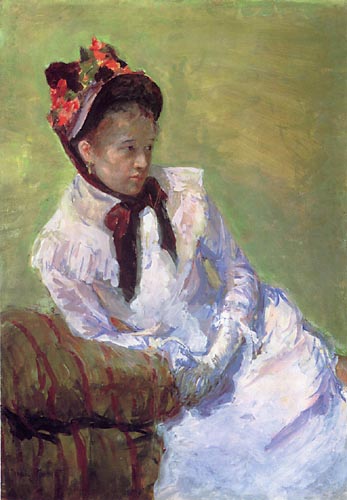
Self portrait, Mary Cassatt
4. Mary Cassatt (1844-1926)
Mary Cassatt was born in Allegheny City, Pennsylvania and attended the Pennsylvania Academy of Fine Arts, where most of the female students saw art not as a profession but as a privilege of high society. She left the Academy for Paris in 1866, frustrated with her teachers’ attitudes toward female artists and determined to study the masters on her own.
In France, Cassatt enlisted various private tutors and copied works in the Louvre to develop her skill. Impressionism was just beginning to rock the foundations of the Parisian art world, but it didn’t catch Cassatt’s fancy until after an unsuccessful stint in Chicago and a return to Paris in 1871. That’s when she met Edgar Degas, who introduced her to Impressionists and offered to show her work in one of their exhibitions.
Cassatt would become a hugely influential figure in the fledgling movement, and would later be named one of “les trois grandes dames” of Impressionism by art critic Gustave Geffroy.
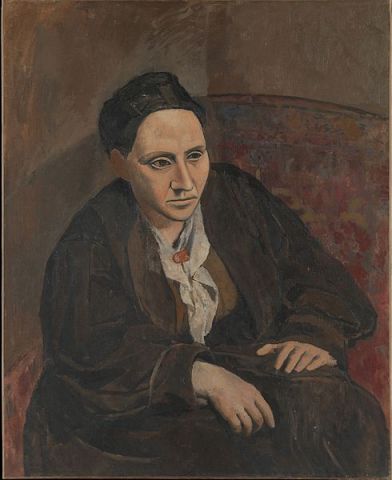
Portrait of Gertrude Stein, Pablo Picasso
Gertrude Stein (1874-1946)
“I always wanted to be historical from almost a baby on, I felt that way about it,” Gertrude Stein once declared. If anyone called into doubt the American modernist writer’s genius, Stein was the first to speak up about it.
Stein’s influence on the history of visual art is partly tied to her radical writing style, which helped define modernism and was crafted in close dialogue with the visual arts. Her significance also rests in her expansive art collection, which populated the walls of her Parisian home where influential modernists like Pablo Picasso, Henri Matisse, Ernest Hemingway and F. Scott Fitzgerald often congregated.
As the often stern den mother of the “Lost Generation” carefully curated her collection and cultivated close friendships with the artists she liked, she was shaping a radical revolution that would forever change the history of art.
Connect with us on Facebook and Twitter for more insight on the women who changed art history forever, and click here to read the second part of this blog post.
Being “cloistered in” may be key to Michelle Y Williams’ process, but that doesn’t mean she’s a recluse. Solitude is what the Houston, Texas artist needs to focus her mind and tune in to her subconscious. Her mixed media works are equally inspired by measured decisions and the pure emptiness of the blank surfaces before her. They’re conglomerations of the figurative and the abstract, and boast a subdued palette that echoes the artist’s fascination with rust, crumbling concrete and peeling paint.
When Williams isn’t in her studio, she’s not afraid to step into the spotlight. In September she’ll be featured in Luxe Magazine, and last week she granted an interview to the Matthews Gallery. Michelle told us about everything from her many materials to the Japanese aesthetic of wabi-sabi, a worldview that has taught her to accept her flaws and create with abandon. Here’s what she had to say:
Petit 28, Michelle Y Williams
You write in your artist statement, “Inspiration for my work is both selective and completely random.” Is the same true for your choice of materials for a particular piece? How do you select a medium?
The primary medium in my work is acrylic (very quickly after I began as a painter using oils, I realized I have an aversion to cleaning brushes). Pigmented inks have also proven to be an often used medium for me (applied with a dropper, then floated across the canvas using my palette knife).
The choice for other materials, indeed, comes more randomly. Whether I incorporate sand or oil bar or even attaching a piece of torched metal with wax string to the canvas happens naturally & intuitively as the work progresses.
You also talk about a “relationship that develops” between you and your work. Does this change your notion of when a work is completed? Is it sad to say goodbye?
I suppose it’s more of a short-term relationship…shall we call it a fling. I invest energy into a piece which is then reciprocated upon completion, but the real gratification comes when someone has made a connection with my work, which couldn’t happen unless I surrendered it readily.
Cut 12-532, Michelle Y Williams
You prefer to work in solitude. What are some other important parts of your process? Do you listen to music? Do you work on multiple pieces at a time, or just one?
My preference for sequestration is actually paramount – in order to maintain the integrity and authenticity of my work, I eliminate most outside influences that could dull my own creative process. Diverse genres of music can be heard in my studio – from acid jazz to classic rock to classical – while I move between several pieces in various stages of completion.
You mention the importance of seeking a balance in your work. How does that connect with the tenets of wabi-sabi, the Japanese aesthetic that embraces the transient self?
Rather than trying to exert control over a painting, my pursuit of aesthetic balance, (while maintaining my penchant for asymmetry), transpires more instinctively. The absence of obsessing over that quest for balance and the capacity to “let go”, relates to the principles of wabi-sabi.
Petit 18, Michelle Y Williams
I found this part of your bio particularly beautiful: “In a stain, we find understanding; in a dent, our ability to heal; in a blemish, an unchained beauty.” Embracing your flaws can be a difficult process. How does your work help you do this?
Quite simply, the alternative to embracing flaws requires far too much negative energy. For me, perfection is boring and I truly find immense beauty in flaws – chips & cracks in tea bowls used in Japanese tea ceremonies or uncut & unpolished rough just-mined diamonds – these things excite and inspire me.
I hear you’re quite the humanitarian. What projects are you involved with?
I am an “equal opportunity donator”, giving my work with abandon to many different charitable organizations throughout the year.
Hannah Holliday Stewart (1924 – 2010) had her sculpture exhibited in over 40 venues including The Smithsonian, Washington, DC; the San Francisco Museum of Art; the High Museum of Art, Atlanta, Georgia; the Dallas Museum of Fine Arts and others. Her work and her career were instrumental to the increased recognition of women sculptors in the United States. The International Sculpture magazine wrote :
“(She) forged the way for serious women sculptors. Uniting Greek mythology and contemporary energy concepts … (her) work fuses both primitive and futuristic sensibilities.”
At a time when the art world marginalized women artists, she chose to create her own world from metal and stone and helped lead the way for a generation of women sculptors. Though she had achieved a high level of success and recognition, she eventually turned her back on the art establishment and continued to work in isolation for the last twenty years of her life. After her death in 2010, sculptures, consisting of work that spanned her entire career, were discovered in her studio – from pieces that are only a few inches tall to one bronze that is over nine feet.
A written statement discovered in one of her notebooks eloquently records her own thoughts on the origins and principles underlying her art work:
When I was eight years old, I asked my mother what the wind really looked like. I remember spending hours … days … sitting with my hands open wide or running with my lightning-bug jar, hoping to catch the wind. I wanted to SEE the wind, that magical force that could bend the huge oak tree in a summer storm, gently caress me on a hot summer day or sing to me as it played through a tree or around the house.
This early interest in natural forces has sustained me throughout my life as a sculptor. My goal is to render visible the hidden realities of pent-up contained energy. The direct fields of reference are Sacred Geometry, Astronomy, Myth & Physics … Each Sculpture is an energy form, the movement arrested in space, a form sustaining an energy. My work is a response to these patterns and delineations and communicates with viewers through the universality of symbolism and form.
The Matthews Gallery is pleased to show this pioneering artist and reacquaint the world with her work. If you would like to learn more about Hannah Holliday Stewart, we have created a website dedicated to her life and work which includes a 163 page online catalog of her work. Click Here to visit the site.












 MATTHEWS GALLERY BLOG