THE STORYTELLER: From petroglyphs to pinewood

Roch Hart- Fine Furniture- Matthews Gallery

 Roch Hart with his pie safe “The Storytellers”

“Furniture is art,” says Roch Hart. It’s a credo the Albuquerque fine furniture maker repeats every time he brings a new creation to the gallery. In Hart’s case, it’s true: each hand-carved piece of sugar pine is as unique as a painting on our wall. This is nothing you’d find at IKEA.

Check out our blog post chronicling Roch’s journey from Spanish Colonial furniture enthusiast to bona fide sculptor, and then delight in the details of his latest creation. This pie safe, dubbed “The Storytellers“, holds quite a few tales…

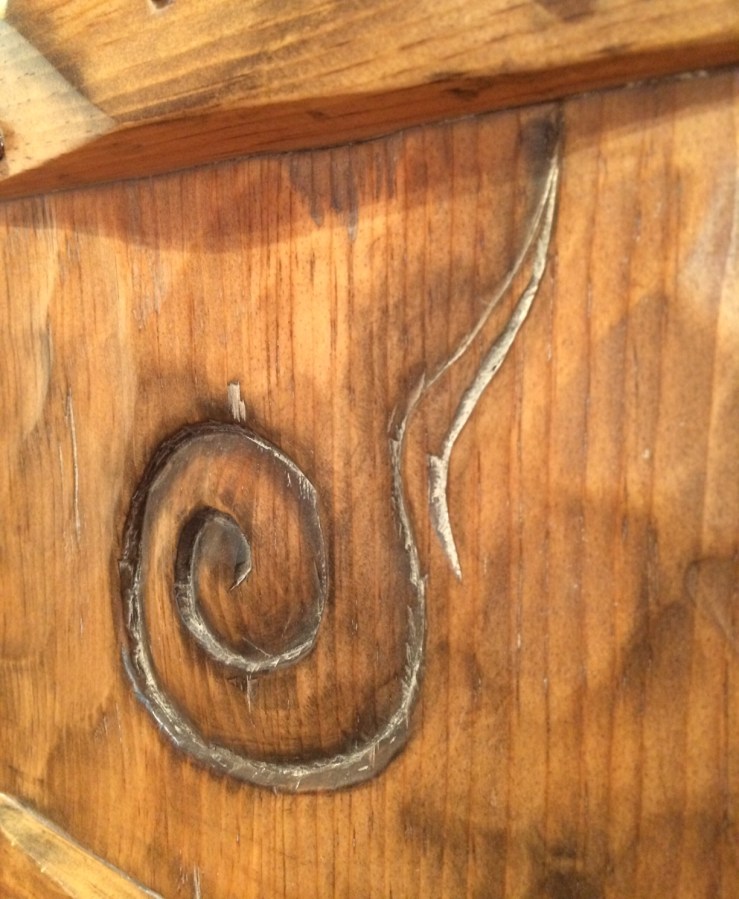
SPIRAL
Roch Hart- Fine Furniture Detail- Matthews Gallery

Hart often draws inspiration from New Mexico petroglyphs.

“A spiral can mean a lot of different things depending on its context, but here it represents eternity or travel,” Hart says. In particular, this symbol refers to a journey from the depths of the earth.

FACES

Roch Hart- Fine Furniture Detail- Matthews Gallery

These symbols on the sides of the pie safe tend to appear together in glyphs. The one on the left with its mouth shut tight is the “listener”, and the one on the right is the “storyteller”. It’s the yin-yang of cultures that depend on the voice to pass down vital knowledge.

The designs surrounding the faces also have an important meaning. Just like the Zia on the New Mexico state flag, they represent the sacred, pervasive number four: four compass directions, four seasons, four stages of a person’s life.

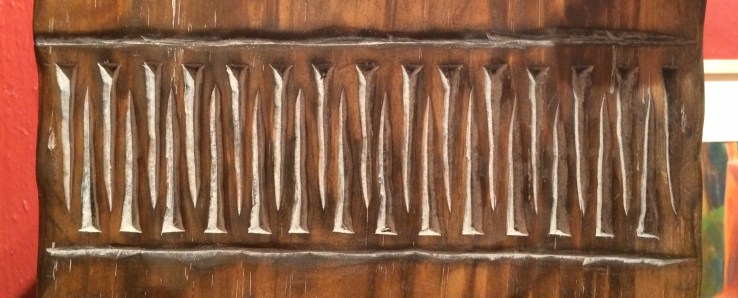
PATTERNS
Roch Hart- Fine Furniture Detail- Matthews Gallery

“This is mimicking the Navajo rugs,” explains Hart. “I thought it would be a great border for the faces.”

Hart uses white ash to make his patterns bolder, rubbing it into the cracks by hand atop a layer of shellac. The finishing touch is a light coat of wax.

JOINTS

Roch Hart- Fine Furniture Detail- Matthews Gallery

Near the beginning of his journey to furniture mastery, Hart visited the Nicolai Fechin House in Taos. Fechin was a Russian painter and carpenter who moved to New Mexico in 1923 and purchased a small adobe home that he would greatly expand over the years. The home is now a museum, and when Hart visited to study the furniture he had a chance encounter with Fechin’s daughter Eya. She taught him about the different joints that her father used, including the sliding dovetail joint pictured here.

“That changed my life,” Hart says.  “I looked at [Fechin’s work] and said, ‘I can do anything. Nobody told him what to do.'”

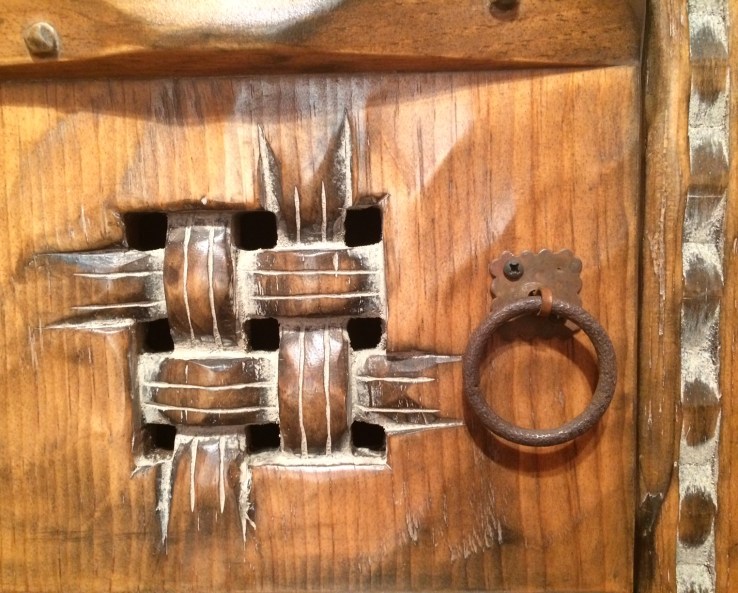
WINDOW
Roch Hart- Fine Furniture Detail- Matthews Gallery

The grid Hart uses as a window for the pie safe doesn’t have an age-old legend behind it. It’s one of Hart’s signature designs that appears in many different manifestations in his work. Myriad influences come together in Hart’s exquisite furniture, but each piece is imbued with his unique sensibility.

See more of Roch’s creations on his artist page, and connect with us on Facebook, Twitter and Instagram for daily gallery updates. Also, check out our upcoming exhibition FOUR CENTURIES: European Art from 1600 to 1950, opening June 13!
MEMORY IN BLUE: Jan van Leeuwen

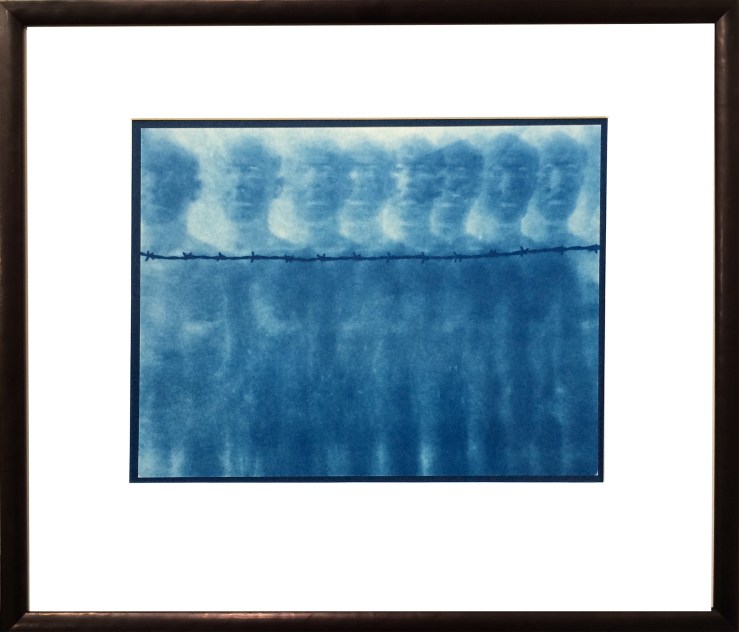
Jan van Leeuwen- Barbed Wire Number 1- Matthews Gallery Blog

Jan van Leeuwen, Barbed Wire No. 1 (Cyanotype), Matthews Gallery

What color is memory? Is the human soul tinted by life’s great joys and sorrows?

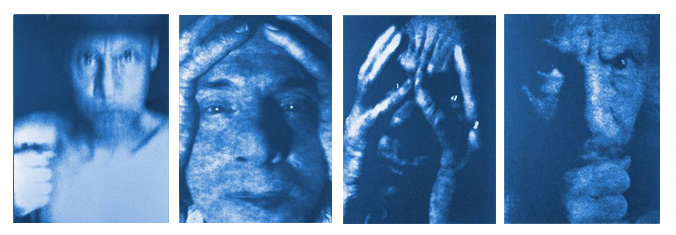
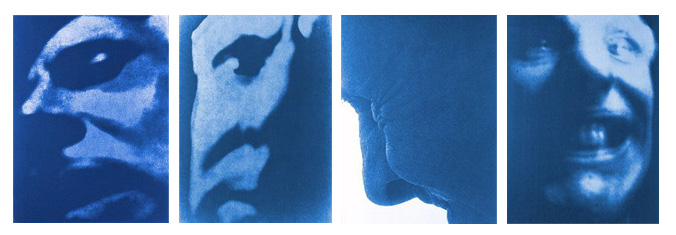
Jan van Leeuwen‘s darkest recollections are a deep blue tide. His self-portraits take shape much like memories do. It’s a long process with details fading in and out of focus, projecting visions of the self that never feel quite complete. It took a lifetime for the photographer to discover his medium, but when he did the images came spilling out.

Jan van Leeuwen- Cyanotype Portraits- Matthews Gallery Blog

Leeuwen was born in Amsterdam in 1932. In 1940, when the artist was 8 years old, the Dutch surrendered to the Nazis and Leeuwen watched as his community fell apart. Jewish neighbors and schoolmates fled or were taken. Over the course of the four-year occupation, the young boy’s confusion turned to anger, frustration and guilt.

Leeuwen’s first career was as a kitchen wares distributor, and he learned how to work a camera by photographing the products. He took his first serious stab at the medium in 1986 when he was in his 50’s, mostly so he’d have something to do when he retired.

Jan Van Leeuwen- Cyanotype Portraits- Matthews Gallery Blog

Drawing inspiration from the innovative spirit of the Dutch Renaissance masters, Leeuwen developed his own method of producing photographs. He uses a 100-year-old wood camera to capture an image on resin-coated paper, creates a negative and then makes a contact print using a UV-B lightbox.

The process of capturing and transferring the images echoes the artist’s struggles with the trauma he experienced in his youth and the impact it has had on his identity. For the cyanotype in our collection, the artist used a long exposure to fracture himself into eight meshed figures. The only thing starker than their furrowed brows is the strand of barbed wire that stands in their way.

Jan Van Leeuwen- Cyanotype Portraits- Matthews Gallery Blog

Leeuwen created Barbed Wire No. 1 in 1993. A year later he quit his job to pursue photography full-time. Since then he’s had a stellar contemporary art career, with shows across the world and artwork in The Photo Review, Art in America and many other publications.

The artist’s success hasn’t dampened the intimacy of his self-portraits, or lightened the burden of his memories. However, Leeuwen reminds us that sadness is accompanied by beauty, and creation always surmounts the pain of destruction.

Learn more about Jan van Leeuwen’s art and life on the Matthews Gallery homepage, and connect with us on Facebook, Twitter and Pinterest for more gallery news.