The Boundless Moment: Words and Images

Eric Thompson- The Photographer- Matthews Gallery blog

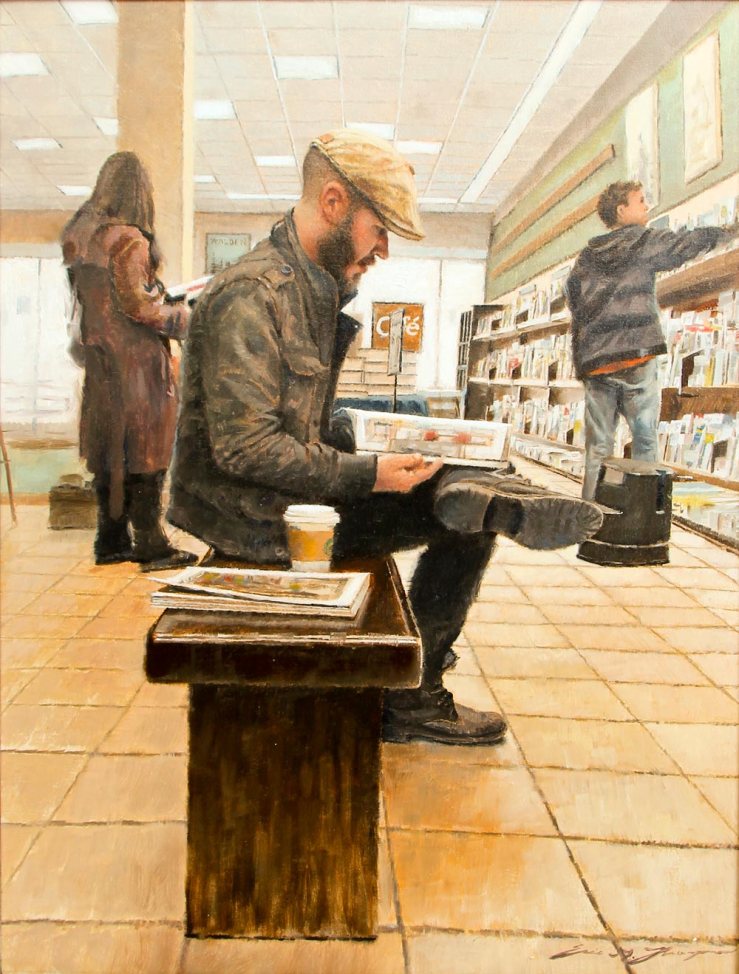
 Eric G. Thompson, The Photographer, Oil on Linen

For the past week, excited art pilgrims—determined to visit every gallery on Canyon Road—have marched purposefully into our front room and come to a screeching halt. Our Eric G. Thompson show ‘The Boundless Moment‘ is a little different from most of the exhibitions you’ll see on this famous art route. Accompanying many of Thompson’s serene realist paintings are writings by great American poets, from Elizabeth Bishop to Walt Whitman.

The interplay of words and images has compelled viewers to slow down and look twice, sparking many a fascinating observation. Most notably, journalist Alison Oatman of the Weekly Alibi attended our opening and wrote an elegant, poetry-filled review of the show.

Eric G. Thompson- Coffee Shop Girl- Matthews Gallery blog

Eric G. Thompson, Coffee Shop Girl, Oil on Panel

An excerpt from Oatman’s article:

Robert Lowell’s “Epilogue” [is] paired with the painting “Coffee Shop Girl.” Lowell writes: “I hear the noise of my own voice:/ The painter’s vision is not a lens,/ it trembles to caress the light” [emphasis original]. These lines are reflected in the Coffee Shop Girl’s illuminated face—as pale as rice paper.

Later on, the poem continues: “Pray for the grace of accuracy/ Vermeer gave to the sun’s illumination/ stealing like the tide across a map/ to his girl solid with yearning.” Though large sunglasses hide her face and her meager mouth is expressionless, the Coffee Shop Girl is ravenous. We see her frayed emotional state in the feathery brushstrokes in the background, the squirming reddish-brown tendrils of her ponytail, and the sparkling clusters of dandelion-like fur attached to the hood of her puffy coat.

We spoke with Thompson on the phone today to fill him in on the big response his show has received. The artist was in Santa Fe last week for the opening reception, but now he’s back home in Salt Lake City, Utah. The long drive home gave him time to gather some thoughts on the exhibition. Read our interview below, and make sure to come see ‘The Boundless Moment‘ before it closes on August 28!

Eric G. Thompson- Half Light- Matthews Gallery blogEric G. Thompson, Half Light, Oil on Canvas

Describe your studio. 

My studio is just a few feet away from my house. It has windows with good natural light, so sometimes I can turn off the light and still get what I need. Sometimes I’ll set up my daughter‘s easel next to mine, and we’ll work next to each other. She gets to see what her dad does. Most of the time the kids aren’t allowed in the studio, though. I’ll play underground folk music, and when I’m really inspired it feels like the music is flowing straight through my brush.

You work in oil, egg tempera and watercolor. How do you choose which medium to use for a new painting? 

Between the three of them, if I want to capture something a little more loose and light I go for watercolor. If I want to capture something very solid, heavy and thick I’ll go with oil. If I want to capture something a little more photorealistic, I go with egg tempera. It gives you a lot of freedom to express the story or the emotion that you’re trying to convey with each medium.

It can be refreshing, but it can also be almost maddening. They’re all so different, it’s unbelievable. You have to switch your brain around and remember how to use that medium. It can be completely challenging, which I love. That’s one of the greatest thing about painting, is the challenge. I can always let a painting go as long as I have another challenge.
Eric G. Thompson- Nestled- Matthews Gallery

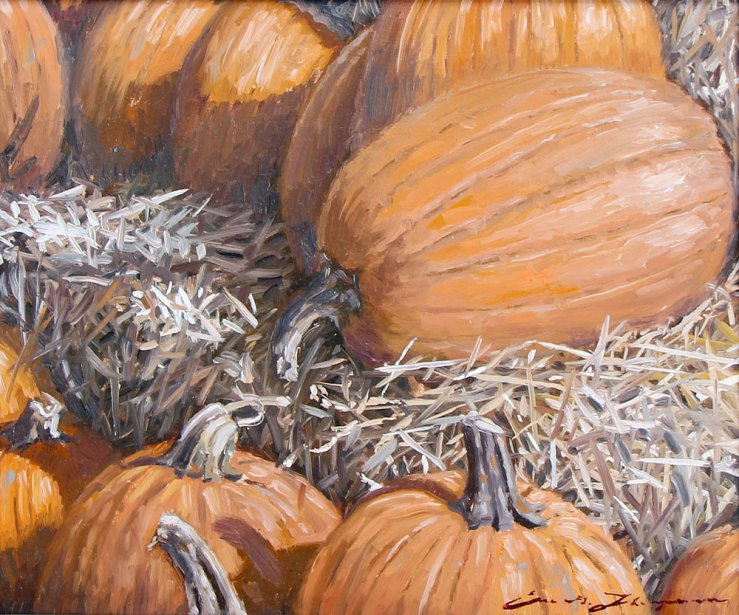
Eric G. Thompson, Nestled, Oil on Panel

Alison Oatman’s review in The Alibi begins with, “One question contemporary realist painters often get is, ‘Why not simply take a photograph?'” Over the course of the article, she critiques that particular line of thought. What’s your answer to that question? 

To a lot of artists, it’s not a great compliment when a viewer says, “That looks just like a photograph.” Maybe to a photorealist that would be flattering, but I think the greatest artists of all time have that balance of, it looks like a painting but it looks so ‘real.’ I’ve made it come to life.

Why does someone need a painting to look just like a photograph? What’s the power in that? Technically it’s amazing, but where’s the artistic freedom? I need artistic license to change things and blur edges and sharpen edges and change value to make it more ethereal.

I can make a painting look like a photograph but then there’s no energy, there’s no life to it. I think just adding a little more energy with brushstrokes or texture brings it more to life.

One of your influences is the Japanese aesthetic of wabi-sabi. How would you describe it? 

It’s what an object has been through, who used it, who touched it. It’s the patina objects acquire over time, like the rust on an oil can. It just adds to the whole character of the object—I see them as little characters. A cup on a windowsill, an oil can or even pumpkins can have little lives of their own.

Your works seem still at first glance, but a longer look gives me a sense of ‘unfolding,’ of motion. Is that one of our goals?  

It’s about capturing a moment in time that I’d like to freeze and experience for longer than the experienced moments.

I’ve definitely been experimenting with looser brushstrokes toward the outer edges of the painting to give it some energy. I need to experiment to see if I can get the perfect balance of detail and looseness. It’s a way of pushing myself as an artist, and it’s been one of the hardest things I’ve ever attempted.
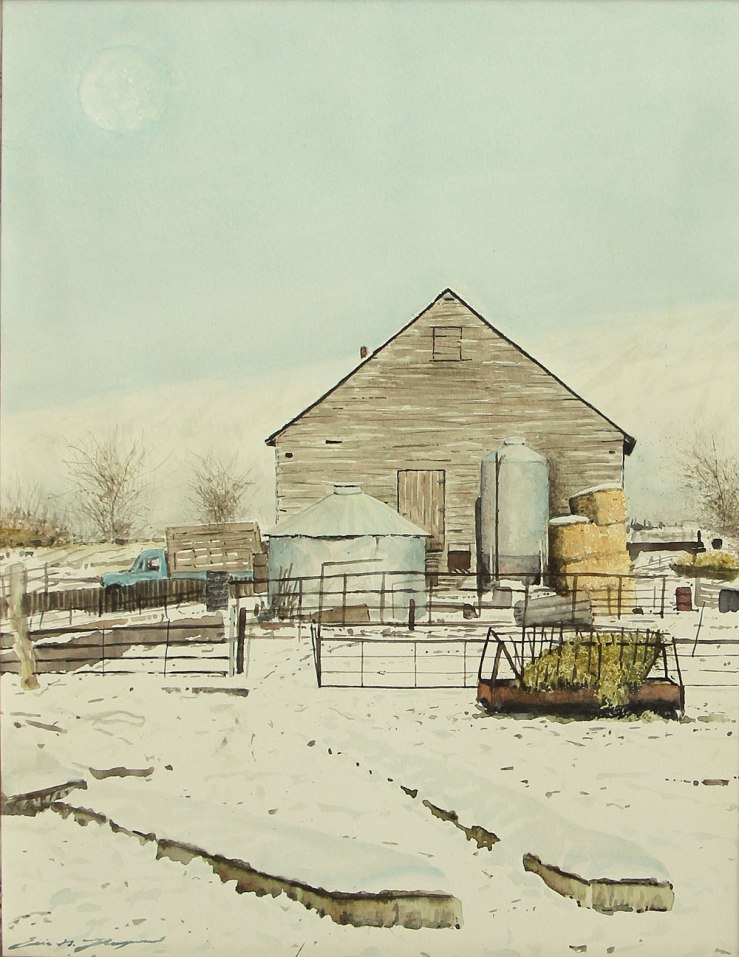
Eric G. Thompson- Winter Moon- Matthews Gallery blogEric G. Thompson, Winter Moon, Watercolor

Which paintings in ‘The Boundless Moment’ are closest to your heart? 

A few of the watercolors are very powerful to me in an emotional way. Just reminding me of something in my past, at my Grandma’s house in Idaho. She had a farm with all of these different structures. They just remind me of that time, and different feelings come up from my childhood.

Raven’s Hair is a very powerful piece. It’s capturing this emotion of a woman laying on this bed. Her eyes are closed and she’s having a very pleasant thought. It seems to have some nice emotion to it.”

Morning Cup is a portrait of your wife Hilary, and inspired her to write a poem that we’re featuring in the show. Do you often inspire each other like that? 

 We’ve named my paintings every year for 12 years or more. We try to outdo each other with the most poetic titles. The title can say so much in just a couple words. What’s the best title, or the strongest? Hilary is amazing with words.

To learn more about Thompson’s show, connect with us on Twitter, Facebook and Pinterest.
HANNAH HOLLIDAY STEWART: Cosmic Mysteries

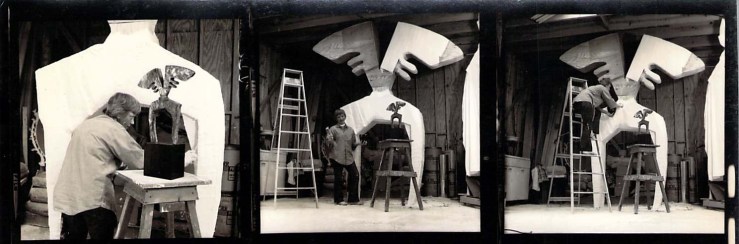
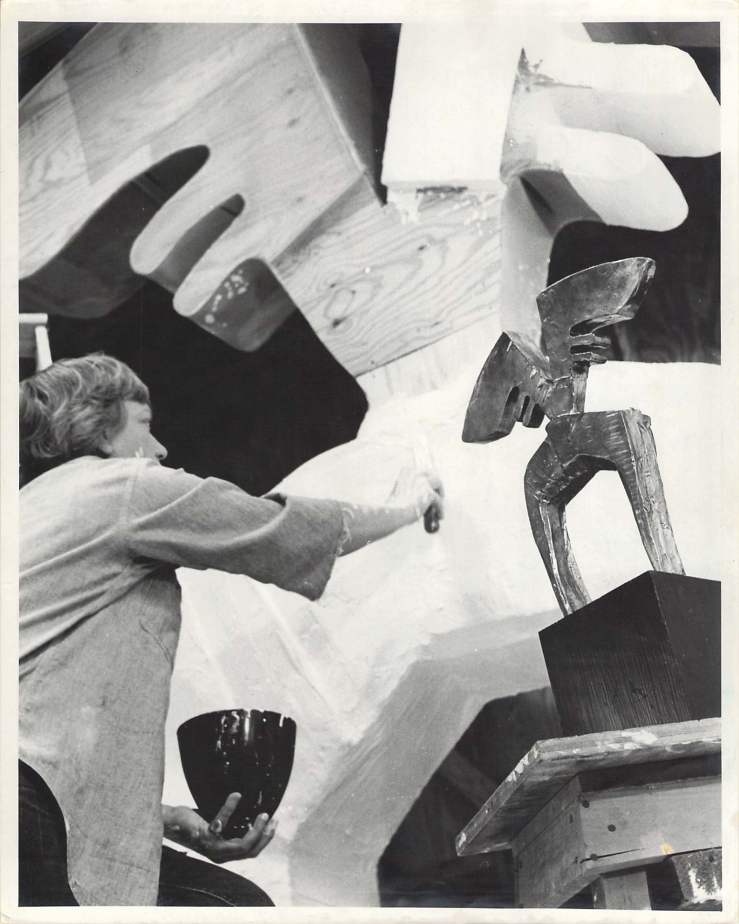
Hannah Holliday Stewart in her studio- Matthews Gallery

It’s not a stretch to call Hannah Holliday Stewart‘s (1924-2010) sculptures cosmic. In the artist’s heyday, the bronze forms that emerged from her Houston studio were often over 10 feet tall and thousands of pounds. She aspired to create physical manifestations of complex ideas in science, mythology and other fields, a system of “pure [abstract] symbols as constant as numbers and letters of the alphabet,” as Paul Klee said in one of Stewart’s favorite quotes. The themes she explored were so vast that Stewart’s work was at times cosmically misunderstood.

In preparation for our posthumous solo exhibition of Stewart’s work this July, we’ve been digging through the sculptor’s carefully organized personal files. One folder marked “Press” holds a 1994 newspaper article from Stewart’s childhood home of Birmingham. By that time Stewart had lived far away from Alabama for a lifetime, building a reputation in Texas and the Desert Southwest as one of the first female sculptors to win competitive public art commissions. “Ms. Stewart talks of such abstract notions as harmony and energy and spiritual awakening,” puzzled the Birmingham Post-Herald reporter. Throughout the rest of the article Stewart scratched out or rewrote swaths of the writer’s analysis in black ink, clarifying concepts and modifying terms. “[I] always go back to classical order and laws,” she scribbled at the bottom.

Hannah Holliday Stewart- Artist Process 1- Matthews Gallery

Stewart was born in 1924 in Marion, Alabama. She studied art in Alabama and Georgia for her BFA, and completed her MFA at Cranbrook Academy of Art in Michigan. After working at foundries in Florida and Mexico, she landed a teaching job at the Museum of Fine Arts in Houston and later at the University of Houston.

By the 1960s Stewart’s work had grown to a monumental scale, and a passionate group of Texas art enthusiasts rose to support it. In an era when female sculptors had to fight for recognition, Stewart’s bronze monoliths were popping up all over Houston—and beyond. In 1962 a swooping, Brancusi-esque bird form called “Libertad” appeared in the courtyard of Houston’s World Trade Center, and in 1972 an 11-foot-tall sculpture titled “Atropos Key” landed on a hill in Hermann Park. A commission for a monumental work in Dallas’ Samuels Park spread her name across the state.

“I found myself devoted to her work very early, I think,” says Dayton Smith, who befriended Stewart around 1969 when he was working for a Houston photography studio. “I realized the significance of it, the weight of it, shall we say.” Over the next few years Smith helped Stewart in various ways, photographing her artwork, transporting sculptures, and organizing a 1973 solo exhibition at Houston’s Jamison Gallery on Hermann Park.

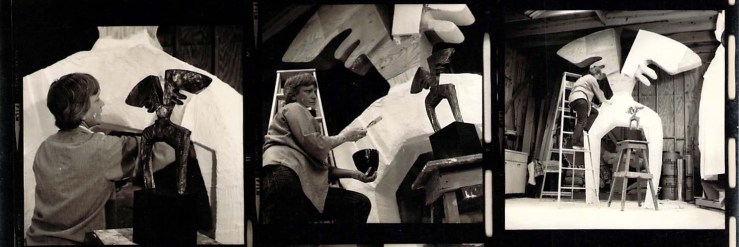
Hannah Holliday Stewart- Artist Process 2- Matthews Gallery

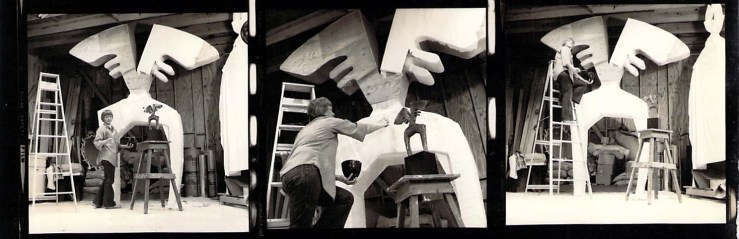
“As I got to know her, I became aware that she was a very literate person, very intelligent,” says Smith. “Her work really did relate to what she encountered in her learning.” Smith noted that Stewart explored many fields of knowledge, from science and architecture to music and mythology, allowing concepts in each field to influence her three-dimensional objects. In 1975 and 1976 she mounted her first major solo show at the Houston Contemporary Arts Museum, exhibiting a series of large plaster models (including “Adam’s Rib“, from the photographs in this blog post) that were based on smaller bronze maquettes. But even as Stewart’s legend grew, Smith says misconceptions about her work persisted.

“The word spiritual often comes to mind, but spiritual is such a misunderstood term in our society,” explains Smith. “If you look at the word itself, the Latin root of it is ‘spiritus’. That means ‘wind.’ We can see the wind when it carries things, when it moves things.” Stewart worked to bring the invisible—a musical note, kinetic energy or a wisp of air—into the physical world.

Hannah Holliday Stewart- Artist Process 3- Matthews Gallery

More mysterious still to many of Stewart’s friends in Houston was her abrupt disappearance from the art world. Smith last saw Stewart in the late 1980s, when she was teaching at St. Thomas University and exhibiting in an impressive array of art institutions across the country. A few years later Stewart packed up and moved away from Houston, settling in Arizona, Alabama and then Albuquerque, New Mexico. She never exhibited her artwork publicly again. Why would a woman who once showed at the Smithsonian Institution, the Getty Museum and prominent galleries in New York, New Orleans and many other cities suddenly leave it all behind?

Smith has a few hunches. Stewart often said that she was inspired by the Desert Southwest, and sent Smith an image of her working in her new studio in Flagstaff. The move to Birmingham probably had to do with the declining health of Stewart’s brother and two sisters, who lived in the area. When it came to her art career, Smith thinks Stewart may have needed room to spread her wings and find new inspiration.

“Once we were talking about something she’d observed,” recalls Smith. “That sometimes to make it in your own town you have to leave and come back with something big. That people could get too used to you, but that perhaps you could come back and be accepted. Maybe she was planning that.”

Follow our blog in the coming weeks as we unravel the mysteries of Hannah Holliday Stewart’s life and artwork, and make sure to attend the opening of HANNAH HOLLIDAY STEWART: An Artistic Legacy Rediscovered on July 4 from 5-7 pm.  Also pick up the July/August issue of American Fine Art Magazine to read more about the show, and follow our investigations on Facebook, Twitter and Instagram.

FAMILIAR STRANGERS: Be a Voyeur, Detective, Surrealist, Humanist!

Found Photograph- Familiar Strangers Show- Matthews Gallery

  Untitled, Unknown

“A photograph is usually looked at—seldom looked into,” said Ansel Adams. When it comes to the pictures in our upcoming show, there’s no other option but to dig a little deeper.

FAMILIAR STRANGERS: Vernacular Photography, opening Friday, May 16, is not your typical Matthews Gallery show. The artists who created our collection of found photographs never got the recognition that Picasso, Toulouse-Lautrec or Renoir did, but there’s no denying their aesthetic sensibilities.

That’s what has kept us digging through estate sales, thrift shops, antique stores and attics for years. We’ve amassed quite the collection of vernacular photographs, also known as “found” or “orphan” photos, and we’re not alone in our scavenging habits. Our friends on social media understand the great allure of the hunt.

Looking at so many old and found photographs I often think that, ‘I’ve seen things you people wouldn’t believe,'” writes Paul Jackson, who maintains the Flickr group Found Photographs.  “The person behind the camera has seen these things, lived that life..you know, we can sometimes almost taste it.” We asked several other photo finders what they love about the pursuit, and they all had equally passionate answers.

Vernacular photography presents unique challenges to the viewer, asking us to shift between different roles to grasp what we’re seeing. Our first impulse is often voyeuristic. We can’t resist a peek at someone’s intimate moment, and we swiftly draw conclusions about what’s going on. In the image above a baton girl gawks open-mouthed at a band boy, but he looks resolutely away. Is this a tale of unrequited love?

Society often slaps us on the wrist for our voyeuristic tendencies. In his brilliant essay on found photography Dr. Barry Mauer of the University of Central Florida says this instinct is something we should indulge.

“At first sight, most of these pictures are hilarious or tragic or both,” writes Mauer. “Voyeurism allows me to experience these reactions from a comfortable distance.” However, Mauer cautions against stopping there. Voyeurism often comes hand-in-hand with judgment and categorization. Stereotyping these mysterious individuals cuts us off from a rich world of visual mysteries. Time to pull out the magnifying glass.

Found Photograph- Familiar Strangers Show- Matthews Gallery


Untitled, Unknown

If we act as detectives, this simple portrait holds a lot of hints about the bicyclist and her photographer. Did you notice the bandages on her knee and arm? If those are recent wounds, perhaps she’s just learning how to ride. It’s difficult to tie a forearm bandage on your own. Maybe the person behind the camera is her teacher and medic? On the other hand, the bags on the handlebars hint at a different adventure. One of them looks like a canteen. Could the other hold snacks for a picnic?

Teasing out these details is invigorating. To take it one step further, note the composition of the photograph. The front wheel is cut off and part of the path is visible behind the girl. This perspective, when combined with the subject’s bent posture and excited face, lends the photo a sense of forward movement. Our mysterious photographer has imbued a picture of a static bike with surprising dynamism. Was that his or her intention?

Found Photograph- Familiar Strangers Show- Matthews Gallery

Untitled, Unknown

Of course, in the end we’ll probably never know if our inferences are correct. Who better to help us surmount our fear of the unknown than the surrealists? André Breton and his friends were inspired rather than daunted by impenetrable mysteries. They sought out fragments of culture, watching films from between their fingers to try to catch discreet details and writing stories based on dreams they had about real experiences.

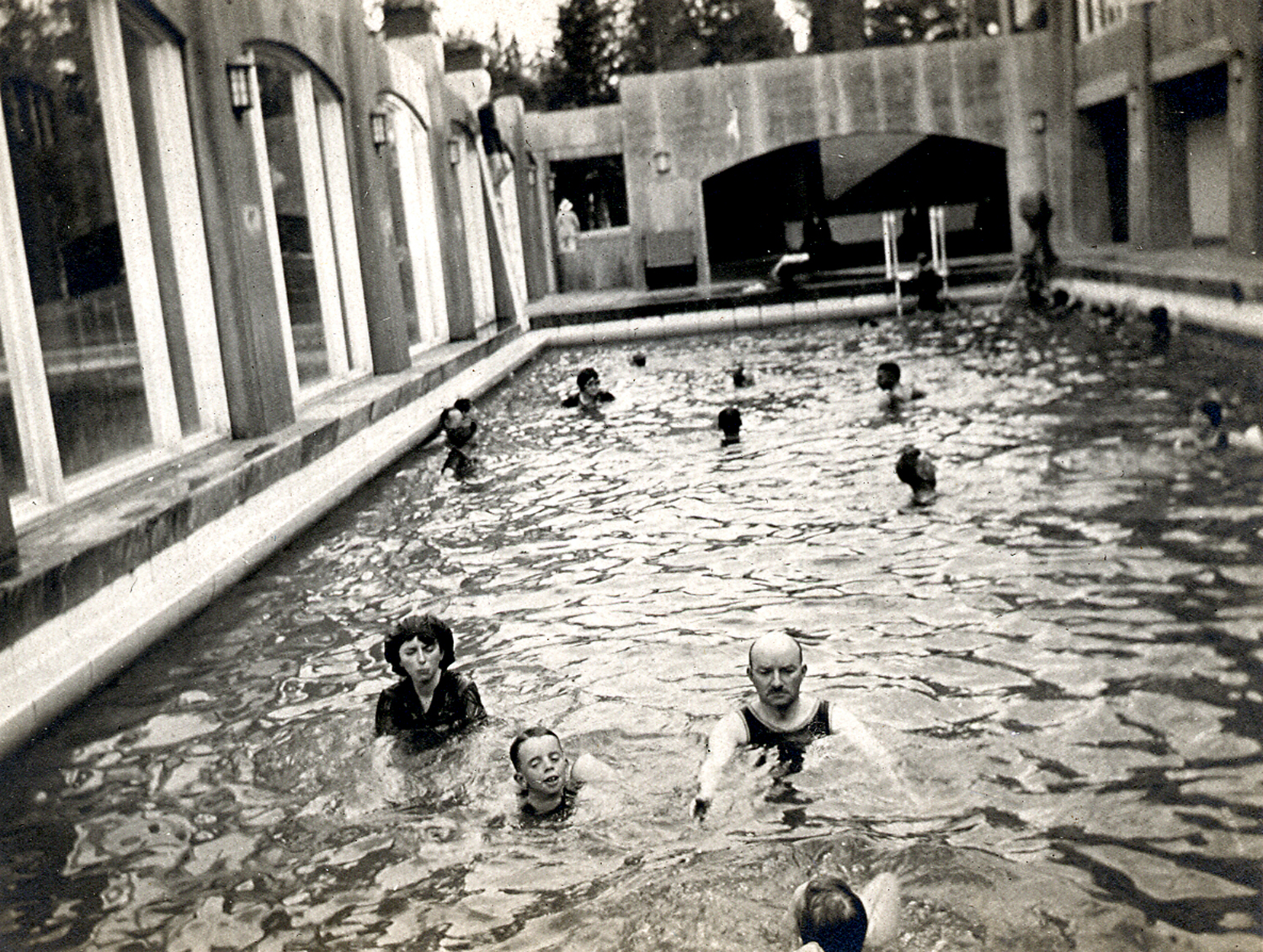
Both techniques allowed them to focus on details they otherwise would’ve ignored. In the photo above, our interest in the group in the foreground distracts from the odd figure standing in the far background. Cropping the photo brings up a whole array of new questions.

Found Photograph Detail- Familiar Strangers Show- Matthews Gallery

Detail of previous photo

In a broader context the entire photo is a fragment. The man in the foreground’s stern expression stands alone, isolated from what happened before or after. Perhaps he cracked a smile a moment later, but this short glimpse of his day at the pool has a foreboding air to it.

“The surrealists used fragmentation as a means to knowledge, discovering significance in the fragment that had been concealed in the contextualized whole,” Mauer writes. It’s not hard to trace the progression of this thinking to Marcel Duchamp’s use of found objects, or to the Dada artists’ repurposing of vernacular photos in collages (more on all of that in an upcoming blog post).

In the end analyzing and relating to the “characters” in these photographs helps develop our skills in another field: humanism. It’s amazing how connected we can feel to a person we’ll never meet, and how powerful our feelings of empathy and sympathy can be when we exercise them. Look long enough, and you’ll start to imagine that these familiar strangers are looking right back.

Step into the shoes of a voyeur, detective, surrealist and humanist at FAMILIAR STRANGERS: Vernacular Photography, opening Friday, May 16. Also, make sure to check out our fascinating interview with four found photography collectors and connect with us on Facebook, Twitter and Tumblr for more gallery news!

NEW RELEASE: Fremont Ellis of Los Cinco Pintores

Fremont Ellis- La Plata Mountains- Matthews Gallery Blog


In 1921, Fremont F. Ellis and his friends Jozef Bakos, Walter Mruk, Willard Nash and Will Shuster founded an avant garde art society that would change Santa Fe forever. The five men were in their early 20s, and most of them had recently migrated there from the East Coast. They chose a name inspired by their new life in the Southwest: Los Cinco Pintores (The Five Painters).

In December of that year, Los Cinco Pintores mounted their first group exhibition at Santa Fe’s Museum of Fine Arts. Their work was diverse in subject matter, but their rallying point was modernism and the art of early Taos painters Robert Henri and John Sloan of the Ashcan School.

“These men believe in color and are not afraid to use it,” wrote a critic who attended the inaugural show. “Upon entering the galleries, visitors are greeted with a great shout of color that’s almost stimulating.”

Fremont Ellis - Watercolors - Matthews Gallery Blog

Over the next few years, Los Cinco Pintores worked together to build a row of casitas along Camino del Monte Sol near Canyon Road. This earned them another nickname, “The Five Nuts in the Adobe Huts”. Meanwhile, word of their exploits had reached other artists back home.

By 1923 another group called the New Mexico Painters was exhibiting paintings of sweeping Southwestern landscapes across the Midwest and the East Coast. Artists like Randall Davey, Andrew Dasburg and Theodore Van Soelen settled in the area, and the Santa Fe Art Colony was born. The City Different has fostered a vibrant art community ever since.

Fremont Ellis- Watercolor Diptychs- Matthews Gallery Blog

These newly released works on paper are by Fremont Ellis (1897-1985), who was the last surviving member of Los Cinco Pintores. Ellis grew up in Montana and was inspired to become an artist at 14 when he saw Albert Bierstadt’s paintings on a trip to New York City. He worked as a photographer in California before settling in Santa Fe, and used his photographs of landscapes to inspire his painted compositions. This body of work holds the vigor and immediacy of the artist’s many outdoor adventures.

Learn more about Fremont Ellis on our website, and connect with us on Facebook, Twitter and Tumblr for daily gallery news. Also, don’t forget to mark your calendar for our exhibition NEW MEXICO MODERNS: The Lumpkins Files, opening next week!