Hannah Holliday Stewart: Letter from Houston

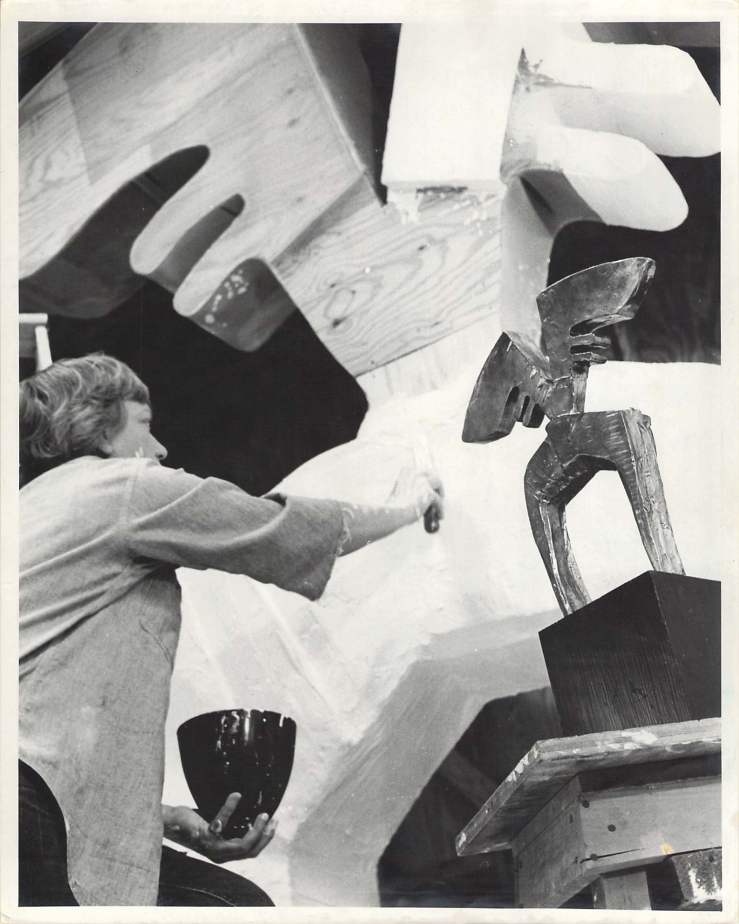
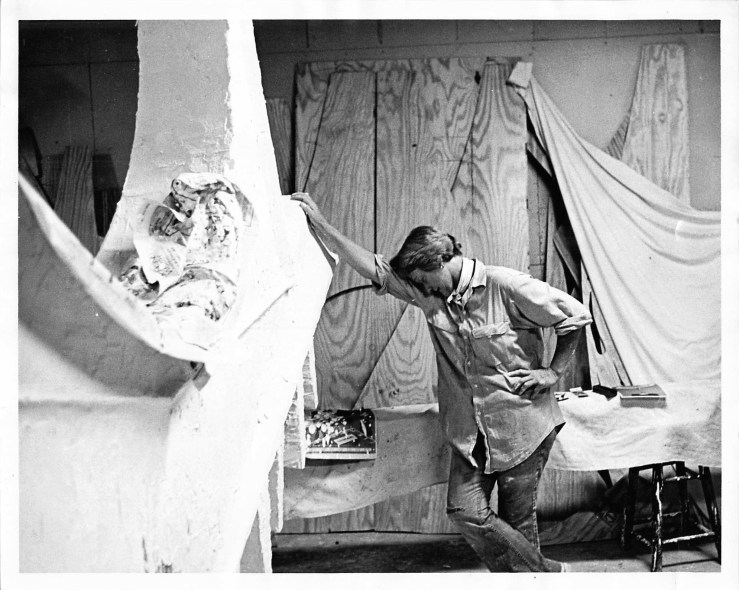
Hannah Holliday Stewart in her Houston Studio- Matthews Gallery

Our exhibition Hannah Holliday Stewart: An Artistic Legacy Rediscovered
begins with an opening reception on Friday, July 4 from 5-7 pm

“In a day in which so many things in Art are merely exercises in Media and devoid of any real significance, it is refreshing to discover an expression which transcends the cerebral prison of its own time and manifests itself in forms poetically germane to a more cosmic significance,” wrote Dayton Smith, with poetic flair of his own, in a typewritten statement dated March 22, 1991.

Smith was referring to the sculptures of his close friend Hannah Holliday Stewart (1924- 2010), whose monumental forms caught the eye of the nation in the 1970s and 80s. As chronicled in our last blog post, Smith and Stewart met in Houston in the late 1960s as Stewart’s career was taking off. He assisted Stewart in various ways for a number of years, and watched as the artist found success in galleries and museums across the country.

More from the note:

Her art mirrors a consciousness expanded beyond the pragmatic doctrinal limits of our milieu. Her commissions stand to prick our higher sensibilities in a world which, it would seem, affords little for the pursuit of what may be a neglected cosmic heritage. In an age in which “symmetry does not balance make” (but which, nevertheless seems to be the applied solution for everything), her bold compositions embody a superbly balanced abstract expression of form and function suggestive of the anthropomorphic with its attendant graces and imperfections.

More than two decades later, Smith admits with a chuckle that the write-up can be a bit “over the top”, but it survives as an illuminating statement about an artist whose cosmic creations were at times misunderstood. After we contacted him, Smith was inspired to return to the typewriter—or, keyboard—and draft another statement on Stewart’s work. His musings provide new insight into the life and artwork of the dynamic sculptor.
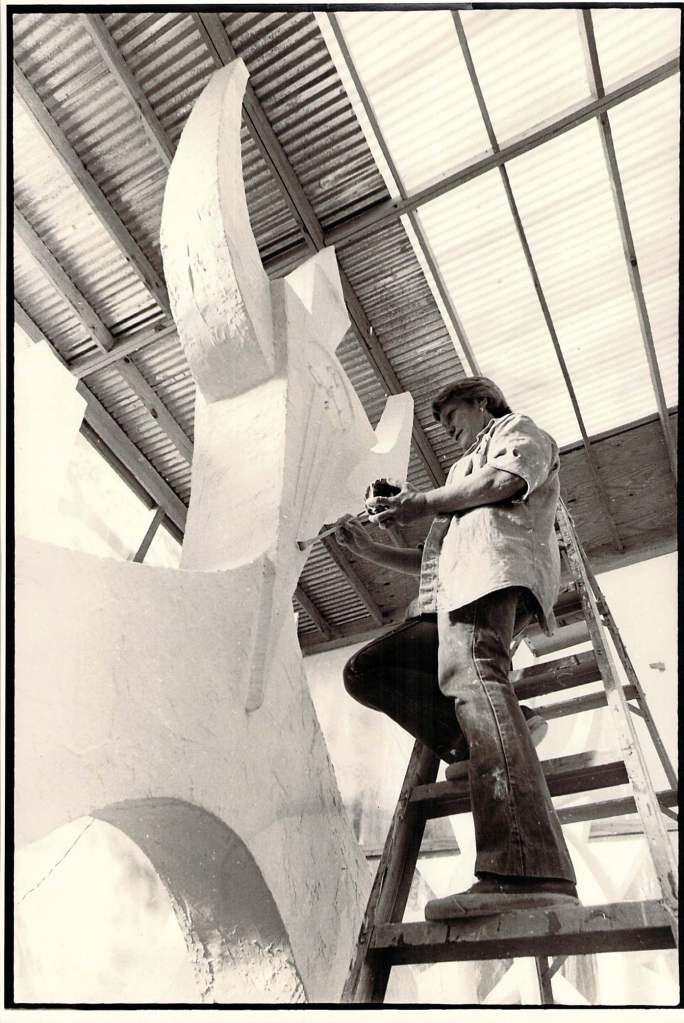
Hannah Holliday Stewart in her Houston studio- Matthews Gallery

From Dayton Smith:

Hannah Remembered

It can be said with clarity and confidence that the monumental sculptural work of Hannah Holliday Stewart is cosmic in scope and spiritual in dimension and process. At the peak of her production in the 1970s and ’80s, there emerged from her studio great plaster forms, many well over ten feet in height. These graceful mammoths, cast in bronze, would weigh hundreds to thousands of pounds, and command public spaces in Houston and other cities. A major exhibition of these large plasters was mounted in January 1976 at Contemporary Arts Museum Houston, and another in the ’80s at One Houston Center. In the 1990s, she established studios in Flagstaff, Arizona, and later in Birmingham, Alabama, and finally in Albuquerque.

Born in 1924 in Marion, Alabama to a prominent family, she studied art in Alabama and Georgia (BFA), and at Cranbrook Academy of Art in Michigan (MFA); studied ceramics in California with the legendary Bauhaus potter Marguerite Wildenhain; worked in foundries in Florida and Mexico; moved to Texas to teach at Museum of Fine Arts Houston, the University of Houston, and the University of St. Thomas. Her notable public works include Atropos Key, installed in 1972 on the hill at Houston’s Miller Outdoor Theatre in Hermann Park; Libertad, a smoothly elegant birdlike bronze at World Trade Center Houston; works in Samuels Park in Dallas and New Harmony in Indiana; and Passage, at University of St. Thomas Houston. Her public commissions are claimed as example of landmark achievement by women in the arts. Respected among Houston architects and adept in various media she developed sand-blasted and sand-cast relief panels for specific architectural settings. Her works of smaller scale are to be found in notable private collections.

Her studies in literature, mythology, metaphysics, esoteric philosophy, religion, science, astrology, dance and yoga suffuse her output, revealing in form and textures. Her earlier smaller works reflect ineffable humanity, humor, elegant charm and always superb craftsmanship. She was disciplined, intelligent and well-read, possessed of an intense work ethic, compassionate and understanding and encouraging of others, and an inspiring teacher, respected and loved by friends in business, academia and the arts. Whether attired in her usual studio denim or occasional Dior, she moved among interesting people and was an accomplished host and gourmet. Music was her creative keynote and the atmosphere mystical, always stimulating and, on occasion, convivial. On so many occasions when I would assist her in some project: photographing, gallery installation and lighting, foundry, studio, even building repair, I was aware that I was only facilitating much greater work. I think she really did come to ‘see’ the wind, and must have stood in awe of that which materialized from her consciousness and hands. I can still hear her warm southern voice and motto – Nil desperandum!, and her memory, towering as her work, is quite, quite treasured.

D.A. Smith
Public Broadcasting, University of Houston, retired

Make sure to attend the opening reception of our exhibition Hannah Holliday Stewart: An Artistic Legacy Rediscovered on Friday, July 4 from 5-7 pm. To learn more, check out our previous blog post and our Hannah Holliday Stewart artist page. For daily gallery news, connect with us on Facebook, Twitter and Pinterest.
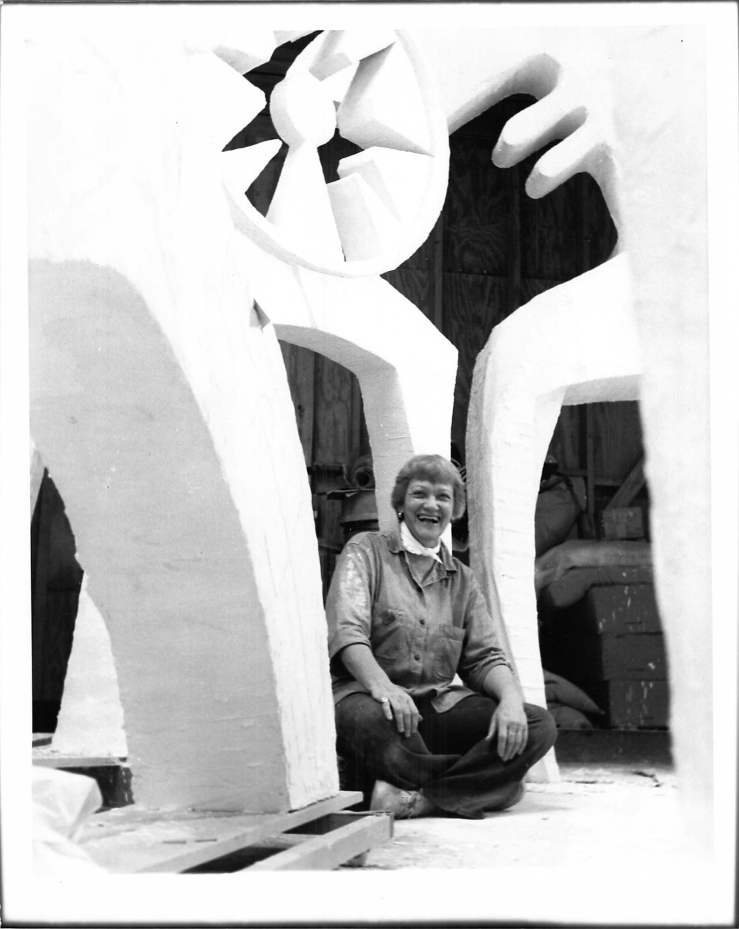
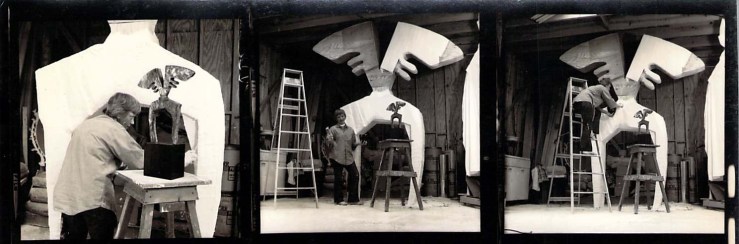
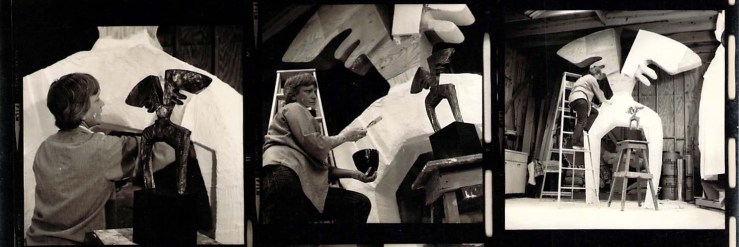
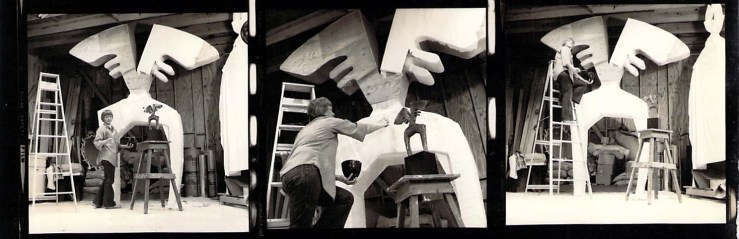
Hannah Holliday Stewart in her Houston studio- Matthews Gallery

HANNAH HOLLIDAY STEWART: Cosmic Mysteries

Hannah Holliday Stewart in her studio- Matthews Gallery

It’s not a stretch to call Hannah Holliday Stewart‘s (1924-2010) sculptures cosmic. In the artist’s heyday, the bronze forms that emerged from her Houston studio were often over 10 feet tall and thousands of pounds. She aspired to create physical manifestations of complex ideas in science, mythology and other fields, a system of “pure [abstract] symbols as constant as numbers and letters of the alphabet,” as Paul Klee said in one of Stewart’s favorite quotes. The themes she explored were so vast that Stewart’s work was at times cosmically misunderstood.

In preparation for our posthumous solo exhibition of Stewart’s work this July, we’ve been digging through the sculptor’s carefully organized personal files. One folder marked “Press” holds a 1994 newspaper article from Stewart’s childhood home of Birmingham. By that time Stewart had lived far away from Alabama for a lifetime, building a reputation in Texas and the Desert Southwest as one of the first female sculptors to win competitive public art commissions. “Ms. Stewart talks of such abstract notions as harmony and energy and spiritual awakening,” puzzled the Birmingham Post-Herald reporter. Throughout the rest of the article Stewart scratched out or rewrote swaths of the writer’s analysis in black ink, clarifying concepts and modifying terms. “[I] always go back to classical order and laws,” she scribbled at the bottom.

Hannah Holliday Stewart- Artist Process 1- Matthews Gallery

Stewart was born in 1924 in Marion, Alabama. She studied art in Alabama and Georgia for her BFA, and completed her MFA at Cranbrook Academy of Art in Michigan. After working at foundries in Florida and Mexico, she landed a teaching job at the Museum of Fine Arts in Houston and later at the University of Houston.

By the 1960s Stewart’s work had grown to a monumental scale, and a passionate group of Texas art enthusiasts rose to support it. In an era when female sculptors had to fight for recognition, Stewart’s bronze monoliths were popping up all over Houston—and beyond. In 1962 a swooping, Brancusi-esque bird form called “Libertad” appeared in the courtyard of Houston’s World Trade Center, and in 1972 an 11-foot-tall sculpture titled “Atropos Key” landed on a hill in Hermann Park. A commission for a monumental work in Dallas’ Samuels Park spread her name across the state.

“I found myself devoted to her work very early, I think,” says Dayton Smith, who befriended Stewart around 1969 when he was working for a Houston photography studio. “I realized the significance of it, the weight of it, shall we say.” Over the next few years Smith helped Stewart in various ways, photographing her artwork, transporting sculptures, and organizing a 1973 solo exhibition at Houston’s Jamison Gallery on Hermann Park.

Hannah Holliday Stewart- Artist Process 2- Matthews Gallery

“As I got to know her, I became aware that she was a very literate person, very intelligent,” says Smith. “Her work really did relate to what she encountered in her learning.” Smith noted that Stewart explored many fields of knowledge, from science and architecture to music and mythology, allowing concepts in each field to influence her three-dimensional objects. In 1975 and 1976 she mounted her first major solo show at the Houston Contemporary Arts Museum, exhibiting a series of large plaster models (including “Adam’s Rib“, from the photographs in this blog post) that were based on smaller bronze maquettes. But even as Stewart’s legend grew, Smith says misconceptions about her work persisted.

“The word spiritual often comes to mind, but spiritual is such a misunderstood term in our society,” explains Smith. “If you look at the word itself, the Latin root of it is ‘spiritus’. That means ‘wind.’ We can see the wind when it carries things, when it moves things.” Stewart worked to bring the invisible—a musical note, kinetic energy or a wisp of air—into the physical world.

Hannah Holliday Stewart- Artist Process 3- Matthews Gallery

More mysterious still to many of Stewart’s friends in Houston was her abrupt disappearance from the art world. Smith last saw Stewart in the late 1980s, when she was teaching at St. Thomas University and exhibiting in an impressive array of art institutions across the country. A few years later Stewart packed up and moved away from Houston, settling in Arizona, Alabama and then Albuquerque, New Mexico. She never exhibited her artwork publicly again. Why would a woman who once showed at the Smithsonian Institution, the Getty Museum and prominent galleries in New York, New Orleans and many other cities suddenly leave it all behind?

Smith has a few hunches. Stewart often said that she was inspired by the Desert Southwest, and sent Smith an image of her working in her new studio in Flagstaff. The move to Birmingham probably had to do with the declining health of Stewart’s brother and two sisters, who lived in the area. When it came to her art career, Smith thinks Stewart may have needed room to spread her wings and find new inspiration.

“Once we were talking about something she’d observed,” recalls Smith. “That sometimes to make it in your own town you have to leave and come back with something big. That people could get too used to you, but that perhaps you could come back and be accepted. Maybe she was planning that.”

Follow our blog in the coming weeks as we unravel the mysteries of Hannah Holliday Stewart’s life and artwork, and make sure to attend the opening of HANNAH HOLLIDAY STEWART: An Artistic Legacy Rediscovered on July 4 from 5-7 pm.  Also pick up the July/August issue of American Fine Art Magazine to read more about the show, and follow our investigations on Facebook, Twitter and Instagram.

SCULPTOR’S PROCESS: Frank makes a fountain

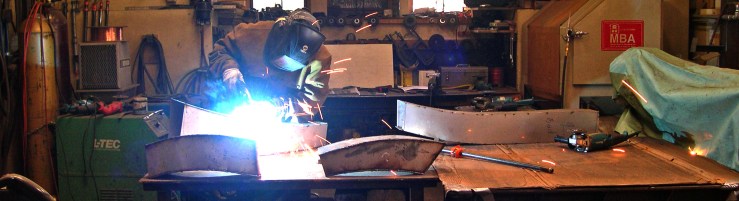
Frank Morbillo- Sculptor- Matthews Gallery

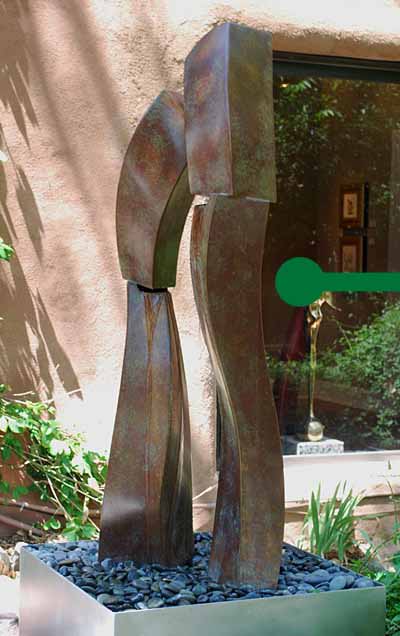
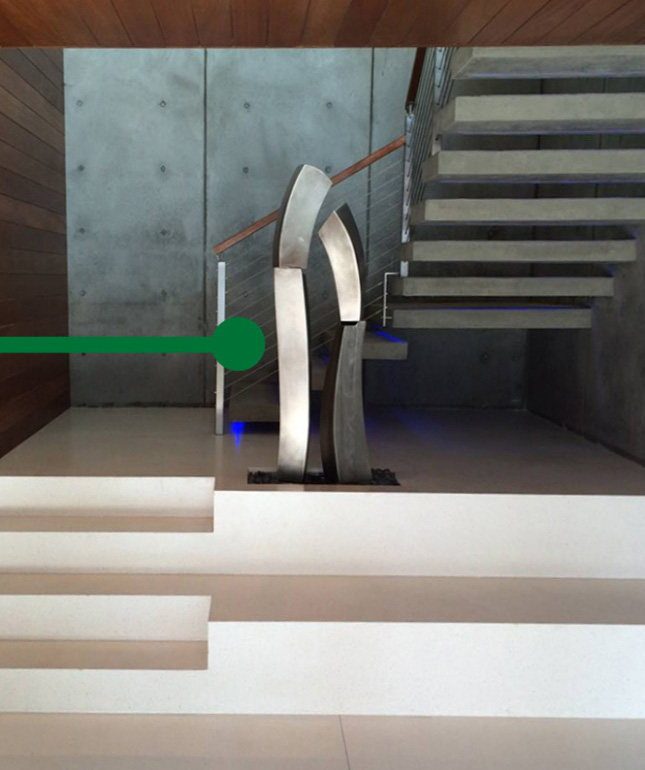
It all started with a sculpture you may recognize if you’ve been to Matthews Gallery in the past few years. Frank Morbillo‘s ‘Complement’ was a fountain that stood outside our building for a time, enchanting Canyon Road tourists with its elegant lines and soothing sounds:

Frank Morbillo- Complement- Matthews Gallery

“It was inspired by the figure, a relationship between people or entities,” says Frank. “The two sides have a connection in terms of how the line of one complements the line of the other.”

Two gallery visitors who were particularly charmed by the sculpture kept it in mind as they built their new home. Nearing the end of construction, they got in touch with Frank and asked him to create a similar piece for their front entryway. Just like the two pillars of the sculpture, Frank says the commission was all about maintaining a carefully balanced dynamic.

“During the course of the commission, I am constantly sending images that are going back and forth between myself and my client,” the artist explains. “Six times throughout this process or more, we were exchanging information and tweaking and getting approval.”

Below you’ll see images from their correspondence, starting with a cardboard model and ending with the stainless steel fountain in its beautiful new space. Follow Frank on his artistic journey…

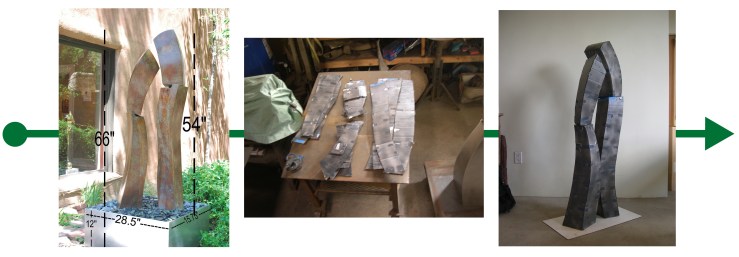
Frank Morbillo- Artist Process- Matthews Gallery Blog


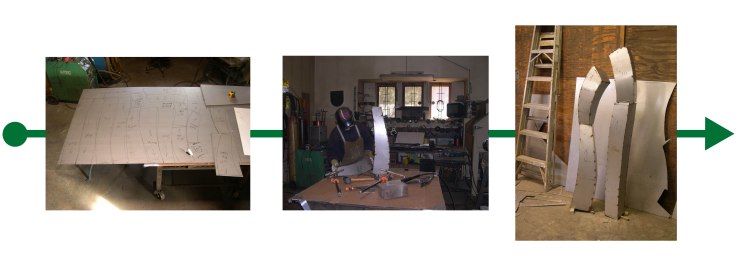
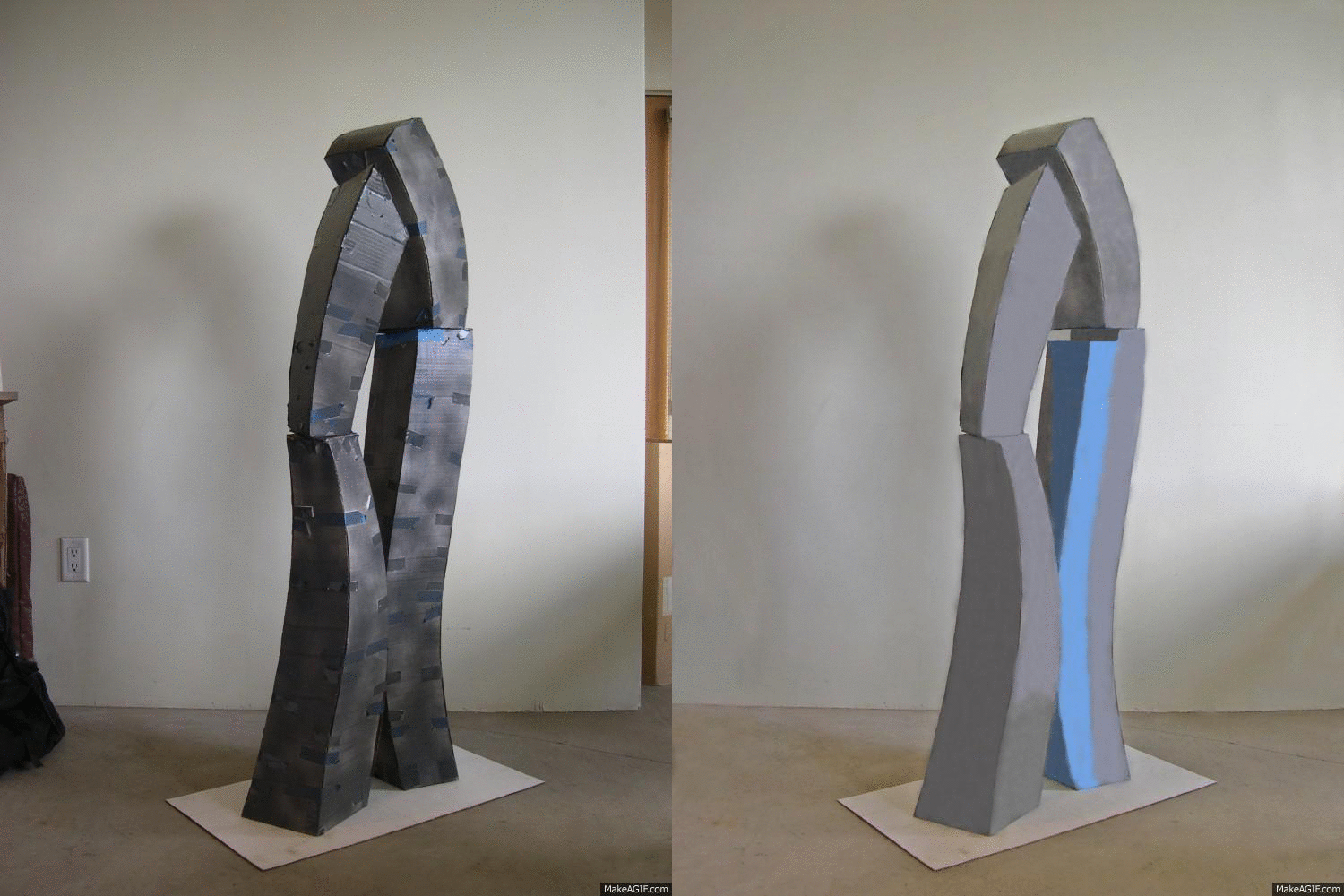
First, Frank marked up an image of the original sculpture (left). ‘Complement’ was larger than his clients wanted, so he adjusted the scale and used the new measurements to resize some cardboard cutouts from the original project (center). The new, smaller cardboard pieces came together to create a full-scale model of the new piece (right).

“When I’m building it in the studio, it’s important to have the model at the level that it’s going to be viewed. In the clients’ home, it’s going to be up a few steps from the ground level. I elevated it to make sure the proportions were working. I want there to be a good interaction of elements.”

“Different materials make the water flow differently. A rough material creates some surface tension, while a slick material will let the water run very fast.”

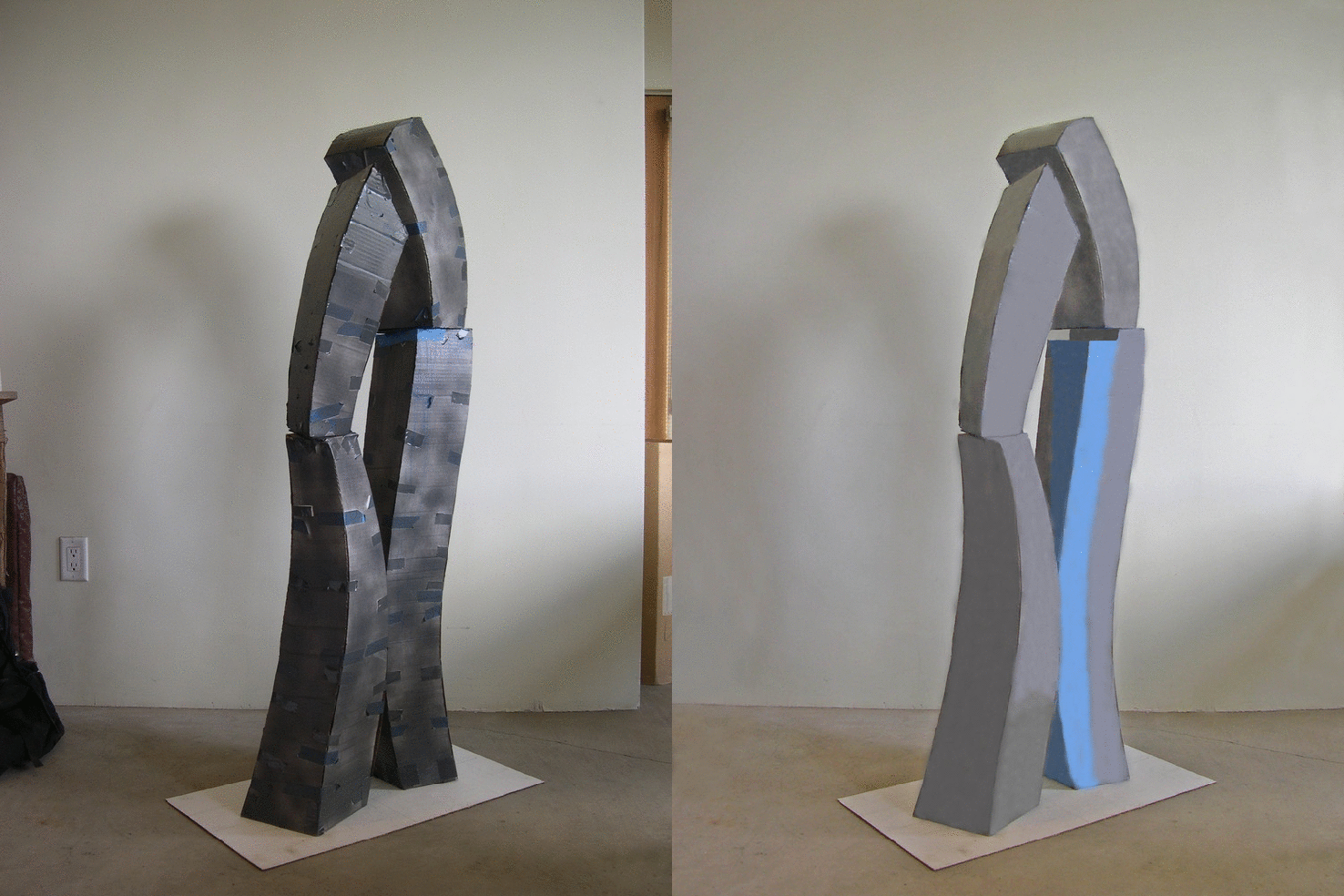
 Frank Morbillo- Sculpture Process- Matthews Gallery blog
Next, Frank manipulated images of the cardboard model in Photoshop to show the flow of the fountain. The blue line you see on the edited photograph is where the water will fall on one side. The white piece of cardboard under the sculpture represents its base, which presented a unique problem.

“From the very beginning, I had to be very careful about water flow because I had a limited landing pad for the water to fall. The basin was much smaller and narrower than in the original sculpture.”

Frank Morbillo- Artist Process- Matthews Gallery Blog

After tweaking the cardboard model, Frank took it apart and traced the pieces on stainless steel (left). He used tack welding to create a rough version of the piece (center and right). Tack welds allowed Frank to alter the form based on his client’s feedback.

 “The dark buttons going up the edge are the tack welds. The tack weld is very strong; a series of four down the side can hold it mostly in place. Once you’re at this step, you want to make sure that everything is right. Afterwards, there are several days worth of work to make the elements seamless.”

Frank Morbillo- Artist Process- Matthews Gallery Blog


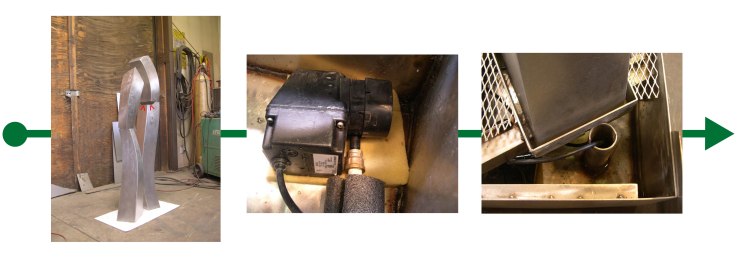
It took about a week to create the shiny sculpture you see on the left. The two red arrows mark openings for the water. Next Frank worked on the base of the sculpture, installing a pump and carefully feeding the electrical cord through a riser tube that holds it above the water (center and right).

“All of those edges have been welded and sanded. This is my first rough pass on putting the finish on the metal.”

“One of the things you look for is the pump’s capacity to go vertical. I size it at a slightly greater capacity than my need is going to be so that I’m sure the water will reach the top.”

“The water enhances and adds to the whole scheme of the project. By placing the pump on the foam pads, it reduces noise vibration from the pump, allowing the viewer to focus on the sound of the fountain.”

Frank Morbillo- Sculpture Process- Matthews Gallery Blog


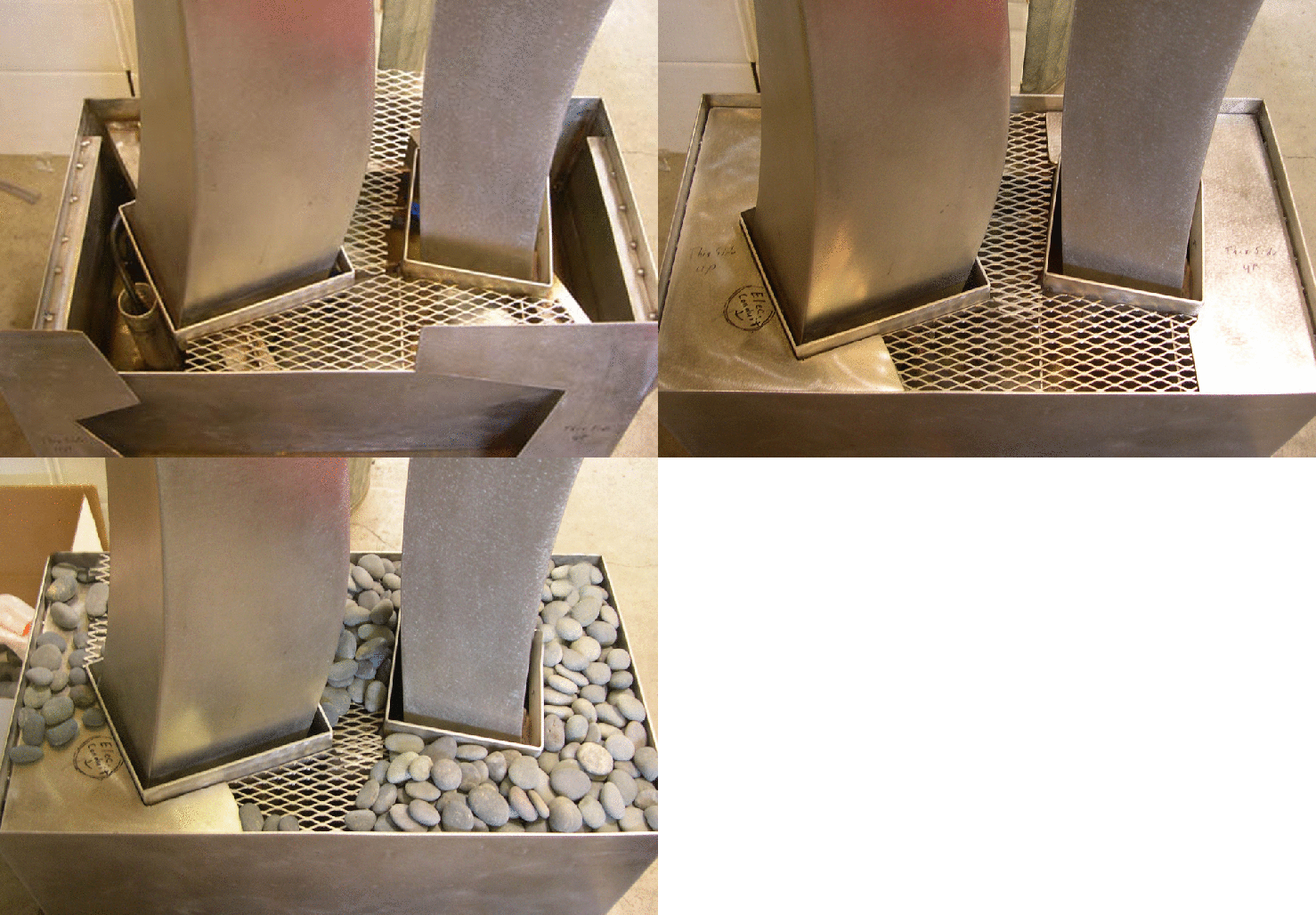
Frank cut mesh and steel plates to cover the base and prevent splashing. The slots you see around the sides of the sculpture are one of Frank’s latest innovations.

“Because of the size of the basin, I have less latitude with what the water does and how it falls. I knew I had to create a slot around the base of both sculptures so as the water falls it goes into this slot. It worked really well, and I learned something from it. It’s changed how I deal with water capture in a small basin.”

“In every sculpture project, there’s always the opportunity to say, ‘What can I do different in the future?’”

Frank Morbillo- Artist Process- Matthews Gallery Blog

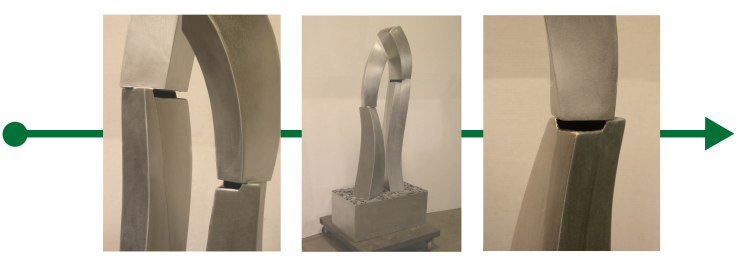
Careful tests of the water flow followed. Frank got the final approval from the client and shipped it.

“There’s a lot of structure in there that you’re not seeing that supports all of the different elements. When all of this is said and done, you don’t see any of that but it’s all happening because of it.”

“I took a good long look at it and liked what I was seeing in terms of how I thought it would look on site.”

And PRESTO!

Frank-Morbillo-SculptureProcessFinal

Frank’s clients sent back images of the piece in its new home, and the sculptor couldn’t be happier.

 “The experience of walking up the steps and around the sculpture must be pretty awesome.”

“It’s interesting, the sculpture is the only thing with curves in the space. Everything else is really hard and geometric. That’s cool that it’s really different than anything else line-wise in the space.”

“When you can have fun going through the process of doing it, for me that’s where my thoughts go when I’m working. There’s a lot of opportunities to have fun.”

“When I saw the contemporary design of the house, I said, ‘Great project.’ I’m really happy that this sculpture became part of it.”

See more of Frank Morbillo’s artwork on the Matthews Gallery website, and connect with us on Twitter, Facebook and Instagram for daily gallery news.


THE STORYTELLER: From petroglyphs to pinewood

Roch Hart- Fine Furniture- Matthews Gallery

 Roch Hart with his pie safe “The Storytellers”

“Furniture is art,” says Roch Hart. It’s a credo the Albuquerque fine furniture maker repeats every time he brings a new creation to the gallery. In Hart’s case, it’s true: each hand-carved piece of sugar pine is as unique as a painting on our wall. This is nothing you’d find at IKEA.

Check out our blog post chronicling Roch’s journey from Spanish Colonial furniture enthusiast to bona fide sculptor, and then delight in the details of his latest creation. This pie safe, dubbed “The Storytellers“, holds quite a few tales…

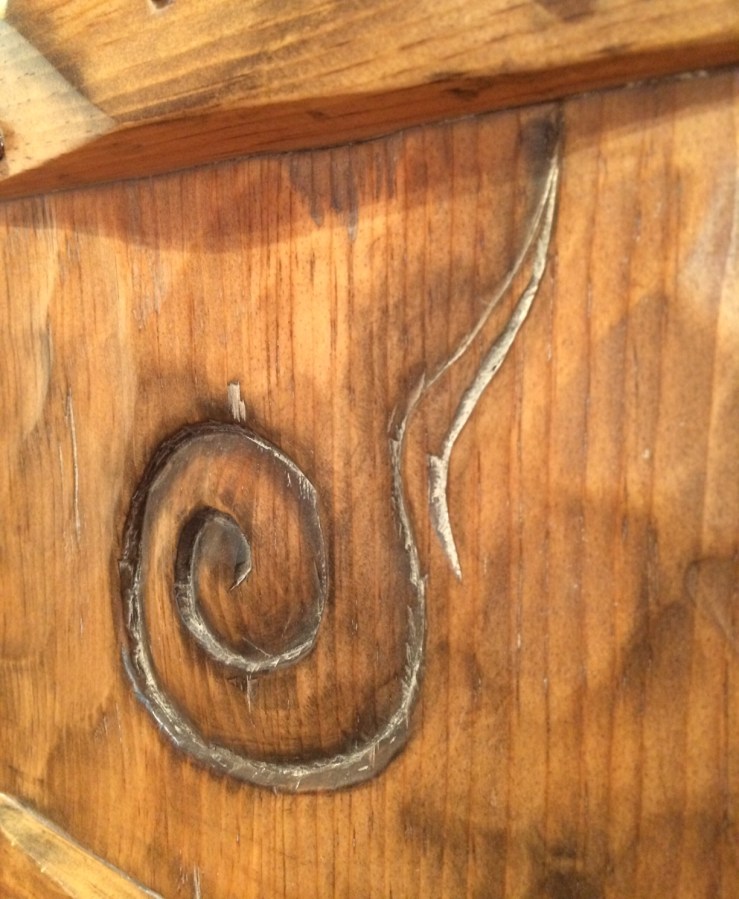
SPIRAL

Roch Hart- Fine Furniture Detail- Matthews Gallery

Hart often draws inspiration from New Mexico petroglyphs.

“A spiral can mean a lot of different things depending on its context, but here it represents eternity or travel,” Hart says. In particular, this symbol refers to a journey from the depths of the earth.

FACES

Roch Hart- Fine Furniture Detail- Matthews Gallery

These symbols on the sides of the pie safe tend to appear together in glyphs. The one on the left with its mouth shut tight is the “listener”, and the one on the right is the “storyteller”. It’s the yin-yang of cultures that depend on the voice to pass down vital knowledge.

The designs surrounding the faces also have an important meaning. Just like the Zia on the New Mexico state flag, they represent the sacred, pervasive number four: four compass directions, four seasons, four stages of a person’s life.

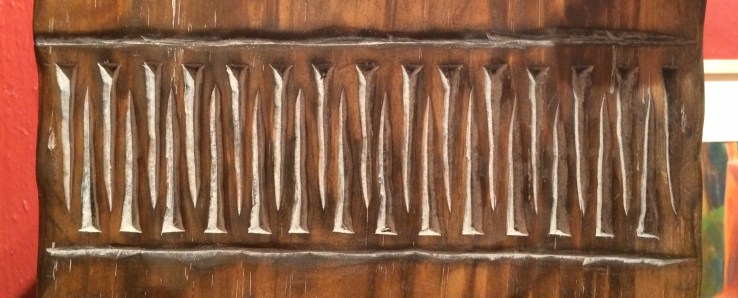
PATTERNS

Roch Hart- Fine Furniture Detail- Matthews Gallery

“This is mimicking the Navajo rugs,” explains Hart. “I thought it would be a great border for the faces.”

Hart uses white ash to make his patterns bolder, rubbing it into the cracks by hand atop a layer of shellac. The finishing touch is a light coat of wax.

JOINTS

Roch Hart- Fine Furniture Detail- Matthews Gallery

Near the beginning of his journey to furniture mastery, Hart visited the Nicolai Fechin House in Taos. Fechin was a Russian painter and carpenter who moved to New Mexico in 1923 and purchased a small adobe home that he would greatly expand over the years. The home is now a museum, and when Hart visited to study the furniture he had a chance encounter with Fechin’s daughter Eya. She taught him about the different joints that her father used, including the sliding dovetail joint pictured here.

“That changed my life,” Hart says.  “I looked at [Fechin’s work] and said, ‘I can do anything. Nobody told him what to do.'”

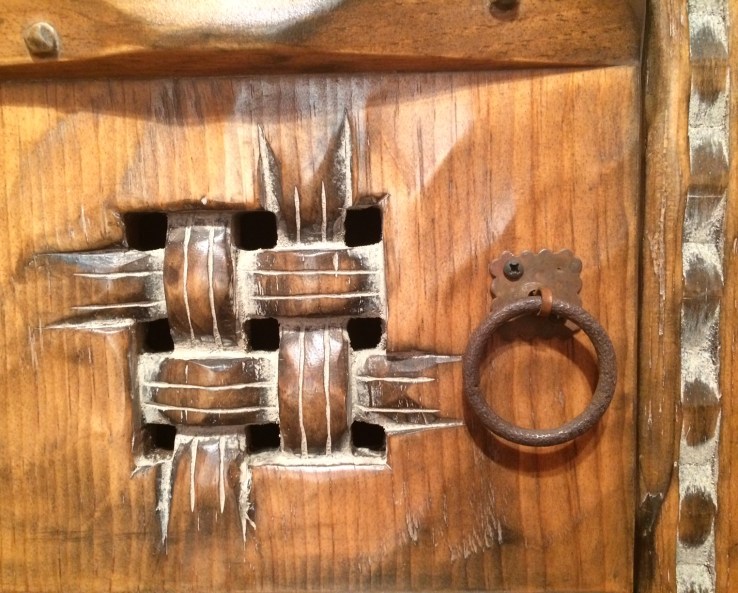
WINDOW

Roch Hart- Fine Furniture Detail- Matthews Gallery

The grid Hart uses as a window for the pie safe doesn’t have an age-old legend behind it. It’s one of Hart’s signature designs that appears in many different manifestations in his work. Myriad influences come together in Hart’s exquisite furniture, but each piece is imbued with his unique sensibility.

See more of Roch’s creations on his artist page, and connect with us on Facebook, Twitter and Instagram for daily gallery updates. Also, check out our upcoming exhibition FOUR CENTURIES: European Art from 1600 to 1950, opening June 13!

FAMILIAR STRANGERS: The Orphanage

Palace of the Governors Photo Archives

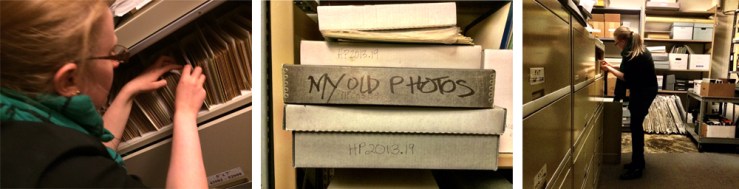
 Palace of the Governors Image Specialist Hannah Abeldeck sifts through the archives

“I think what you’re referring to is what we call ‘orphan photographs,'” said Palace of the Governors Photo Archivist Daniel Kosharek over the phone. “We have boxes and boxes of them.”

We contacted Kosharek last week in hopes of getting another angle on vernacular photography for our upcoming FAMILIAR STRANGERS show, which opens this Friday. The private collectors we had interviewed so far seemed delighted by the often unsolvable mysteries of found photographs. Did a professional archivist find an unknown image intriguing… or annoying?

A few days later, Daniel’s colleague Hannah Abeldeck ushered us onto an elevator and down to the basement of the Palace of the Governors. Abeldeck works as an image specialist for the archives, cataloguing, scanning and researching images in the collection of about 1,000,000 objects. The main room of the archives is packed with file cabinets and bookshelves. Sunlight streams down from a stairwell, making the subterranean space surprisingly bright.

“We weren’t a hundred percent sure what you were interested in, so I pulled some stuff to give you examples,” Abeldeck said, pointing to a teetering stack of files and a big green box.

To be honest, we weren’t sure either. We had no specific criteria when we were compiling photographs for FAMILIAR STRANGERS, which features compelling, mysterious images of diverse people and places. Unlike the scholars and history enthusiasts Abeldeck usually works with, we were more interested in questions than answers. In the following excerpts of our Q&A, Abeldeck provided us with a healthy helping of both as we explored a small corner of the “orphanage”.

Tools- Palace of the Governors Photo Archives The archivist’s toolkit


You started at the archives last October. Was it intimidating to approach such a large collection? 

I’ve worked in archives before, and for a rare book dealer. There are things about it that are not intimidating, but there are plenty of things that are. Partly, it’s the size of our collection. It’s huge. There’s stuff that’s really well processed, and then there’s stuff that’s hardly processed at all. There are so many different filing systems, so an original photograph can get put somewhere and be difficult to find again. There are systems by medium, by size, by when it arrived, by collection number.

Why were you interested in archival work? 

I think that our ideas about the past are often very simple. They’re based on things like summaries that people wrote about what they think happened. Sometimes photographs are a way of going back and re-looking at the past that you can’t do with words. You can get some idea of the complexity of the past. There’s a book that I read called “The Past is a Foreign Country.” In some ways, this job is like being a tourist. It’s interesting to see what is the same and what is different, what has changed and what is new.

Palace of the Governors Photo Archives

Orphan photos are catalogued in several ways: by location (left, New Mexico), collector (center, Forrest Fenn) or subject (right, portraits)


Where did the stack of orphan photos we’re looking at come from? 

We have a set of collections that exist in this limbo land between the old cataloguing system and the new cataloguing system. We might know something about them, or they might just be a box of photographs sitting on a shelf. This box says “Forrest Fenn“, so he probably donated them. Some have a photographer’s name on the back and some don’t. The stack of files is catalogued by location or subject— “New Mexico Towns” or “Portraits”.

Is there a way to estimate how many of your photographs are “orphaned”?

No, there’s not. Most of the stuff that we have, we know at least one thing about, so they’re not completely orphaned. Usually we know the photographer. Their name will be on the back, or the collection will be from their studio. Sometimes we don’t know anything about the photographer, but we know the location. When we seek things out for our collection, we’re usually looking for things where we know the photographer or the subject matter. But people also donate stuff to us. Those items that come in bulk collections, we know less about. The date is usually the thing that is the least identified about a photo.

What is the attitude among archivists towards orphan photos? 

Over the past 20 years, a lot of people who work in archives have adopted a philosophy called “MPLP.” That means “More Product, Less Processing.” It’s a way to deal with the huge volume of material that’s coming in. The volume of records that got created over the 20th century exponentially increased as the technology of production became cheaper. In the 1960s a photo archivist here might have spent four hours trying to identify a building in a photo. Now, we just don’t have time to do that. That’s one reason things get orphaned.

Palace of the Governors Photo Archives

 Mysterious beauty


The found photo collectors we interviewed find the element of mystery alluring. Do you get excited sometimes when you’re looking through orphan photographs, even though you don’t know their origins? 

Yeah! I’ll be looking through 100 unremarkable photographs from the past, and there’s one that seems more interesting or outstanding than others. There might be something aesthetically different about that photograph, but we’re also looking for historically interesting things. It doesn’t have to be a historical event, it could be about social history: why are these people together in this scenario? There are all sorts of social or technological things that could be interesting, even with orphan photographs.

In a blog post for FAMILIAR STRANGERS, we wrote about different roles people take when they’re looking at vernacular photographs: voyeur, detective, surrealist, even humanist. What would you add to that list? 

I’d add sociologist or social historian, particularly with the vernacular photography. We have a book called “Dressed for the Photographer” that’s a huge study of what people were wearing in daguerrotypes. You can date them based on their class and their region, so you can pin it a little more closely to the decade. It’s a way to find out what kinds of people passed through different places. We have portraits of Chinese men from Las Vegas, New Mexico that we don’t know much about, but their presence captures a bit of railroad history in the Southwest.

The photo collectors we interviewed also talked about the importance of bringing long-forgotten memories into the digital world. Do you feel similarly as an archivist? 

One of my main job duties is digitization. If you wanted to see and study some of these things, you would have to come to Santa Fe, New Mexico on an afternoon between Tuesday and Friday. Through digital cataloguing, we can post that stuff online and people can search from their houses. However, we have over 1,000,000 images and we’ve digitized maybe 30,000 of them. There’s still a huge mismatch between what we have and what is searchable online.

Palace of the Governors Photo Archives

Adelbeck flips through photographic glass plates in the archives. “As long as you don’t drop them, these will last forever.”


On the flip side, photo enthusiasts also stressed the importance of holding the physical object in their hands.

Having the original copy is very important for us in our ability to archive things. There’s something called digital obsolescence. For a physical photograph, if we put it in an archival mylar sleeve and keep them in a climate controlled environment, that is 95% of the preservation job. Digital objects are not that way, they need constant babysitting. Things periodically need to be switched over or upgraded. The CD is already an obsolete technology, so if you created a digital photograph in that format you have to migrate it to something else. With digital objects, there is a risk of the object disappearing within 15 years.

Do you have any stories of people identifying themselves or family members in an orphan photo? 

I just posted a picture on Facebook last week of two kids playing baseball. We knew the photographer and the date, and we knew it was in New Mexico somewhere. Someone recognized his brother in the photo. It’s really cool when that happens, but it’s bound to happen sometimes. We have all of these photos of unidentified people, and someone out there must know who they are. Those people existed at some point.

Is it frustrating when you encounter photographs that have recently left the range of “living memory”? 

It’s kind of interesting, because you start to understand the process by which photos get made, and how that affects what we can recover from the past. In the past, the occasions of photography were more constrained. You got a photo taken at an important event, like a wedding. As technology makes photography more accessible to the average person, you see a much larger growth of everyday captured moments that are not remarkable. At the same time, even within the proliferation of photography, there are things that happen that people don’t think to take pictures of. The process of painting a house might be interesting to future historians, but no one bothers to document that. There are a hundred billion photographs taken of the Santa Fe Plaza or the Palace of the Governors—and people are still taking them today—but there might be a storefront somewhere that no one has really photographed. It’s really interesting what people are choosing to document, and what they don’t document. We try to fill in those gaps by collecting photographers like Robert Christensen, a deliveryman who captured obscure stretches of road in rural New Mexico.

So this is just the tip of the iceberg?

Oh, yes. We have many, many, many more unidentified photos. If you needed pictures of ancestors and didn’t have any of your own, you could just come pick some. (laughs) “This is my great grandmother.”

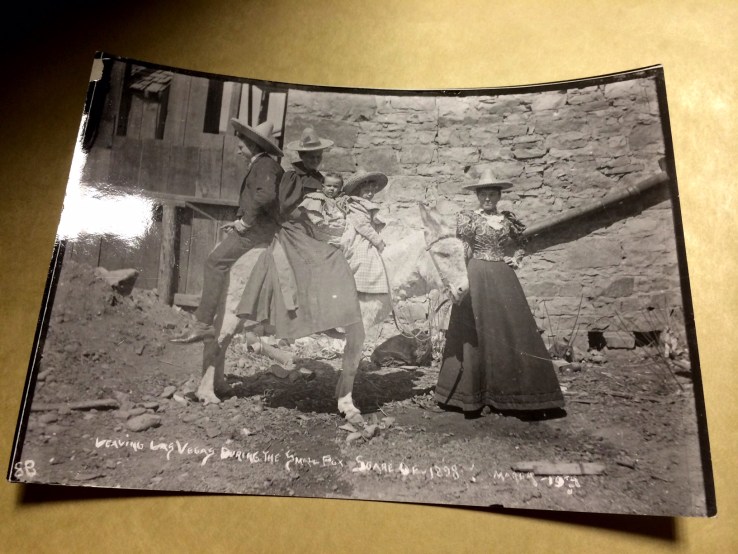
Burro Photograph- Palace of the Governors Photo Archives

 Caption: Leaving Las Vegas During the Small Pox Scare, 1898; filed under Transportation, Land, Burros

You can follow Abeldeck and Kosharek’s exploits on the Palace of the Governors Photo Archives Facebook and Tumblr pages. Also, make sure to come to the opening of FAMILIAR STRANGERS: Vernacular Photography this Friday from 5-7 pm. Read more about the show in this week’s Santa Fe Reporter.