MORANG AND FRIENDS: Ghost Stories

El Farol- A Toast to Morang- Matthews Gallery Blog

“There are ghosts at El Farol, there’s no question about it,” says Freda Keller with a playful smile. “There’s been a lot that’s happened over the years. In 1835 there were gunfights in the bar. People hear and see ghosts late at night.”

Keller is the general manager at Santa Fe’s oldest restaurant and cantina, and we’re on a hunt for a particular ghost. Alfred Morang (1901-1958) often haunted the establishment in his years among the living. This Thursday, El Farol and Matthews Gallery are throwing a special toast to his lingering spirit in the cantina, where Morang painted a series of stunning murals. The event will christen our December 12-26 exhibition MORANG AND FRIENDS, which features rare artwork and artifacts from the man who was known as Santa Fe’s Toulouse-Lautrec.

El Farol- A Toast to Morang- Matthews Gallery Blog

“The biggest thing with El Farol, the reason why it’s been around so long, is that it’s family driven,” Keller says. “I think the customers feel like they’re family, and obviously [Morang] did too. Being an artist and offering to do these murals, you would have to be part of the family of El Farol.”

Like any proud clan, the El Farol staff is always happy to take guests on an art tour through their cozy rooms. In addition to Morang’s works, there are murals and paintings by Santa Fe legends William Vincent (a student of Morang), Stan Natchez, Sergio Moyano and Roland van Loon. Keller produces a little fact sheet that helps everyone keep the stories straight. Here’s the write-up on Morang:

El Farol- A Toast to Morang- Matthews Gallery Blog

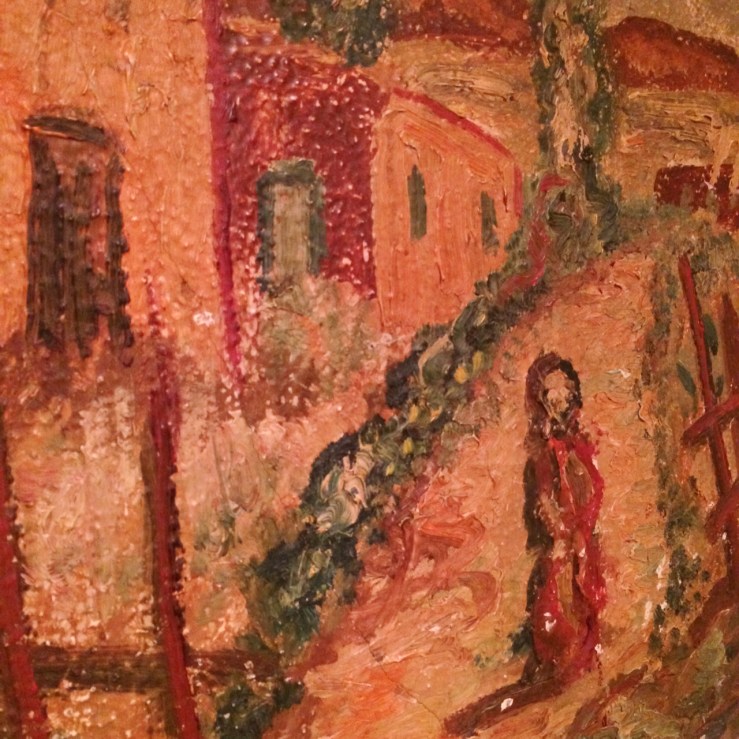
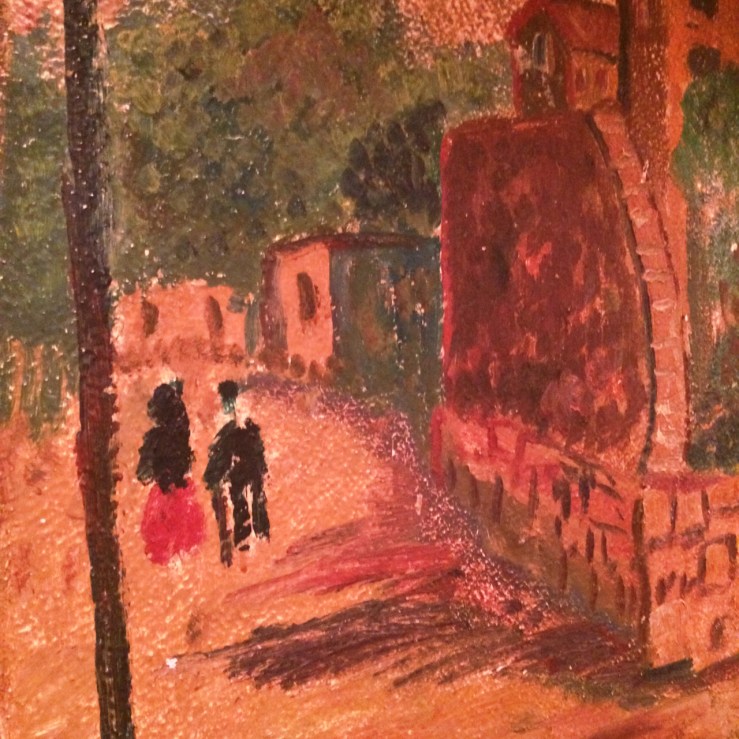
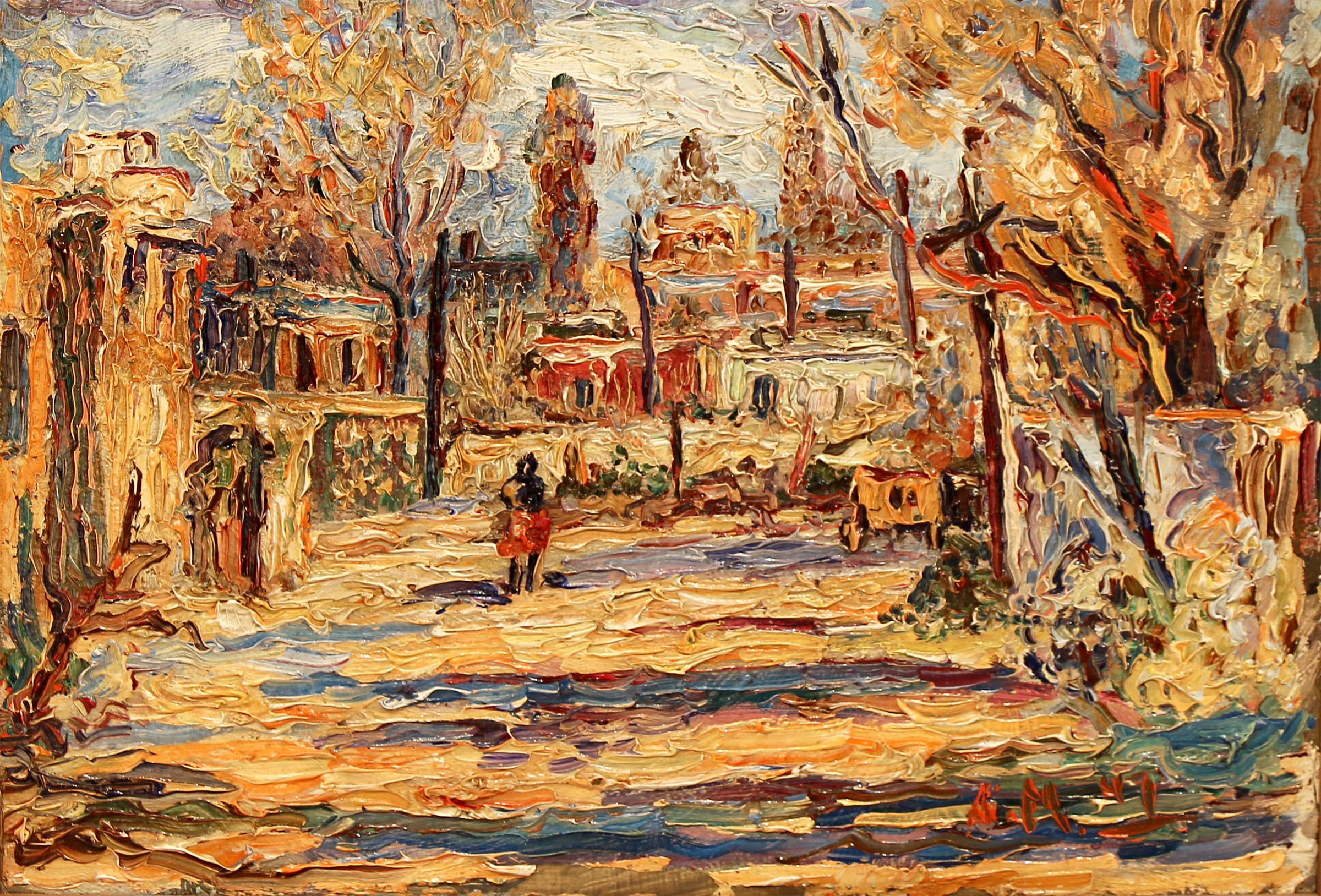
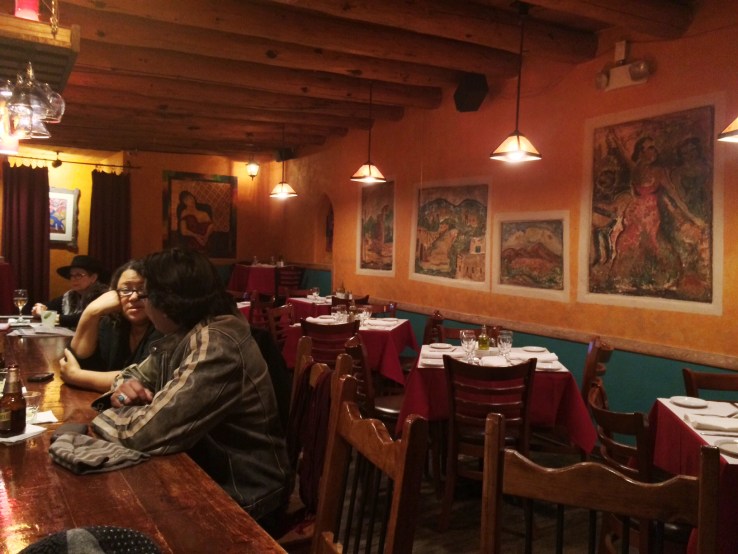
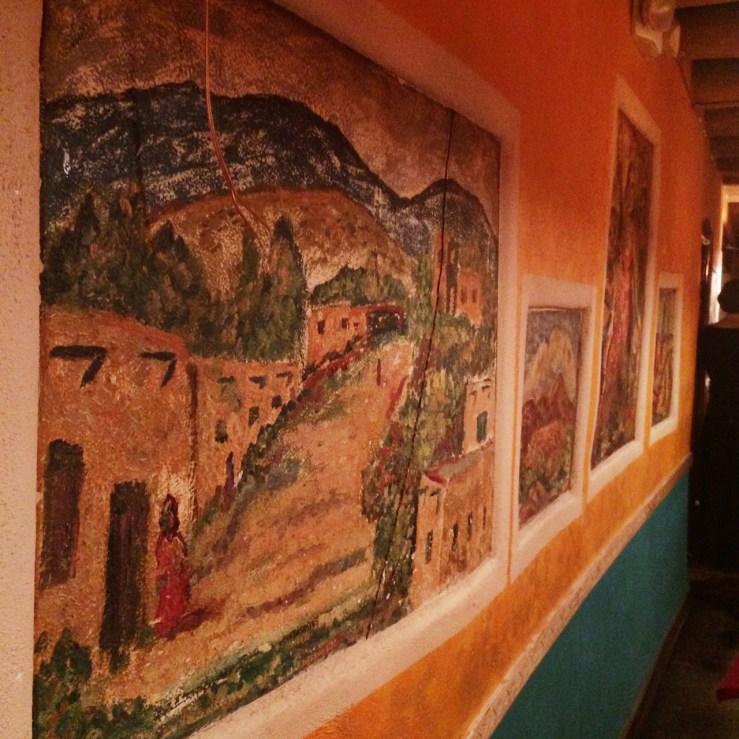
When you enter our rustic cantina, one of the first things to catch your eye will be the beautiful murals displayed throughout. The first artist to grace our walls was Alfred Morang.  On the long west wall of the bar and one behind the bar, are our oldest murals were painted between 1948 and 1952. Mr. Morang was already an established artist when he frequented El Farol during that period. He painted the murals to settle his tab at El Farol.  The scenes are of local landscapes and adobe homes in Santa Fe. We’ve chosen to reproduce our most famous mural of the flamenco dancer in the red dress accompanied by a guitarist as our poster for the 2004 Muralist dinner.  From 1968 to 1980 the owner at the time covered the murals with paneling.  When Bob Ward purchased El Farol in 1980 he removed the paneling to discover the beautiful murals beneath.  When David Salazar purchased El Farol in 1985 he was always mindful of the treasures on the walls.  Painting, re-stucco and remodeling were completed while protecting the murals.

Then comes the part of the tour that sends chills up our spines. Do you believe in ghosts? Maybe this will convince you:

On Easter morning in 1997 David and the staff were awakened by phone calls that El Farol had been burned.  The murals, though singed, had made it through the fire.

Morang died in a 1958 studio fire, so the news that some of his most notable works survived a blaze decades later is eerie to say the least. We walk over to the cantina to view the murals. When the hostess hears us mention Morang’s name, she lights up.

El Farol- A Toast to Morang- Matthews Gallery Blog

“That’s right, the murals still have burn marks on them from the fire,” she says, pointing out subtle passages of missing pigment that were lost to the flames. “They still don’t know how that fire started. They think someone may have set it.”

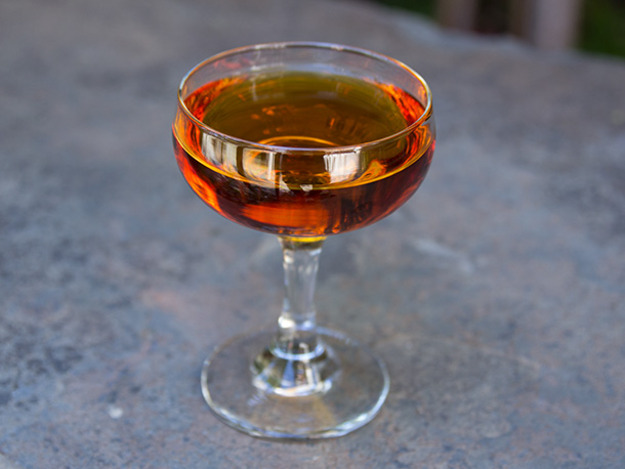
El Farol has long since been restored to its elegant Old West aesthetic, much as it was when Morang would stop by for a shot of cognac and draw inspiration for his impressionistic paintings of Santa Fe’s wild 1940’s nightlife. On Thursday at 6:30 PM, Keller will join the gallery staff to tell stories and toast the artist with a new “Alfred’s Special” cocktail.

El Farol- A Toast to Morang- Matthews Gallery Blog

“I read up on Morang and learned that he was born in Maine, and how beautiful the landscapes are there,” says Keller. “He did a lot of painting there. His first inspiration was that landscape.” Keller selected a cocktail called Remember the Maine (with rye whiskey, Cherry Heering liqueur and a splash of absinthe) in honor of Morang’s home state. Come have a drink and time travel with us to a true Santa Fe golden age!

Learn more about our Toast to Morang event on the El Farol website and on our gallery homepage, and connect with us Facebook, Twitter and Instagram to learn more about Morang.

MORANG AND FRIENDS: Alfred in Paris

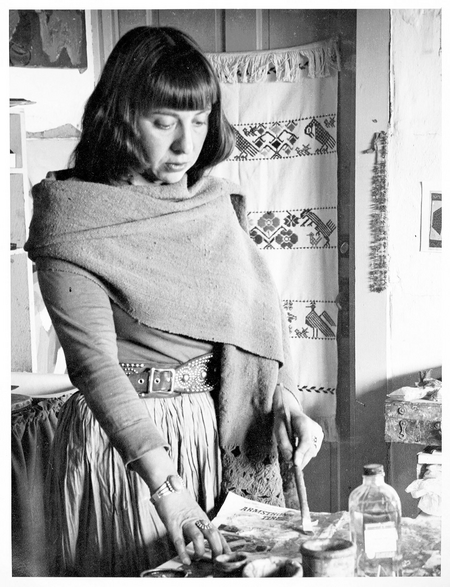
Alfred Morang Portrait- Morang and Friends Exhibition- Matthews Gallery BlogAlfred Morang, 1952

“After Morang’s death, all of a sudden people started to realize that he was a great artist. People regretted that they didn’t pay enough attention to him,” Santa Fe art collector Paul Parker said at the end of our interview last week.

As Parker will tell you, Alfred Morang’s death in a Canyon Road fire in 1958 was the end of an era in Santa Fe. From his arrival in 1937, Morang had helped cultivate a vibrant art scene in the City Different. His house parties of the 1930’s and 40’s earned him a reputation as “one of Santa Fe’s… most colorful Bohemians,” as the Santa Fe New Mexican dubbed him in his obituary. Morang was a masterful painter who drew inspiration from the French Impressionists, and a talented teacher who passed his knowledge to the next generation of Santa Fe artists. He was a great writer, musician and radio broadcaster.

However, towards the end of Morang’s life, he and his wife Dorothy divorced and he became increasingly isolated. He spent most of his time fervently painting in his Canyon Road studio. Santa Fe artist Bill Tate had this recollection of a frigid winter in the 1950’s:

Oh my, it was cold! The snow was pouring down unmercifully and as I walked into Alfred’s tiny studio, I pushed paintings aside to make a path, then found them sliding in behind me as I penetrated the cache of completed canvases. It appeared that paintings were everywhere. There in the middle was Alfred, happily painting away, bundled up like a Siberian monk—galoshes, muffler, sweater, heavy top coat which came to his ankles, and a woman’s hat pulled snuggly down over his ears and neck.

The studio had a sky light, but where the glass was supposed to be, there was none. Alfred had hung an old muslin sheet over the opening to shut out the falling snow. Evidently Alfred had let the fire go out in the small space heater. Or maybe had forgotten to pay his gas bill. I don’t know. But it was awful. I had been there just a few minutes when the muslin partially ripped loose from the ceiling and began flopping in the wind. Snow dumped all over Alfred as well as the canvas.

Alfred never looked up, never stopped painting. His blue-cold hands kept mixing painting and dabbing it on the canvas. Occasionally, he would lean back to assess the effect, but throughout, he was totally oblivious to my presence… or the muslin that danced in the bitter breeze.

I attempted to speak, but only a chatter came out. I retreated to the warmth of my own studio. To the day he died, Alfred never knew I was there.

This somber image of an artist in the winter of his life is not how Parker likes to think of Morang. Soon after he first visited Santa Fe in the 1990’s Parker developed a fascination for the Santa Fe icon that has taken him on many adventures, including a national treasure hunt that inspired our latest exhibition. The artifacts Parker discovered will appear alongside artwork by Morang and his contemporaries in our December 12-26 exhibition MORANG AND FRIENDS, evoking an era full of crackling creativity. Morang stood at its warm heart.

In the story below, Parker captures the Santa Fe zeitgeist before and after Morang’s death, and travels to Paris to complete a mission in Morang’s memory:
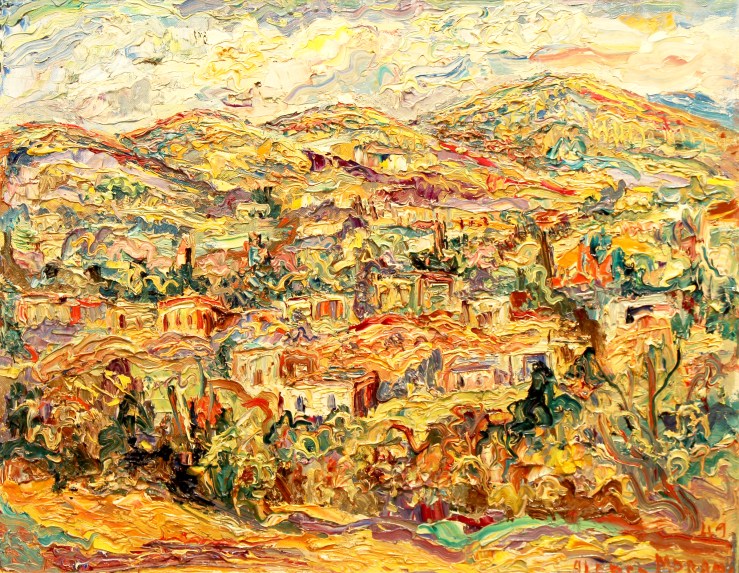
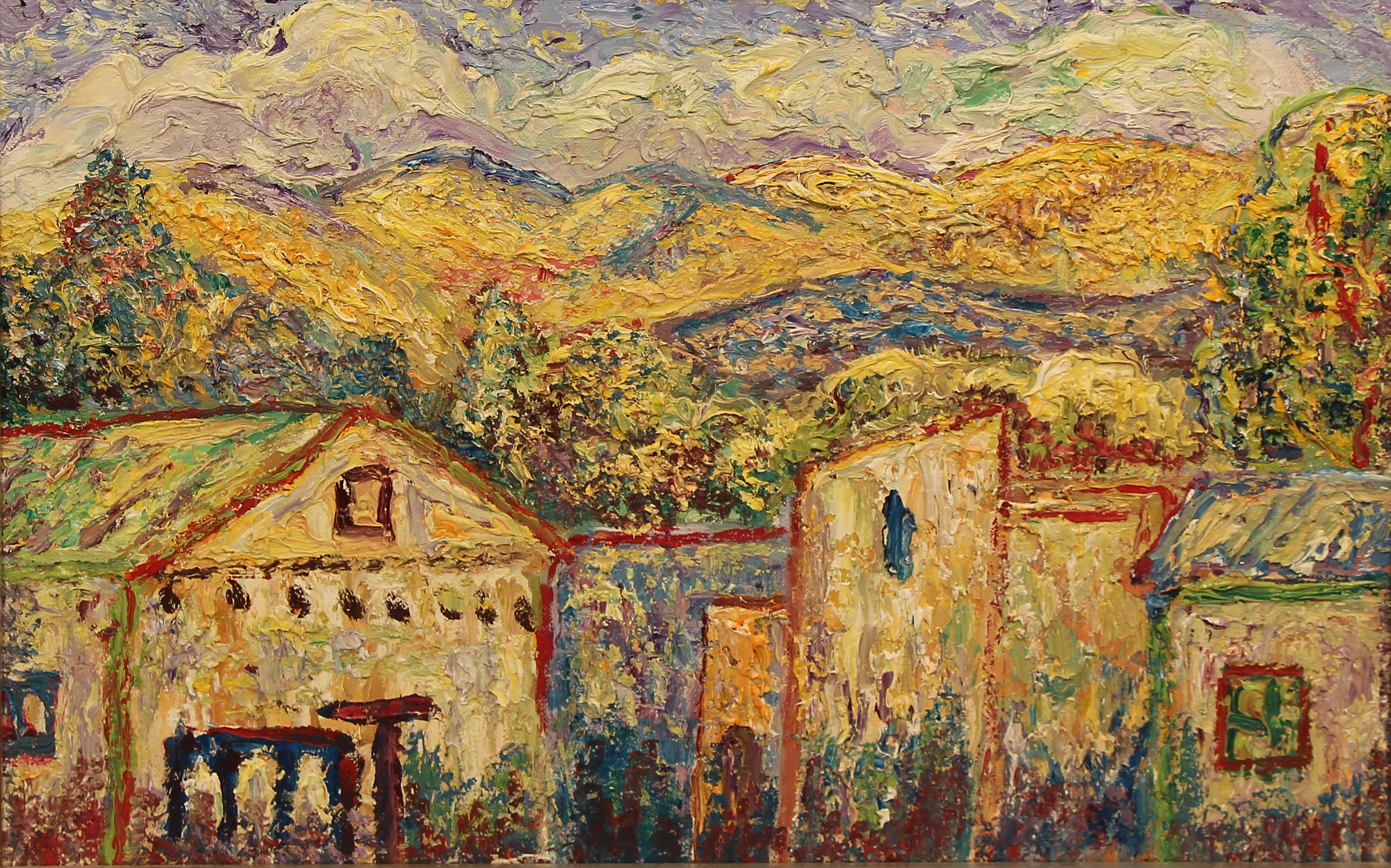
 Alfred Morang- Santa Fe Hillside 1949- Matthews Gallery Blog Alfred Morang, Untitled (Santa Fe Hillside) 1949, Oil on Canvas

HUNTING FOR ALFRED MORANG

by Paul Parker

I had been thinking about this mission for a long time and I finally find myself in the library seated in front of this antique microfilm viewer the size of a small refrigerator and I have loaded the reel containing the early 1958 issues of the Santa Fe New Mexican.

I was not sure why I had this unremitting need to know more about Alfred Morang. I had first seen his work painted on the adobe walls across from the bar in El Farol on Canyon Road and in Maria’s on Cordova, but I know the real inspiration came from my good friend Jim Parsons in Taos. Jim was an art dealer and appraiser forever and a friend and mentor for 20 years. When he mentioned that Alfred Morang was one of his favorites I knew I needed to pay attention. It was like Willy Wonka telling me about one of his favorite chocolate bars.

It helps that Alfred was such a compelling man, so well versed in music and literature as well as painting. He was the youngest person ever to perform a solo violin concert in the prestigious Jordan Hall in Boston. He was also an accomplished writer. The London Times once called him one of America’s leading non-political short story writers. Erskine Caldwell was a friend of his and he often visited Alfred and his wife Dorothy in Santa Fe.  Alfred’s short stories and poems were published alongside Frost, Poe and Mark Twain. I do know the main reason I am so drawn to him is that his art touches me. Behind that art is Alfred’s story, his life experience and that is what drove him to create the art that Jim and I and many others enjoy so much.

Alfred Morang- Untitled Portrait of a Woman 1950- Matthews Gallery BlogAlfred Morang, Untitled (Portrait of a Woman) 1950, Oil on Board

There is a very sad part to his story and it is that part that drew me to the library. Alfred Morang died in a fire in his Canyon Road apartment studio on a cold January night at the age of 56. I had wanted to come here to the library and read the January 29, 1958 issue of the Santa Fe New Mexican for some time. I wanted to know the details, I wanted to read what people said, I wanted to know what page it was on and how big the article was. I was scrolling through the microfilm and as I started approaching the day he died I realized I was reading the papers that he probably read unaware he only had days to live.

The closer I got to the issue of the paper I had come to see the more time I took reading the articles and I even started reading the ads. I lingered the longest on Tuesday’s edition dated January 28, 1958. That was the last paper Alfred could have read.

There was an article on that day that I am sure must have caught Alfred’s eye and the headline read, “French Ballet loses Backing”. Alfred never made it to Paris, but his heart was there. His heroes were the French Impressionists and he considered himself to be one of them. Monet and Bonnard were his favorites. The article explained that the French Education Ministry had withdrawn the government subsidy for the production of Francoise Sagan’s ballet “The Broken Date”. The ministry’s action followed a storm of protest. Apparently one dance was performed in a bathroom setting designed by painter Bernard Buffet and was described by some critics as scandalously erotic. I would like to have gone to Paris with Alfred and attended that performance. A French ballet with a bathroom setting designed by Bernard Buffet coupled with scandalously erotic, I am sure we both would have enjoyed that.

That Tuesday the Lensic was showing “Pal Joey” starring Rita Hayworth, Frank Sinatra and Kim Novak. Kaune’s was having a sale featuring Pork Chops at 59 cents a pound and Swanson’s Pot Pies at four for a dollar with your choice of chicken, turkey or beef. Cherry Motor’s at 607 Cerrillos Road had an ad for the new Rambler American for $1789. The ad proclaimed that one had been driven from New York to Los Angeles using only 80 gallons of gas averaging over 30 mpg. I remembered that time. One week before this ad ran I had celebrated my 12th birthday and becoming a teenager was in sight. Unlike today I was looking forward to getting older and that was the time I began thinking about cars. Chevrolet had just introduced the 283 V-8 a year earlier in the now iconic 1957 Chevy. The fuel economy push left over from the war was fading fast and the Plymouth Hemi and the “Little GTO” were on the horizon. The economical 6 cylinder Rambler American never had a chance.
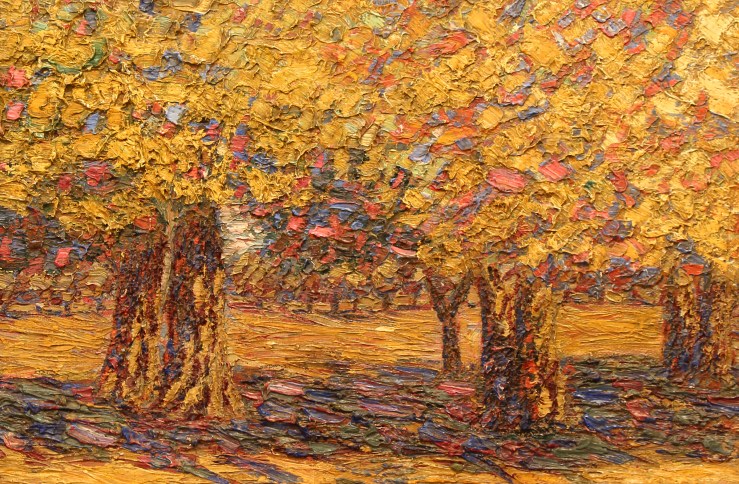
IMG_0474Alfred Morang, Pecan Grove, Oil on Panel

I read every bit of that Tuesday’s paper. It was as if I felt that Alfred would be okay as long as I did not turn the page, but I knew it was time to see what I had come to see. I took a last look at the classifieds and marveled at an ad for a 2-bedroom adobe with wall-to-wall carpet “close in” for $16,500 and then I hit the button and watched the microfilm reel turn slowly.

The first thing I saw positioned on the top left side of the front page of that Wednesday edition of the Santa Fe New Mexican was a large photograph of a cat crouching on the corner of a charred mattress. The rest of the bed was strewn with papers and tubes of paint. Underneath the right half of the photo was a caption “Mourning for Her Master…This lonely cat was found wandering through the charred ruins of the home of her master Alfred Morang who died in the fire early this morning. The cat is on the bed where he died.” Morang’s friends had commented on his love of cats and noted that he often went hungry himself so he could afford to feed them. Two other cats perished in the fire with him. Unfortunately I discovered that the cat on the mattress in the picture had to be put down because it had extensive lung damage. There was also a picture of Alfred. A cigarette in a holder was hanging from the corner of his mouth dangling over his scraggly beard and he was wearing a black hat with a brim that was tilted slightly to the left making him look decidedly like an artist and decidedly French. The story next to the photo read “Well Known Artist Dies In Home Fire… Alfred Morang, 56, one of Santa Fe’s best known and most colorful Bohemians died at about 1:30 am last night in a tragic fire at his home in the 600 block of Canyon Road.”  Friends reported they had last seen Alfred in Claude’s bar around midnight. His apartment was just up the alley out back.

Five days after the fire the New Mexican noted…“Funeral services were held Saturday at the Fairview Memorial Park Crematorium in Albuquerque for Alfred Morang, widely known Santa Fe artist, writer and critic who was burned to death early Wednesday morning in a fire at his home here. The body was escorted to Albuquerque by a group of close friends, including Randall Davey, Will Shuster, Harlan Lizer, Walter Dawley and William Currie. Alfred was transported in a Spanish Colonial coffin made by Abolonio Rodriguez, custodian of the art museum.”
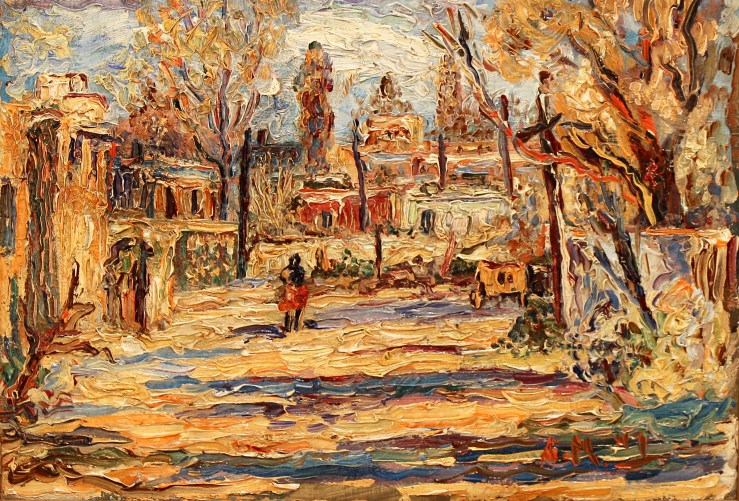
IMG_0505Alfred Morang, Guadalupe Plaza 1947, Oil on Board

Alfred was born in Ellsworth, Maine in 1901 and came to Santa Fe in 1937. Like many who came here he suffered from TB. He immediately became a fixture in the Santa Fe art scene. He wrote a weekly column for the newspaper and he produced a weekly radio program for 17 years on KVSF called “The World of Art with Alfred Morang.” Most of all he was famous for his enthusiasm for art and his ability to teach and many benefited from “The Morang School of Fine Art”.

Walt Wiggins authored a book published in 1979 appropriately titled “Alfred Morang…A Neglected Master”. Walt uncovered several quotes during his research for his book and my favorites include the following.  “When Alfred Morang’s life came to a tragic end in January of 1958 nothing before or since has so shaken the New Mexico art colony. Some say it was a sense of guilt that struck the community for not having shown a greater sense of appreciation for one who, by destiny, was different.” One Santa Fe artist reasoned, “Why shouldn’t Santa Fe be stunned with the loss of Alfred?  After all, he taught half of us how to paint and the other half how to see.”

The February 10th 1958 issue of the Santa Fe New Mexican carried the report of the local memorial service for Alfred in Lorraine Carr’s column “It Happened in Old Santa Fe”. Dr. Reginald Fisher, director of the Art Museum spoke first. “Friends this is not a funeral, we are simply gathered here for a creative expression of merit and appreciation of a spirit that has been active in an activity that we in Santa Fe like to call art. Alfred was an inventive, searching and daring spirit as French as Lautrec, yet he never saw Paris. Last week his restless spirit found peace.”

Painter and close friend Randall Davey was next. “I have known Alfred since he arrived back in 1937. He was a kind, a gentle and a humble soul and in all those years I never heard him speak unkindly of his fellow man. He was a great painter; many of you did not think so, because often he sold his work for a mere pittance through necessity. Nevertheless it was great art and the happiest work I have seen in New Mexico. He had a love and a delight for painting and I doubt that anyone will surpass him in this field.”

IMG_0495Alfred Morang, Untitled (Mountain Landscape), Oil on Board

I hope Alfred enjoyed himself on that Tuesday. I hope he spent some time with friends and some extra time petting his cats. I hope he wrote another poem and put the final touches on his most recent favorite painting before he headed down the alley to Claude’s that evening.

Claude James ran the well-known Canyon Road bar where he often spent time and, as legend has it, her rowdy spirit was just what was needed to run that place. I would love to have met Alfred there that fateful night for a few drinks. I’m sure we would have talked through the evening about art and life as we cast occasional glances at the ever present ladies that were often the subject of his paintings and when Claude said “It’s midnight, would you fellows like another one?”  I would nod and say, how about a couple of shots of your best cognac. I would love to take a sip, lean back and turn to him and say “Alfred I know you often say that you don’t believe in art for art’s sake, but you believe in art for people’s sake. Can you explain to me what you mean by that, and please…take your time?”

A few weeks after I finished writing this story I found myself engrossed in the details of planning a trip to Paris. I was not sure why, but suddenly it came flooding over me with incredible clarity. Human life really is very fragile and it really is all going to come to an end someday and we do not know when. I knew then I needed to go to Paris and I needed to go now. Unfortunately most people have that epiphany too late in life. They start thinking about the things they never got to do after it’s too late to do them. I knew then that this sudden obsession with Paris was a message from Alfred. Paris was his promised land, but he never made it there and I was going to go for both of us.

I told a friend in Santa Fe this story and he said, “You should do something for Alfred in Paris.” It was a great idea, but what would I do? I had been in Paris 5 days when I suddenly knew. I found an image of a Morang painting on my laptop. I printed it and wrote a bit on the back about Alfred and headed off to the Musee d’Orsay. This time as I enjoyed the paintings I was also searching for a repository for Alfred’s work and I finally found it. I can tell you that a fine example of the genius of Alfred Morang now has a home in Musee d’Orsay on the banks of the Seine and it will take a jackhammer to find it. He is close to Monet and Bonnard, the masters he so admired. Alfred, you finally made it.

Source: Bill Tate’s tale first appeared in the 1979 book Alfred Morang: A Neglected Master by Walt Wiggins.
MORANG AND FRIENDS: The Violin

Alfred Morang's Violin will appear in the Morang and Friends exhibition- Matthews Gallery Blog

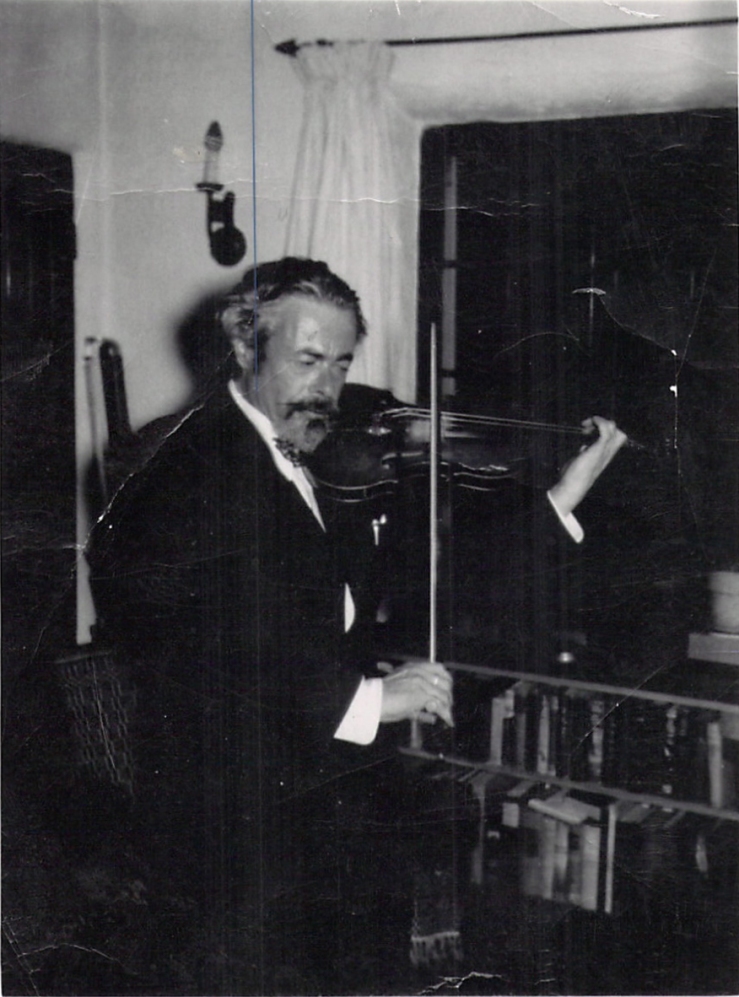
When Alfred Morang was a teenager he took to the nightclubs of Boston with his trusty violin. He had been a sickly child, bedridden and unable to attend school, but his mother and uncle recognized his fiery creativity and hired private music and painting tutors. Morang grew from a talented tot to a full-fledged young Renaissance Man, and his passionate musical performances earned him enough money to thrive. It was the beginning of a lifelong artistic journey.

A century later, Morang’s fiddle launched yet another adventure. Santa Fe art collector Paul Parker was researching Morang’s life when he came upon a letter by the artist’s longtime wife Dorothy. After Morang’s tragic death in a studio fire, Dorothy was having a hard time finding an heir to his worldly possessions. She’d finally contacted a distant relative, and was arranging the shipment of a few things collected from the ruins of Morang’s Canyon Road casita.

Santa Fe Artist Alfred Morang Playing the Violin- Matthews Gallery BlogAlfred Morang playing his violin

The letter was Parker’s first clue in a treasure hunt that spanned the nation and stretched to the farthest branches of the Morang family tree. At the end of the trail was a treasure trove that connected the dots of Morang’s life, from his early years as a celebrated musician and writer to his time as an iconic Santa Fe artist. Morang’s well-worn violin, blackened by the fire, is perhaps Parker’s most striking find. It will appear alongside Morang’s artwork in our December 12-26 exhibition MORANG AND FRIENDS.

We interviewed Parker about his search for the fascinating artifacts that will anchor our exhibition to this legendary Santa Fe master:

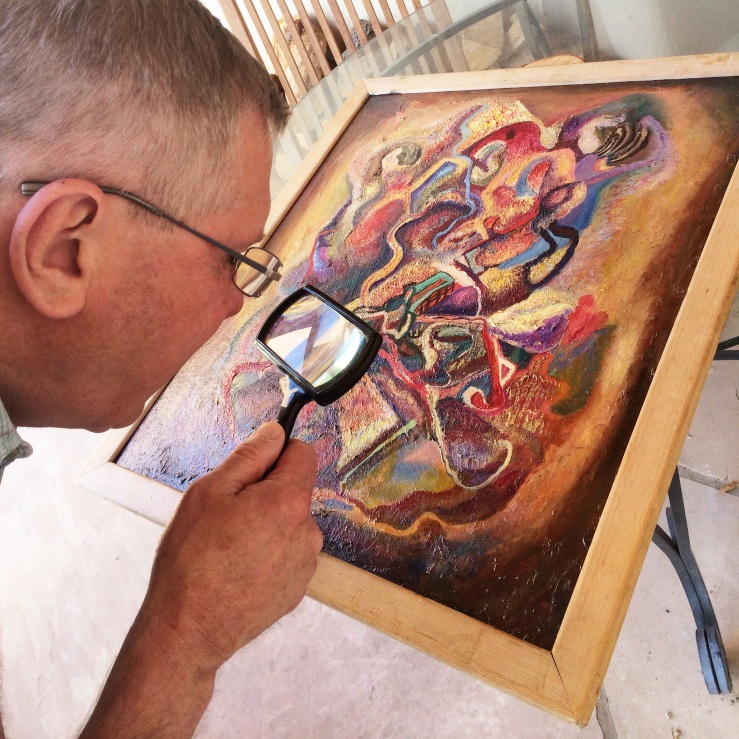
Paul Parker Inspects a Painting by Alfred Morang- Matthews Gallery Blog Paul Parker inspecting a painting by Alfred Morang


 How did you first get interested in Alfred Morang?

I came to Santa Fe in the 1990’s, and met Jim Parsons in Taos not long after. He had a little booth with a rack of prints and drawings and things, and he had a pile of books called The Art Fever. We hit it off and just talked and talked, and I bought a copy of his book. I took it home and read it, and realized who I was talking to.

There was a time when Jim Parsons was the most powerful person in the Western art business. Back in the day, he had a little art gallery in his Denver apartment. He convinced Philip Anschutz to start a Western art collection, which is now the largest and most prestigious collection of Western art in private hands in the world.

Jim was a giant Morang fan, and he showed me his work. I became instantly fascinated with Morang’s story. I had seen his paintings in El Farol but didn’t know anything about him until Jim told me.

Tell me about Morang’s childhood.

He was born in a little town called Ellsworth, Maine. There’s still a Morang Chevrolet in Ellsworth that his father owned with another partner. He and his mother had a very close relationship.

Even as a child, Morang was something of a polymath.

 Yes, he learned from Carrol S. Tyson and other American Impressionists. He was also the youngest-ever solo violinist to play at Jordan Hall in Boston. I mean, he was a very accomplished musician. His wife Dorothy was a member of the music conservancy in Boston. That’s where he met her.

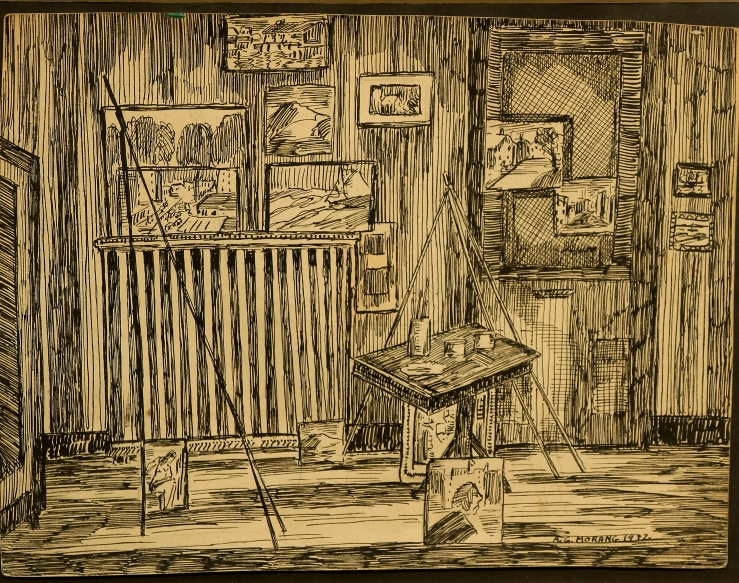
Alfred Morang- The Artist's Studio Portland Maine- Pen and Ink- Matthews Gallery Blog

Alfred Morang, Artist’s Studio-Portland, 1932, Pen and Ink


He and Dorothy lived in Portland, Maine before his tuberculosis forced them to move to Santa Fe in 1938. Morang had a successful a writing and painting career back East. What are your thoughts on his early work?

I’ve seen some of his work from back then. Like a lot of artists, when Morang came to New Mexico and saw the color and the light and everything, it inspired him. I think that’s the biggest thing.

It’s almost akin to my life. I thought I enjoyed art, but until I moved to Santa Fe, until I drove by 100 galleries every night on my way home and everybody that I associated with and talked to was in the business in some way, shape or form, something about that was really inspiring.

Artifacts of Santa Fe Artist Alfred Morang to Appear in December Exhibition- Matthews Gallery BlogSanta Fe New Mexican columnist Lorraine Carr covered Morang’s memorial service in February, 1958


How did you start hunting for the box of Morang’s possessions?

I was writing a story about Morang, and I went to the library to find out what the newspaper said when he died in 1958. I was reading all of the articles and eulogies and things, and I thought, ‘This is an amazing man.”

After I went to the library that day, I realized I needed more research, so I went to the New Mexico Museum of Art and searched their archives for anything I could find in Alfred Morang’s folder. That’s when I found Dorothy Morang’s folder, and saw her letter. It said that she had sent this box of Morang’s possessions away to Carrie Morang Robinson in Atlanta, Georgia. All I had was the name Carrie Morang Robinson and this address in Atlanta. I did my research and found out that she was deceased. I couldn’t find any relatives, and her former house had a different owner.

 That must have seemed like a dead-end.

Yeah, I made several phone calls and then just kind of gave up for a while. Then something hit me a couple months later and I said, “Damn it, I’m going to try again.”

I did some more research and tried to find Alfred’s relatives. Carrie Morang Robinson was the daughter of one of Alfred Morang’s uncles because she was a cousin and had the family name. I found one uncle’s name through the Morang Chevy dealership in Ellsworth, but then I ran into another dead-end.

A couple months later I got a Maine antiques publication, and there was something about ancestors in it. I got some other names of who Carrie Morang Robinson’s father might have been. I found some members of the Robinson family, and started researching them.

You were making some headway!

 I just start calling people again, and this woman whose name was Robinson came up. I called her, and she said, “Oh, our cousin Alfred. Our mother used to tell us about him.” I started telling her a little bit of the story, and she said, “You have to talk to Gwen.” I just lit up, because Gwen was Carrie Morang Robinson’s granddaughter and lived with her grandmother in the final years of her life. Now Gwen owns Carrie’s house.

I called Gwen up, and she had all of these family stories about Alfred, that he used to go through the woods with his violin and his cats following him. “Weird cousin Alfred” or something like that. She said, “Well, if my grandmother owned the box, it’s probably still up in the attic.” Then I got excited.

You were one step away. It must have been tantalizing. 

Well, Gwen was renting the house, so she told me she’d search for the stuff the next time she was in Atlanta. A month or two goes by, and I call her up again. She says, “We’ll be selling the house, so I’ll look for it then.” A long period of time goes by, and all of a sudden I hear the phone ring one day. “Well, I found your box,” she says. “I’ve got a couple more things—a violin and a painting.”

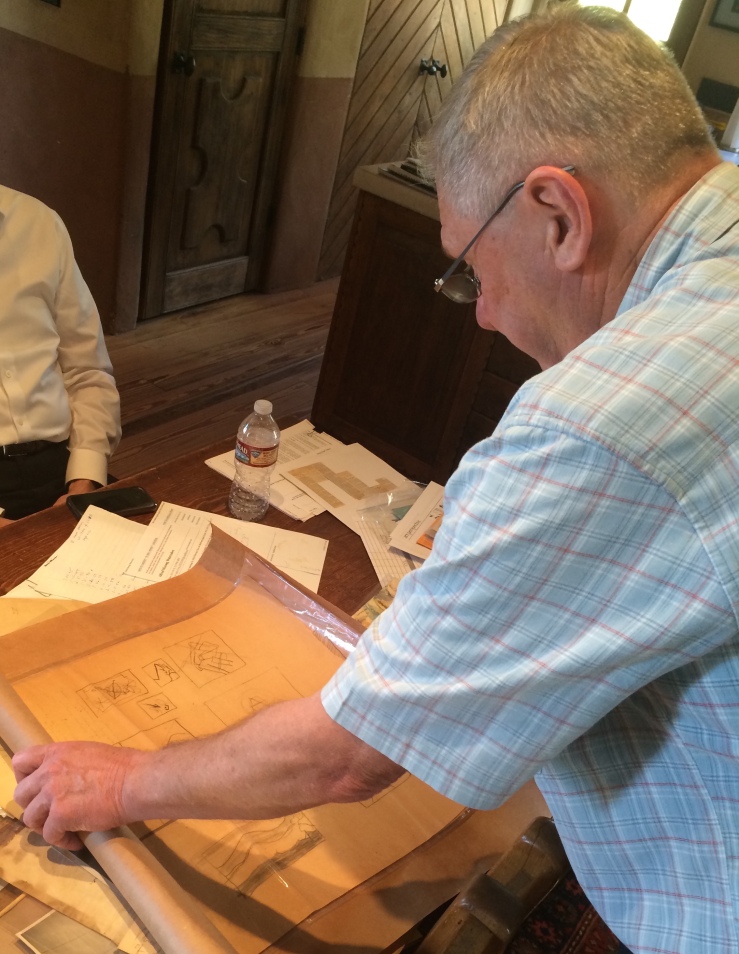
 Paul Parker Surveys Artifacts of Legendary Santa Fe Artist Alfred Morang- Matthews Gallery BlogParker surveys sketches and other artifacts of Alfred Morang


How did it feel when Morang’s artifacts finally arrived at your door? 

It was absolutely phenomenal. It was like the biggest Christmas ever. To see that violin and just to touch it. Talk about personal.

The box was full of many different short stories and manuscripts, which he submitted to radio stations to be read as radio plays. Many of these stories were never published, and might have been lost forever.

Did this elaborate hunt make you wonder why someone didn’t try to keep the artifacts in Santa Fe? 

Dorothy and Alfred got divorced in 1950, but even then Dorothy kind of watched out for him. When he died, she knew about this cousin Carrie Morang Robinson, who was the only rightful heir to his possessions. Dorothy stepped up to help contact her, and at the time it wasn’t a big deal to send them away.

One of the stories that Morang’s adopted daughter Claire LaTour has told me is that they didn’t know what to do with his ashes. They left them in a closet in the art museum after the last memorial service. Claire came back, and somebody flew her over Canyon Road and she dumped his ashes out the window of the airplane, which was a difficult task. She told me, “I was wearing a fur coat, and I always laughed that forever afterward I was brushing Alfred out of my coat.”

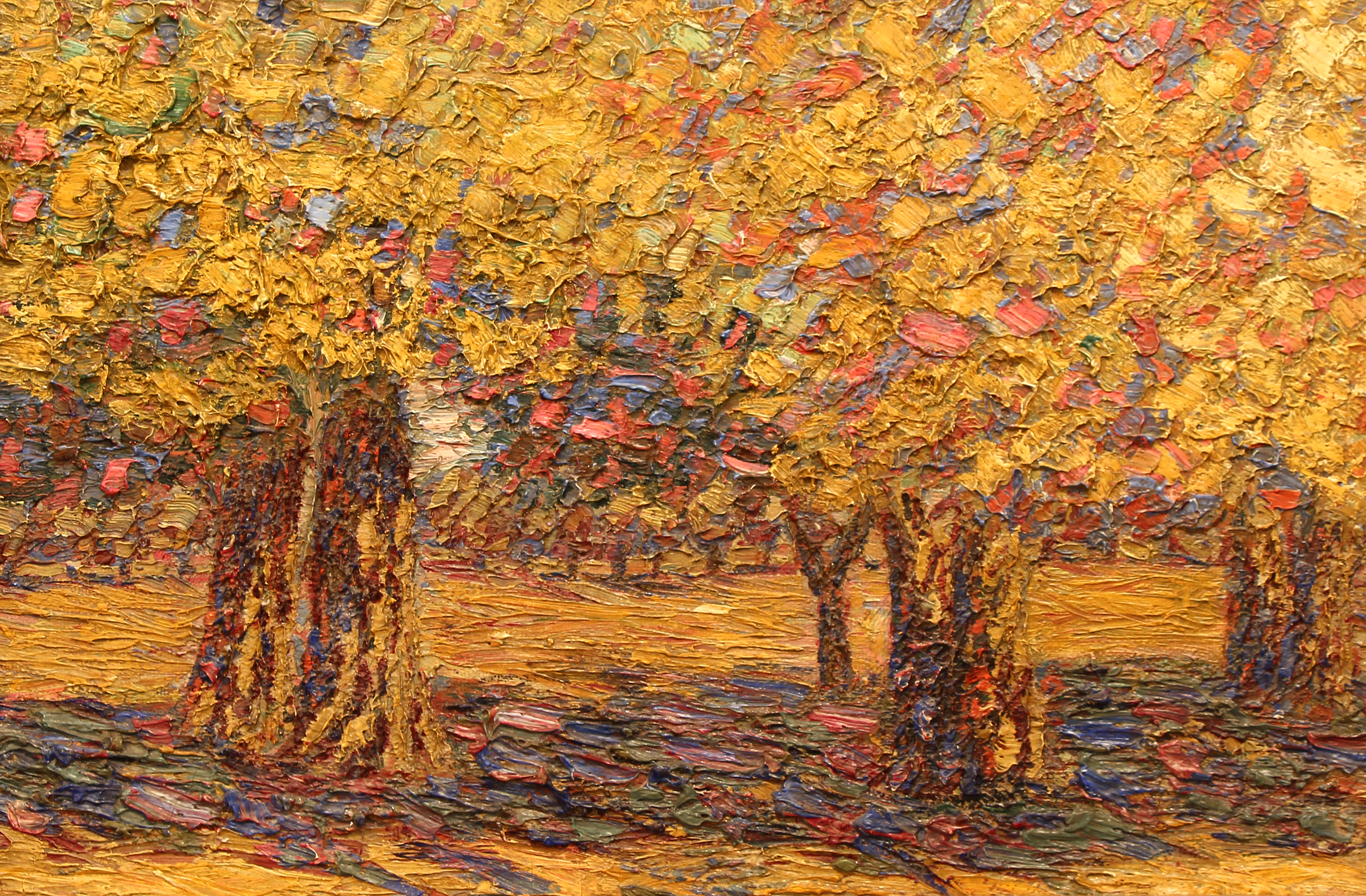
Alfred Morang- Autumn in the Park- Oil on Canvas- Matthews Gallery BlogAlfred Morang, Autumn in the Park, 1954, Oil on Canvas


Morang’s colorful personality often overshadows his artwork. Is that frustrating for you, as a big fan of his work ?

It’s the same frustration that I have now with van Gogh. I know from all my research that van Gogh was not a crazy man. He had epileptic fits that affected his life and personality, but he was a very brilliant man and definitely not insane.

It’s almost the same thing with Alfred. People like the story of a bohemian alcoholic, something that fits better with the story of Toulouse-Lautrec. He wasn’t an alcoholic. He couldn’t have done the things that he did if he were an alcoholic.

The greatest quote that I’ve ever heard about an artist is from Morang’s memorial service. It’s not attributed to anybody specifically, but an unknown artist said, “It’s no wonder that we in Santa Fe mourn the loss of Alfred, he taught half of us how to paint and the other half how to see.” After Morang’s death, all of a sudden people started to realize that he was a great artist. People regretted that they didn’t pay enough attention to him.

Coming up next week, Paul Parker digs up more mysteries of Alfred Morang’s life and travels to Paris to complete a mission in Morang’s memory. Make sure to connect with us on Facebook, Twitter and Instagram for daily updates on MORANG AND FRIENDS.

COLLECTOR’S FORUM: Join the Network

Get Connected- Collector's Forum Workshops- Matthews Gallery blog

Seats are filling up for our free COLLECTOR’S FORUM workshops, which begin next Friday as part of the Santa Fe Gallery Association’s Art Matters lecture series. The events have already given us the opportunity to connect with art lovers of all stripes. As the news spreads from person to person, a network is forming with links to local art legends like Alfred Morang and Fremont Ellis.

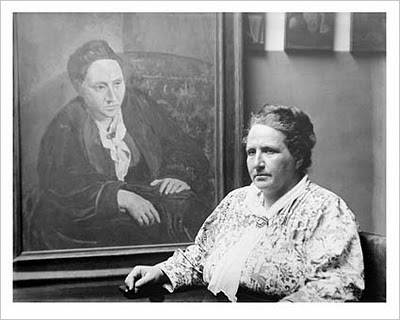
Gertrude Stein with her famous Picasso portrait- Matthews Gallery blogGertrude Stein with Pablo Picasso’s famous portrait of her

That’s why this lovely friendship map of Parisian modern artists and patrons from the early 20th century caught our eye on Twitter the other day. Celebrated salonniere Gertrude Stein is the spider at the center of the web, of course, with Pablo Picasso and Henri Matisse and Joseph Stella and Henri-Pierre Roche entangled around her. Mabel Dodge and Marsden Hartley appear too, and their later New Mexico adventures tie this famous circle directly to our own rich cultural history. Forget six degrees of separation, we’re down to one!

The art world is beautifully interconnected, but that doesn’t mean it has to be exclusive. Our workshops are designed for anyone who’s ever considered dipping a toe into the art market, whether you have a full array of masterpieces or a virtual wish list of art treasures on Tumblr. We’ll cover every angle of the art business, including:

  • How the price of artwork is determined
  • How the primary art market differs from the secondary market
  • The importance of provenance
  • When conservation should be considered for an artwork and what is involved
  • How to insure your artwork
  • How to receive an accurate art appraisal
  • How to negotiate the purchase of art
  • The best strategies for buying or selling art at auction

The workshops will feature fascinating behind-the-scenes stories from our gallery, and tales of tricky art conservation projects from special guest Matt Horowitz. Shoot us an email to reserve your seat and become a link in the long chain of art connoisseurs, from the City of Light to the City Different!

Learn more about COLLECTOR’S FORUM on our exhibition page, and connect with us on Facebook and Twitter for daily gallery news.

ONE WORK OF ART: Beatrice Mandelman’s ‘Cool Wind’

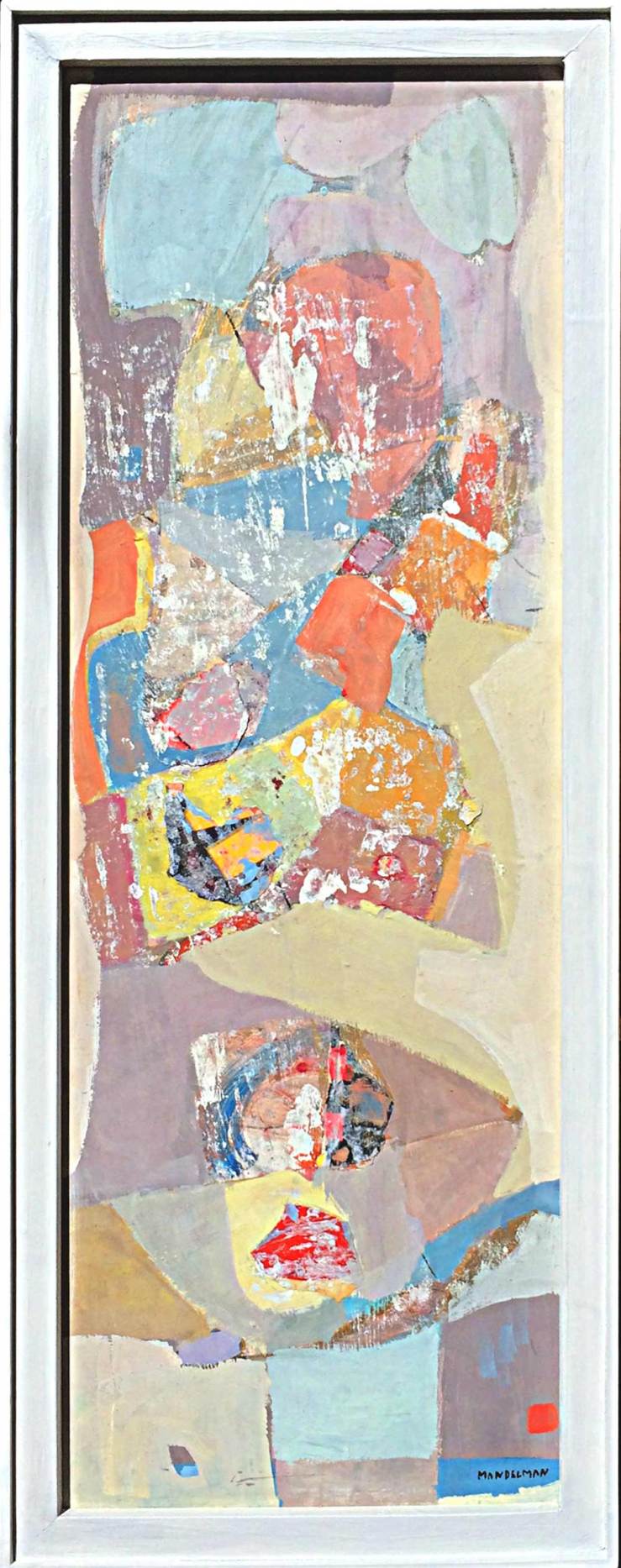
Beatrice Mandelman- Cool Wind circa 1950- Matthews Gallery

Beatrice Mandelman, Cool Wind c. 1950, Casein with Collage on Masonite Panel

When John Sloan invited Beatrice Mandelman and Louis Ribak to visit Santa Fe in 1944, the two artists were on the rise among New York City’s avant-garde. They had ties to Hans Hoffman and Fernand Leger, and were often mentioned in the same breath as Jackson Pollock. Sloan, who had been summering in New Mexico for years, had a reputation for spiriting away his favorite artists to the Desert Southwest. During their trip the recently married duo took a train to Taos and decided to stay.

The move marked a radical change in Mandelman and Ribak’s artwork. “We had to start all over again,” Mandelman said. “We spent the first couple years painting landscapes.” They were known for their figurative paintings in New York, but in this radically different environment their focus shifted to pure abstraction. They were trailblazers for a new wave of artists called the Taos Moderns, a movement that enlivened the Taos art colony but enraged an older vanguard of academic painters with ties to the Taos Society of Artists of the 1910’s and 20’s. To this tight clique of romanticists, the newcomers stuck out like colorful cacti—particularly Mandelman.

Portrait of Beatrice Mandelman in her Taos studio circa 1950- Matthews Gallery Beatrice Mandelman, 1950

“She worked with full abstraction at a time when most artists were not daring enough to do so,” writes David L. Witt in his book Taos Moderns, noting that Mandelman considered herself “the first of the second generation of artists in Taos.” The voice of a young, female abstract painter had never been part of the remote art community.

Far from the big city, Mandelman developed a new appreciation for the natural world and humanity’s relationship with it. By the late 1940’s she was developing an abstract symbol system to express her emotional responses to the landscape. Her elegant compositions didn’t mimic the lines or palette of the high desert, but they perfectly evoked the strong, solitary spirit of its inhabitants.

The mixed media painting in our collection was likely done in the 1950’s. Early in her experiments with abstraction Mandelman chose a muted palette, but here brighter colors poke through. This more expressive style was inspired by Henri Matisse and Mandelman’s former teacher Leger, and allowed her to explore the highs and lows of human experience with great vigor. Cool Wind‘s undercurrent of chilly blues and bright accents of orange and red call forth the sensation of a shiver passing up the spine.

As the evenings get cooler in Santa Fe, we’ve developed an ever-evolving passion for this piece and the innovative artist who created it. Learn more about Beatrice Mandelman on our website, and connect with us on Facebook, Twitter and Instagram for daily gallery news.

ROCH HART: Mystery of the Petroglyphs

Roch-Hart-New-Mexico-Jeep-Tours Roch Hart’s jeep outside Matthews Gallery

Roch Hart is the first and only fine furniture maker in our stable, but he also has a pretty awesome day job. As the owner of New Mexico Jeep Tours, Hart takes visitors on rugged expeditions across a 20,000 acre private ranch between Santa Fe and Albuquerque. The property is home to wild horses and numerous petroglyphs left behind by ancient Pueblo cultures.

We first met Hart through the image sharing website Flickr, where he posts stunning photographs from his adventures. We had no idea that he was also a master craftsman until he reached out to us. Not long after, a big red jeep full of beautiful hand-carved benches appeared outside the gallery. When we saw how good Hart’s work looked in our Southwestern art room, we knew it was a perfect match.

It didn’t take long to realize that Hart’s adventurous occupation and his impressive hobby were connected. As chronicled in previous posts, many of his works feature symbols from the petroglyphs he discovers on the ranch. The ancient marks are part of a complex language, and their meanings are partly lost to history. Luckily, Hart is a passionate detective. We asked him to show us some of his photos and tell the stories of petroglyphs that have inspired his work.

Take it away, Roch:

New-Mexico-Flag-Roch-Hart

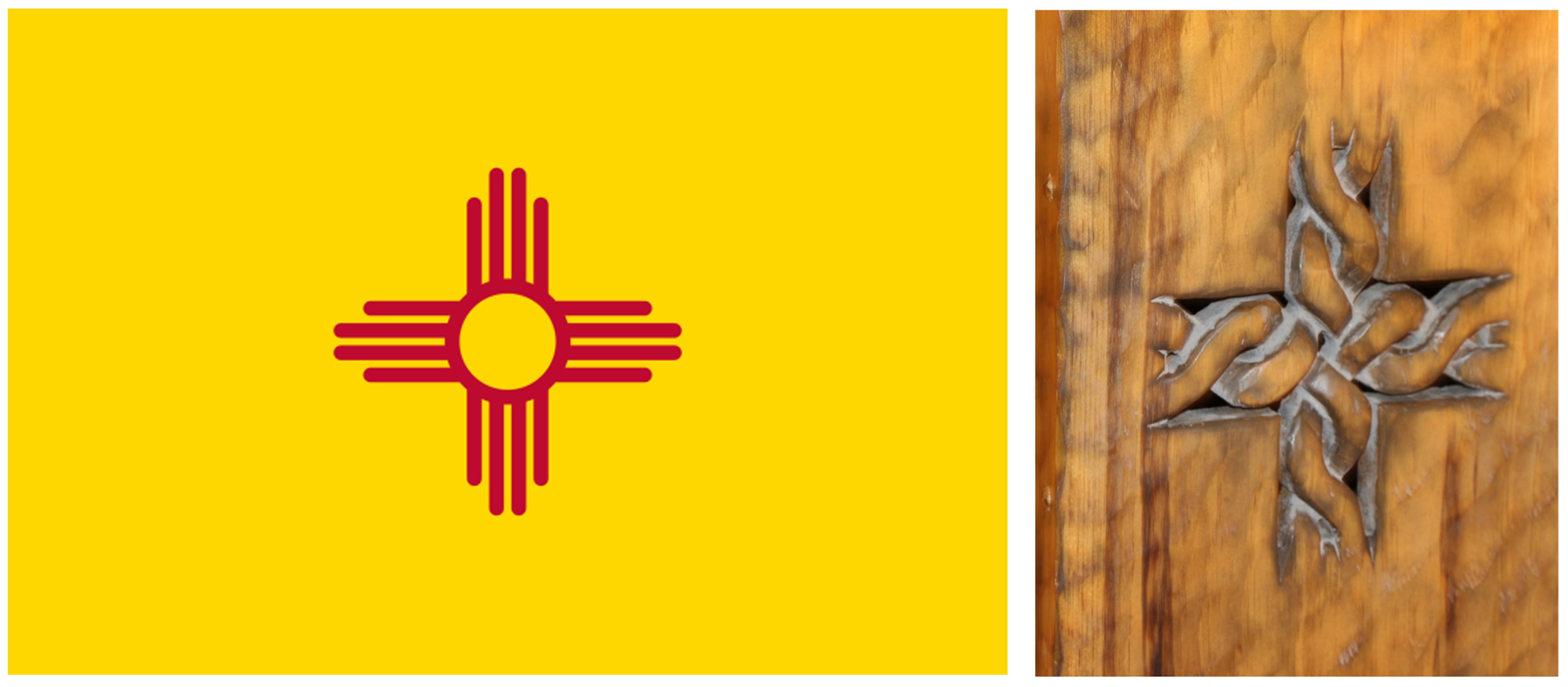
New Mexico state flag, and a cross from Roch’s pie chest ‘The Way

In petroglyphs, the same symbol can hold multiple meanings. Take for example the Zia symbol on our state flag. Our European or Western paradigms might lead us to interpret the Zia as a simple, decorative depiction of the sun, but in the Pueblo culture these symbols were a communication form rather than an art form.  The circle of the Zia represents the circle of life. The four rays radiating from the circle represent many different things: the four directions, the seasons, the elements or even four stages in a person’s life. In the Pueblo culture, the four is a sacred number. I have found petroglyphs with faces whose mouths are in a square shape, perhaps speaking of the fours.

Roch-Hart-The-Way-Petroglyphs

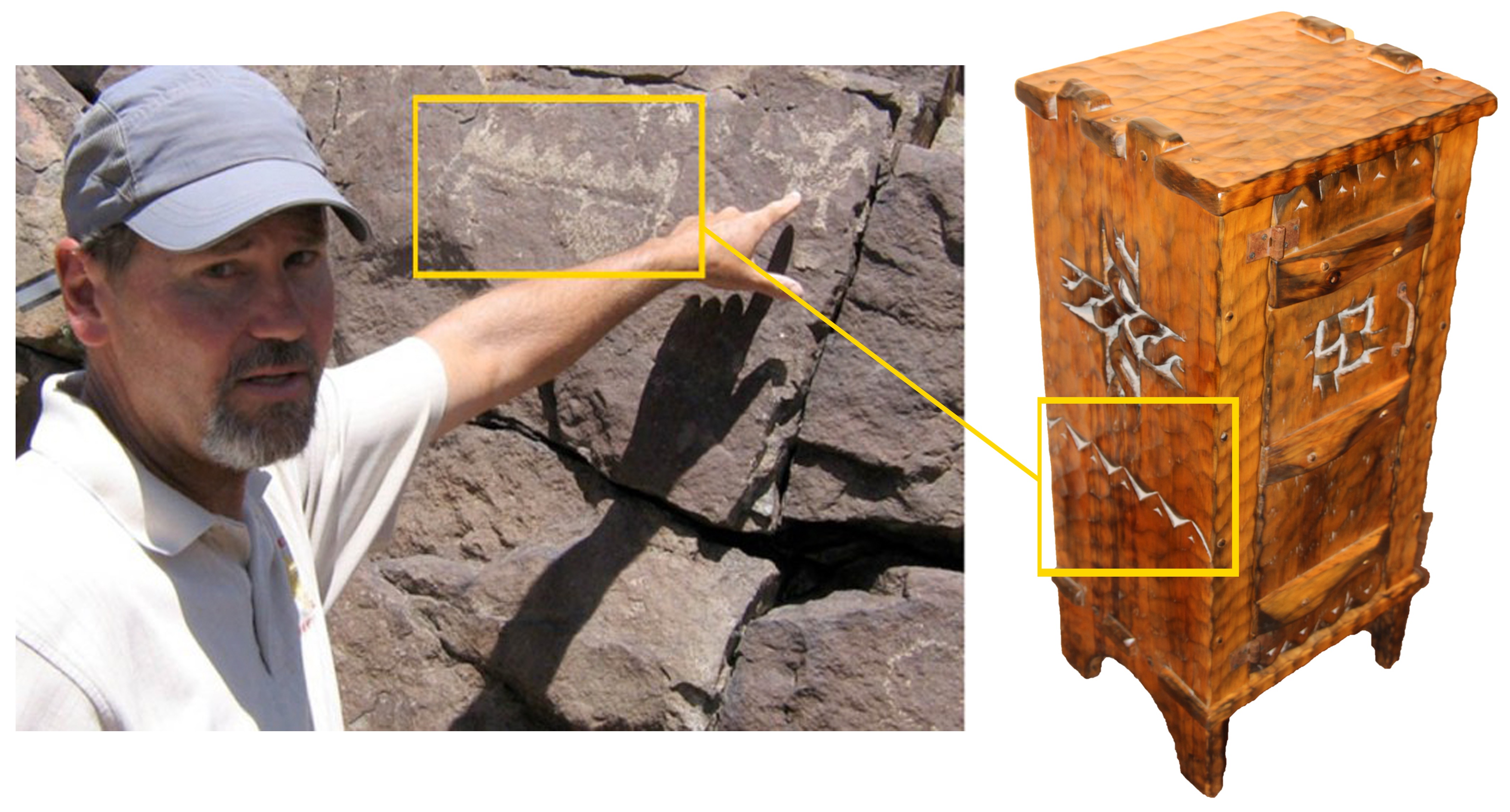
Roch Hart with New Mexico petroglyphs, a similar design on Hart’s pie safe ‘The Way

Sometimes petroglyphs mimic the lines and rhythms of nature. I’ve been told by a trusted, unnamed native source that the triangular petroglyphs in the photo above represent mountains. The straight lines below the mountains may represent mesas, and below that is a mark that resembles a body of water. This could be a map of sorts. Not far from this petroglyph, there is a small pond with a view of mesas and the Jemez Mountains. On my latest pie safe, ‘The Way, I carved a similar pattern to represent mountains.
Roch-Hart-Petroglyph-Shield-WarriorShield Warrior petroglyph, photo by Roch Hart

In the world of petroglyphs there is a common theme of anthropomorphism (I really just like saying that word). Humans will sometimes take on the form of an animal, insect, or warrior shield. In the simple petroglyph above, a circled cross with a head and eyes represents a Shield Warrior. If we were still doing petroglyphs, this one could have represented me during my days as a cop. As you can see, this little guy also has the cross in his shield, representing the fours or ‘the way.’
Roch-Hart-Bear-Claw-PetroglyphsBear claw petroglyphs with storyteller and listener faces, photo by Roch Hart


Another common theme in petroglyphs is the ‘yin and yang.’ For instance, every storyteller needs a listener. The images above show petroglyphs that represent bear tracks. The tracks come in pairs, and each track has a face inside it representing a storyteller or a listener.

Roch-Hart-Storyteller-Faces

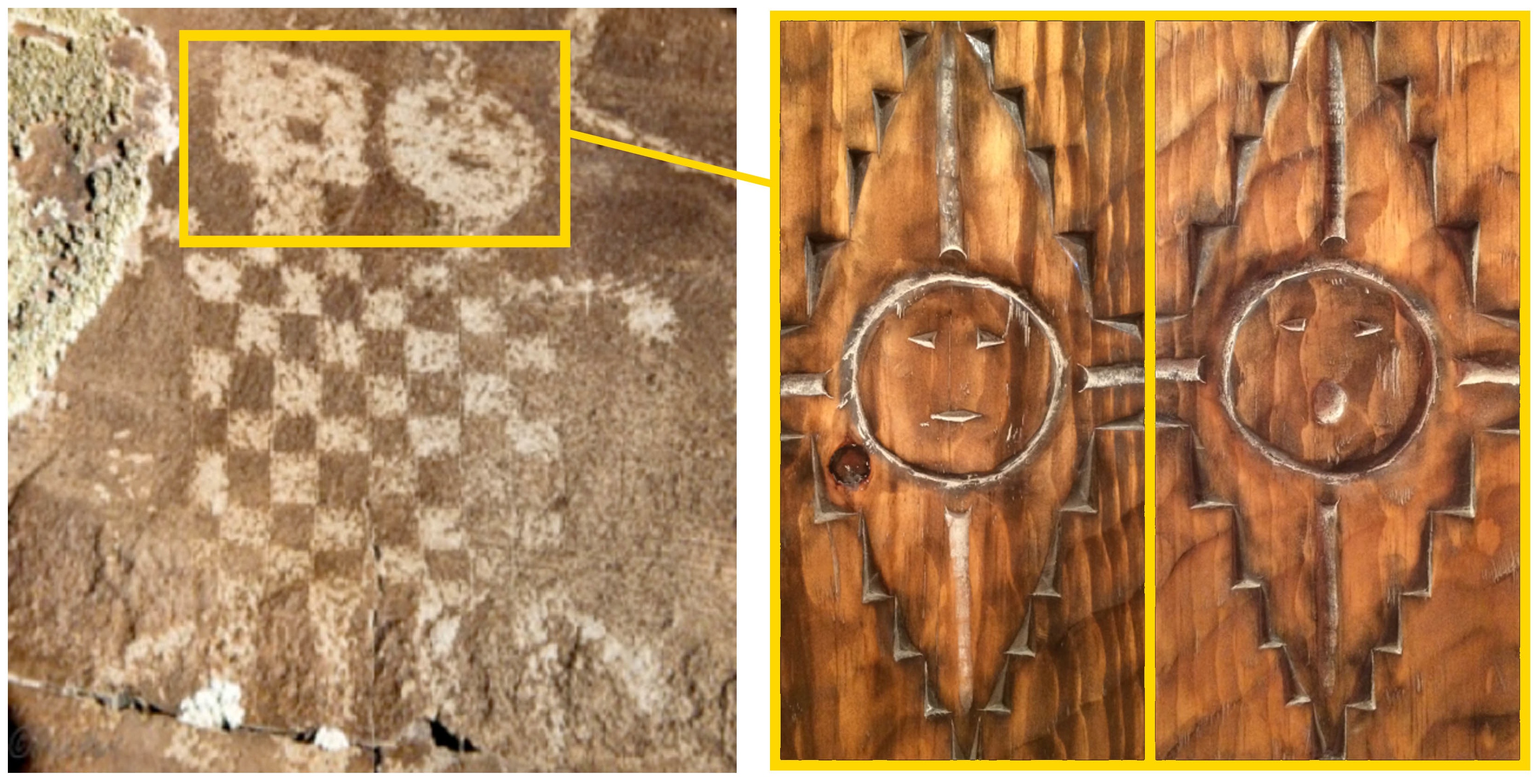
 ‘Marriage’ petroglyph, faces on Hart’s pie safe ‘The Storytellers

I call the petroglyph above ‘The Marriage.’ You can see two distinct people occupying one checkerboard body. If you look carefully, the square head appears to be speaking while the round head has its mouth closed. My pie safe called ‘The Storytellers‘ explores this theme of opposites. The listener and the speaker depend on each other.

Roch-Hart-New-Mexico-Petroglyphs

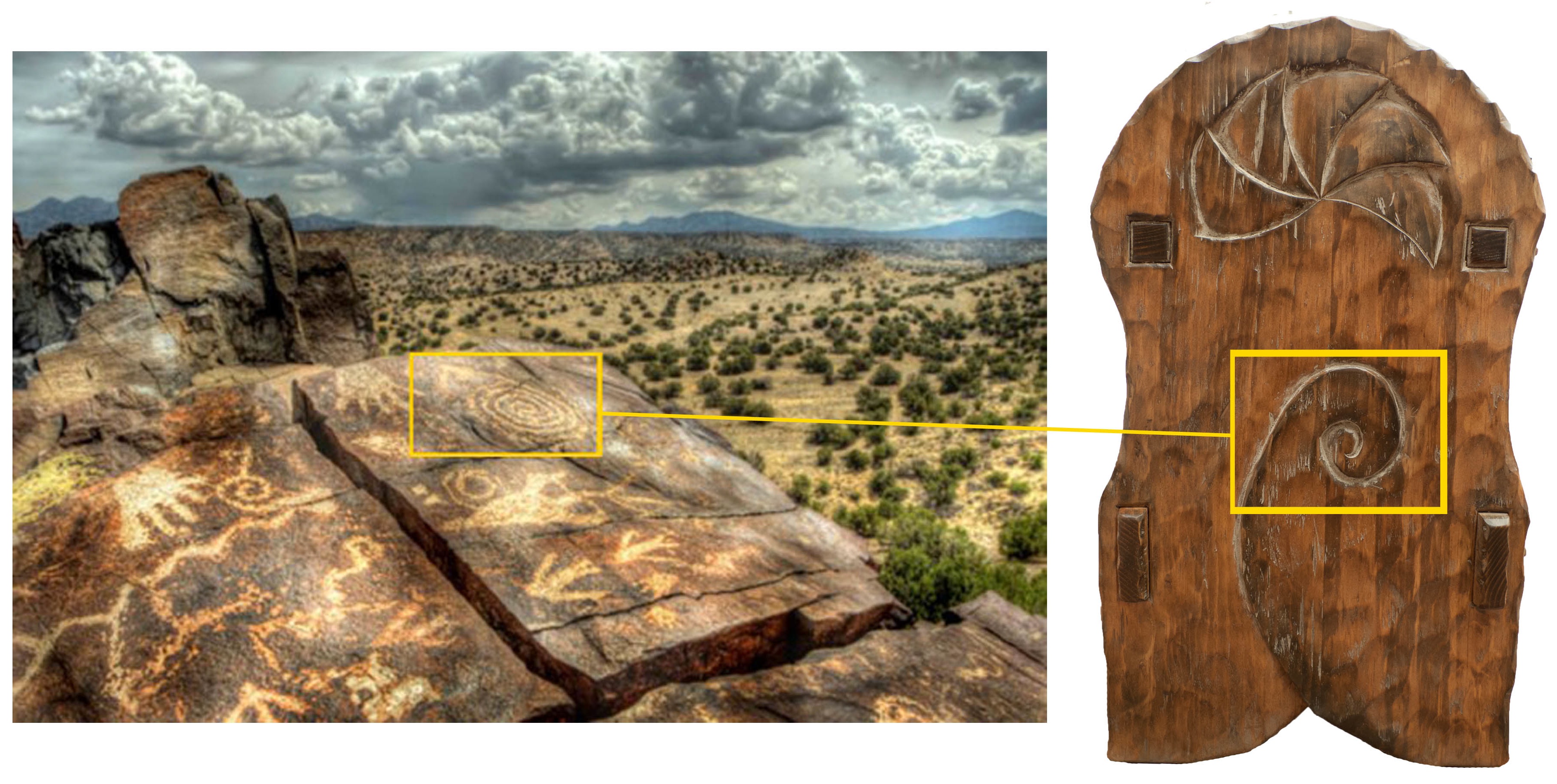
New Mexico petroglyphs, a spiral design on a bench by Roch Hart

Another common symbol is the spiral.  Spirals or concentric circles often represent time or travel.  I have found that cracks are often incorporated into these petroglyphs and I will find a spiral with the outer end going to or ending in a crack.  A common legend amongst the Pueblo natives is that they originated under the earth’s crust and made the journey to surface.  I believe these spirals convey that journey.  On one of my early pie safes, I placed a spiral on the door with the tail leading up to the middle joint of the door.

 Screen Shot 2014-09-11 at 6.22.02 PMNew Mexico petroglyphs

Petroglyphs are very complex and have multiple layers of meaning and legend.  This blog post just scratches the surface, so to speak.  We have lost much knowledge of petroglyphs because early Spanish priests saw them as spiritualism apart from Catholicism. Catholicism was the state religion and the only legal one, so petroglyphs were outlawed.  In fact we often find crucifixes etched into the stones near these sites, placed there by the early priests to exorcise the place of evil spiritualism and to remind the Pueblo natives that this was not longer an accepted practice.

While part of me is upset about how we lost the knowledge of these ancient symbols, I enjoy that I don’t completely understand the mystery.  I love the idea that in some respects it is open to the interpretation of the beholder. Only the maker knew.

To make my fine furniture, I blend influence from the native cultures with my knowledge of Spanish colonial carpentry laws. That’s how I arrive on how to make a piece down to the joinery. But that’s for another blog post!

To see more photos by Hart, make sure to check out his Flickr account. See all of his furniture on our website, and connect with us on Facebook, Twitter and Pinterest for daily gallery news.


The Boundless Moment: Words and Images

Eric Thompson- The Photographer- Matthews Gallery blog

 Eric G. Thompson, The Photographer, Oil on Linen

For the past week, excited art pilgrims—determined to visit every gallery on Canyon Road—have marched purposefully into our front room and come to a screeching halt. Our Eric G. Thompson show ‘The Boundless Moment‘ is a little different from most of the exhibitions you’ll see on this famous art route. Accompanying many of Thompson’s serene realist paintings are writings by great American poets, from Elizabeth Bishop to Walt Whitman.

The interplay of words and images has compelled viewers to slow down and look twice, sparking many a fascinating observation. Most notably, journalist Alison Oatman of the Weekly Alibi attended our opening and wrote an elegant, poetry-filled review of the show.

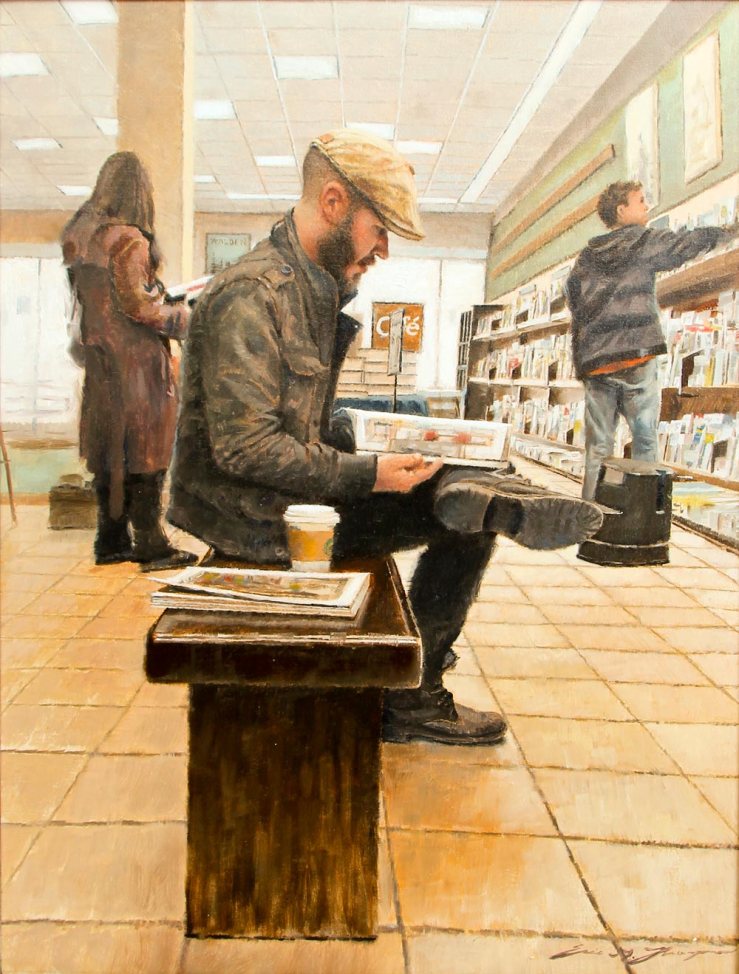
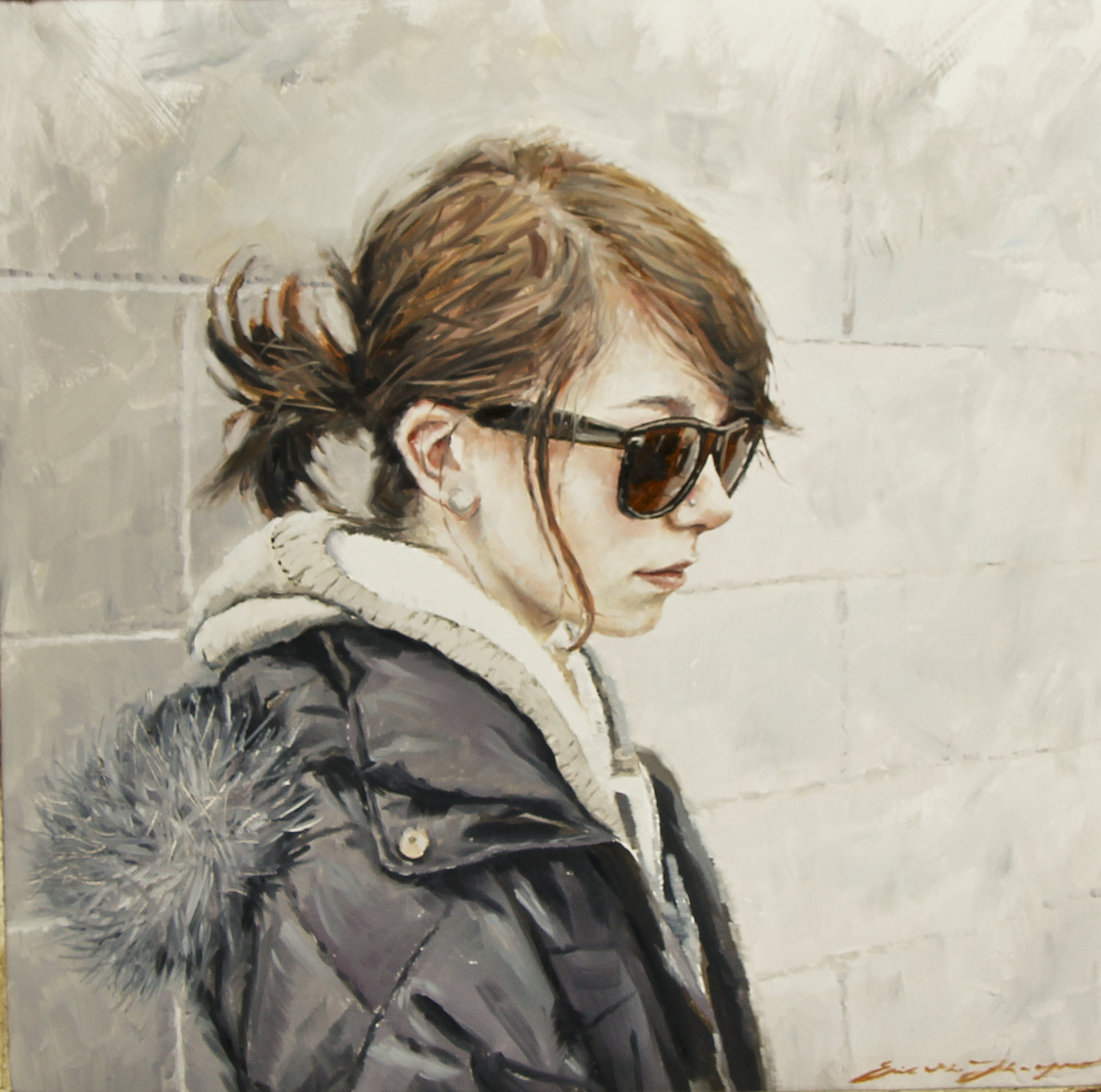
Eric G. Thompson- Coffee Shop Girl- Matthews Gallery blog

Eric G. Thompson, Coffee Shop Girl, Oil on Panel

An excerpt from Oatman’s article:

Robert Lowell’s “Epilogue” [is] paired with the painting “Coffee Shop Girl.” Lowell writes: “I hear the noise of my own voice:/ The painter’s vision is not a lens,/ it trembles to caress the light” [emphasis original]. These lines are reflected in the Coffee Shop Girl’s illuminated face—as pale as rice paper.

Later on, the poem continues: “Pray for the grace of accuracy/ Vermeer gave to the sun’s illumination/ stealing like the tide across a map/ to his girl solid with yearning.” Though large sunglasses hide her face and her meager mouth is expressionless, the Coffee Shop Girl is ravenous. We see her frayed emotional state in the feathery brushstrokes in the background, the squirming reddish-brown tendrils of her ponytail, and the sparkling clusters of dandelion-like fur attached to the hood of her puffy coat.

We spoke with Thompson on the phone today to fill him in on the big response his show has received. The artist was in Santa Fe last week for the opening reception, but now he’s back home in Salt Lake City, Utah. The long drive home gave him time to gather some thoughts on the exhibition. Read our interview below, and make sure to come see ‘The Boundless Moment‘ before it closes on August 28!

Eric G. Thompson- Half Light- Matthews Gallery blogEric G. Thompson, Half Light, Oil on Canvas

Describe your studio. 

My studio is just a few feet away from my house. It has windows with good natural light, so sometimes I can turn off the light and still get what I need. Sometimes I’ll set up my daughter‘s easel next to mine, and we’ll work next to each other. She gets to see what her dad does. Most of the time the kids aren’t allowed in the studio, though. I’ll play underground folk music, and when I’m really inspired it feels like the music is flowing straight through my brush.

You work in oil, egg tempera and watercolor. How do you choose which medium to use for a new painting? 

Between the three of them, if I want to capture something a little more loose and light I go for watercolor. If I want to capture something very solid, heavy and thick I’ll go with oil. If I want to capture something a little more photorealistic, I go with egg tempera. It gives you a lot of freedom to express the story or the emotion that you’re trying to convey with each medium.

It can be refreshing, but it can also be almost maddening. They’re all so different, it’s unbelievable. You have to switch your brain around and remember how to use that medium. It can be completely challenging, which I love. That’s one of the greatest thing about painting, is the challenge. I can always let a painting go as long as I have another challenge.

Eric G. Thompson- Nestled- Matthews Gallery

Eric G. Thompson, Nestled, Oil on Panel

Alison Oatman’s review in The Alibi begins with, “One question contemporary realist painters often get is, ‘Why not simply take a photograph?'” Over the course of the article, she critiques that particular line of thought. What’s your answer to that question? 

To a lot of artists, it’s not a great compliment when a viewer says, “That looks just like a photograph.” Maybe to a photorealist that would be flattering, but I think the greatest artists of all time have that balance of, it looks like a painting but it looks so ‘real.’ I’ve made it come to life.

Why does someone need a painting to look just like a photograph? What’s the power in that? Technically it’s amazing, but where’s the artistic freedom? I need artistic license to change things and blur edges and sharpen edges and change value to make it more ethereal.

I can make a painting look like a photograph but then there’s no energy, there’s no life to it. I think just adding a little more energy with brushstrokes or texture brings it more to life.

One of your influences is the Japanese aesthetic of wabi-sabi. How would you describe it? 

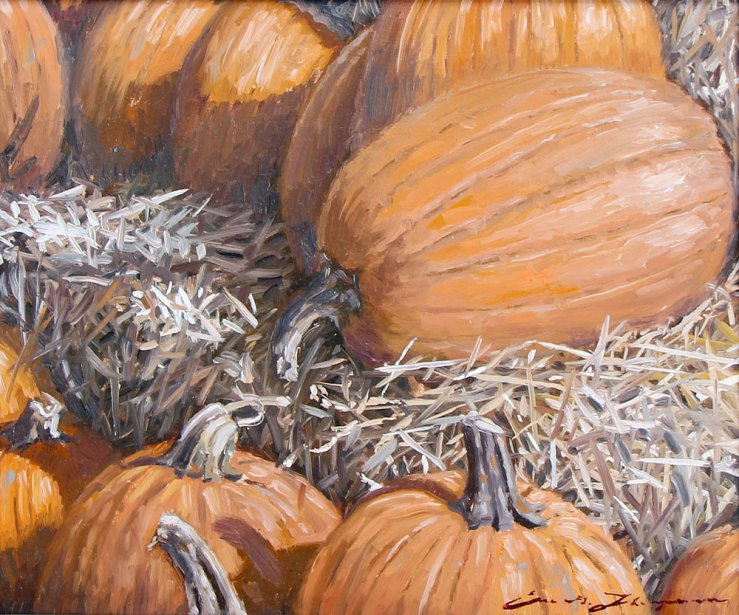
It’s what an object has been through, who used it, who touched it. It’s the patina objects acquire over time, like the rust on an oil can. It just adds to the whole character of the object—I see them as little characters. A cup on a windowsill, an oil can or even pumpkins can have little lives of their own.

Your works seem still at first glance, but a longer look gives me a sense of ‘unfolding,’ of motion. Is that one of our goals?  

It’s about capturing a moment in time that I’d like to freeze and experience for longer than the experienced moments.

I’ve definitely been experimenting with looser brushstrokes toward the outer edges of the painting to give it some energy. I need to experiment to see if I can get the perfect balance of detail and looseness. It’s a way of pushing myself as an artist, and it’s been one of the hardest things I’ve ever attempted.

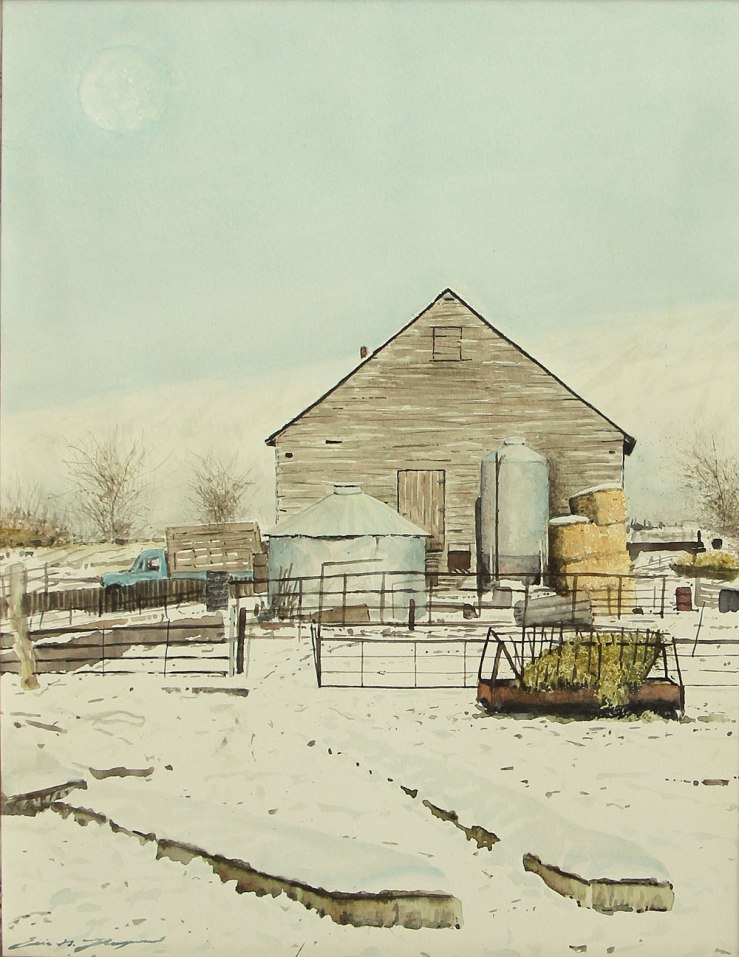
Eric G. Thompson- Winter Moon- Matthews Gallery blogEric G. Thompson, Winter Moon, Watercolor

Which paintings in ‘The Boundless Moment’ are closest to your heart? 

A few of the watercolors are very powerful to me in an emotional way. Just reminding me of something in my past, at my Grandma’s house in Idaho. She had a farm with all of these different structures. They just remind me of that time, and different feelings come up from my childhood.

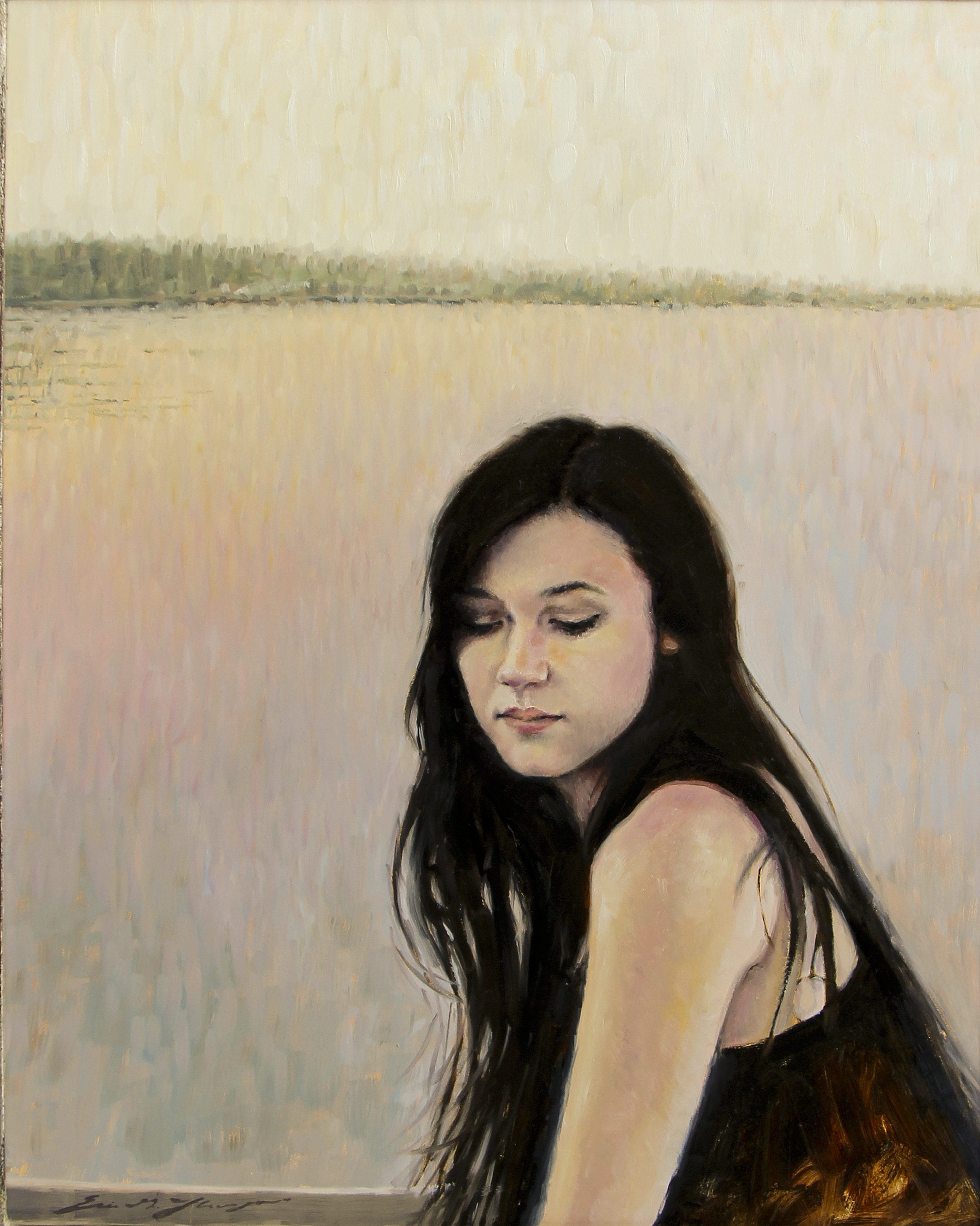
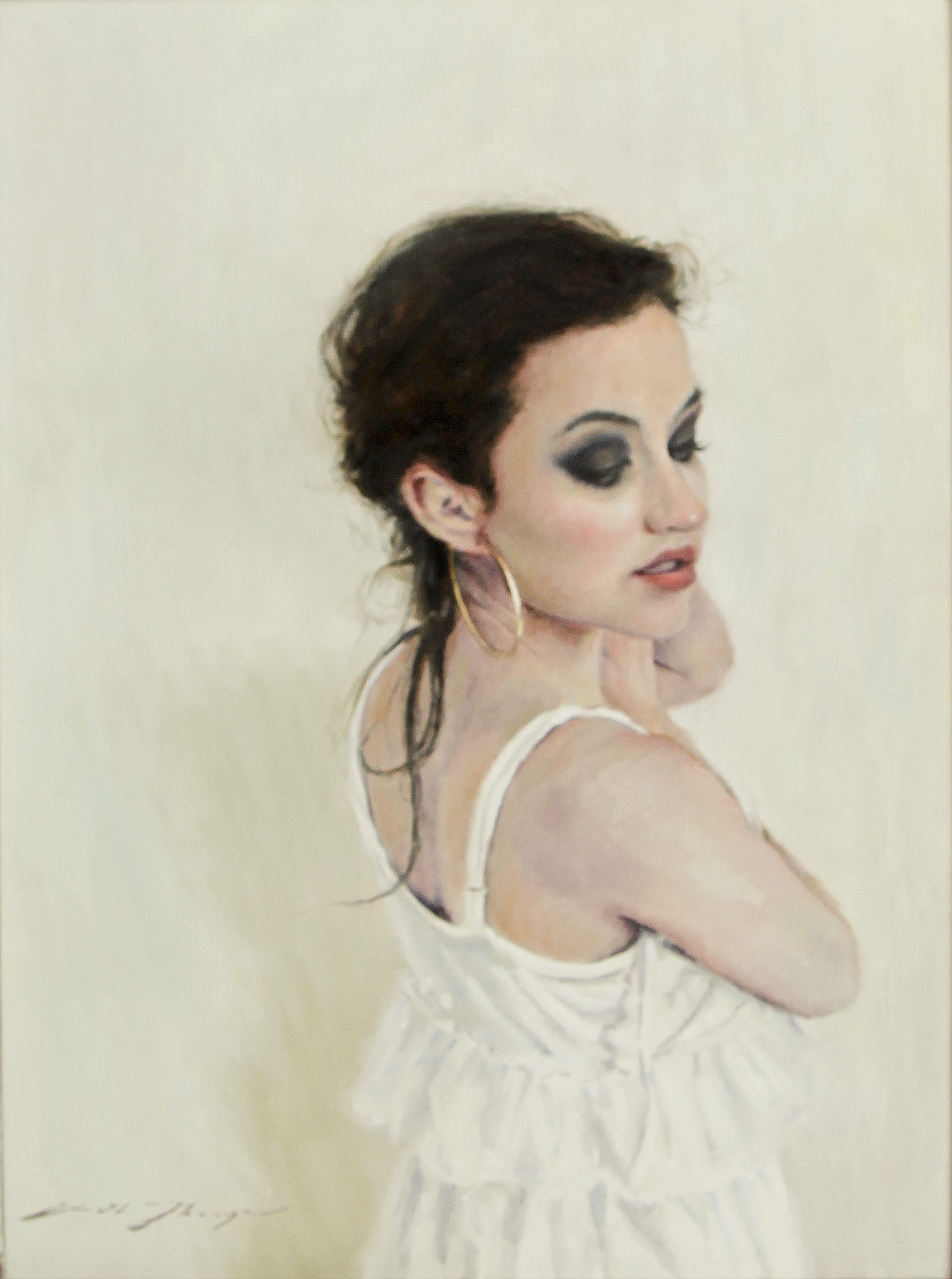
Raven’s Hair is a very powerful piece. It’s capturing this emotion of a woman laying on this bed. Her eyes are closed and she’s having a very pleasant thought. It seems to have some nice emotion to it.”

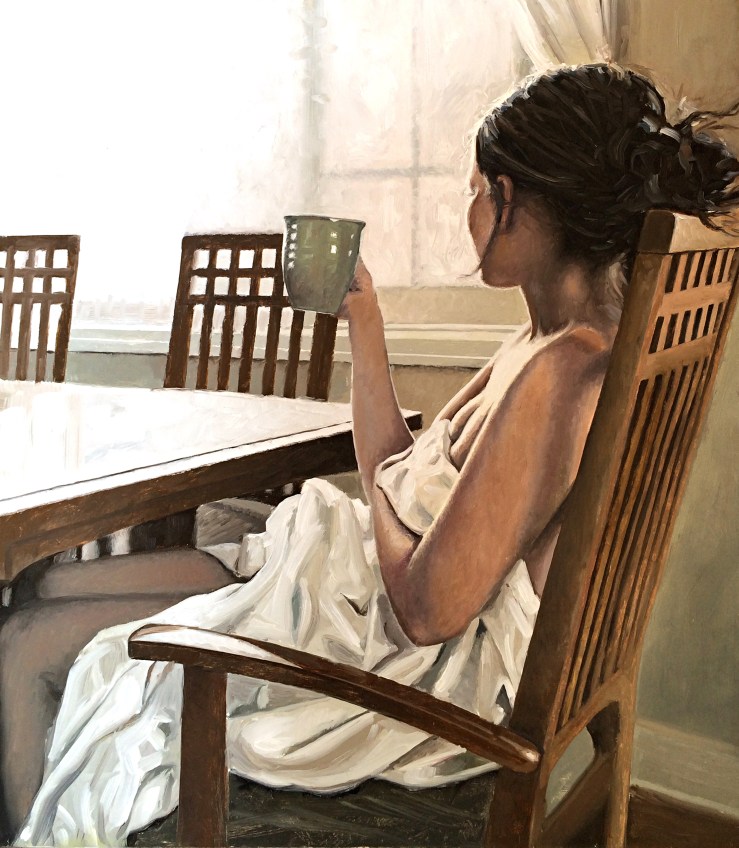
Morning Cup is a portrait of your wife Hilary, and inspired her to write a poem that we’re featuring in the show. Do you often inspire each other like that? 

 We’ve named my paintings every year for 12 years or more. We try to outdo each other with the most poetic titles. The title can say so much in just a couple words. What’s the best title, or the strongest? Hilary is amazing with words.

To learn more about Thompson’s show, connect with us on Twitter, Facebook and Pinterest.

The Boundless Moment: All Together Now

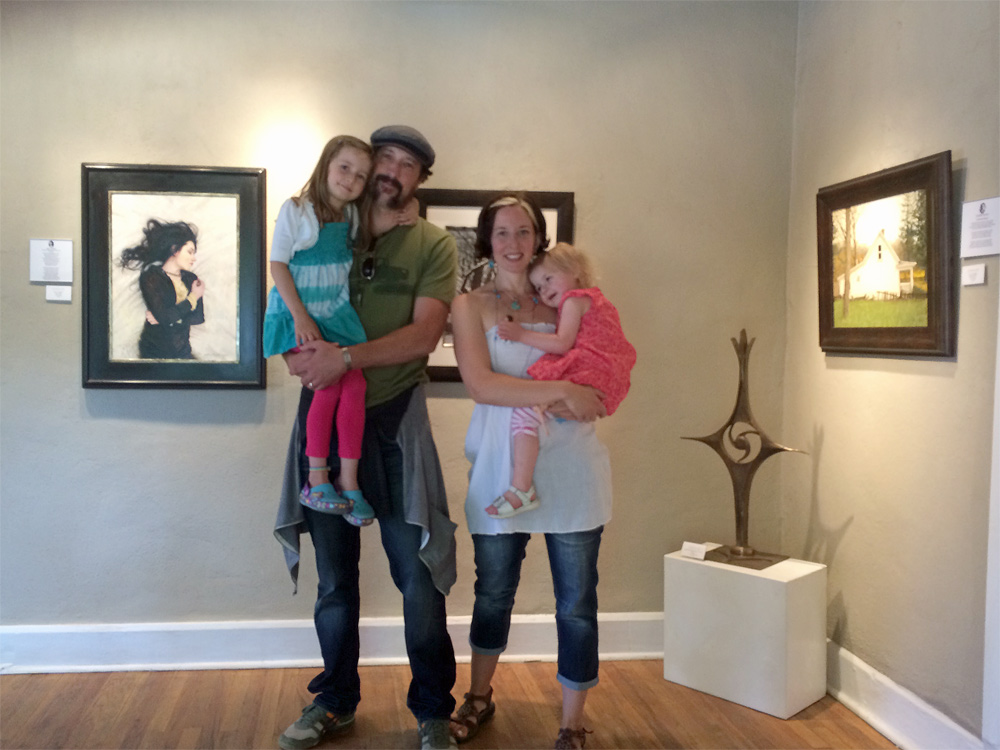
Eric-Thompson-Artist-Family

Eric G. Thompson’s ‘The Boundless Moment
opens Friday, August 15 from 5-7 pm
and closes August 28.

Eric and Hilary Thompson’s daughters dash around Matthews Gallery, exploring their father’s new solo exhibition ‘The Boundless Moment.’ They’ve just finished a long car ride from Salt Lake City but they’re bursting with energy.

Over the past year the children have grown alongside these canvases and panels, watching as thousands of brushstrokes transformed into rolling landscapes and rosy skin. Now these familiar images have magically appeared in our lofty, brightly lit space, sparking the girls’ curiosity. They stop before each work, craning their necks to get a good look.

The girls’ vivacity matches Hilary’s temperament. She keeps an eye on them as she chats and laughs with us. Eric is a quieter presence. He strolls around the gallery, analyzing the arrangement of the work and reading the legendary poems we paired with them. Eric likes to think of his paintings as ‘visual haikus,’ which inspired us to select writings by Frost, Dickinson, Lowell and others to display during the show.

‘The Boundless Moment’ is something of a family act. Hilary was Eric’s model for the painting ‘Morning Cup,’ and wrote an accompanying poem that will debut at the opening reception. ‘The Chiseled Mother’ is a passionate meditation on parenthood and aging. As Eric cradles one of his daughters in his arms, you can tell that he’s just as inspired by the radiant spirit of his children. 

Read Hilary’s poem below, and make sure to attend Eric’s artist reception on Friday, August 15 from 5-7 pm.

Eric G. Thompson- Morning Cup- Matthews Gallery blog Eric G. Thompson, Morning Cup, Oil on Panel

From Hilary Thompson:

The Chiseled Mother

I honor this body
This matryoshka

The delicate lines of my eyes
Like tissue paper
Crinkled from sun beams
Washboards slow the momentum
of tears

These ears, these conches
That entombed the beeping screaming alarms
Echoing endlessly on exhausted drives home
Mercifully quieting with age

Eric G. Thompson- Waiting for a Song- Matthews Gallery blog


Eric G. Thompson, Waiting for a Song, Oil on Panel

This mouth
Which broadcasts comforts, screeches, praise
Fractures the tightrope of vexation

These beautiful, perfect arms
That embraced defeat
Carried a child to the surgeon’s knife
Willing arms
That waved, furrowed, aching
Sturdy farewells

This heart that beats out
The anthem of the womb
I Am
I Am
I Am

Eric-Thompson-Art-CoffeeshopGirl

Eric G. Thompson, Coffee Shop Girl, Oil on Panel

A womb
That is the definition of Creation
Bringing forth what does not exist
Into existence
Torn out of me
With upheaval and sanguine waves of nurture

These knees that caught me
When my frame buckled
Unable to support my grief

These marks, stretched
Yawning tiger stripes
Where my body gave room
Shimmer as silver reminders of a past shape

EricGThompson-Art-Evening

Eric G. Thompson, Evening, Oil on Panel

These feet
Planted.  Supporting.
Rooted even in motion, substantial
Pacing halls, hospital rooms
Threshing carpets bare-threaded

I am the red rock slot canyon
Worn smooth, fissured, curved
Sculpted
By this flawed life

This body is a shrine
A Holy place, a pilgrimage
A masterpiece painted stroke by stroke
By the breathtakingly exquisite nourishment
Of not getting what I want.

Breathe that in,
Chiseled edifice of the Mother,
Slather it like salve into your stripes,
You silver tiger.

 Connect with us on Facebook, Twitter and Instagram to learn more about Eric G. Thompson.

Hannah Holliday Stewart: Open-Ended Questions

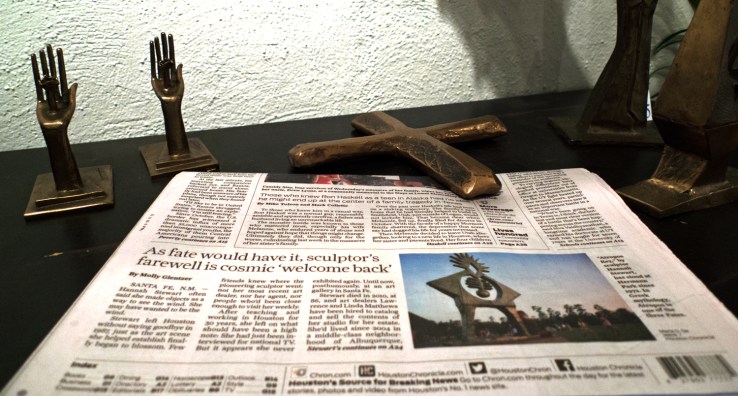
Houston Chronicle's article on Hannah Holliday Stewart among her sculptures- Matthews Gallery

Our exhibition Hannah Holliday Stewart: An Artistic Legacy Rediscovered
runs through July 24, 2014

Two weeks ago, Houston Chronicle arts editor Molly Glentzer appeared at our door with a camera around her neck and notebook in hand. We figured that if anyone could find answers to our burning questions about Hannah Holliday Stewart’s life, it would be a reporter from the city where she rose to prominence. Last Sunday her findings appeared on the front page of the Chronicle. Early on in the article, Glentzer outlines the challenges she faced in her investigation:

Stewart left Houston without saying goodbye in 1987, just as the art scene she helped establish finally began to blossom. Few friends knew where the pioneering sculptor went: not her most recent art dealer, nor her agent, nor people who’d been close enough to visit her weekly.

The beautifully detailed report lays out the highlights of Stewart’s art career. As Glentzer discusses Stewart’s accomplishments—from monumental public art commissions to solo exhibitions at prestigious institutions across the nation—she’s careful to outline the sculptor’s struggle for recognition:

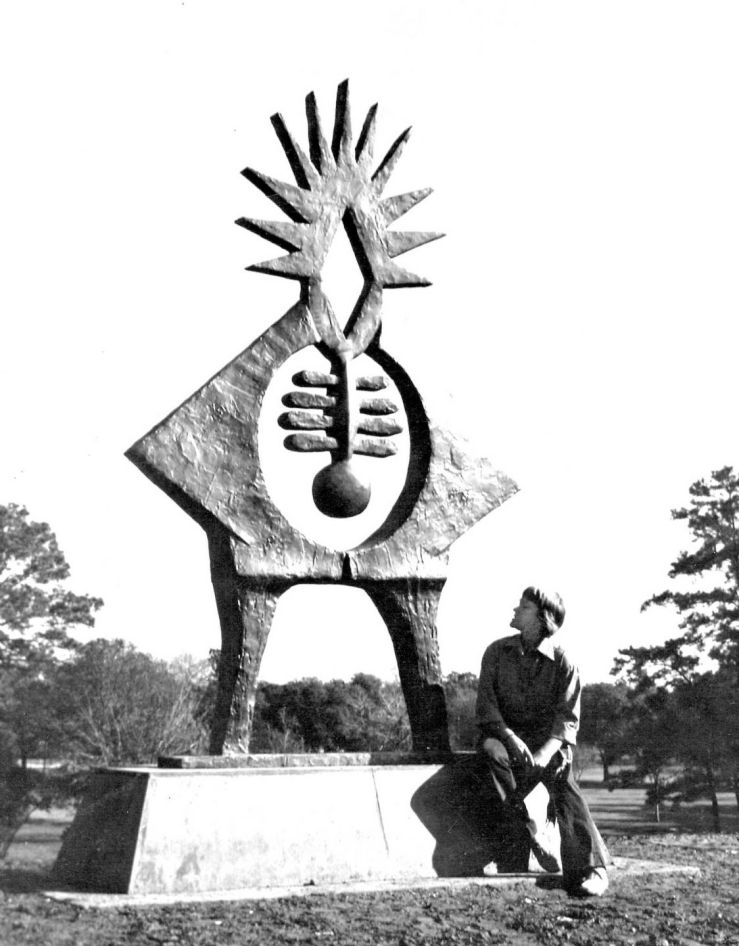
Her success came at a time when women sculptors were rare birds in a man’s world. […] it was a coup when Houston accepted “Atropos Key” …. in 1972. Stewart’s sculpture was unlike anything else in the landscape.

When it comes to Stewart’s departure from Houston and the art world, Glentzer arrives at the same conclusions we did. Stewart first returned to Birmingham to care for her ailing brother, and chose the Southwest as a part-time home because she was drawn to the “light and open landscape”. However, her move to Albuquerque in the final years of her life hinted at grander plans.

“How many people do you know who at age 80 would move 1,000 miles away, where they had no relatives, and build a house and studio with 20-foot ceilings?” [Stewart’s nephew Rusty Stewart] said. “She wasn’t out there to retire.”

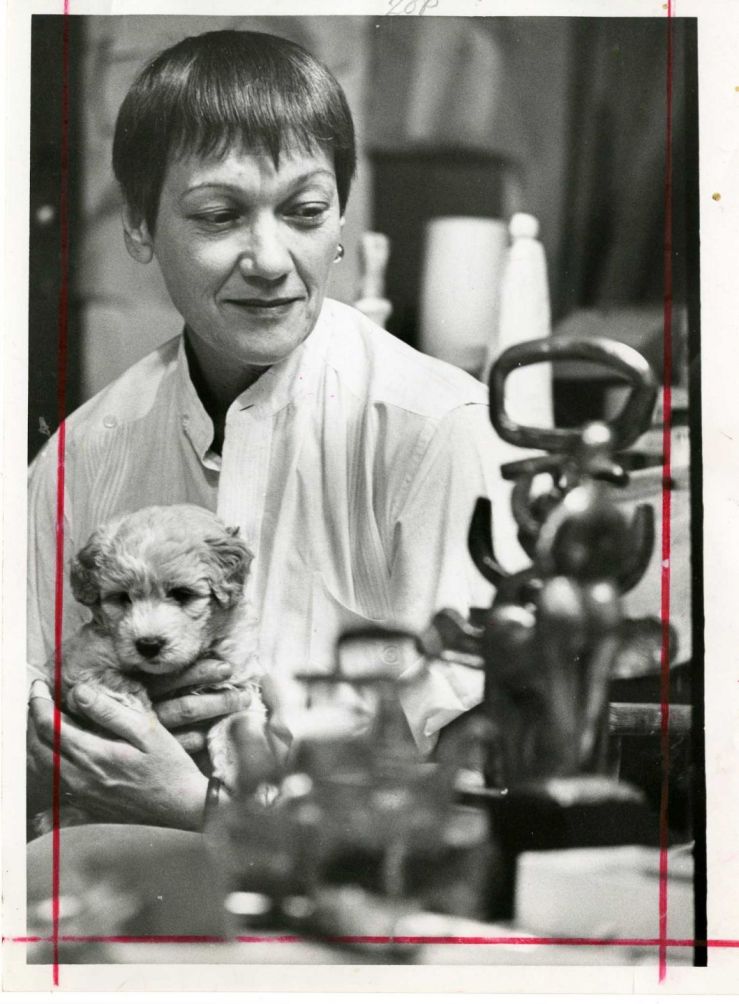
Sculptor Hannah Stewart with her cocker-poodle, Major, in 1967- Houston Chronicle

Stewart with her cocker-poodle, Major, in 1967; Photo from Houston Chronicle

And so the answer to one question opens up another mystery. What did Stewart plan to do next? Her friend Dayton Smith told us she may have intended to complete some larger projects and return to Houston. In her sketchbooks from the 2000s Stewart often mentioned a series of sculptures called ‘Harmonic Resonance’ that may have been her forthcoming magnum opus.

Other friends of Stewart who have called or visited us since the appearance of the Chronicle article had few answers. An acquaintance who took yoga classes with Stewart for years said he’d lost contact with her in the 1980s before she left Houston. Another friend who stopped by told us vivid stories from Stewart’s life in Houston, but had just as many questions about her Southwestern exploits.

Last week we switched gears and teased out some of the mysteries of Stewart’s artwork. As Smith told Glentzer, Stewart “always preferred her work be talked about rather than her life.” Perhaps she didn’t want us to know what happened in Houston, or what her future plans were. In a note from Stewart’s sketchbook dated 2007, the 83-year-old artist wrote,”Tired—work to finish FINALLY!! Move on to others in series…”


1440x1440-5

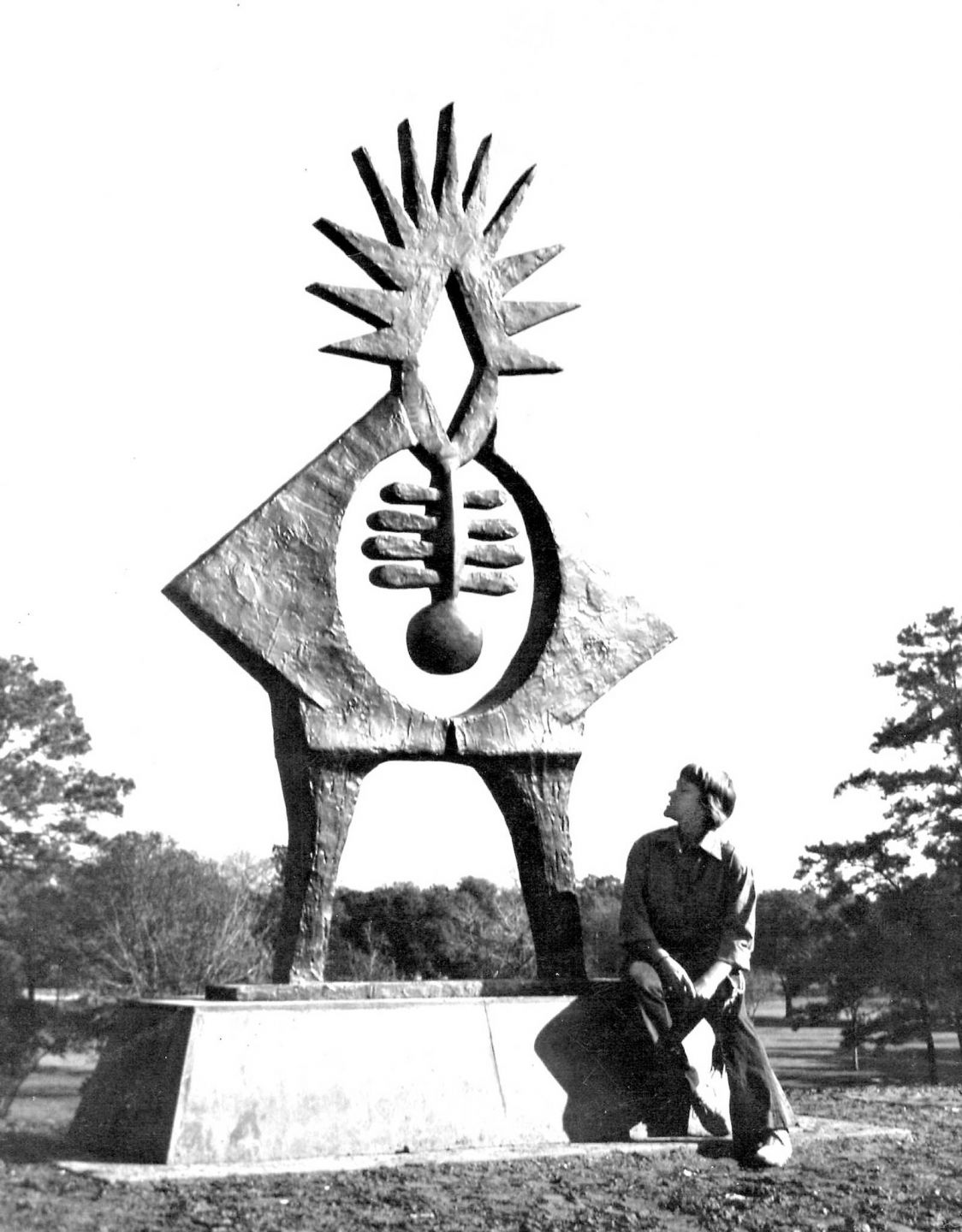
Stewart with “Atropos Key” in Hermann Park; Houston Chronicle

Then, late last week, we received a call from Dr. Liam Purdon in Nebraska. We recognized his name from an elegant essay in Stewart’s files. In the 1980s, Purdon was working on a PhD in medieval literature from Rice University. He had seen Stewart’s “Atropos Key” sculpture in Hermann Park and was inspired to contact her.

“I literally stumbled upon it as I walked up the hill in the park,” he said. “You come over a rise and suddenly there it is in front of you. You’re startled by it, and the first question you ask yourself is, ‘What is it, and why is it here?’ When you read the name of it, then you suddenly realize it’s tied to Greek mythology.”

Purdon said the shock and curiosity he experienced was Stewart’s overarching goal. “She wanted to startle the observer into recollecting the whole mythology of a time when humans lived in harmony,” he explained. Stewart agreed to let Purdon observe her in the studio for three weeks, but kept a careful distance from the scholar. Later on they became good friends, and Stewart told Purdon her plans for the future.

“She felt that being in the Southwest… would be more supportive of her vision,” he says. “She loved the natural beauty of the Southwest. In some of her pieces, you do see it. In others you may not recognize it, but if you look at them for a while and meditate on them, it starts to become apparent.”

The two stayed in contact after Purdon took a teaching job at Doane College in Nebraska, and Stewart expressed interest in applying for public art commissions from the Nebraska Arts Council. When nothing materialized, Stewart was discouraged.

1440x1440-4

Stewart in 1960 with a sculpture she recently completed; Houston Chronicle

“I think that probably underscored the fact that she felt… uncomfortable revealing the work until the time was right, until we re-cycled into an age when we wanted to hear the narrative again,” Purdon said. “She would have to wait for a period of time to introduce her work to people who were ready to understand.”

That’s the closest we’ve gotten to answering the ever-shifting riddle of Stewart’s twilight years, but perhaps it’s enough to know that people are ready to hear the artist’s stories again. We’ve had a huge response from collectors in Houston who read the article, and art lovers from across the country have discovered her work as a result of the press coverage our show has received.

“In general, i think that people are wanting narrative more,” said Purdon. “It is so remarkably different, her work… That’s why it needs a narrative. There has to be a starting point.”

Come see Hannah Holliday Stewart: An Artistic Legacy Rediscovered through Thursday, July 24, and learn more about the artist on our website. Make sure to connect with us on Facebook, Twitter and Pinterest for more gallery news!

SCULPTOR’S PROCESS: Frank makes a fountain

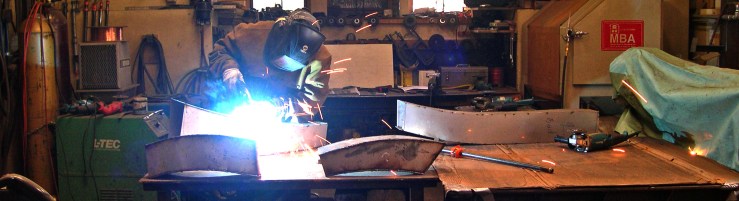
Frank Morbillo- Sculptor- Matthews Gallery

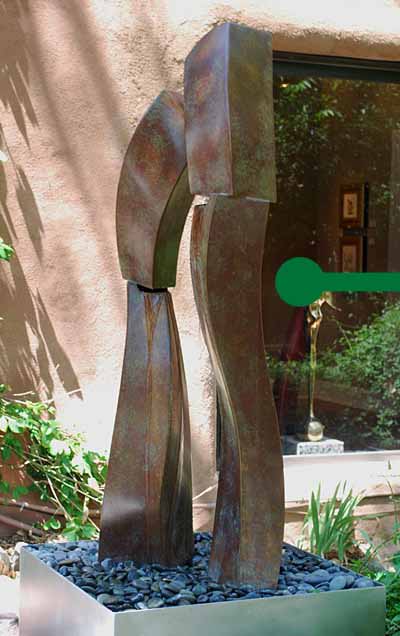
It all started with a sculpture you may recognize if you’ve been to Matthews Gallery in the past few years. Frank Morbillo‘s ‘Complement’ was a fountain that stood outside our building for a time, enchanting Canyon Road tourists with its elegant lines and soothing sounds:

Frank Morbillo- Complement- Matthews Gallery

“It was inspired by the figure, a relationship between people or entities,” says Frank. “The two sides have a connection in terms of how the line of one complements the line of the other.”

Two gallery visitors who were particularly charmed by the sculpture kept it in mind as they built their new home. Nearing the end of construction, they got in touch with Frank and asked him to create a similar piece for their front entryway. Just like the two pillars of the sculpture, Frank says the commission was all about maintaining a carefully balanced dynamic.

“During the course of the commission, I am constantly sending images that are going back and forth between myself and my client,” the artist explains. “Six times throughout this process or more, we were exchanging information and tweaking and getting approval.”

Below you’ll see images from their correspondence, starting with a cardboard model and ending with the stainless steel fountain in its beautiful new space. Follow Frank on his artistic journey…

Frank Morbillo- Artist Process- Matthews Gallery Blog


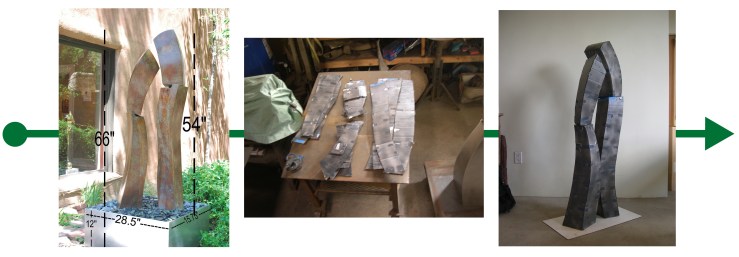
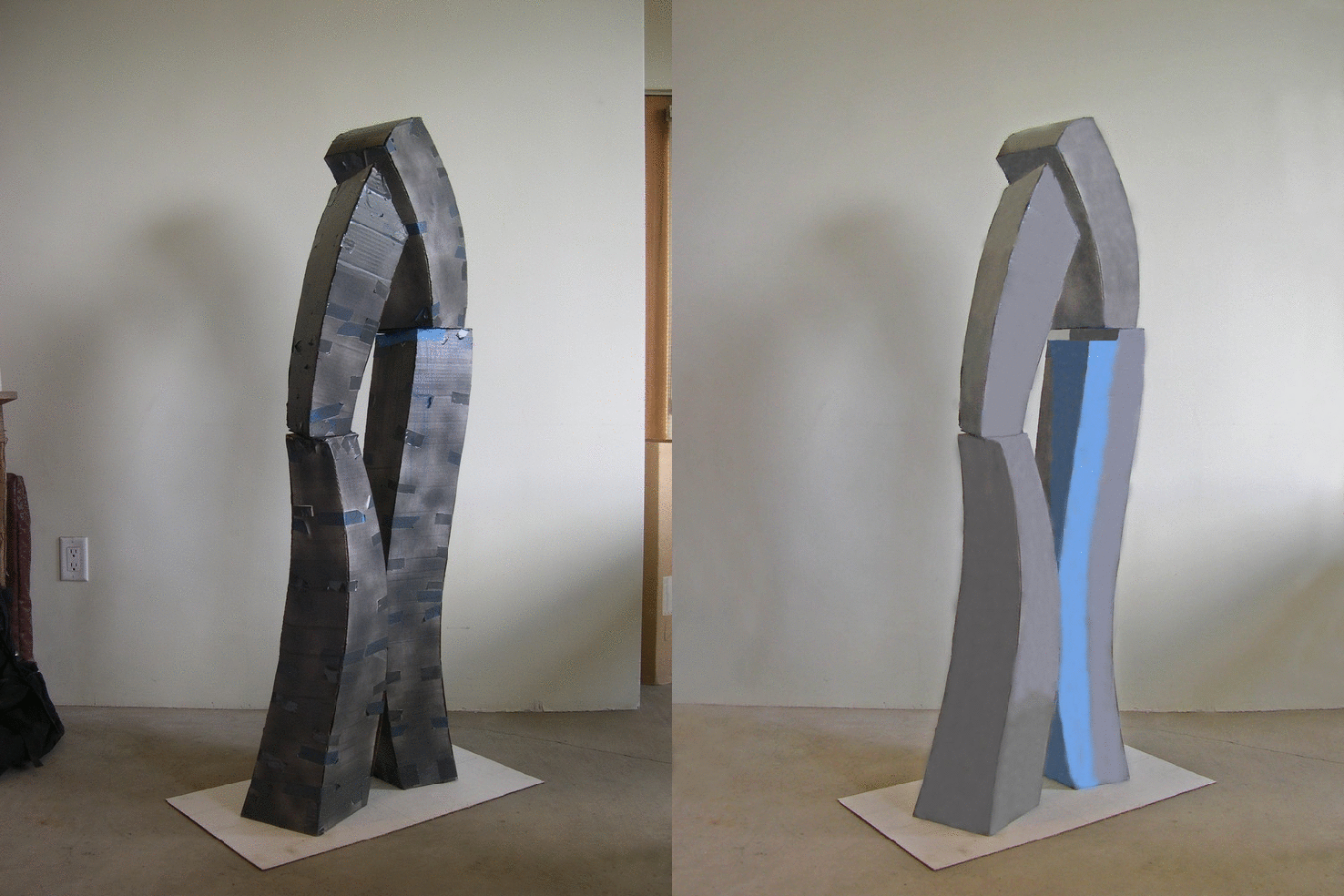
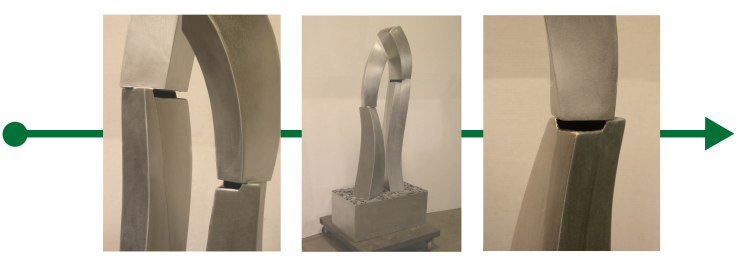
First, Frank marked up an image of the original sculpture (left). ‘Complement’ was larger than his clients wanted, so he adjusted the scale and used the new measurements to resize some cardboard cutouts from the original project (center). The new, smaller cardboard pieces came together to create a full-scale model of the new piece (right).

“When I’m building it in the studio, it’s important to have the model at the level that it’s going to be viewed. In the clients’ home, it’s going to be up a few steps from the ground level. I elevated it to make sure the proportions were working. I want there to be a good interaction of elements.”

“Different materials make the water flow differently. A rough material creates some surface tension, while a slick material will let the water run very fast.”

 Frank Morbillo- Sculpture Process- Matthews Gallery blog
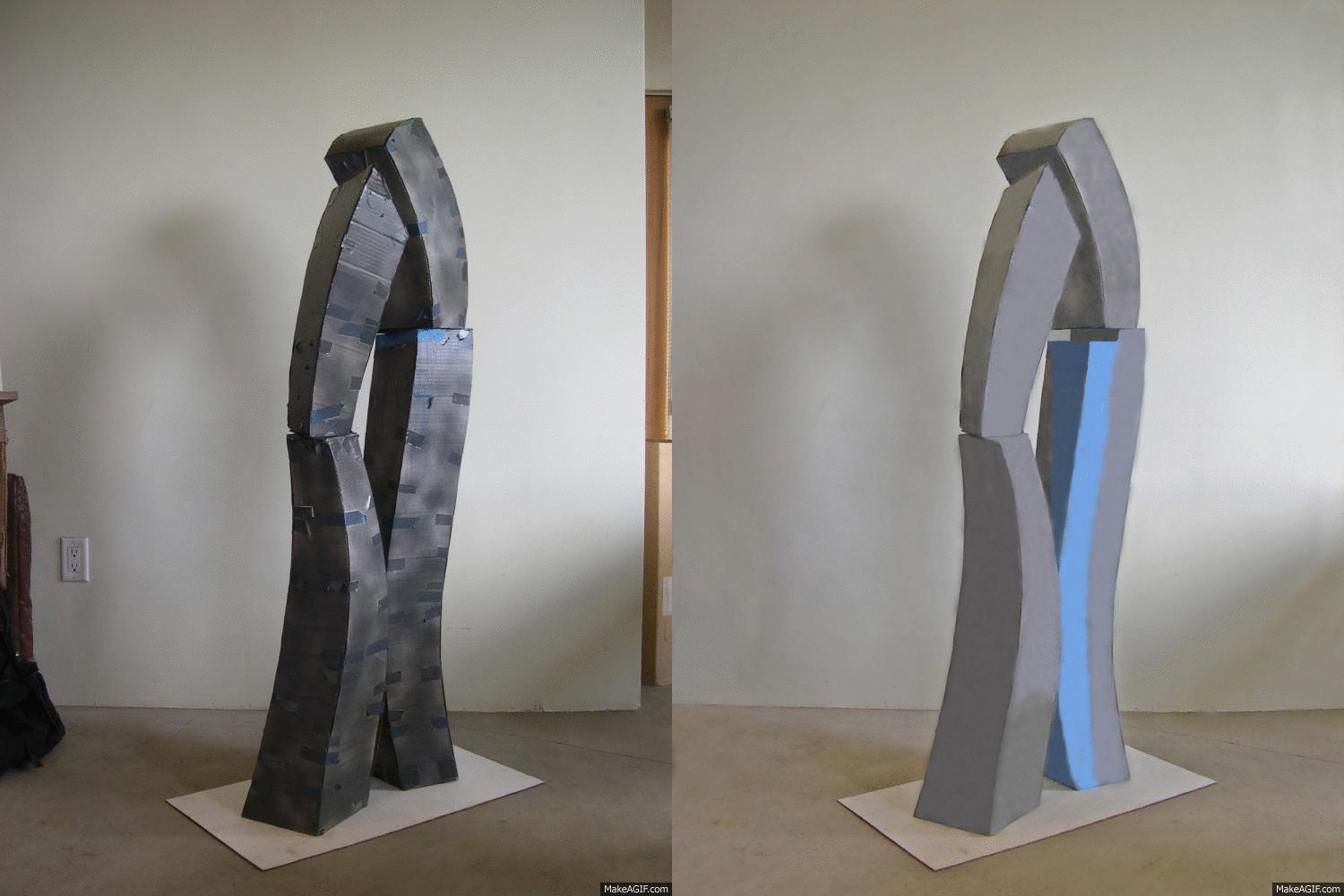
Next, Frank manipulated images of the cardboard model in Photoshop to show the flow of the fountain. The blue line you see on the edited photograph is where the water will fall on one side. The white piece of cardboard under the sculpture represents its base, which presented a unique problem.

“From the very beginning, I had to be very careful about water flow because I had a limited landing pad for the water to fall. The basin was much smaller and narrower than in the original sculpture.”

Frank Morbillo- Artist Process- Matthews Gallery Blog

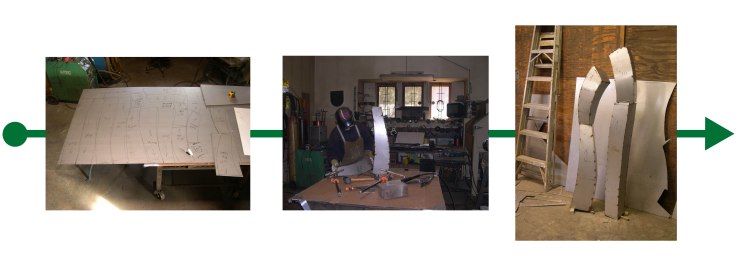
After tweaking the cardboard model, Frank took it apart and traced the pieces on stainless steel (left). He used tack welding to create a rough version of the piece (center and right). Tack welds allowed Frank to alter the form based on his client’s feedback.

 “The dark buttons going up the edge are the tack welds. The tack weld is very strong; a series of four down the side can hold it mostly in place. Once you’re at this step, you want to make sure that everything is right. Afterwards, there are several days worth of work to make the elements seamless.”

Frank Morbillo- Artist Process- Matthews Gallery Blog


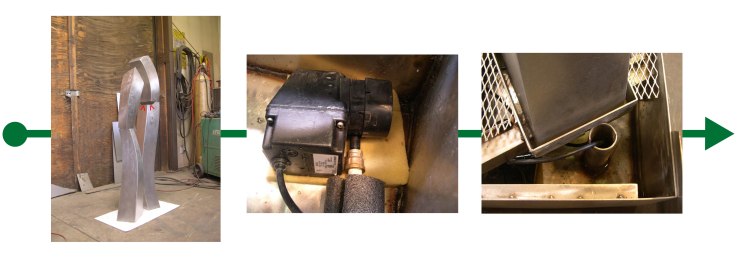
It took about a week to create the shiny sculpture you see on the left. The two red arrows mark openings for the water. Next Frank worked on the base of the sculpture, installing a pump and carefully feeding the electrical cord through a riser tube that holds it above the water (center and right).

“All of those edges have been welded and sanded. This is my first rough pass on putting the finish on the metal.”

“One of the things you look for is the pump’s capacity to go vertical. I size it at a slightly greater capacity than my need is going to be so that I’m sure the water will reach the top.”

“The water enhances and adds to the whole scheme of the project. By placing the pump on the foam pads, it reduces noise vibration from the pump, allowing the viewer to focus on the sound of the fountain.”

Frank Morbillo- Sculpture Process- Matthews Gallery Blog


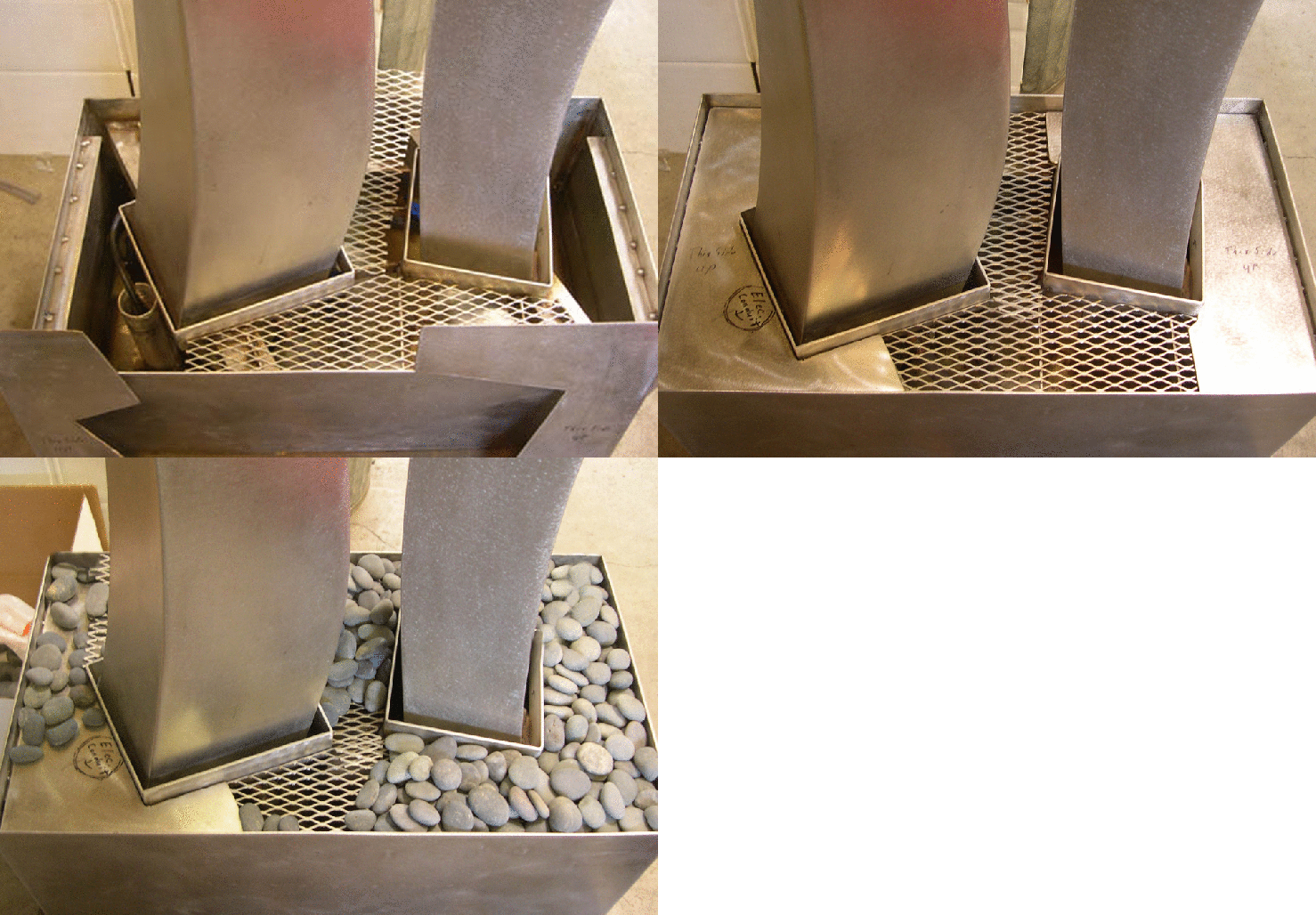
Frank cut mesh and steel plates to cover the base and prevent splashing. The slots you see around the sides of the sculpture are one of Frank’s latest innovations.

“Because of the size of the basin, I have less latitude with what the water does and how it falls. I knew I had to create a slot around the base of both sculptures so as the water falls it goes into this slot. It worked really well, and I learned something from it. It’s changed how I deal with water capture in a small basin.”

“In every sculpture project, there’s always the opportunity to say, ‘What can I do different in the future?’”

Frank Morbillo- Artist Process- Matthews Gallery Blog

Careful tests of the water flow followed. Frank got the final approval from the client and shipped it.

“There’s a lot of structure in there that you’re not seeing that supports all of the different elements. When all of this is said and done, you don’t see any of that but it’s all happening because of it.”

“I took a good long look at it and liked what I was seeing in terms of how I thought it would look on site.”

And PRESTO!

Frank-Morbillo-SculptureProcessFinal

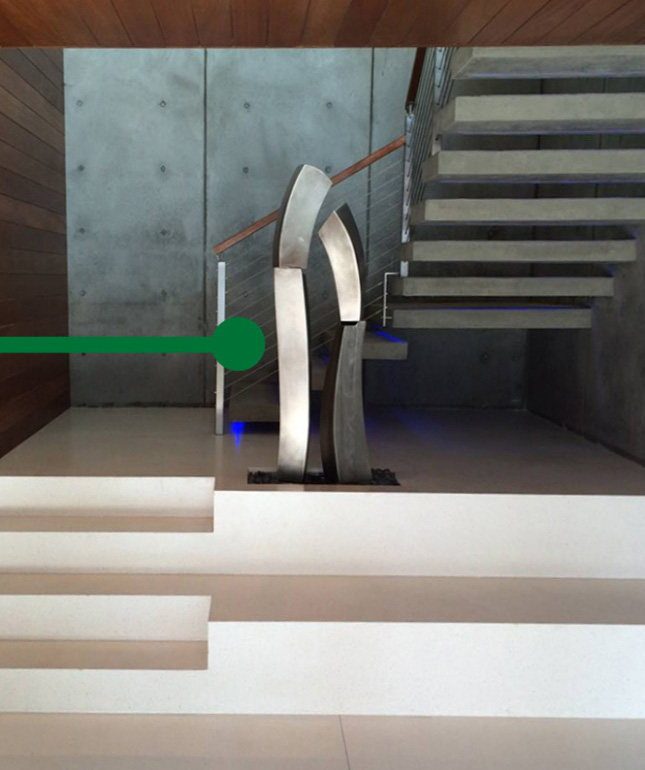
Frank’s clients sent back images of the piece in its new home, and the sculptor couldn’t be happier.

 “The experience of walking up the steps and around the sculpture must be pretty awesome.”

“It’s interesting, the sculpture is the only thing with curves in the space. Everything else is really hard and geometric. That’s cool that it’s really different than anything else line-wise in the space.”

“When you can have fun going through the process of doing it, for me that’s where my thoughts go when I’m working. There’s a lot of opportunities to have fun.”

“When I saw the contemporary design of the house, I said, ‘Great project.’ I’m really happy that this sculpture became part of it.”

See more of Frank Morbillo’s artwork on the Matthews Gallery website, and connect with us on Twitter, Facebook and Instagram for daily gallery news.