MORANG AND FRIENDS: The Violin

Alfred Morang's Violin will appear in the Morang and Friends exhibition- Matthews Gallery Blog

When Alfred Morang was a teenager he took to the nightclubs of Boston with his trusty violin. He had been a sickly child, bedridden and unable to attend school, but his mother and uncle recognized his fiery creativity and hired private music and painting tutors. Morang grew from a talented tot to a full-fledged young Renaissance Man, and his passionate musical performances earned him enough money to thrive. It was the beginning of a lifelong artistic journey.

A century later, Morang’s fiddle launched yet another adventure. Santa Fe art collector Paul Parker was researching Morang’s life when he came upon a letter by the artist’s longtime wife Dorothy. After Morang’s tragic death in a studio fire, Dorothy was having a hard time finding an heir to his worldly possessions. She’d finally contacted a distant relative, and was arranging the shipment of a few things collected from the ruins of Morang’s Canyon Road casita.
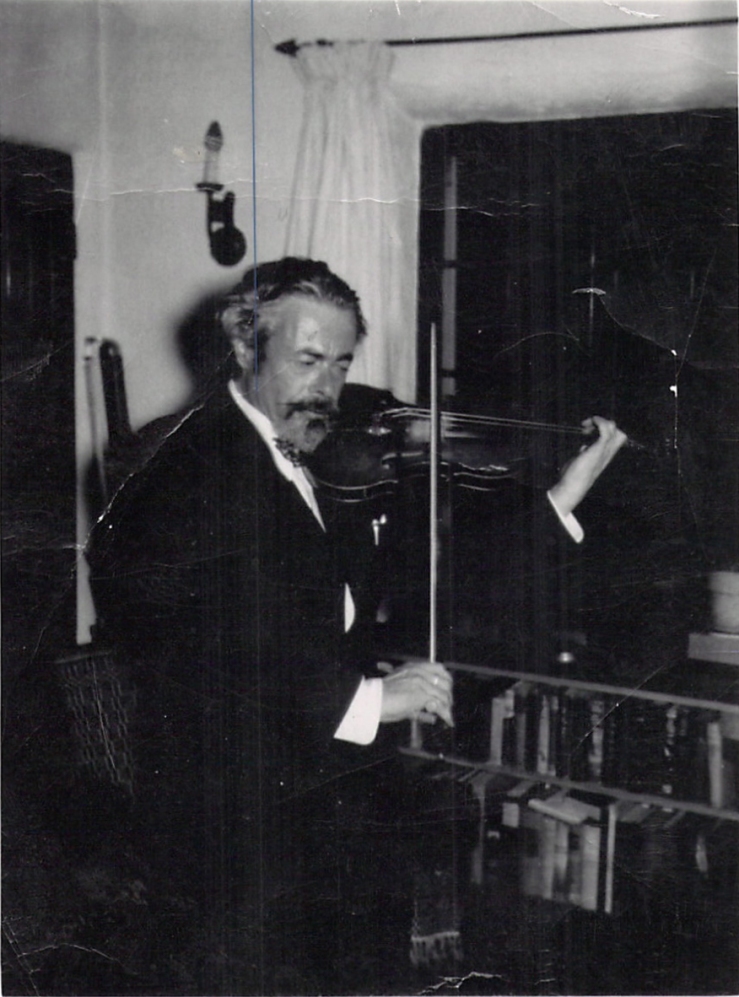
Santa Fe Artist Alfred Morang Playing the Violin- Matthews Gallery BlogAlfred Morang playing his violin

The letter was Parker’s first clue in a treasure hunt that spanned the nation and stretched to the farthest branches of the Morang family tree. At the end of the trail was a treasure trove that connected the dots of Morang’s life, from his early years as a celebrated musician and writer to his time as an iconic Santa Fe artist. Morang’s well-worn violin, blackened by the fire, is perhaps Parker’s most striking find. It will appear alongside Morang’s artwork in our December 12-26 exhibition MORANG AND FRIENDS.

We interviewed Parker about his search for the fascinating artifacts that will anchor our exhibition to this legendary Santa Fe master:
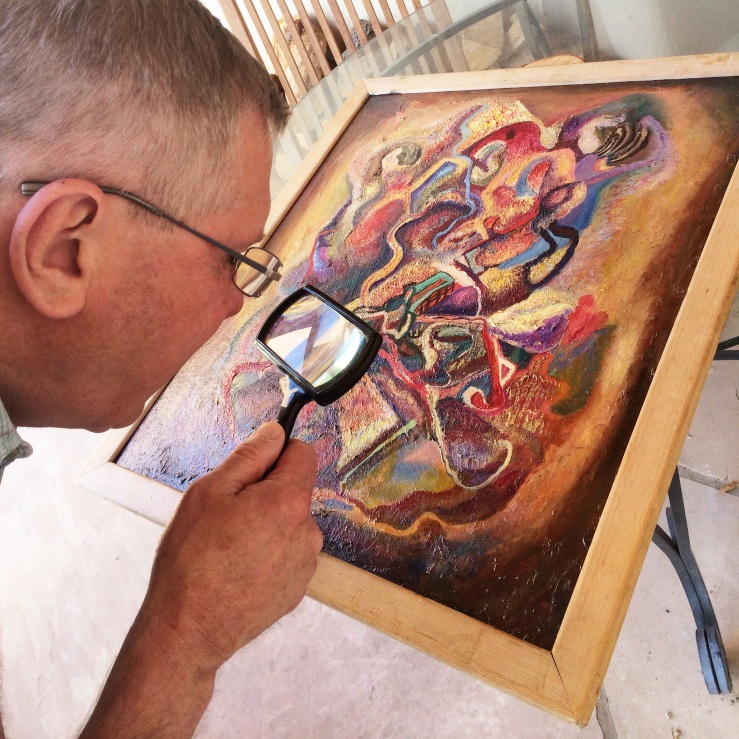
Paul Parker Inspects a Painting by Alfred Morang- Matthews Gallery Blog Paul Parker inspecting a painting by Alfred Morang


 How did you first get interested in Alfred Morang?

I came to Santa Fe in the 1990’s, and met Jim Parsons in Taos not long after. He had a little booth with a rack of prints and drawings and things, and he had a pile of books called The Art Fever. We hit it off and just talked and talked, and I bought a copy of his book. I took it home and read it, and realized who I was talking to.

There was a time when Jim Parsons was the most powerful person in the Western art business. Back in the day, he had a little art gallery in his Denver apartment. He convinced Philip Anschutz to start a Western art collection, which is now the largest and most prestigious collection of Western art in private hands in the world.

Jim was a giant Morang fan, and he showed me his work. I became instantly fascinated with Morang’s story. I had seen his paintings in El Farol but didn’t know anything about him until Jim told me.

Tell me about Morang’s childhood.

He was born in a little town called Ellsworth, Maine. There’s still a Morang Chevrolet in Ellsworth that his father owned with another partner. He and his mother had a very close relationship.

Even as a child, Morang was something of a polymath.

 Yes, he learned from Carrol S. Tyson and other American Impressionists. He was also the youngest-ever solo violinist to play at Jordan Hall in Boston. I mean, he was a very accomplished musician. His wife Dorothy was a member of the music conservancy in Boston. That’s where he met her.
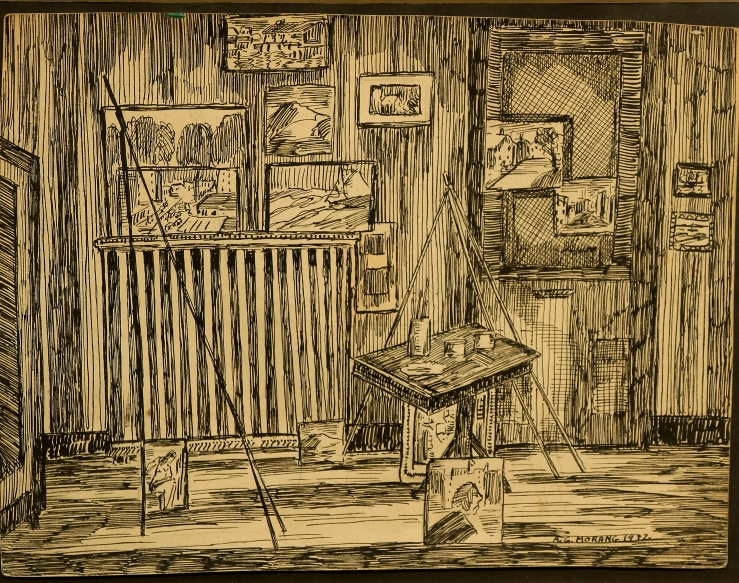
Alfred Morang- The Artist's Studio Portland Maine- Pen and Ink- Matthews Gallery Blog

Alfred Morang, Artist’s Studio-Portland, 1932, Pen and Ink


He and Dorothy lived in Portland, Maine before his tuberculosis forced them to move to Santa Fe in 1938. Morang had a successful a writing and painting career back East. What are your thoughts on his early work?

I’ve seen some of his work from back then. Like a lot of artists, when Morang came to New Mexico and saw the color and the light and everything, it inspired him. I think that’s the biggest thing.

It’s almost akin to my life. I thought I enjoyed art, but until I moved to Santa Fe, until I drove by 100 galleries every night on my way home and everybody that I associated with and talked to was in the business in some way, shape or form, something about that was really inspiring.

Artifacts of Santa Fe Artist Alfred Morang to Appear in December Exhibition- Matthews Gallery BlogSanta Fe New Mexican columnist Lorraine Carr covered Morang’s memorial service in February, 1958


How did you start hunting for the box of Morang’s possessions?

I was writing a story about Morang, and I went to the library to find out what the newspaper said when he died in 1958. I was reading all of the articles and eulogies and things, and I thought, ‘This is an amazing man.”

After I went to the library that day, I realized I needed more research, so I went to the New Mexico Museum of Art and searched their archives for anything I could find in Alfred Morang’s folder. That’s when I found Dorothy Morang’s folder, and saw her letter. It said that she had sent this box of Morang’s possessions away to Carrie Morang Robinson in Atlanta, Georgia. All I had was the name Carrie Morang Robinson and this address in Atlanta. I did my research and found out that she was deceased. I couldn’t find any relatives, and her former house had a different owner.

 That must have seemed like a dead-end.

Yeah, I made several phone calls and then just kind of gave up for a while. Then something hit me a couple months later and I said, “Damn it, I’m going to try again.”

I did some more research and tried to find Alfred’s relatives. Carrie Morang Robinson was the daughter of one of Alfred Morang’s uncles because she was a cousin and had the family name. I found one uncle’s name through the Morang Chevy dealership in Ellsworth, but then I ran into another dead-end.

A couple months later I got a Maine antiques publication, and there was something about ancestors in it. I got some other names of who Carrie Morang Robinson’s father might have been. I found some members of the Robinson family, and started researching them.

You were making some headway!

 I just start calling people again, and this woman whose name was Robinson came up. I called her, and she said, “Oh, our cousin Alfred. Our mother used to tell us about him.” I started telling her a little bit of the story, and she said, “You have to talk to Gwen.” I just lit up, because Gwen was Carrie Morang Robinson’s granddaughter and lived with her grandmother in the final years of her life. Now Gwen owns Carrie’s house.

I called Gwen up, and she had all of these family stories about Alfred, that he used to go through the woods with his violin and his cats following him. “Weird cousin Alfred” or something like that. She said, “Well, if my grandmother owned the box, it’s probably still up in the attic.” Then I got excited.

You were one step away. It must have been tantalizing. 

Well, Gwen was renting the house, so she told me she’d search for the stuff the next time she was in Atlanta. A month or two goes by, and I call her up again. She says, “We’ll be selling the house, so I’ll look for it then.” A long period of time goes by, and all of a sudden I hear the phone ring one day. “Well, I found your box,” she says. “I’ve got a couple more things—a violin and a painting.”
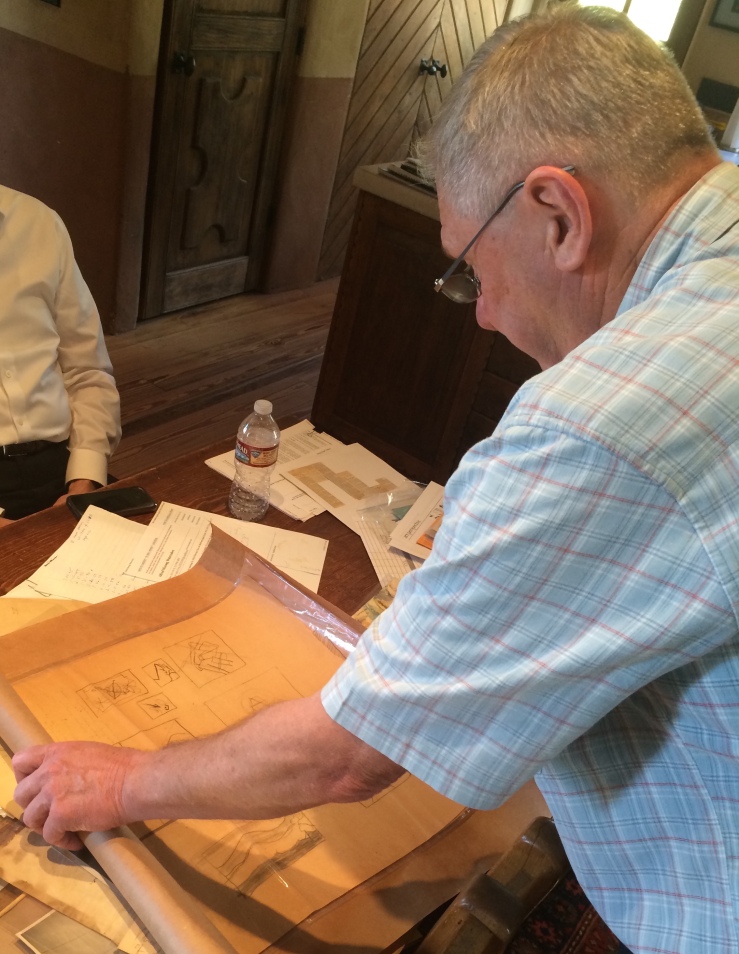
 Paul Parker Surveys Artifacts of Legendary Santa Fe Artist Alfred Morang- Matthews Gallery BlogParker surveys sketches and other artifacts of Alfred Morang


How did it feel when Morang’s artifacts finally arrived at your door? 

It was absolutely phenomenal. It was like the biggest Christmas ever. To see that violin and just to touch it. Talk about personal.

The box was full of many different short stories and manuscripts, which he submitted to radio stations to be read as radio plays. Many of these stories were never published, and might have been lost forever.

Did this elaborate hunt make you wonder why someone didn’t try to keep the artifacts in Santa Fe? 

Dorothy and Alfred got divorced in 1950, but even then Dorothy kind of watched out for him. When he died, she knew about this cousin Carrie Morang Robinson, who was the only rightful heir to his possessions. Dorothy stepped up to help contact her, and at the time it wasn’t a big deal to send them away.

One of the stories that Morang’s adopted daughter Claire LaTour has told me is that they didn’t know what to do with his ashes. They left them in a closet in the art museum after the last memorial service. Claire came back, and somebody flew her over Canyon Road and she dumped his ashes out the window of the airplane, which was a difficult task. She told me, “I was wearing a fur coat, and I always laughed that forever afterward I was brushing Alfred out of my coat.”

Alfred Morang- Autumn in the Park- Oil on Canvas- Matthews Gallery BlogAlfred Morang, Autumn in the Park, 1954, Oil on Canvas


Morang’s colorful personality often overshadows his artwork. Is that frustrating for you, as a big fan of his work ?

It’s the same frustration that I have now with van Gogh. I know from all my research that van Gogh was not a crazy man. He had epileptic fits that affected his life and personality, but he was a very brilliant man and definitely not insane.

It’s almost the same thing with Alfred. People like the story of a bohemian alcoholic, something that fits better with the story of Toulouse-Lautrec. He wasn’t an alcoholic. He couldn’t have done the things that he did if he were an alcoholic.

The greatest quote that I’ve ever heard about an artist is from Morang’s memorial service. It’s not attributed to anybody specifically, but an unknown artist said, “It’s no wonder that we in Santa Fe mourn the loss of Alfred, he taught half of us how to paint and the other half how to see.” After Morang’s death, all of a sudden people started to realize that he was a great artist. People regretted that they didn’t pay enough attention to him.

Coming up next week, Paul Parker digs up more mysteries of Alfred Morang’s life and travels to Paris to complete a mission in Morang’s memory. Make sure to connect with us on Facebook, Twitter and Instagram for daily updates on MORANG AND FRIENDS.
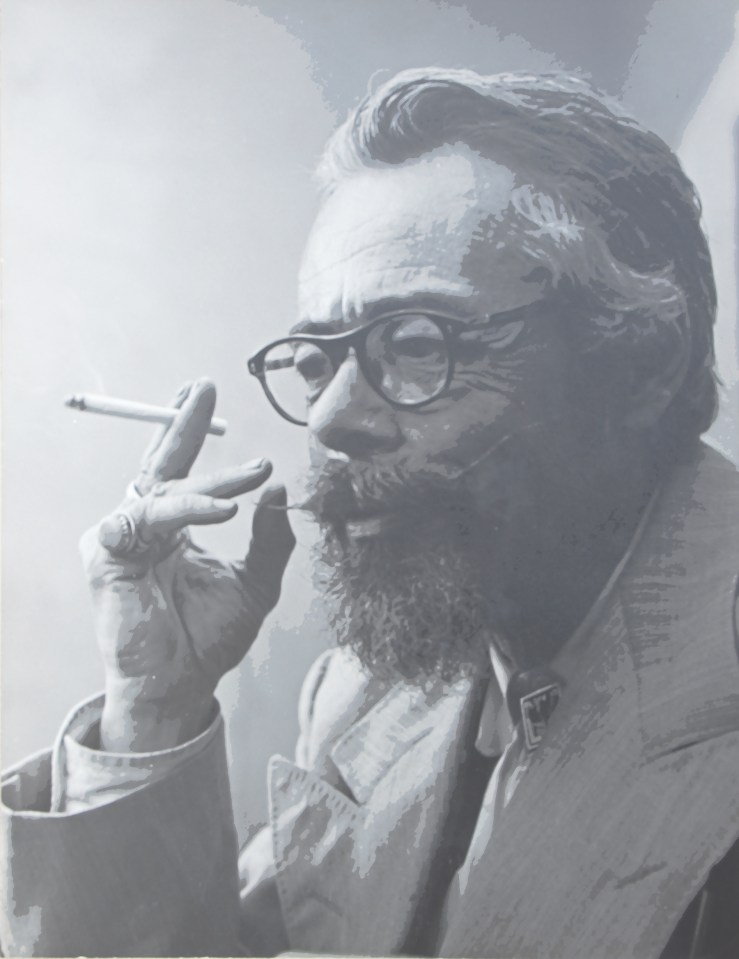
MORANG AND FRIENDS: The Fire

Santa Fe Master Alfred Morang- Matthews Gallery Blog

Alfred Morang’s life ended with a fire. That’s where the story of our upcoming exhibition begins.

It was a frigid January evening in 1958, and Morang was up late at Claude’s Tavern. The saloon was on Canyon Road’s 600 block, just down the street from Matthews Gallery. Its owner Claude was a burly woman known for ejecting unruly patrons by slinging them over her shoulder. She presided over a wild scene: legend has it someone once rode a horse straight through the bar.

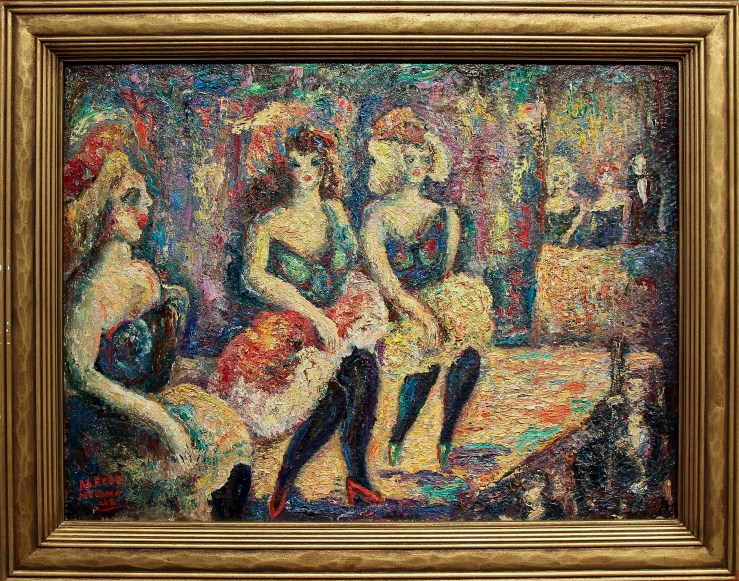
Alfred Morang- Dancers at Midnight- Matthews Gallery Blog

This was a fitting final evening for Morang. Claude’s was one of his favorite haunts, a place that still captured the dwindling spirit of his legendary house parties of the 1930’s and 40’s. Back then, he and his wife Dorothy were the toast of the Santa Fe art colony. Morang was a revered painter, art teacher, art critic and radio personality. His impressionistic paintings of colorful soirées filled with dancing ‘Ladies of the Evening’ and skeletal gentlemen had earned him the nickname ‘Santa Fe’s Toulouse’.

Morang’s studio apartment was directly behind Claude’s, and he returned there around midnight. It was a tiny space so packed with canvases that you could barely navigate it. Sometimes the heating broke, and when it snowed Morang would haphazardly pin a muslin cloth over the open skylight.

At around 1:30 am, smoke filled the air. Here’s Santa Fe artist Drew Bacigalupa‘s account of what happened next:

I was in the neighborhood bar the night his house caught fire. An old army buddy from Chicago had come to town and wanted to down cognac while viewing local color. There wasn’t much to view. It was a bitterly cold night, the streets deserted, the bar almost empty and quite cheerless. My bachelor friend dredged up memories of a thousand other cafes in France and Germany while my thoughts strayed to demands at home. Three weary women at the other end of the long bar seemed to be nowhere waiting for nothing.

The sound of sirens startled us all. Fire engines skidded past the door, we could hear them screeching to a halt in a compound behind the bar. I knew Alfred’s small adobe casita was there.

Nothing could be done. The roof had already crashed in and flames leaped high in the sky. I was thinking how very, very strange it was to be standing beside this war comrade watching helplessly, just as we’d done in Europe, as property and life were devoured by fire. And even stranger—later—when stretcher carriers fled the still-blazing ruin and rested their burden on the frozen ground. For firelight, like streaks of red and yellow pigment, crawled erratically over the sad tableau. And looking up from the bearded profile on the stretcher, I saw the women from the bar had joined us. Harsh, bright colors spiraled over their tawdry dress and hennaed hair, highlighting them against the black night. They were exactly like his painting […] his Ladies of the Evening.

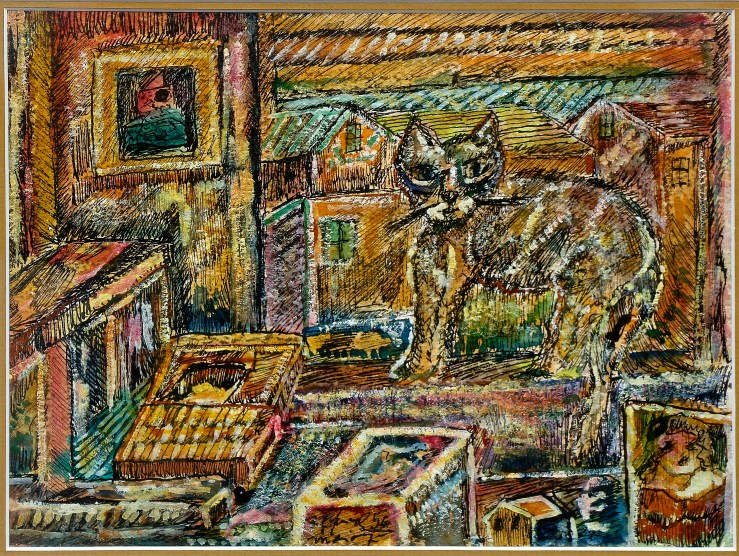
Alfred Morang- Mitzi Cat- Matthews Gallery Blog

The next morning, the Santa Fe New Mexican printed a photo of one of Morang’s cats perched sadly atop a blackened mattress. The caption read, “Mourning For Her Master… this lonely cat was found wandering through the charred ruins of the home of her master Alfred Morang. The cat is on the bed where he died.”

The Santa Fe art community was distraught. There was a sense of guilt among Morang’s closest friends, a grave regret that the masterful artist had received only a fraction of the recognition he deserved. “Why shouldn’t Santa Fe be stunned by the loss of Alfred?” said one local artist. “After all, he taught half of us how to paint; the other half how to see.”

Art luminaries Randall Davey and Will Shuster helped escort the body to Albuquerque for the funeral, and Davey spoke at the Santa Fe memorial service in early February. “He was a great painter; many of you did not think so because he sold his art for a mere pittance through necessity,” said Davey. “Nevertheless it was great art and the happiest work I have seen in New Mexico. He had a love and delight for painting and I doubt that anyone will surpass him in his field.”

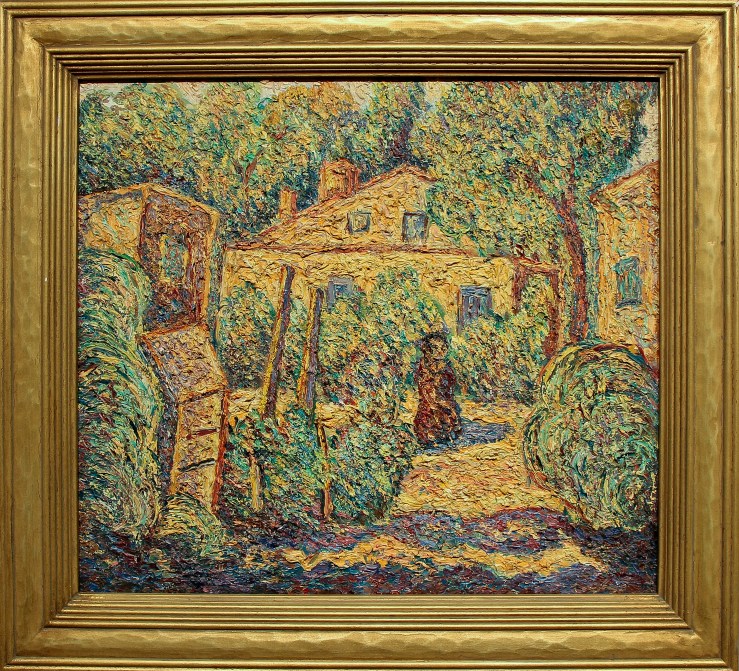
Alfred Morang- Gormley Lane Santa Fe- Matthews Gallery Blog

Meanwhile, the City of Santa Fe was having a hard time finding Morang’s heirs. He and Dorothy had divorced in 1950, and he wasn’t close to any of his relatives. Morang’s ashes sat in a closet in the New Mexico Museum of Art for two years before they were scattered over Canyon Road. Eventually, Dorothy helped locate a distant family member to send a box of Morang’s possessions that had been plucked from the ashes of the deadly fire.

Decades after Morang’s death, local art scholar Paul Parker conducted a national search for that box, which had passed down through the Morang family. The ephemera he discovered—including a charred violin, sketches and extensive writings—will appear alongside artwork by Morang and other New Mexico modernists of the period in our December 12-26 exhibition MORANG & FRIENDS.
As the show approaches we’ll tell the story of Parker’s treasure hunt, and recount colorful chapters from the life of Alfred Morang. Make sure to subscribe to our blog, and connect with us on Facebook, Twitter and Instagram for additional updates on this exciting project.

Source: Drew Bacigalupa’s tale first appeared in the 1979 book Alfred Morang: A Neglected Master by Walt Wiggins

Picasso: Past, Present and Future!

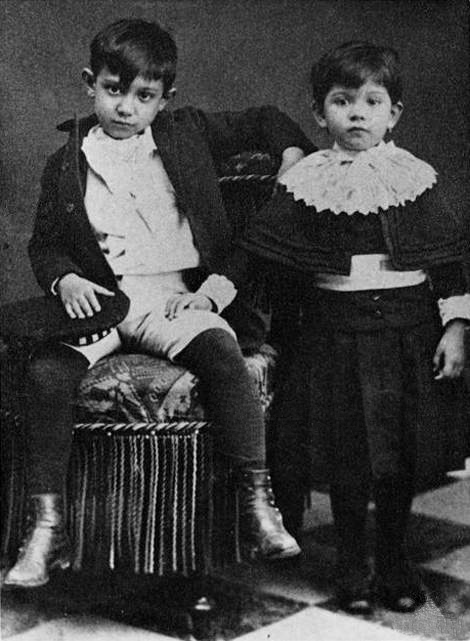
Pablo Picasso and sister Lola- Matthews Gallery blogPicasso and his sister Lola. He was about 8 years old
in this picture, and already had some swagger.

In the art world, it’s a holiday. Pablo Picasso was born in Málaga, Spain on October 25, 1881. In the 133 years since, the artist has irrevocably changed the way we look at art— and the world around it.

We’re frequently struck by the way Picasso would capture an artist’s attention and radically alter his or her course. Just look at this 1955 lithograph by Italian futurist Gino Severini, which is often mistaken for a Picasso by gallery visitors. French artist Jean-Pierre Jouffroy shifted from figurative artwork to pure abstraction after studying Picasso and his contemporaries, and Robert Motherwell‘s decision to become an artist hinged on a European tour of modern masterworks.

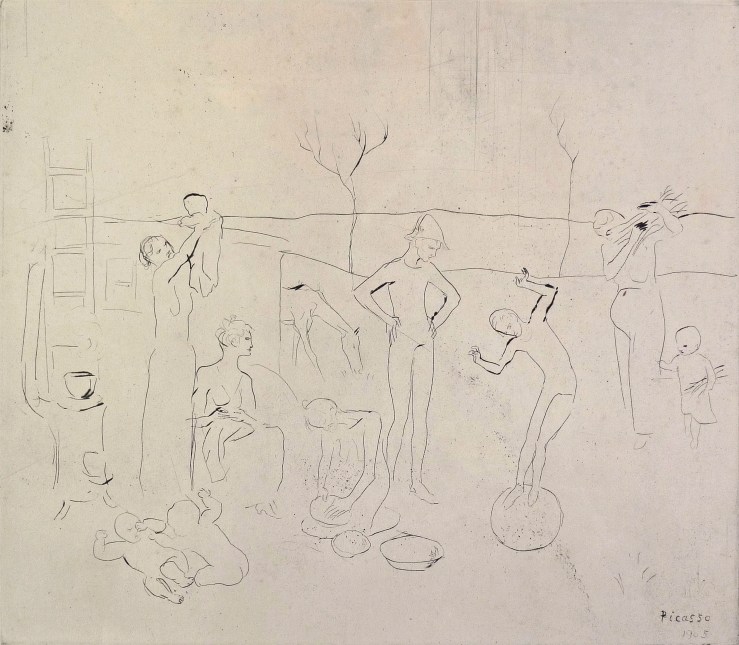
On this momentous day, we’re looking back at every Picasso that has passed through our gallery. Each one has a fascinating story… Pablo Picasso- Les Saltimbanque- Matthews Gallery blog Les Saltimbanques is the earliest work by Picasso we’ve ever exhibited. It’s a drypoint from 1905, when the artist was about 24. It was commissioned by legendary art dealer Ambroise Vollard, who gave Picasso his first gallery show in 1901. The frolicking figures are characters from an opera-comique about a circus troupe. An early appearance by the harlequin (far right) is notable, as the archetype would become one of Picasso’s most-used personal symbols.

Pablo Picasso- Personnages Masques et Femme Oiseau- Matthews Gallery blog

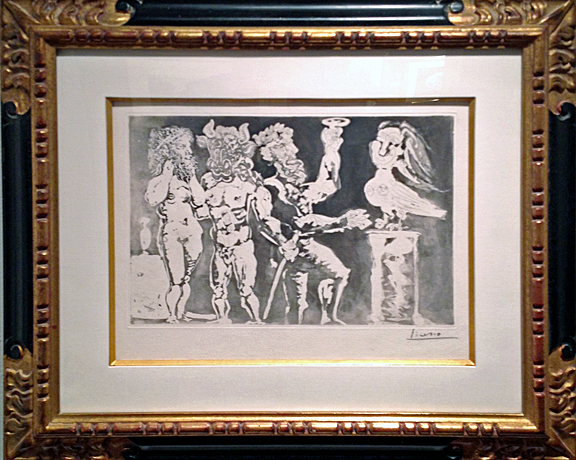
Fast forward to 1930. With the help of Vollard, Picasso had built his name into the first true global artistic brand. In yet another stroke of marketing genius, Vollard commissioned Picasso to create a series of 100 etchings—including several portraits of the dealer himself. The star of the Vollard Suite is the minotaur (second from left), another one of Picasso’s personal symbols. At the beginning of the series the minotaur is a virile beast, but by the end he is blind and weak, relying on a beautiful young muse to guide him. Completed in 1937, it’s the middle-aged Picasso’s meditation on his waning virility.

Pablo Picasso- Alex Maguy Gallery- Matthews Gallery blog

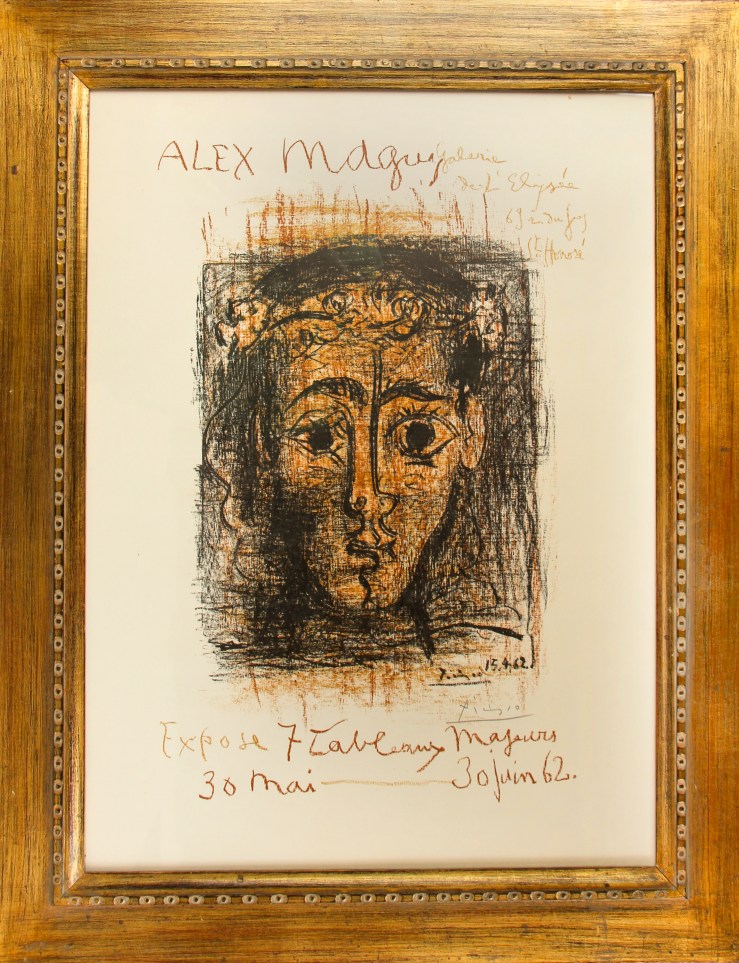
A youthful face peers from this offset lithograph Picasso designed for the Alex Maguy gallery in 1962. The exhibition was a retrospective of his artwork, but those captivating, wonder-filled eyes hardly hint at the darker themes the octogenarian turned to in his later years.

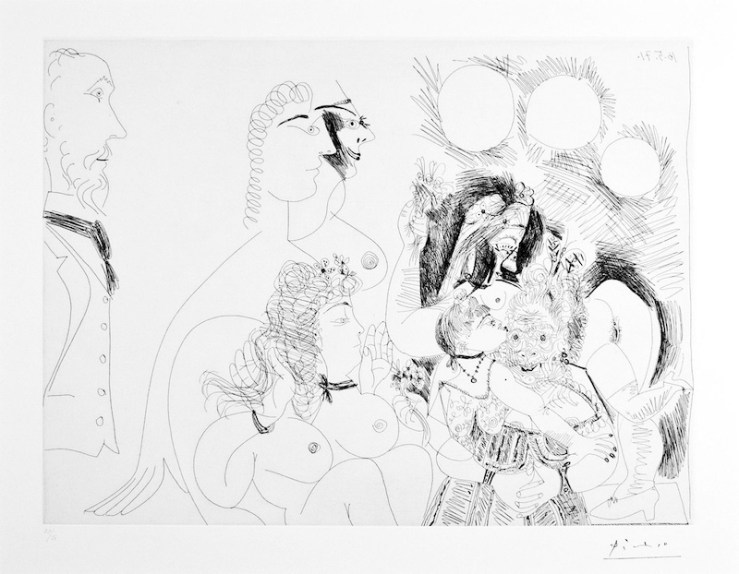
Pablo Picasso- 156 Suite- Matthews Gallery blog Picasso created the 156 Suite in 1971, not long before his death. Some consider the etchings to be his most personal series, a diary of a man struggling with impotence and pushing helplessly against the inevitable.

In contrast to our print from the Vollard Suite, women take the dominant role in these works. Models turn on artists, witch doctors stab at their patients and—in the case of this print—prostitutes tangle at a brothel while a man looks on, paralyzed. The gentleman is Degas, who appears in several prints in the series and with whom Picasso felt solidarity in his struggles.

Pablo Picasso 1971- Matthews Gallery blog Check out our Twitter, Tumblr and Pinterest profiles today for more insight on Picasso, and learn more about all of the artwork in this post on our homepage.

COLLECTOR’S FORUM: The Passionate Pursuit

Our first COLLECTOR’S FORUM workshop was this Friday, and the gallery was packed! We covered every angle of art collecting, from buying and selling to consignment agreements, insurance and art conservation. Event participants received a special packet at the end of the event with a comprehensive write-up on art collecting by Lawrence. Check out his beautiful introduction on the ‘passionate pursuit’ below, and come to our second workshop on Friday, October 24 to see our presentation and get the rest of the packet. Seats are limited, so make sure to contact us if you’d like to reserve a spot.

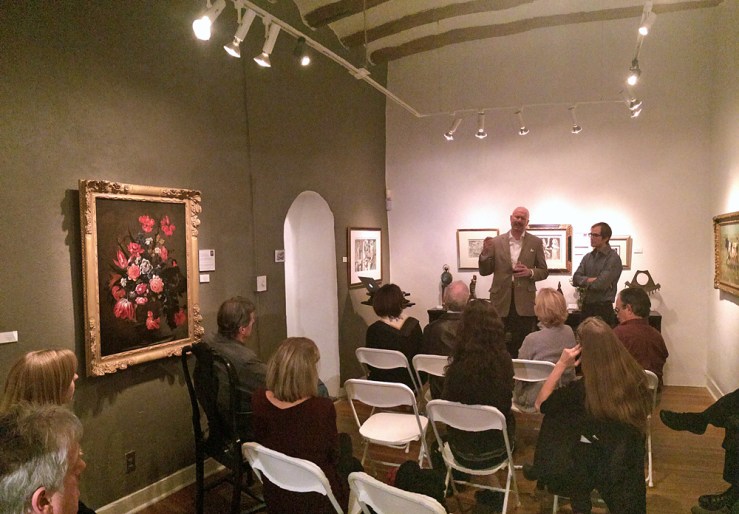
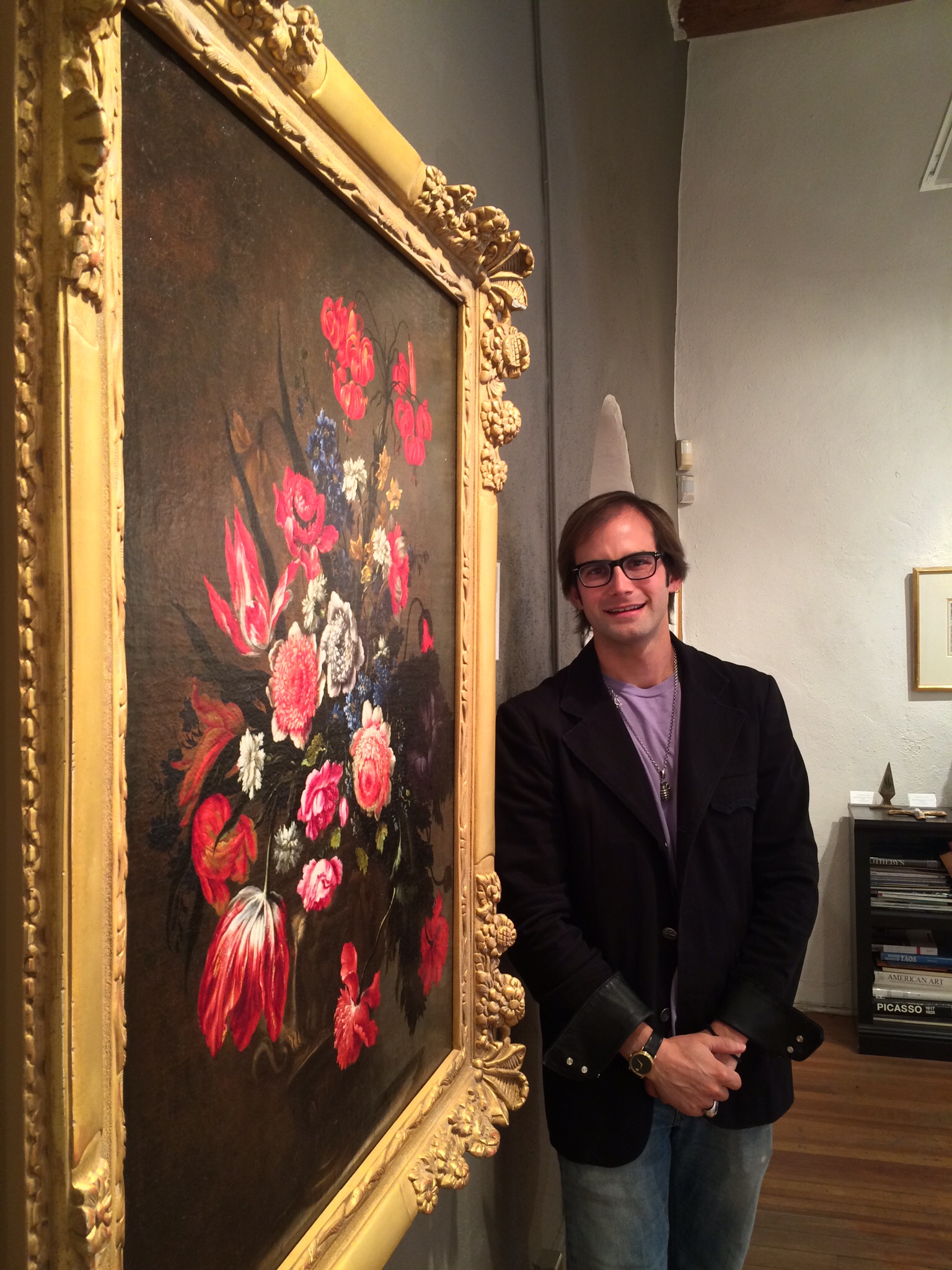
Collector's Forum- Art Collectors Workshop- Matthews Gallery blogLawrence Matthews and Matt Horowitz discuss a 17th century painting attributed to Jean-Baptiste Monnoyer

Close your eyes for a moment and think of a great piece of art you’ve seen and remember the way it made you feel. Was it was a sculpture, a painting or a drawing? Maybe it was a portrait or a landscape or an abstract. Maybe you saw it in a hometown gallery, in an artist’s studio, or in Paris walking through the Louvre. Wherever it was, remember that moment where you were overcome by that artwork, when you were flooded with a feeling that that swept you outside of yourself and put you in touch with something powerful and moving.

That is the true essence of art. The feeling you remember connects you to something deep within the human spirit and reminds you of what it means to be truly alive. It has nothing to do with money or the fame of the artist or how the art decorates a room. It has to do with the pure joy of imagination and creativity and our desire for beauty and intellectual enrichment.

Art Conservator Matt Horowitz at Collectors Forum- Matthews Gallery

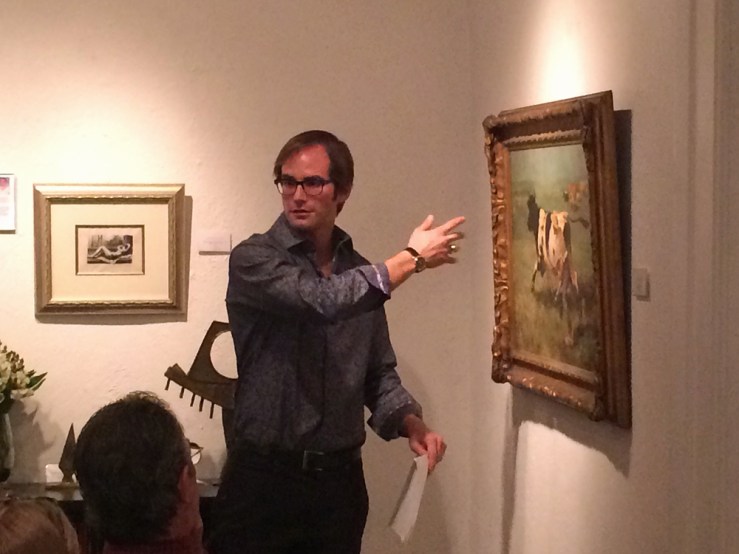
Fine art conservator Matt Horowitz talks about caring for art with our oil painting by A.J. Barry

Now, imagine another scenario. You and your spouse live in a small apartment. You both have low paying jobs but are passionate about art. You develop a plan and over the course of several years of collecting you amass 4,782 artworks many of which are considered masterpieces. You even give 2500 works from your collection to 50 museums around the country. You do all this when the highest yearly salary you ever earned was $23,000. This is the story of Herb and Dorothy Vogel – two of the greatest art collectors in recent memory.

How did they do it with so little money? First, they developed a plan, then they learned as much as they could about art – they read; they took classes; they talked to artists, gallery owners, museum curators and other collectors. They became knowledgeable, focused on the type of collection they wanted, and excited about building it. Eventually they built it into one of the greatest art collections of the 20th century.

Collecting art can enrich your life and potentially create a valuable asset for you and your heirs. Following are strategies you will need to create, maintain and grow your art collection whether you decide to focus on just a few pieces or enough to fill a museum. These insights and practical advice will help you achieve your collecting goals.

Building an art collection involves four main areas:
1. Learning About Art
2. Buying Art
3. Caring For Art
4. Selling Art

Get the details on all  of these pursuits next Friday at COLLECTOR’S FORUM Workshop 2, and connect with us on Facebook, Twitter and Instagram for daily gallery news.

COLLECTOR’S FORUM: Join the Network

Get Connected- Collector's Forum Workshops- Matthews Gallery blog

Seats are filling up for our free COLLECTOR’S FORUM workshops, which begin next Friday as part of the Santa Fe Gallery Association’s Art Matters lecture series. The events have already given us the opportunity to connect with art lovers of all stripes. As the news spreads from person to person, a network is forming with links to local art legends like Alfred Morang and Fremont Ellis.

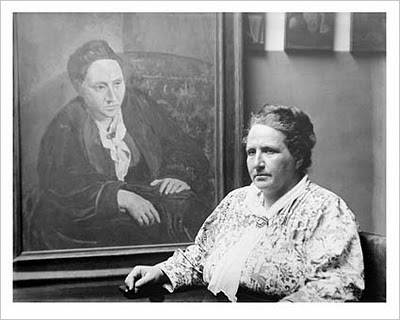
Gertrude Stein with her famous Picasso portrait- Matthews Gallery blogGertrude Stein with Pablo Picasso’s famous portrait of her

That’s why this lovely friendship map of Parisian modern artists and patrons from the early 20th century caught our eye on Twitter the other day. Celebrated salonniere Gertrude Stein is the spider at the center of the web, of course, with Pablo Picasso and Henri Matisse and Joseph Stella and Henri-Pierre Roche entangled around her. Mabel Dodge and Marsden Hartley appear too, and their later New Mexico adventures tie this famous circle directly to our own rich cultural history. Forget six degrees of separation, we’re down to one!

The art world is beautifully interconnected, but that doesn’t mean it has to be exclusive. Our workshops are designed for anyone who’s ever considered dipping a toe into the art market, whether you have a full array of masterpieces or a virtual wish list of art treasures on Tumblr. We’ll cover every angle of the art business, including:

  • How the price of artwork is determined
  • How the primary art market differs from the secondary market
  • The importance of provenance
  • When conservation should be considered for an artwork and what is involved
  • How to insure your artwork
  • How to receive an accurate art appraisal
  • How to negotiate the purchase of art
  • The best strategies for buying or selling art at auction

The workshops will feature fascinating behind-the-scenes stories from our gallery, and tales of tricky art conservation projects from special guest Matt Horowitz. Shoot us an email to reserve your seat and become a link in the long chain of art connoisseurs, from the City of Light to the City Different!

Learn more about COLLECTOR’S FORUM on our exhibition page, and connect with us on Facebook and Twitter for daily gallery news.

COLLECTOR’S FORUM: Conservator Matt Horowitz

 Fine art conservator Matt Horowitz will appear at our COLLECTOR’S FORUM workshops
on October 17 and 24. The free events are for anyone who’s ever considered buying, selling or caring for fine art and has questions about the inner workings of the art world. To reserve a seat, make sure to contact us!

Matt-Horowitz-Goldleaf-Framemakers-Conservator

Conservator Matt Horowitz with a 17th century painting he restored for Matthews Gallery

“I came in and they gave me a de Kooning,” says Matt Horowitz. He’s telling the story of his arrival in Manhattan at 24 years old to work for a famed art restoration firm. If he failed this audition, there would be dire art historical consequences.

“A piece of the white paint had chipped away, which is the hardest thing to match, because white is never really white,” Horowitz says, nervously twisting the ring on his finger. “I was like, ‘You don’t even know who the hell I am, and you just gave me a de Kooning and you want me to fix it.'” At the end of the painstaking task, Horowitz had a new job. Eight years later he sits in Matthews Gallery’s front room among paintings he’s restored for us, with a budding reputation as a rare young master in his field.

Horowitz grew up in Santa Fe, where his father Marty founded Goldleaf Framemakers in 1988. One summer in high school he got bored with the family business and asked local art conservator Steven Prins to teach him the tricks of the trade.

After receiving his BFA in painting and drawing at the University of New Mexico, Horowitz returned to Santa Fe to work with Prins, but he’d always dreamed of living in New York. When he got a job offer from Lowy Frame & Restoration Company in Manhattan, he took the leap.

Matt Horowitz- Art Conservator- Goldleaf Framemakers of Santa FeHorowitz at work

“I didn’t go and get my masters degree in conservation because I went for a ‘apprenticeship to working commercially’ route,” Horowitz says. “I prefer it because when you go to school it’s a very different environment. It’s very intellectual.” At Lowy he got hands-on experience with diverse museum-quality work: paintings by Degas, Dali and other legends.

Horowitz had a great job and an apartment in Manhattan, but he was far away from his family. “Things had gotten really rough after the recession,” he recalls. “My dad calls and says, ‘Would you be interested in coming back and helping your old man out?'” It was a difficult decision, but Horowitz left New York behind.

His first winter back in Santa Fe was hard work. Horowitz lived in the family shop and turned out beautifully restored artwork on tight deadlines, building a successful new wing of the business. It’s been four years since his return and a decade since he started working as a professional art conservator, and business is booming.

Still Life Attributed to Jean-Baptiste Monnoyer- Matthews Gallery blogUntitled still life by Jean-Baptiste Monnoyer, impeccably restored by Horowitz

“Now that I’ve been doing it for 10 years, I really push that,” Horowitz says. “I’ve definitely come up against the ageism, and the people who say, ‘How could you know what you’re doing? You’re too young.'” That’s why he jumped at the chance to collaborate with us on our Art Matters event, COLLECTOR’S FORUM. During our free workshops on October 17 and 24, he’ll discuss the fine points of maintaining and restoring artwork in your collection and tell fascinating stories from his career, including the tale of restoring one of Matthews Gallery’s oldest works of art.

“It’s kind of like being a detective,” he says. “It’s exciting. Something comes in and it’s not always totally straightforward, there’s a combination of things. It can be stressful but it’s exciting. You have to follow the clues and figure it all out.”

Learn more about COLLECTOR’S FORUM on our exhibition page, and connect with us on Facebook, Twitter and Instagram for daily gallery updates.

ONE WORK OF ART: Beatrice Mandelman’s ‘Cool Wind’

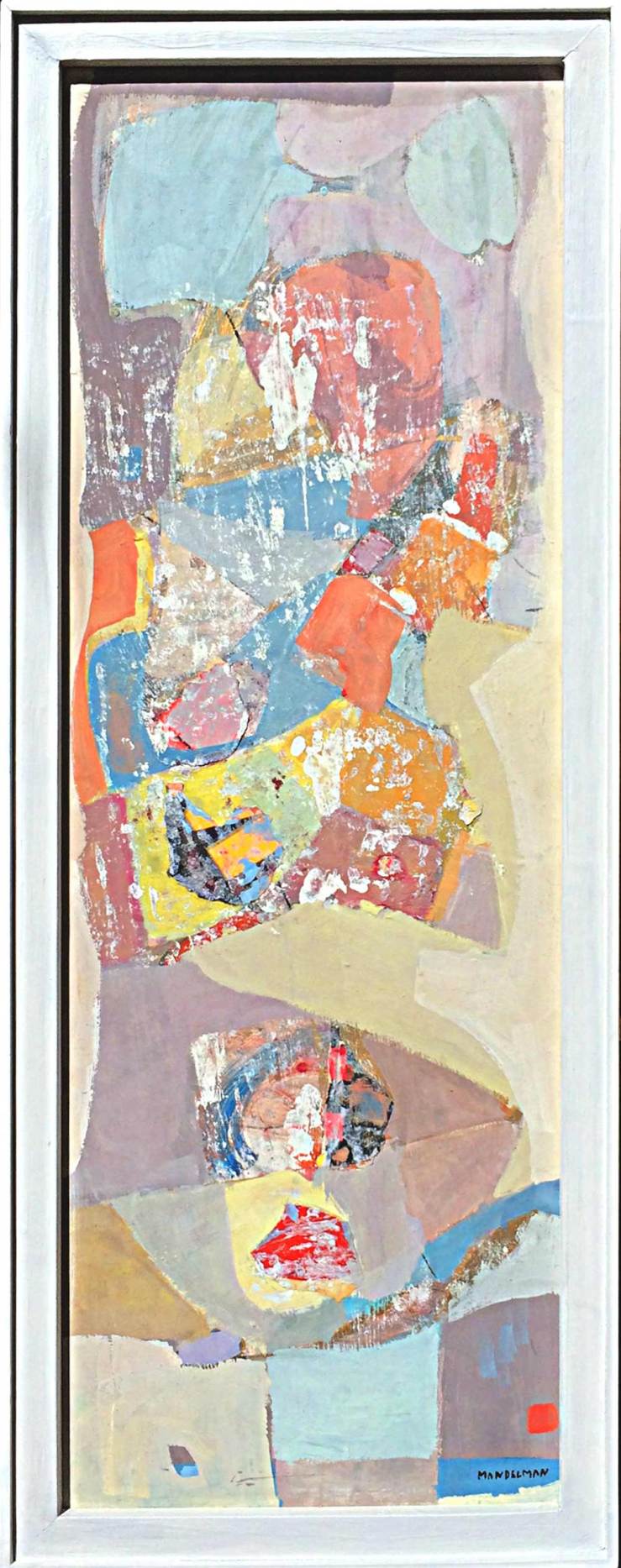
Beatrice Mandelman- Cool Wind circa 1950- Matthews Gallery

Beatrice Mandelman, Cool Wind c. 1950, Casein with Collage on Masonite Panel

When John Sloan invited Beatrice Mandelman and Louis Ribak to visit Santa Fe in 1944, the two artists were on the rise among New York City’s avant-garde. They had ties to Hans Hoffman and Fernand Leger, and were often mentioned in the same breath as Jackson Pollock. Sloan, who had been summering in New Mexico for years, had a reputation for spiriting away his favorite artists to the Desert Southwest. During their trip the recently married duo took a train to Taos and decided to stay.

The move marked a radical change in Mandelman and Ribak’s artwork. “We had to start all over again,” Mandelman said. “We spent the first couple years painting landscapes.” They were known for their figurative paintings in New York, but in this radically different environment their focus shifted to pure abstraction. They were trailblazers for a new wave of artists called the Taos Moderns, a movement that enlivened the Taos art colony but enraged an older vanguard of academic painters with ties to the Taos Society of Artists of the 1910’s and 20’s. To this tight clique of romanticists, the newcomers stuck out like colorful cacti—particularly Mandelman.

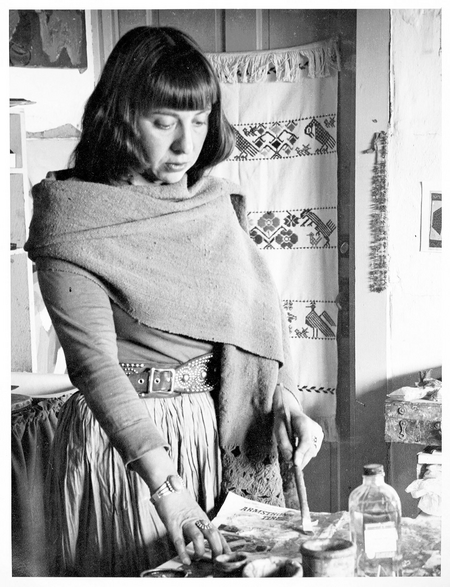
Portrait of Beatrice Mandelman in her Taos studio circa 1950- Matthews Gallery Beatrice Mandelman, 1950

“She worked with full abstraction at a time when most artists were not daring enough to do so,” writes David L. Witt in his book Taos Moderns, noting that Mandelman considered herself “the first of the second generation of artists in Taos.” The voice of a young, female abstract painter had never been part of the remote art community.

Far from the big city, Mandelman developed a new appreciation for the natural world and humanity’s relationship with it. By the late 1940’s she was developing an abstract symbol system to express her emotional responses to the landscape. Her elegant compositions didn’t mimic the lines or palette of the high desert, but they perfectly evoked the strong, solitary spirit of its inhabitants.

The mixed media painting in our collection was likely done in the 1950’s. Early in her experiments with abstraction Mandelman chose a muted palette, but here brighter colors poke through. This more expressive style was inspired by Henri Matisse and Mandelman’s former teacher Leger, and allowed her to explore the highs and lows of human experience with great vigor. Cool Wind‘s undercurrent of chilly blues and bright accents of orange and red call forth the sensation of a shiver passing up the spine.

As the evenings get cooler in Santa Fe, we’ve developed an ever-evolving passion for this piece and the innovative artist who created it. Learn more about Beatrice Mandelman on our website, and connect with us on Facebook, Twitter and Instagram for daily gallery news.

ROCH HART: Mystery of the Petroglyphs

Roch-Hart-New-Mexico-Jeep-Tours Roch Hart’s jeep outside Matthews Gallery

Roch Hart is the first and only fine furniture maker in our stable, but he also has a pretty awesome day job. As the owner of New Mexico Jeep Tours, Hart takes visitors on rugged expeditions across a 20,000 acre private ranch between Santa Fe and Albuquerque. The property is home to wild horses and numerous petroglyphs left behind by ancient Pueblo cultures.

We first met Hart through the image sharing website Flickr, where he posts stunning photographs from his adventures. We had no idea that he was also a master craftsman until he reached out to us. Not long after, a big red jeep full of beautiful hand-carved benches appeared outside the gallery. When we saw how good Hart’s work looked in our Southwestern art room, we knew it was a perfect match.

It didn’t take long to realize that Hart’s adventurous occupation and his impressive hobby were connected. As chronicled in previous posts, many of his works feature symbols from the petroglyphs he discovers on the ranch. The ancient marks are part of a complex language, and their meanings are partly lost to history. Luckily, Hart is a passionate detective. We asked him to show us some of his photos and tell the stories of petroglyphs that have inspired his work.

Take it away, Roch:

New-Mexico-Flag-Roch-Hart

New Mexico state flag, and a cross from Roch’s pie chest ‘The Way

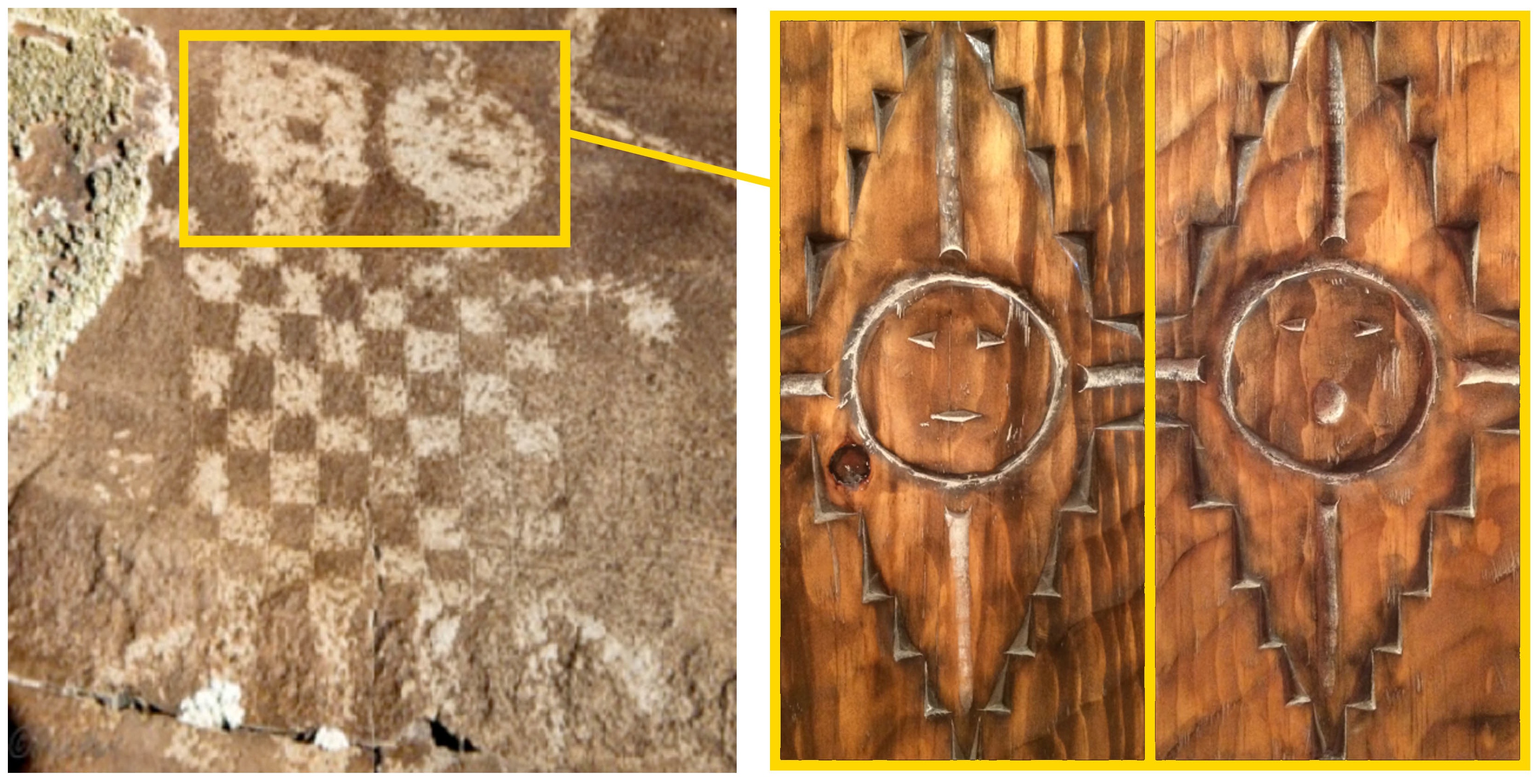
In petroglyphs, the same symbol can hold multiple meanings. Take for example the Zia symbol on our state flag. Our European or Western paradigms might lead us to interpret the Zia as a simple, decorative depiction of the sun, but in the Pueblo culture these symbols were a communication form rather than an art form.  The circle of the Zia represents the circle of life. The four rays radiating from the circle represent many different things: the four directions, the seasons, the elements or even four stages in a person’s life. In the Pueblo culture, the four is a sacred number. I have found petroglyphs with faces whose mouths are in a square shape, perhaps speaking of the fours.

Roch-Hart-The-Way-Petroglyphs

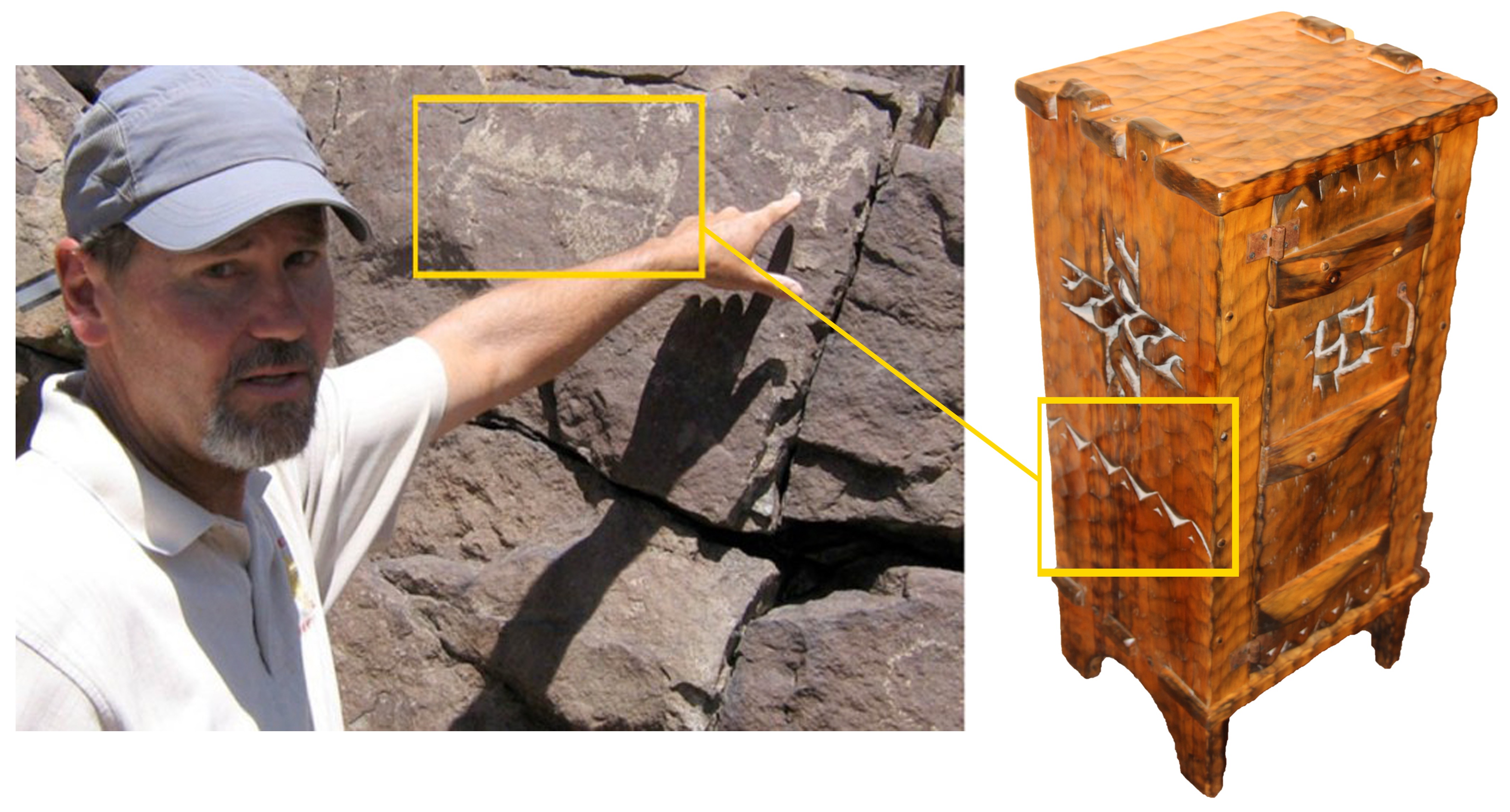
Roch Hart with New Mexico petroglyphs, a similar design on Hart’s pie safe ‘The Way

Sometimes petroglyphs mimic the lines and rhythms of nature. I’ve been told by a trusted, unnamed native source that the triangular petroglyphs in the photo above represent mountains. The straight lines below the mountains may represent mesas, and below that is a mark that resembles a body of water. This could be a map of sorts. Not far from this petroglyph, there is a small pond with a view of mesas and the Jemez Mountains. On my latest pie safe, ‘The Way, I carved a similar pattern to represent mountains.

Roch-Hart-Petroglyph-Shield-WarriorShield Warrior petroglyph, photo by Roch Hart

In the world of petroglyphs there is a common theme of anthropomorphism (I really just like saying that word). Humans will sometimes take on the form of an animal, insect, or warrior shield. In the simple petroglyph above, a circled cross with a head and eyes represents a Shield Warrior. If we were still doing petroglyphs, this one could have represented me during my days as a cop. As you can see, this little guy also has the cross in his shield, representing the fours or ‘the way.’

Roch-Hart-Bear-Claw-PetroglyphsBear claw petroglyphs with storyteller and listener faces, photo by Roch Hart


Another common theme in petroglyphs is the ‘yin and yang.’ For instance, every storyteller needs a listener. The images above show petroglyphs that represent bear tracks. The tracks come in pairs, and each track has a face inside it representing a storyteller or a listener.

Roch-Hart-Storyteller-Faces

 ‘Marriage’ petroglyph, faces on Hart’s pie safe ‘The Storytellers

I call the petroglyph above ‘The Marriage.’ You can see two distinct people occupying one checkerboard body. If you look carefully, the square head appears to be speaking while the round head has its mouth closed. My pie safe called ‘The Storytellers‘ explores this theme of opposites. The listener and the speaker depend on each other.

Roch-Hart-New-Mexico-Petroglyphs

New Mexico petroglyphs, a spiral design on a bench by Roch Hart

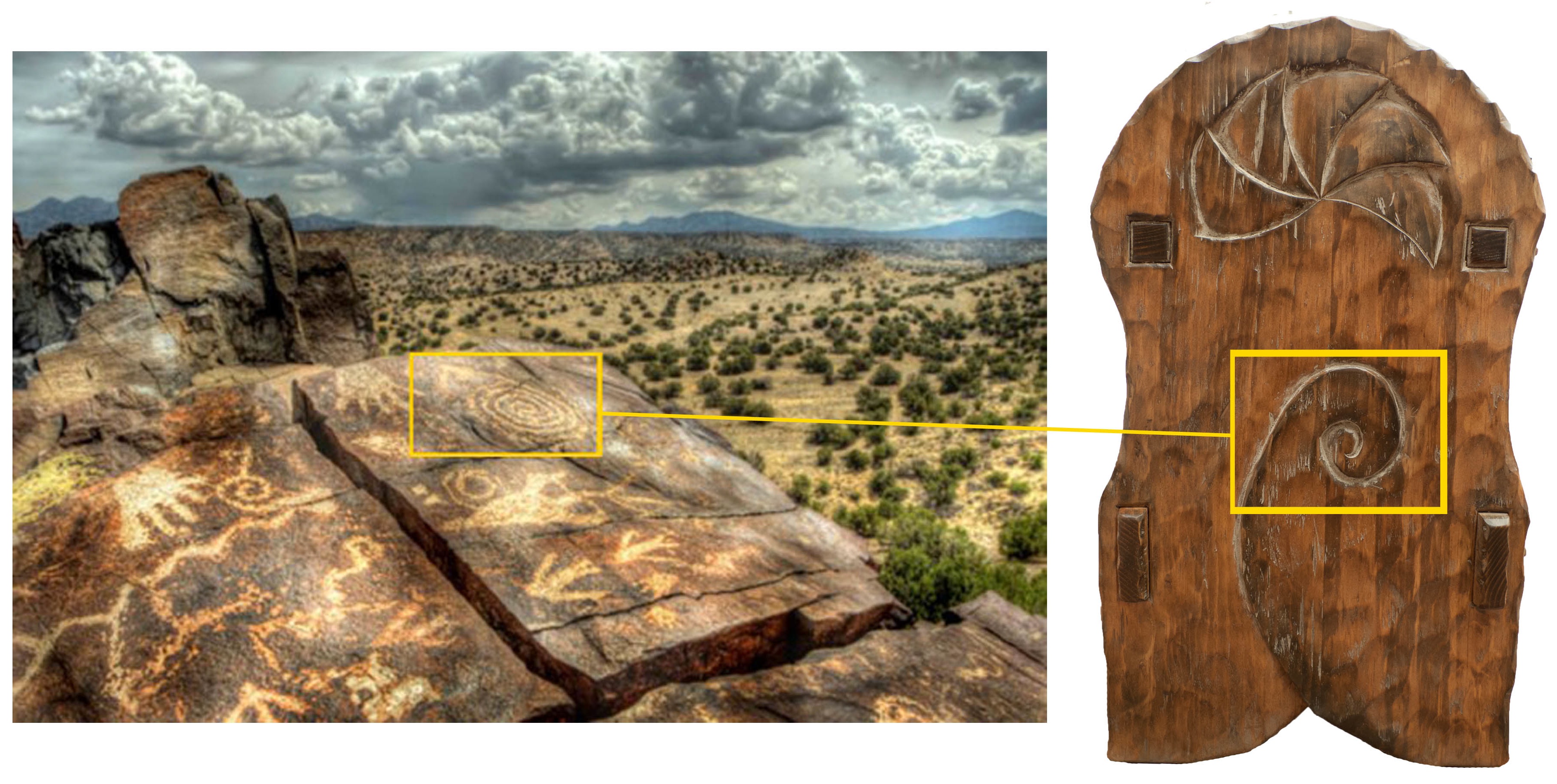
Another common symbol is the spiral.  Spirals or concentric circles often represent time or travel.  I have found that cracks are often incorporated into these petroglyphs and I will find a spiral with the outer end going to or ending in a crack.  A common legend amongst the Pueblo natives is that they originated under the earth’s crust and made the journey to surface.  I believe these spirals convey that journey.  On one of my early pie safes, I placed a spiral on the door with the tail leading up to the middle joint of the door.

 Screen Shot 2014-09-11 at 6.22.02 PMNew Mexico petroglyphs

Petroglyphs are very complex and have multiple layers of meaning and legend.  This blog post just scratches the surface, so to speak.  We have lost much knowledge of petroglyphs because early Spanish priests saw them as spiritualism apart from Catholicism. Catholicism was the state religion and the only legal one, so petroglyphs were outlawed.  In fact we often find crucifixes etched into the stones near these sites, placed there by the early priests to exorcise the place of evil spiritualism and to remind the Pueblo natives that this was not longer an accepted practice.

While part of me is upset about how we lost the knowledge of these ancient symbols, I enjoy that I don’t completely understand the mystery.  I love the idea that in some respects it is open to the interpretation of the beholder. Only the maker knew.

To make my fine furniture, I blend influence from the native cultures with my knowledge of Spanish colonial carpentry laws. That’s how I arrive on how to make a piece down to the joinery. But that’s for another blog post!

To see more photos by Hart, make sure to check out his Flickr account. See all of his furniture on our website, and connect with us on Facebook, Twitter and Pinterest for daily gallery news.


The Boundless Moment: Words and Images

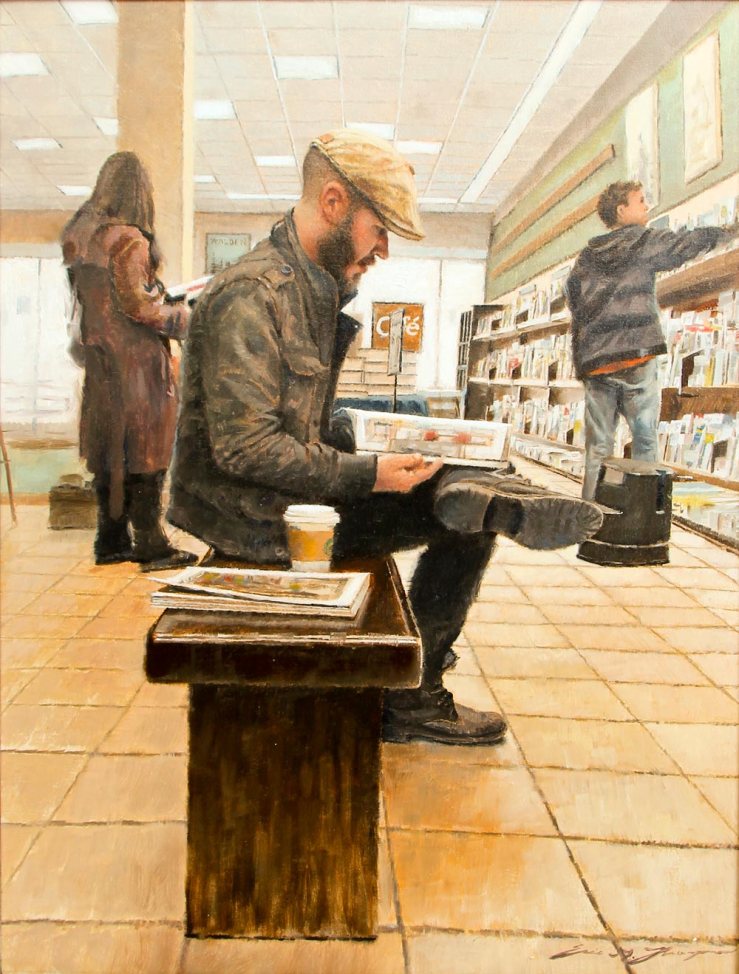
Eric Thompson- The Photographer- Matthews Gallery blog

 Eric G. Thompson, The Photographer, Oil on Linen

For the past week, excited art pilgrims—determined to visit every gallery on Canyon Road—have marched purposefully into our front room and come to a screeching halt. Our Eric G. Thompson show ‘The Boundless Moment‘ is a little different from most of the exhibitions you’ll see on this famous art route. Accompanying many of Thompson’s serene realist paintings are writings by great American poets, from Elizabeth Bishop to Walt Whitman.

The interplay of words and images has compelled viewers to slow down and look twice, sparking many a fascinating observation. Most notably, journalist Alison Oatman of the Weekly Alibi attended our opening and wrote an elegant, poetry-filled review of the show.

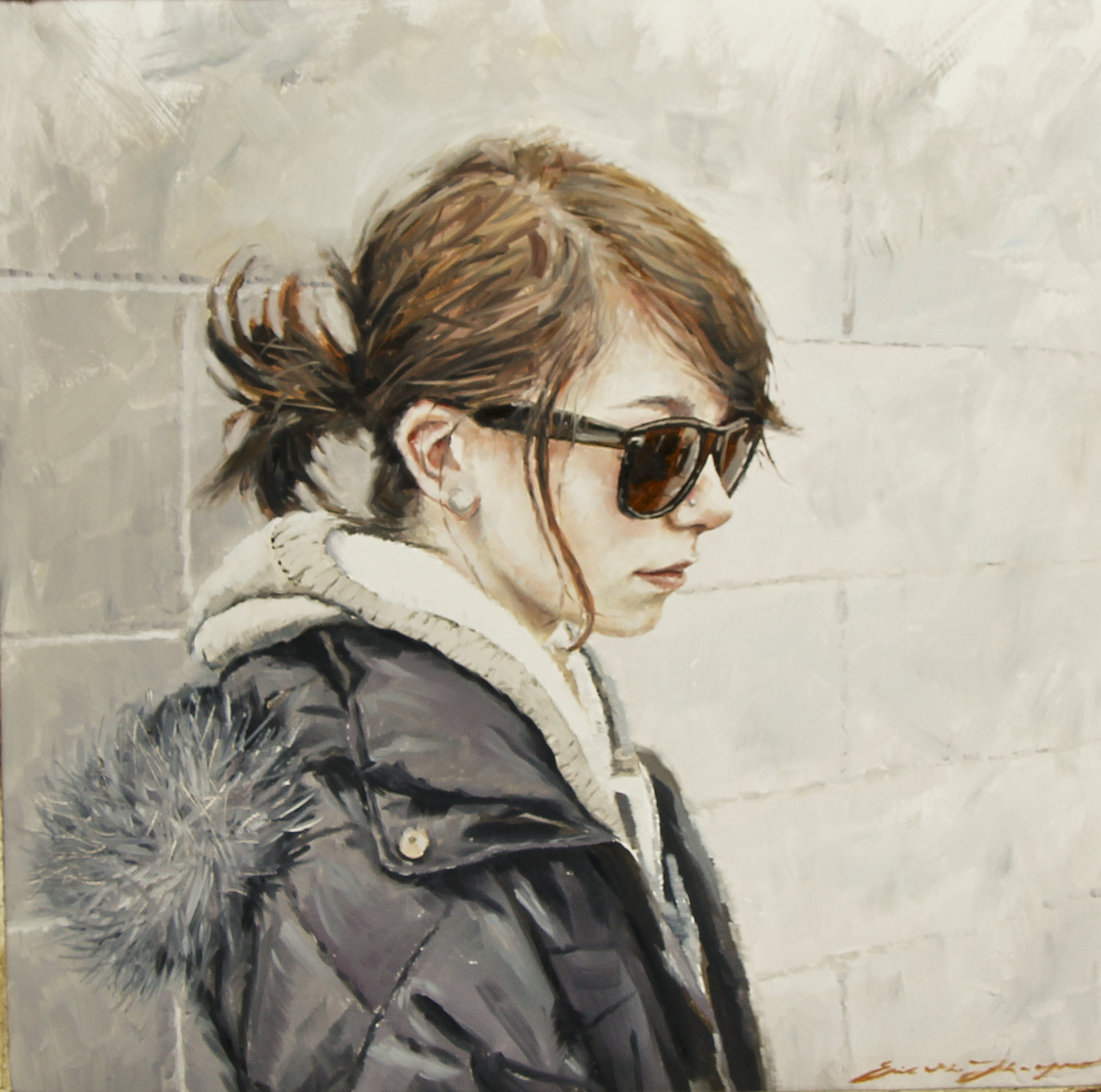
Eric G. Thompson- Coffee Shop Girl- Matthews Gallery blog

Eric G. Thompson, Coffee Shop Girl, Oil on Panel

An excerpt from Oatman’s article:

Robert Lowell’s “Epilogue” [is] paired with the painting “Coffee Shop Girl.” Lowell writes: “I hear the noise of my own voice:/ The painter’s vision is not a lens,/ it trembles to caress the light” [emphasis original]. These lines are reflected in the Coffee Shop Girl’s illuminated face—as pale as rice paper.

Later on, the poem continues: “Pray for the grace of accuracy/ Vermeer gave to the sun’s illumination/ stealing like the tide across a map/ to his girl solid with yearning.” Though large sunglasses hide her face and her meager mouth is expressionless, the Coffee Shop Girl is ravenous. We see her frayed emotional state in the feathery brushstrokes in the background, the squirming reddish-brown tendrils of her ponytail, and the sparkling clusters of dandelion-like fur attached to the hood of her puffy coat.

We spoke with Thompson on the phone today to fill him in on the big response his show has received. The artist was in Santa Fe last week for the opening reception, but now he’s back home in Salt Lake City, Utah. The long drive home gave him time to gather some thoughts on the exhibition. Read our interview below, and make sure to come see ‘The Boundless Moment‘ before it closes on August 28!

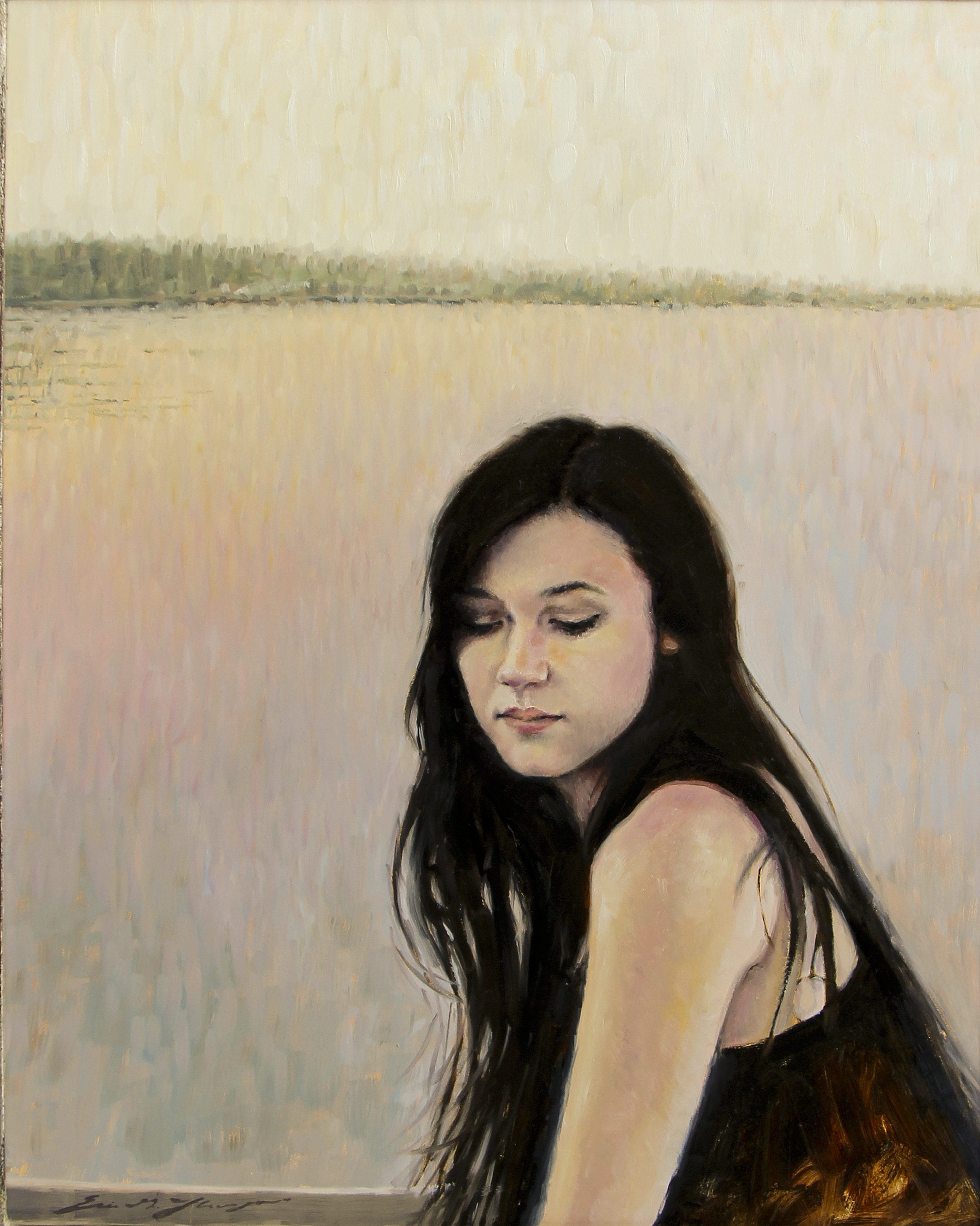
Eric G. Thompson- Half Light- Matthews Gallery blogEric G. Thompson, Half Light, Oil on Canvas

Describe your studio. 

My studio is just a few feet away from my house. It has windows with good natural light, so sometimes I can turn off the light and still get what I need. Sometimes I’ll set up my daughter‘s easel next to mine, and we’ll work next to each other. She gets to see what her dad does. Most of the time the kids aren’t allowed in the studio, though. I’ll play underground folk music, and when I’m really inspired it feels like the music is flowing straight through my brush.

You work in oil, egg tempera and watercolor. How do you choose which medium to use for a new painting? 

Between the three of them, if I want to capture something a little more loose and light I go for watercolor. If I want to capture something very solid, heavy and thick I’ll go with oil. If I want to capture something a little more photorealistic, I go with egg tempera. It gives you a lot of freedom to express the story or the emotion that you’re trying to convey with each medium.

It can be refreshing, but it can also be almost maddening. They’re all so different, it’s unbelievable. You have to switch your brain around and remember how to use that medium. It can be completely challenging, which I love. That’s one of the greatest thing about painting, is the challenge. I can always let a painting go as long as I have another challenge.

Eric G. Thompson- Nestled- Matthews Gallery

Eric G. Thompson, Nestled, Oil on Panel

Alison Oatman’s review in The Alibi begins with, “One question contemporary realist painters often get is, ‘Why not simply take a photograph?'” Over the course of the article, she critiques that particular line of thought. What’s your answer to that question? 

To a lot of artists, it’s not a great compliment when a viewer says, “That looks just like a photograph.” Maybe to a photorealist that would be flattering, but I think the greatest artists of all time have that balance of, it looks like a painting but it looks so ‘real.’ I’ve made it come to life.

Why does someone need a painting to look just like a photograph? What’s the power in that? Technically it’s amazing, but where’s the artistic freedom? I need artistic license to change things and blur edges and sharpen edges and change value to make it more ethereal.

I can make a painting look like a photograph but then there’s no energy, there’s no life to it. I think just adding a little more energy with brushstrokes or texture brings it more to life.

One of your influences is the Japanese aesthetic of wabi-sabi. How would you describe it? 

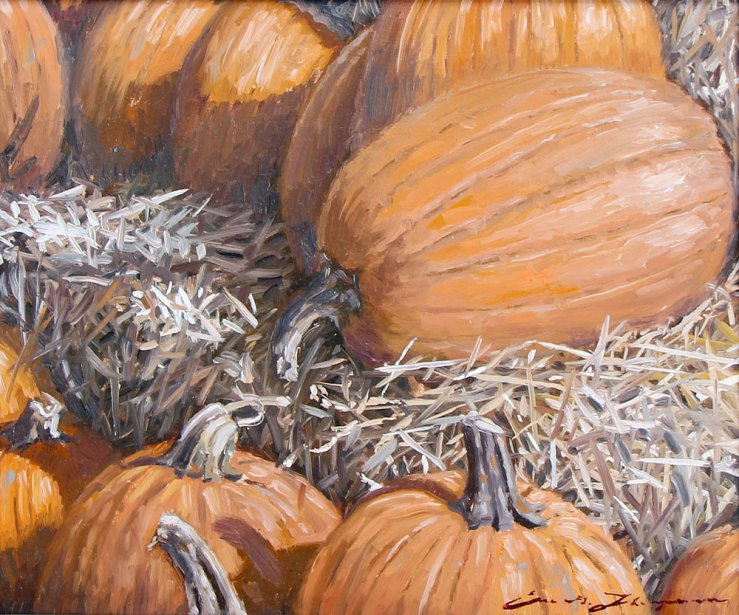
It’s what an object has been through, who used it, who touched it. It’s the patina objects acquire over time, like the rust on an oil can. It just adds to the whole character of the object—I see them as little characters. A cup on a windowsill, an oil can or even pumpkins can have little lives of their own.

Your works seem still at first glance, but a longer look gives me a sense of ‘unfolding,’ of motion. Is that one of our goals?  

It’s about capturing a moment in time that I’d like to freeze and experience for longer than the experienced moments.

I’ve definitely been experimenting with looser brushstrokes toward the outer edges of the painting to give it some energy. I need to experiment to see if I can get the perfect balance of detail and looseness. It’s a way of pushing myself as an artist, and it’s been one of the hardest things I’ve ever attempted.

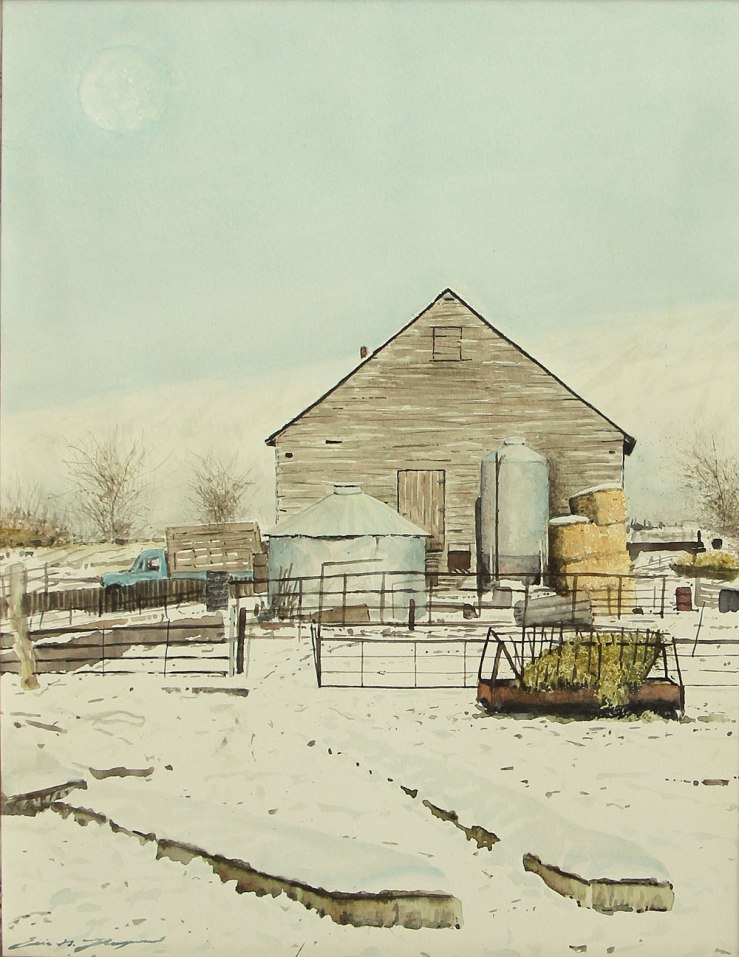
Eric G. Thompson- Winter Moon- Matthews Gallery blogEric G. Thompson, Winter Moon, Watercolor

Which paintings in ‘The Boundless Moment’ are closest to your heart? 

A few of the watercolors are very powerful to me in an emotional way. Just reminding me of something in my past, at my Grandma’s house in Idaho. She had a farm with all of these different structures. They just remind me of that time, and different feelings come up from my childhood.

Raven’s Hair is a very powerful piece. It’s capturing this emotion of a woman laying on this bed. Her eyes are closed and she’s having a very pleasant thought. It seems to have some nice emotion to it.”

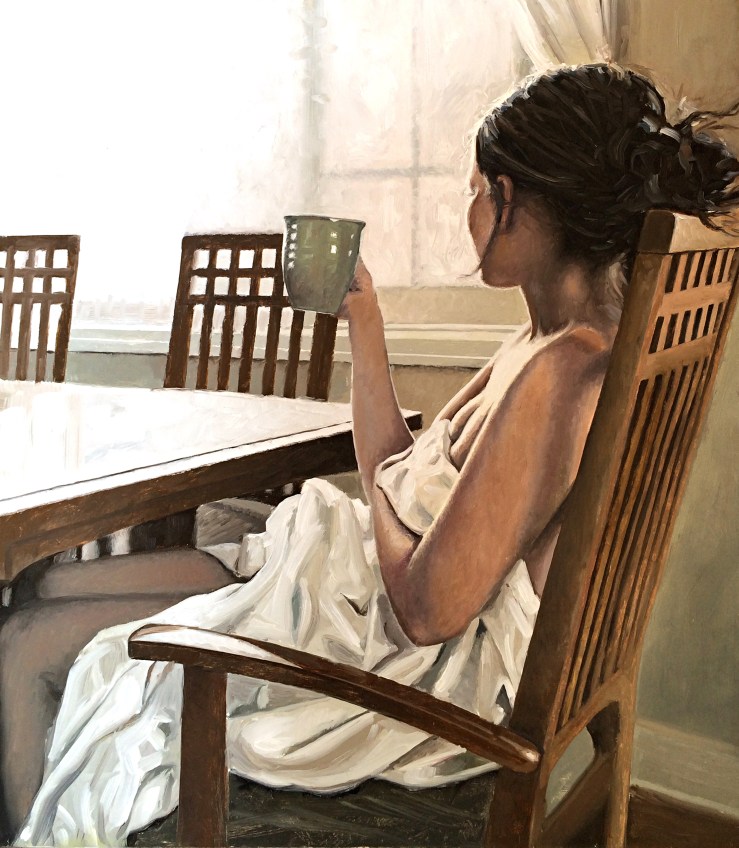
Morning Cup is a portrait of your wife Hilary, and inspired her to write a poem that we’re featuring in the show. Do you often inspire each other like that? 

 We’ve named my paintings every year for 12 years or more. We try to outdo each other with the most poetic titles. The title can say so much in just a couple words. What’s the best title, or the strongest? Hilary is amazing with words.

To learn more about Thompson’s show, connect with us on Twitter, Facebook and Pinterest.

The Boundless Moment: All Together Now

Eric-Thompson-Artist-Family

Eric G. Thompson’s ‘The Boundless Moment
opens Friday, August 15 from 5-7 pm
and closes August 28.

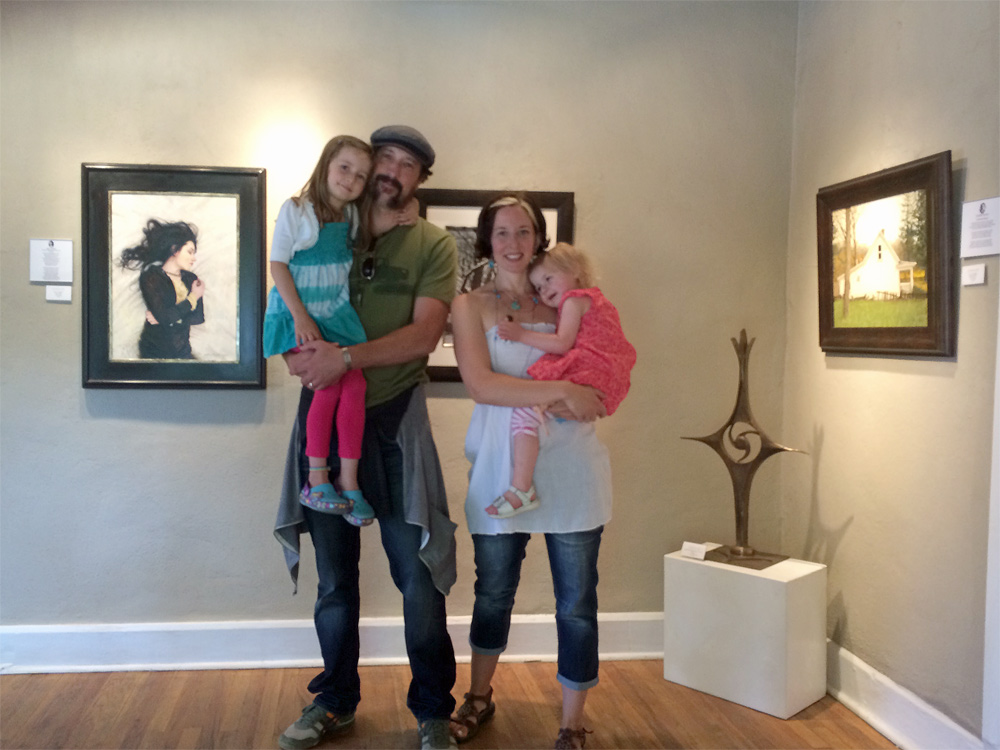
Eric and Hilary Thompson’s daughters dash around Matthews Gallery, exploring their father’s new solo exhibition ‘The Boundless Moment.’ They’ve just finished a long car ride from Salt Lake City but they’re bursting with energy.

Over the past year the children have grown alongside these canvases and panels, watching as thousands of brushstrokes transformed into rolling landscapes and rosy skin. Now these familiar images have magically appeared in our lofty, brightly lit space, sparking the girls’ curiosity. They stop before each work, craning their necks to get a good look.

The girls’ vivacity matches Hilary’s temperament. She keeps an eye on them as she chats and laughs with us. Eric is a quieter presence. He strolls around the gallery, analyzing the arrangement of the work and reading the legendary poems we paired with them. Eric likes to think of his paintings as ‘visual haikus,’ which inspired us to select writings by Frost, Dickinson, Lowell and others to display during the show.

‘The Boundless Moment’ is something of a family act. Hilary was Eric’s model for the painting ‘Morning Cup,’ and wrote an accompanying poem that will debut at the opening reception. ‘The Chiseled Mother’ is a passionate meditation on parenthood and aging. As Eric cradles one of his daughters in his arms, you can tell that he’s just as inspired by the radiant spirit of his children. 

Read Hilary’s poem below, and make sure to attend Eric’s artist reception on Friday, August 15 from 5-7 pm.

Eric G. Thompson- Morning Cup- Matthews Gallery blog Eric G. Thompson, Morning Cup, Oil on Panel

From Hilary Thompson:

The Chiseled Mother

I honor this body
This matryoshka

The delicate lines of my eyes
Like tissue paper
Crinkled from sun beams
Washboards slow the momentum
of tears

These ears, these conches
That entombed the beeping screaming alarms
Echoing endlessly on exhausted drives home
Mercifully quieting with age

Eric G. Thompson- Waiting for a Song- Matthews Gallery blog


Eric G. Thompson, Waiting for a Song, Oil on Panel

This mouth
Which broadcasts comforts, screeches, praise
Fractures the tightrope of vexation

These beautiful, perfect arms
That embraced defeat
Carried a child to the surgeon’s knife
Willing arms
That waved, furrowed, aching
Sturdy farewells

This heart that beats out
The anthem of the womb
I Am
I Am
I Am

Eric-Thompson-Art-CoffeeshopGirl

Eric G. Thompson, Coffee Shop Girl, Oil on Panel

A womb
That is the definition of Creation
Bringing forth what does not exist
Into existence
Torn out of me
With upheaval and sanguine waves of nurture

These knees that caught me
When my frame buckled
Unable to support my grief

These marks, stretched
Yawning tiger stripes
Where my body gave room
Shimmer as silver reminders of a past shape

EricGThompson-Art-Evening

Eric G. Thompson, Evening, Oil on Panel

These feet
Planted.  Supporting.
Rooted even in motion, substantial
Pacing halls, hospital rooms
Threshing carpets bare-threaded

I am the red rock slot canyon
Worn smooth, fissured, curved
Sculpted
By this flawed life

This body is a shrine
A Holy place, a pilgrimage
A masterpiece painted stroke by stroke
By the breathtakingly exquisite nourishment
Of not getting what I want.

Breathe that in,
Chiseled edifice of the Mother,
Slather it like salve into your stripes,
You silver tiger.

 Connect with us on Facebook, Twitter and Instagram to learn more about Eric G. Thompson.