COLLECTOR’S FORUM: Join the Network

Get Connected- Collector's Forum Workshops- Matthews Gallery blog

Seats are filling up for our free COLLECTOR’S FORUM workshops, which begin next Friday as part of the Santa Fe Gallery Association’s Art Matters lecture series. The events have already given us the opportunity to connect with art lovers of all stripes. As the news spreads from person to person, a network is forming with links to local art legends like Alfred Morang and Fremont Ellis.

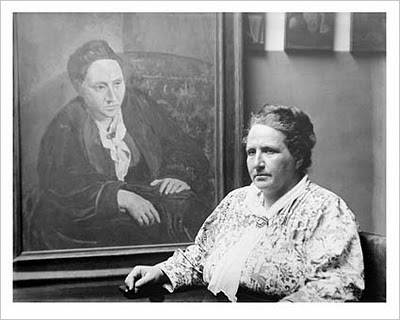
Gertrude Stein with her famous Picasso portrait- Matthews Gallery blogGertrude Stein with Pablo Picasso’s famous portrait of her

That’s why this lovely friendship map of Parisian modern artists and patrons from the early 20th century caught our eye on Twitter the other day. Celebrated salonniere Gertrude Stein is the spider at the center of the web, of course, with Pablo Picasso and Henri Matisse and Joseph Stella and Henri-Pierre Roche entangled around her. Mabel Dodge and Marsden Hartley appear too, and their later New Mexico adventures tie this famous circle directly to our own rich cultural history. Forget six degrees of separation, we’re down to one!

The art world is beautifully interconnected, but that doesn’t mean it has to be exclusive. Our workshops are designed for anyone who’s ever considered dipping a toe into the art market, whether you have a full array of masterpieces or a virtual wish list of art treasures on Tumblr. We’ll cover every angle of the art business, including:

  • How the price of artwork is determined
  • How the primary art market differs from the secondary market
  • The importance of provenance
  • When conservation should be considered for an artwork and what is involved
  • How to insure your artwork
  • How to receive an accurate art appraisal
  • How to negotiate the purchase of art
  • The best strategies for buying or selling art at auction

The workshops will feature fascinating behind-the-scenes stories from our gallery, and tales of tricky art conservation projects from special guest Matt Horowitz. Shoot us an email to reserve your seat and become a link in the long chain of art connoisseurs, from the City of Light to the City Different!

Learn more about COLLECTOR’S FORUM on our exhibition page, and connect with us on Facebook and Twitter for daily gallery news.

COLLECTOR’S FORUM: Conservator Matt Horowitz

 Fine art conservator Matt Horowitz will appear at our COLLECTOR’S FORUM workshops
on October 17 and 24. The free events are for anyone who’s ever considered buying, selling or caring for fine art and has questions about the inner workings of the art world. To reserve a seat, make sure to contact us!

Matt-Horowitz-Goldleaf-Framemakers-Conservator

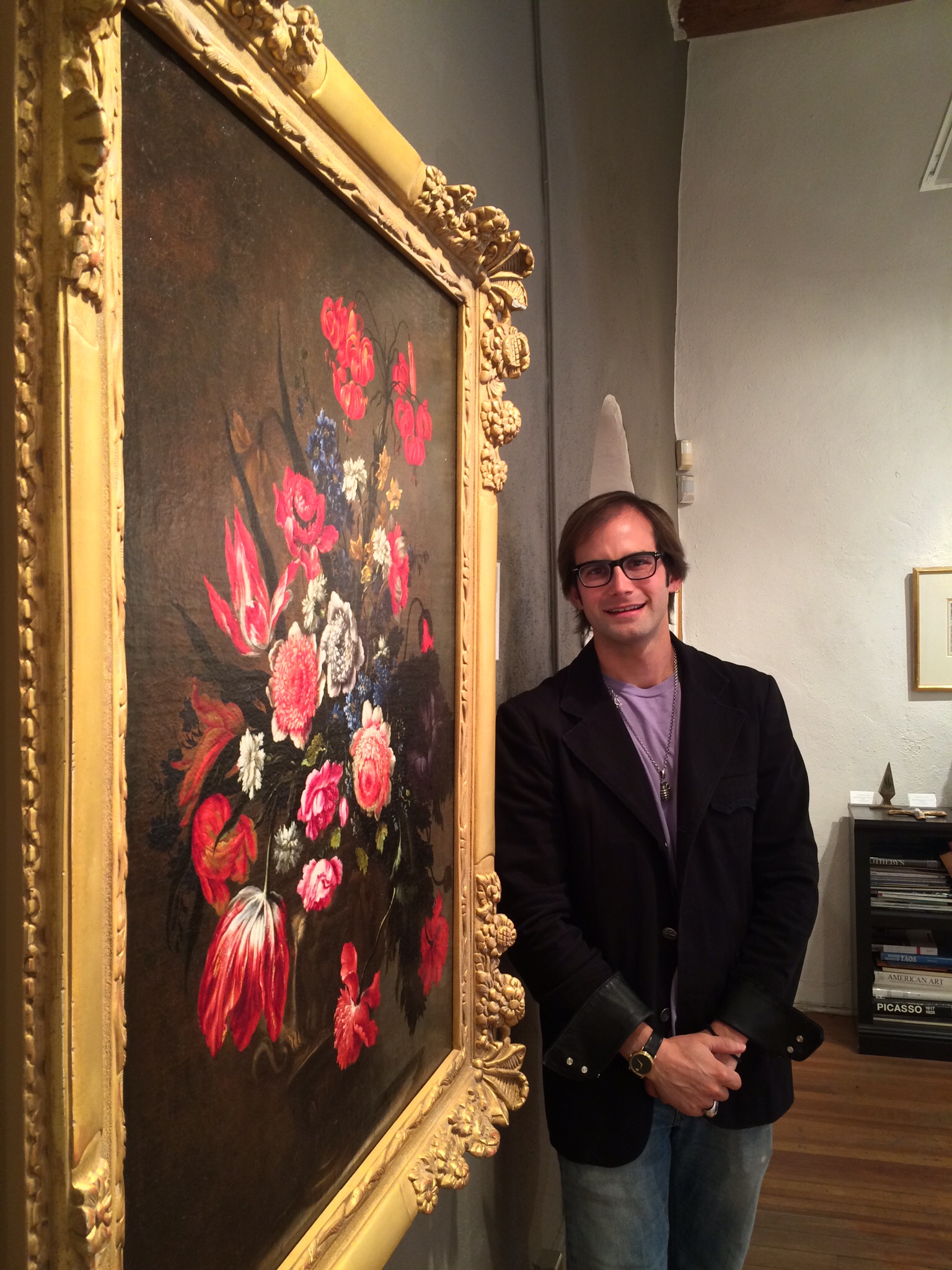
Conservator Matt Horowitz with a 17th century painting he restored for Matthews Gallery

“I came in and they gave me a de Kooning,” says Matt Horowitz. He’s telling the story of his arrival in Manhattan at 24 years old to work for a famed art restoration firm. If he failed this audition, there would be dire art historical consequences.

“A piece of the white paint had chipped away, which is the hardest thing to match, because white is never really white,” Horowitz says, nervously twisting the ring on his finger. “I was like, ‘You don’t even know who the hell I am, and you just gave me a de Kooning and you want me to fix it.'” At the end of the painstaking task, Horowitz had a new job. Eight years later he sits in Matthews Gallery’s front room among paintings he’s restored for us, with a budding reputation as a rare young master in his field.

Horowitz grew up in Santa Fe, where his father Marty founded Goldleaf Framemakers in 1988. One summer in high school he got bored with the family business and asked local art conservator Steven Prins to teach him the tricks of the trade.

After receiving his BFA in painting and drawing at the University of New Mexico, Horowitz returned to Santa Fe to work with Prins, but he’d always dreamed of living in New York. When he got a job offer from Lowy Frame & Restoration Company in Manhattan, he took the leap.

Matt Horowitz- Art Conservator- Goldleaf Framemakers of Santa FeHorowitz at work

“I didn’t go and get my masters degree in conservation because I went for a ‘apprenticeship to working commercially’ route,” Horowitz says. “I prefer it because when you go to school it’s a very different environment. It’s very intellectual.” At Lowy he got hands-on experience with diverse museum-quality work: paintings by Degas, Dali and other legends.

Horowitz had a great job and an apartment in Manhattan, but he was far away from his family. “Things had gotten really rough after the recession,” he recalls. “My dad calls and says, ‘Would you be interested in coming back and helping your old man out?'” It was a difficult decision, but Horowitz left New York behind.

His first winter back in Santa Fe was hard work. Horowitz lived in the family shop and turned out beautifully restored artwork on tight deadlines, building a successful new wing of the business. It’s been four years since his return and a decade since he started working as a professional art conservator, and business is booming.

Still Life Attributed to Jean-Baptiste Monnoyer- Matthews Gallery blogUntitled still life by Jean-Baptiste Monnoyer, impeccably restored by Horowitz

“Now that I’ve been doing it for 10 years, I really push that,” Horowitz says. “I’ve definitely come up against the ageism, and the people who say, ‘How could you know what you’re doing? You’re too young.'” That’s why he jumped at the chance to collaborate with us on our Art Matters event, COLLECTOR’S FORUM. During our free workshops on October 17 and 24, he’ll discuss the fine points of maintaining and restoring artwork in your collection and tell fascinating stories from his career, including the tale of restoring one of Matthews Gallery’s oldest works of art.

“It’s kind of like being a detective,” he says. “It’s exciting. Something comes in and it’s not always totally straightforward, there’s a combination of things. It can be stressful but it’s exciting. You have to follow the clues and figure it all out.”

Learn more about COLLECTOR’S FORUM on our exhibition page, and connect with us on Facebook, Twitter and Instagram for daily gallery updates.

ONE WORK OF ART: Beatrice Mandelman’s ‘Cool Wind’

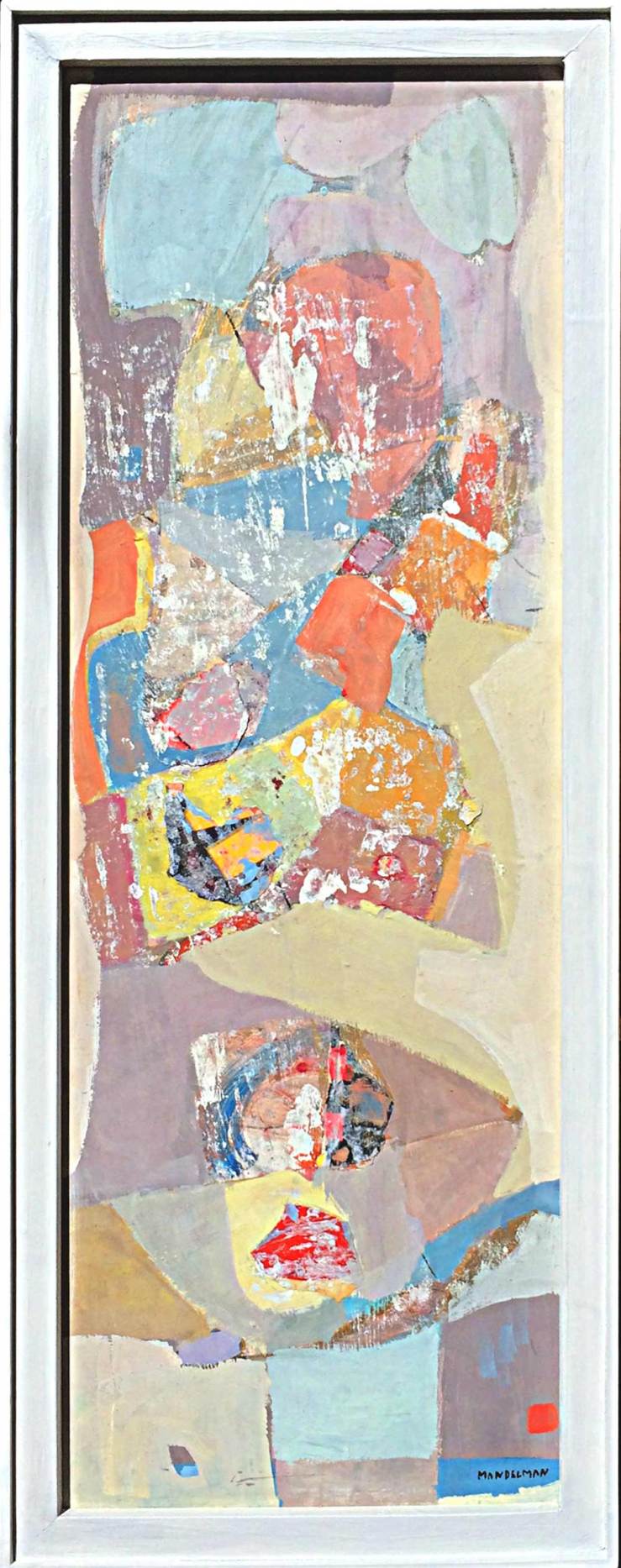
Beatrice Mandelman- Cool Wind circa 1950- Matthews Gallery

Beatrice Mandelman, Cool Wind c. 1950, Casein with Collage on Masonite Panel

When John Sloan invited Beatrice Mandelman and Louis Ribak to visit Santa Fe in 1944, the two artists were on the rise among New York City’s avant-garde. They had ties to Hans Hoffman and Fernand Leger, and were often mentioned in the same breath as Jackson Pollock. Sloan, who had been summering in New Mexico for years, had a reputation for spiriting away his favorite artists to the Desert Southwest. During their trip the recently married duo took a train to Taos and decided to stay.

The move marked a radical change in Mandelman and Ribak’s artwork. “We had to start all over again,” Mandelman said. “We spent the first couple years painting landscapes.” They were known for their figurative paintings in New York, but in this radically different environment their focus shifted to pure abstraction. They were trailblazers for a new wave of artists called the Taos Moderns, a movement that enlivened the Taos art colony but enraged an older vanguard of academic painters with ties to the Taos Society of Artists of the 1910’s and 20’s. To this tight clique of romanticists, the newcomers stuck out like colorful cacti—particularly Mandelman.

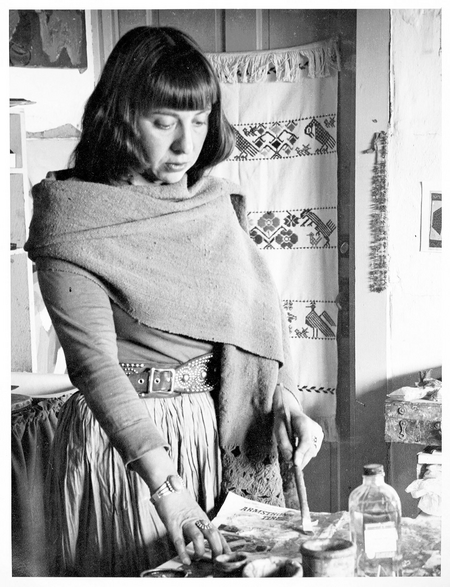
Portrait of Beatrice Mandelman in her Taos studio circa 1950- Matthews Gallery Beatrice Mandelman, 1950

“She worked with full abstraction at a time when most artists were not daring enough to do so,” writes David L. Witt in his book Taos Moderns, noting that Mandelman considered herself “the first of the second generation of artists in Taos.” The voice of a young, female abstract painter had never been part of the remote art community.

Far from the big city, Mandelman developed a new appreciation for the natural world and humanity’s relationship with it. By the late 1940’s she was developing an abstract symbol system to express her emotional responses to the landscape. Her elegant compositions didn’t mimic the lines or palette of the high desert, but they perfectly evoked the strong, solitary spirit of its inhabitants.

The mixed media painting in our collection was likely done in the 1950’s. Early in her experiments with abstraction Mandelman chose a muted palette, but here brighter colors poke through. This more expressive style was inspired by Henri Matisse and Mandelman’s former teacher Leger, and allowed her to explore the highs and lows of human experience with great vigor. Cool Wind‘s undercurrent of chilly blues and bright accents of orange and red call forth the sensation of a shiver passing up the spine.

As the evenings get cooler in Santa Fe, we’ve developed an ever-evolving passion for this piece and the innovative artist who created it. Learn more about Beatrice Mandelman on our website, and connect with us on Facebook, Twitter and Instagram for daily gallery news.

The Boundless Moment: Words and Images

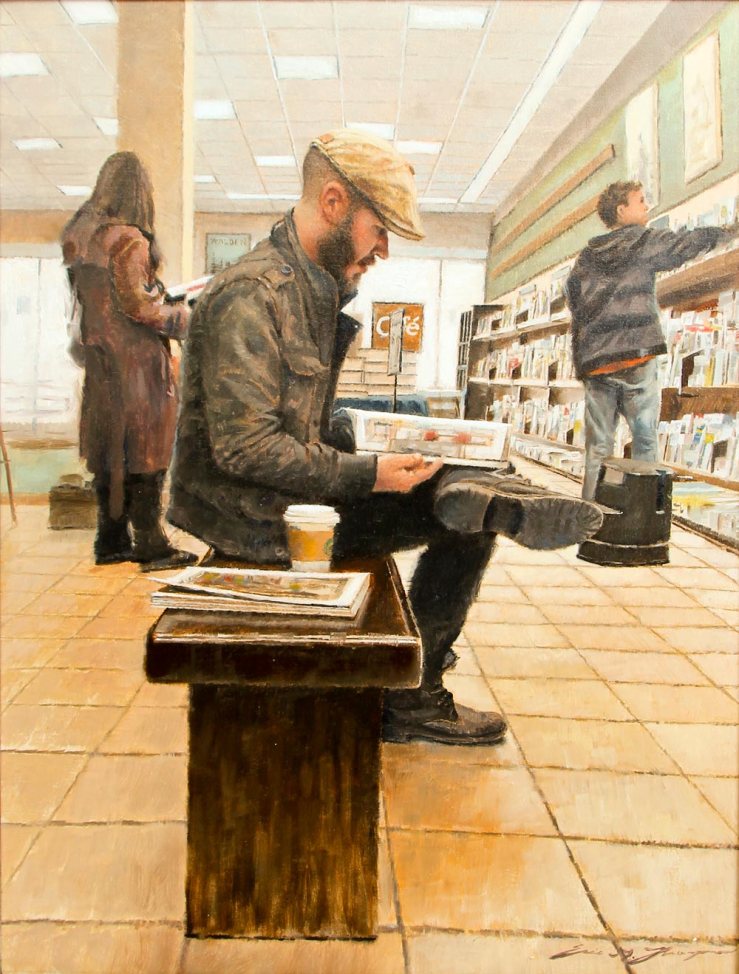
Eric Thompson- The Photographer- Matthews Gallery blog

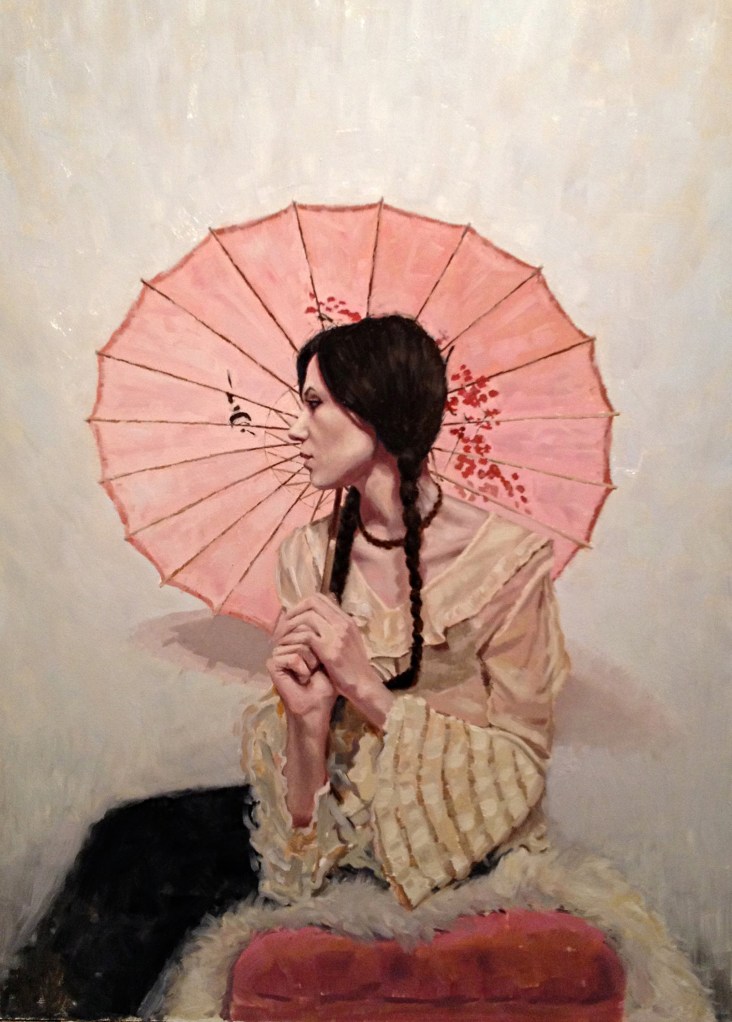
 Eric G. Thompson, The Photographer, Oil on Linen

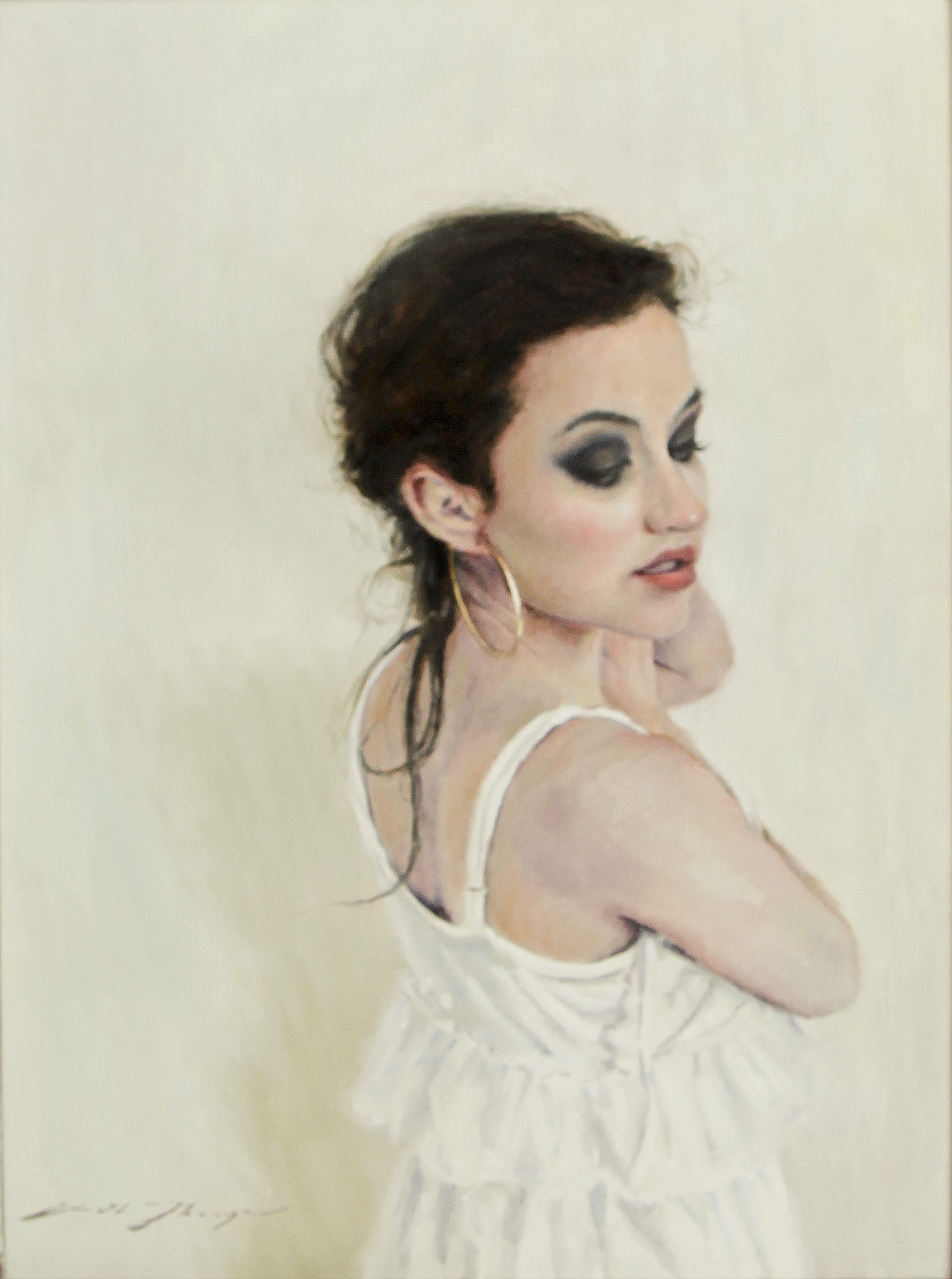
For the past week, excited art pilgrims—determined to visit every gallery on Canyon Road—have marched purposefully into our front room and come to a screeching halt. Our Eric G. Thompson show ‘The Boundless Moment‘ is a little different from most of the exhibitions you’ll see on this famous art route. Accompanying many of Thompson’s serene realist paintings are writings by great American poets, from Elizabeth Bishop to Walt Whitman.

The interplay of words and images has compelled viewers to slow down and look twice, sparking many a fascinating observation. Most notably, journalist Alison Oatman of the Weekly Alibi attended our opening and wrote an elegant, poetry-filled review of the show.

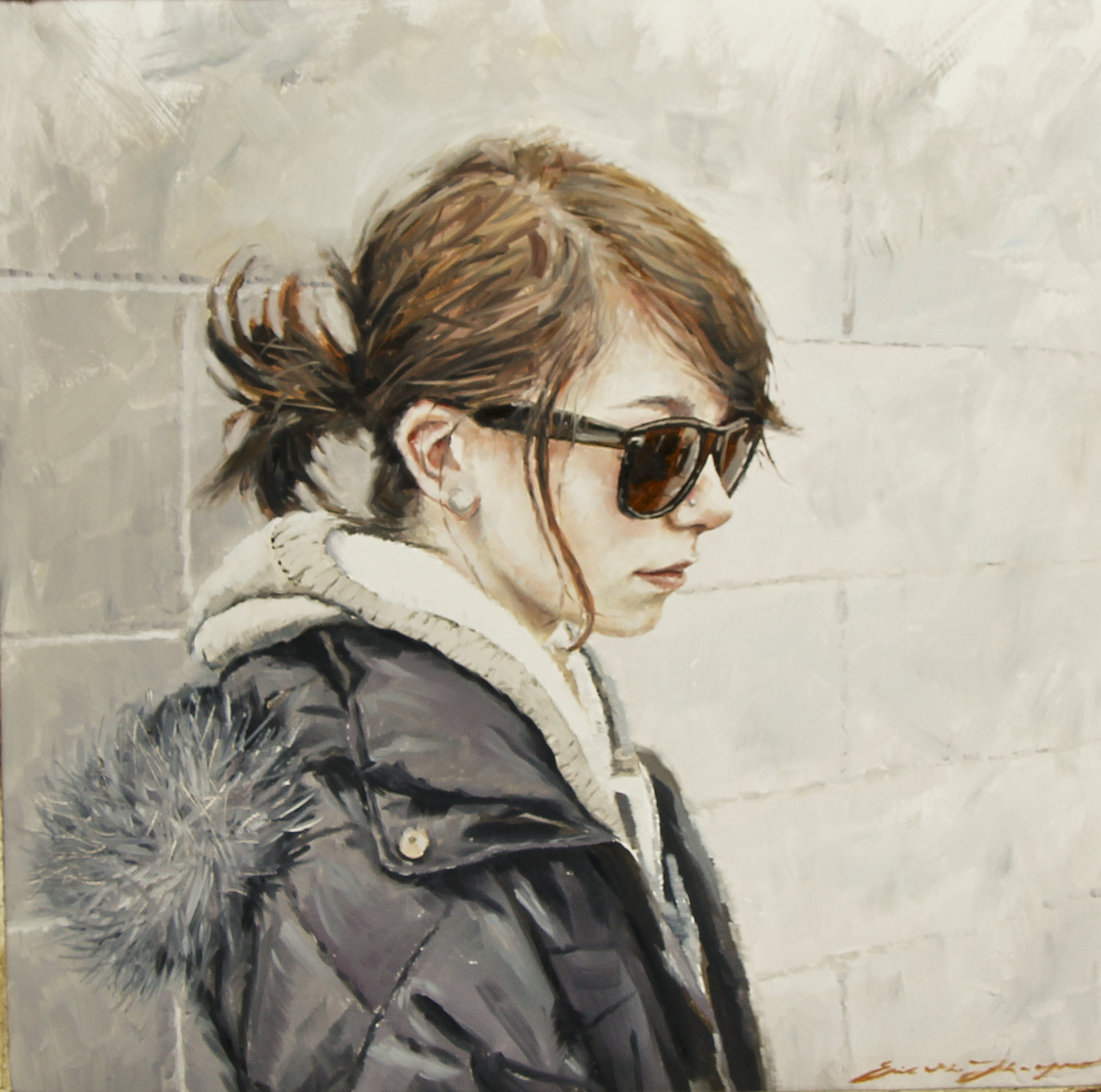
Eric G. Thompson- Coffee Shop Girl- Matthews Gallery blog

Eric G. Thompson, Coffee Shop Girl, Oil on Panel

An excerpt from Oatman’s article:

Robert Lowell’s “Epilogue” [is] paired with the painting “Coffee Shop Girl.” Lowell writes: “I hear the noise of my own voice:/ The painter’s vision is not a lens,/ it trembles to caress the light” [emphasis original]. These lines are reflected in the Coffee Shop Girl’s illuminated face—as pale as rice paper.

Later on, the poem continues: “Pray for the grace of accuracy/ Vermeer gave to the sun’s illumination/ stealing like the tide across a map/ to his girl solid with yearning.” Though large sunglasses hide her face and her meager mouth is expressionless, the Coffee Shop Girl is ravenous. We see her frayed emotional state in the feathery brushstrokes in the background, the squirming reddish-brown tendrils of her ponytail, and the sparkling clusters of dandelion-like fur attached to the hood of her puffy coat.

We spoke with Thompson on the phone today to fill him in on the big response his show has received. The artist was in Santa Fe last week for the opening reception, but now he’s back home in Salt Lake City, Utah. The long drive home gave him time to gather some thoughts on the exhibition. Read our interview below, and make sure to come see ‘The Boundless Moment‘ before it closes on August 28!

Eric G. Thompson- Half Light- Matthews Gallery blogEric G. Thompson, Half Light, Oil on Canvas

Describe your studio. 

My studio is just a few feet away from my house. It has windows with good natural light, so sometimes I can turn off the light and still get what I need. Sometimes I’ll set up my daughter‘s easel next to mine, and we’ll work next to each other. She gets to see what her dad does. Most of the time the kids aren’t allowed in the studio, though. I’ll play underground folk music, and when I’m really inspired it feels like the music is flowing straight through my brush.

You work in oil, egg tempera and watercolor. How do you choose which medium to use for a new painting? 

Between the three of them, if I want to capture something a little more loose and light I go for watercolor. If I want to capture something very solid, heavy and thick I’ll go with oil. If I want to capture something a little more photorealistic, I go with egg tempera. It gives you a lot of freedom to express the story or the emotion that you’re trying to convey with each medium.

It can be refreshing, but it can also be almost maddening. They’re all so different, it’s unbelievable. You have to switch your brain around and remember how to use that medium. It can be completely challenging, which I love. That’s one of the greatest thing about painting, is the challenge. I can always let a painting go as long as I have another challenge.

Eric G. Thompson- Nestled- Matthews Gallery

Eric G. Thompson, Nestled, Oil on Panel

Alison Oatman’s review in The Alibi begins with, “One question contemporary realist painters often get is, ‘Why not simply take a photograph?'” Over the course of the article, she critiques that particular line of thought. What’s your answer to that question? 

To a lot of artists, it’s not a great compliment when a viewer says, “That looks just like a photograph.” Maybe to a photorealist that would be flattering, but I think the greatest artists of all time have that balance of, it looks like a painting but it looks so ‘real.’ I’ve made it come to life.

Why does someone need a painting to look just like a photograph? What’s the power in that? Technically it’s amazing, but where’s the artistic freedom? I need artistic license to change things and blur edges and sharpen edges and change value to make it more ethereal.

I can make a painting look like a photograph but then there’s no energy, there’s no life to it. I think just adding a little more energy with brushstrokes or texture brings it more to life.

One of your influences is the Japanese aesthetic of wabi-sabi. How would you describe it? 

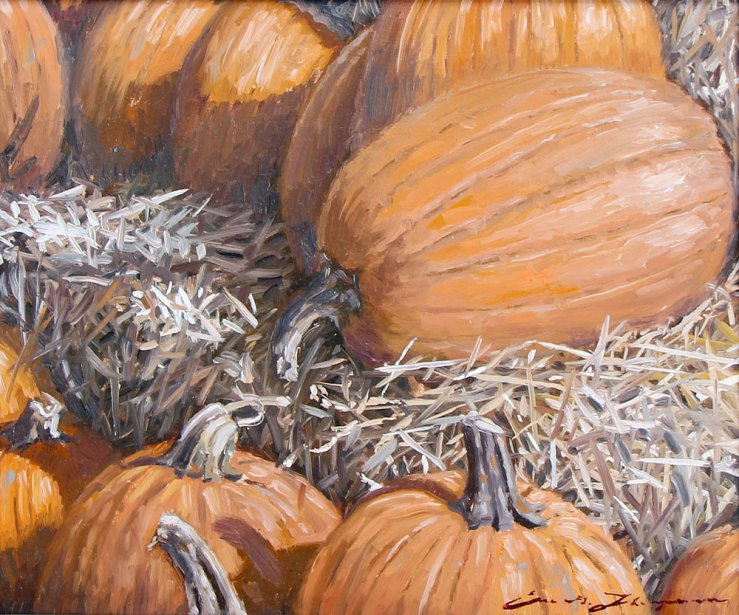
It’s what an object has been through, who used it, who touched it. It’s the patina objects acquire over time, like the rust on an oil can. It just adds to the whole character of the object—I see them as little characters. A cup on a windowsill, an oil can or even pumpkins can have little lives of their own.

Your works seem still at first glance, but a longer look gives me a sense of ‘unfolding,’ of motion. Is that one of our goals?  

It’s about capturing a moment in time that I’d like to freeze and experience for longer than the experienced moments.

I’ve definitely been experimenting with looser brushstrokes toward the outer edges of the painting to give it some energy. I need to experiment to see if I can get the perfect balance of detail and looseness. It’s a way of pushing myself as an artist, and it’s been one of the hardest things I’ve ever attempted.

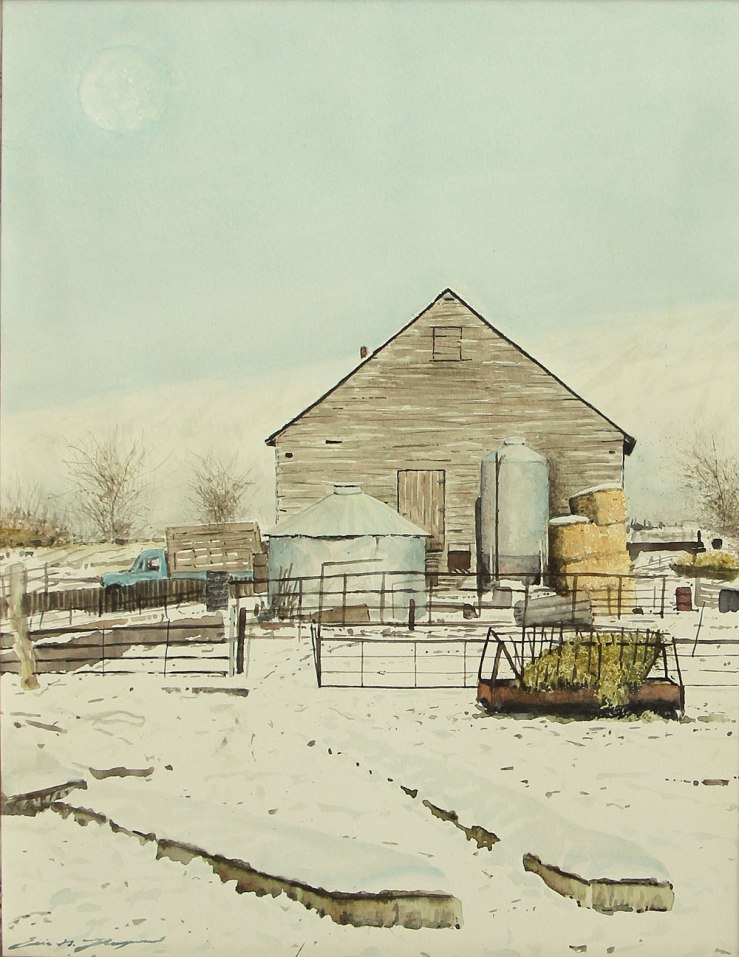
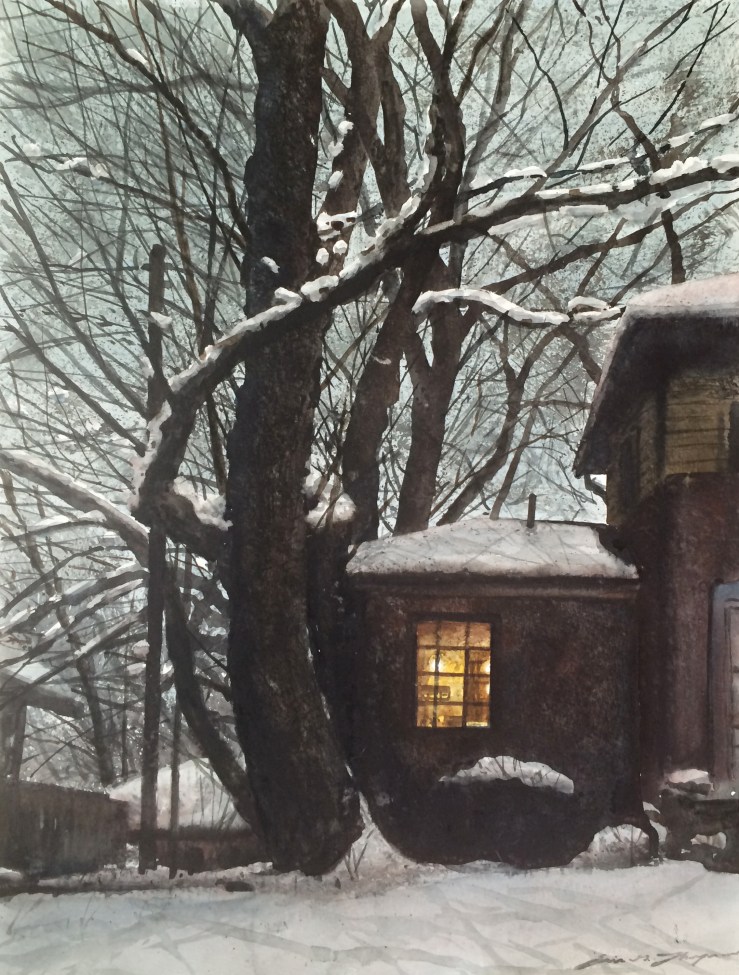
Eric G. Thompson- Winter Moon- Matthews Gallery blogEric G. Thompson, Winter Moon, Watercolor

Which paintings in ‘The Boundless Moment’ are closest to your heart? 

A few of the watercolors are very powerful to me in an emotional way. Just reminding me of something in my past, at my Grandma’s house in Idaho. She had a farm with all of these different structures. They just remind me of that time, and different feelings come up from my childhood.

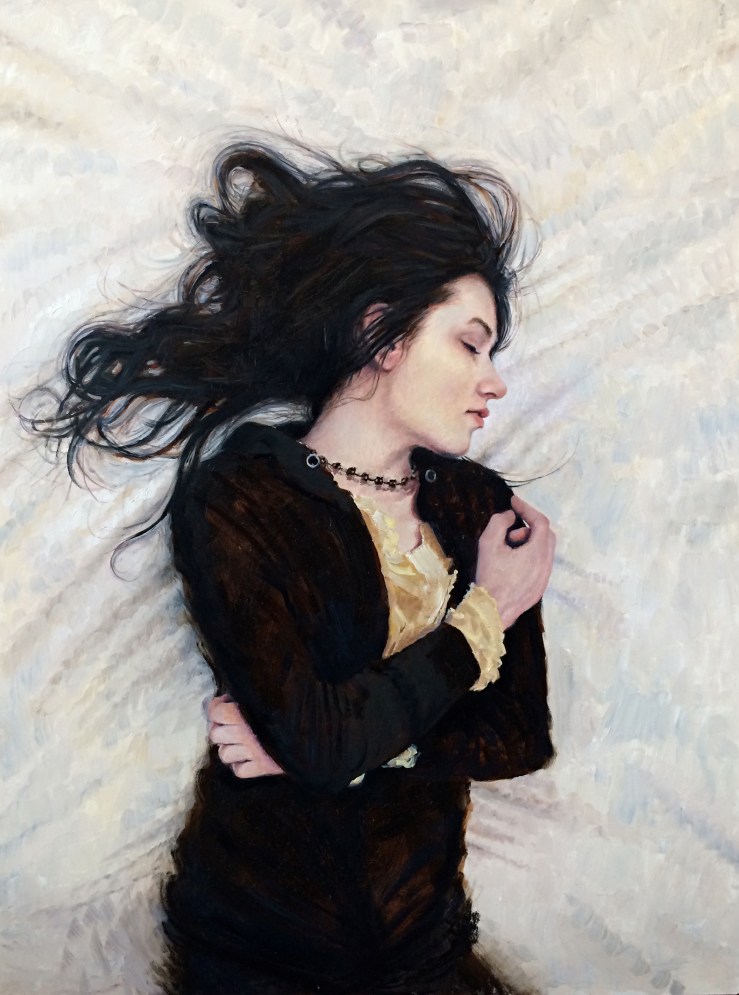
Raven’s Hair is a very powerful piece. It’s capturing this emotion of a woman laying on this bed. Her eyes are closed and she’s having a very pleasant thought. It seems to have some nice emotion to it.”

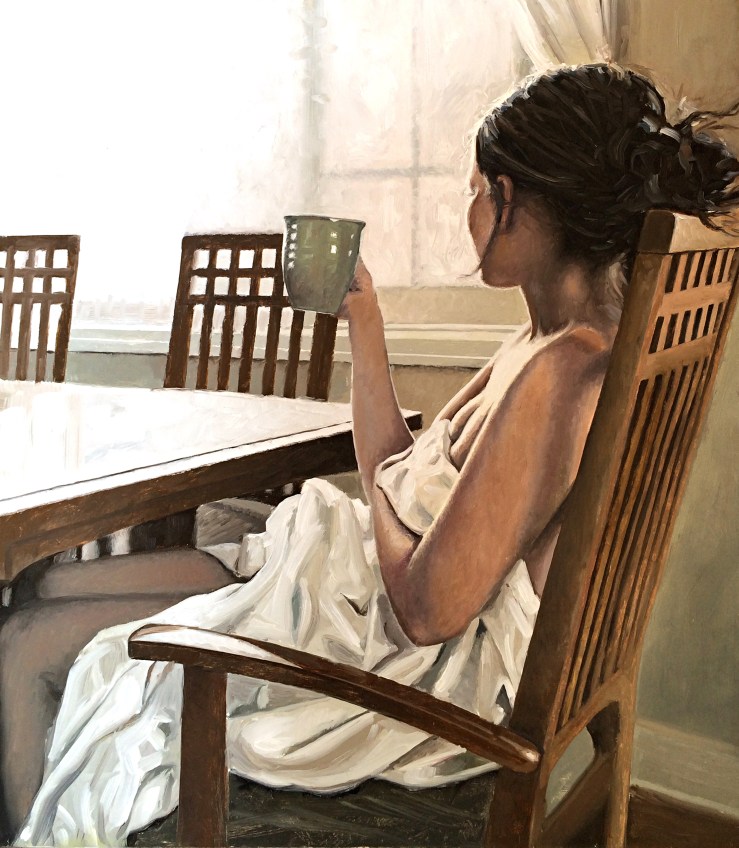
Morning Cup is a portrait of your wife Hilary, and inspired her to write a poem that we’re featuring in the show. Do you often inspire each other like that? 

 We’ve named my paintings every year for 12 years or more. We try to outdo each other with the most poetic titles. The title can say so much in just a couple words. What’s the best title, or the strongest? Hilary is amazing with words.

To learn more about Thompson’s show, connect with us on Twitter, Facebook and Pinterest.

The Boundless Moment: All Together Now

Eric-Thompson-Artist-Family

Eric G. Thompson’s ‘The Boundless Moment
opens Friday, August 15 from 5-7 pm
and closes August 28.

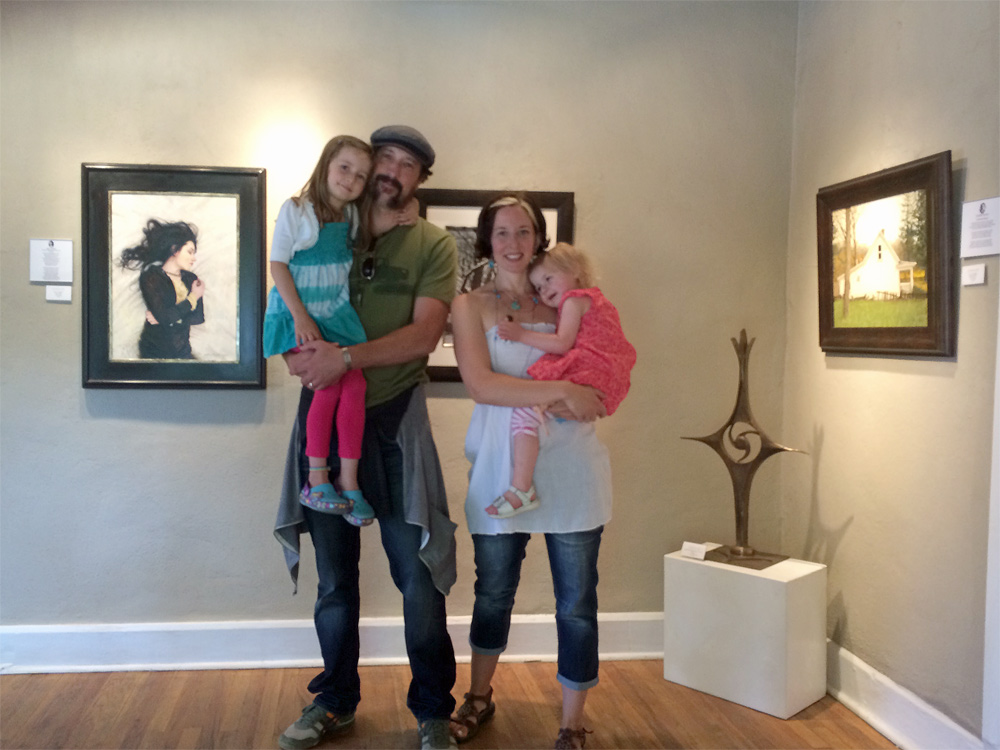
Eric and Hilary Thompson’s daughters dash around Matthews Gallery, exploring their father’s new solo exhibition ‘The Boundless Moment.’ They’ve just finished a long car ride from Salt Lake City but they’re bursting with energy.

Over the past year the children have grown alongside these canvases and panels, watching as thousands of brushstrokes transformed into rolling landscapes and rosy skin. Now these familiar images have magically appeared in our lofty, brightly lit space, sparking the girls’ curiosity. They stop before each work, craning their necks to get a good look.

The girls’ vivacity matches Hilary’s temperament. She keeps an eye on them as she chats and laughs with us. Eric is a quieter presence. He strolls around the gallery, analyzing the arrangement of the work and reading the legendary poems we paired with them. Eric likes to think of his paintings as ‘visual haikus,’ which inspired us to select writings by Frost, Dickinson, Lowell and others to display during the show.

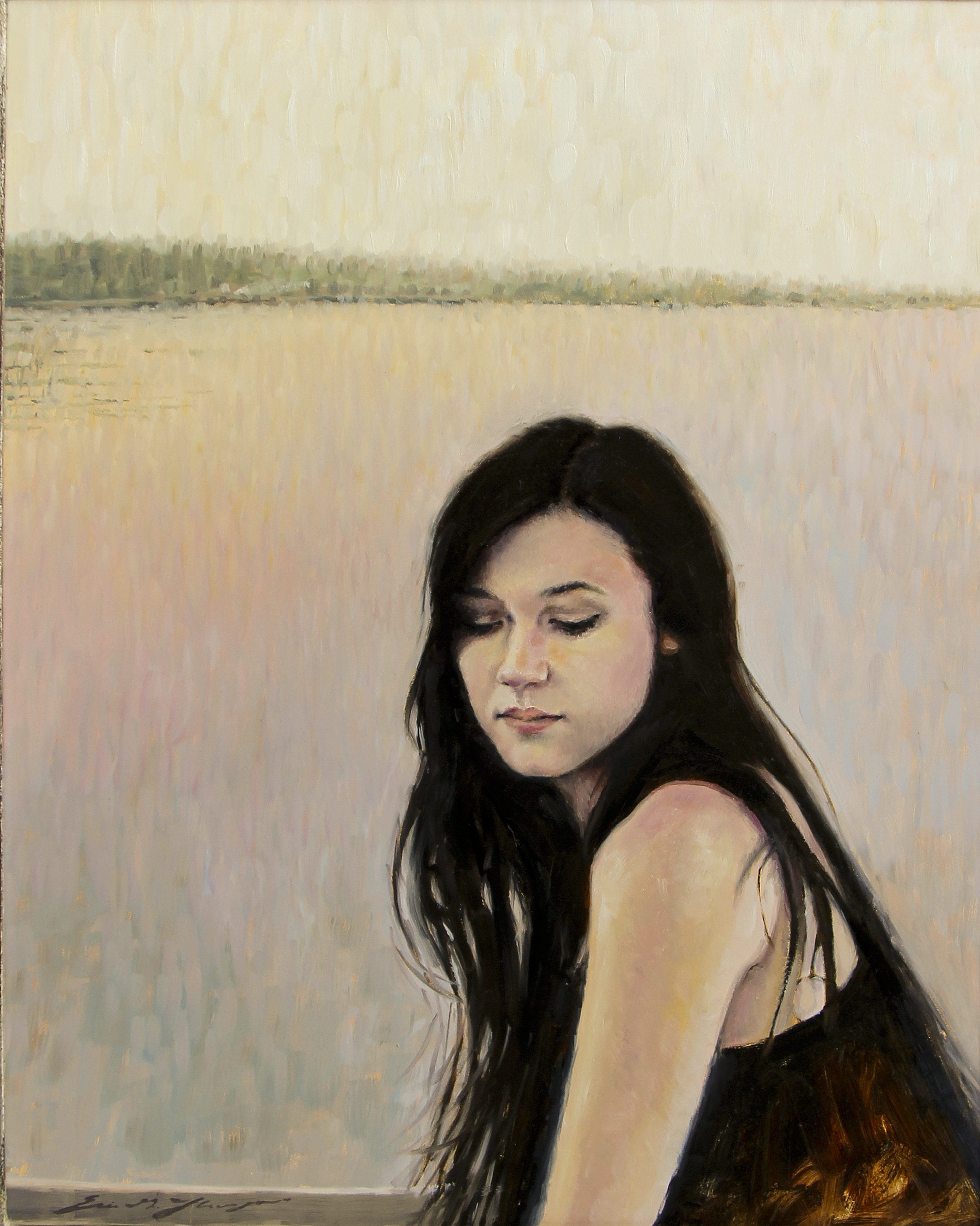
‘The Boundless Moment’ is something of a family act. Hilary was Eric’s model for the painting ‘Morning Cup,’ and wrote an accompanying poem that will debut at the opening reception. ‘The Chiseled Mother’ is a passionate meditation on parenthood and aging. As Eric cradles one of his daughters in his arms, you can tell that he’s just as inspired by the radiant spirit of his children. 

Read Hilary’s poem below, and make sure to attend Eric’s artist reception on Friday, August 15 from 5-7 pm.

Eric G. Thompson- Morning Cup- Matthews Gallery blog Eric G. Thompson, Morning Cup, Oil on Panel

From Hilary Thompson:

The Chiseled Mother

I honor this body
This matryoshka

The delicate lines of my eyes
Like tissue paper
Crinkled from sun beams
Washboards slow the momentum
of tears

These ears, these conches
That entombed the beeping screaming alarms
Echoing endlessly on exhausted drives home
Mercifully quieting with age

Eric G. Thompson- Waiting for a Song- Matthews Gallery blog


Eric G. Thompson, Waiting for a Song, Oil on Panel

This mouth
Which broadcasts comforts, screeches, praise
Fractures the tightrope of vexation

These beautiful, perfect arms
That embraced defeat
Carried a child to the surgeon’s knife
Willing arms
That waved, furrowed, aching
Sturdy farewells

This heart that beats out
The anthem of the womb
I Am
I Am
I Am

Eric-Thompson-Art-CoffeeshopGirl

Eric G. Thompson, Coffee Shop Girl, Oil on Panel

A womb
That is the definition of Creation
Bringing forth what does not exist
Into existence
Torn out of me
With upheaval and sanguine waves of nurture

These knees that caught me
When my frame buckled
Unable to support my grief

These marks, stretched
Yawning tiger stripes
Where my body gave room
Shimmer as silver reminders of a past shape

EricGThompson-Art-Evening

Eric G. Thompson, Evening, Oil on Panel

These feet
Planted.  Supporting.
Rooted even in motion, substantial
Pacing halls, hospital rooms
Threshing carpets bare-threaded

I am the red rock slot canyon
Worn smooth, fissured, curved
Sculpted
By this flawed life

This body is a shrine
A Holy place, a pilgrimage
A masterpiece painted stroke by stroke
By the breathtakingly exquisite nourishment
Of not getting what I want.

Breathe that in,
Chiseled edifice of the Mother,
Slather it like salve into your stripes,
You silver tiger.

 Connect with us on Facebook, Twitter and Instagram to learn more about Eric G. Thompson.

Eric G. Thompson: Seeking ‘The Boundless Moment’

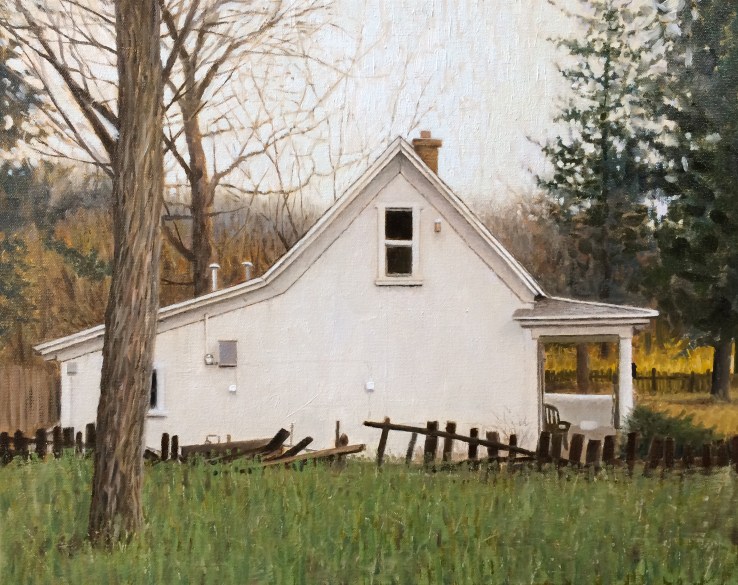
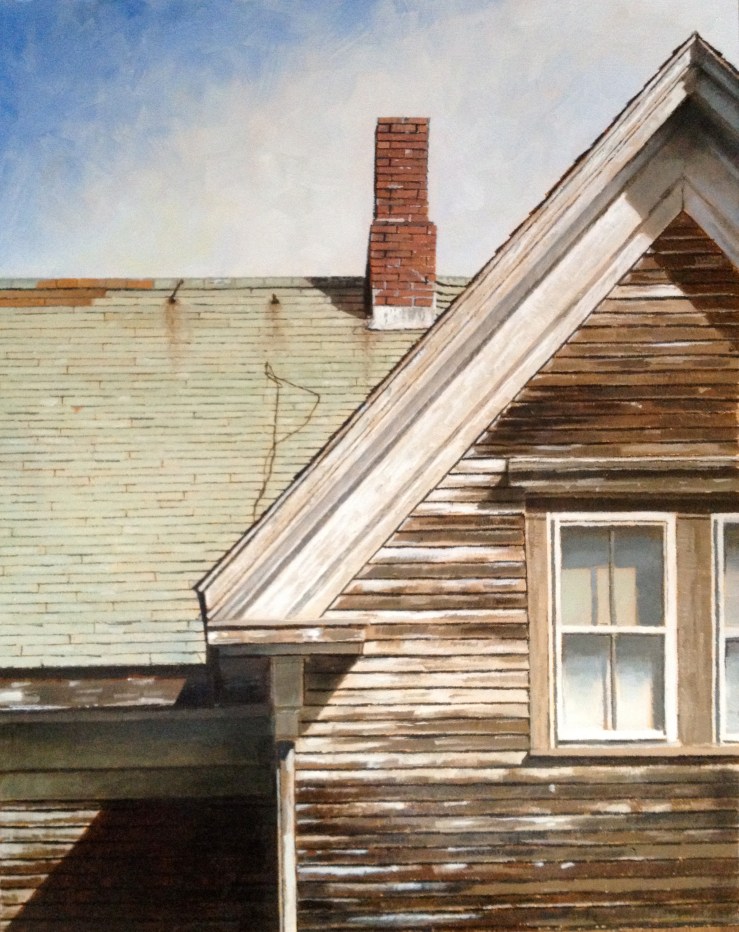
Eric G. Thompson- Spring City House- Matthews Gallery blogEric Thompson, Spring City House, Oil on Canvas

“He halted in the wind, and — what was that/ Far in the maples, pale, but not a ghost?”

So begins Robert Frost’s poem A Boundless Moment, the inspiration for the title of Eric G. Thompson’s upcoming solo exhibition. The show will feature the Utah Valley artist’s contemporary realist paintings alongside the writings of Frost, Dickinson and other well-known American poets.

Thompson isn’t necessarily inspired by these figures, but as you’ll see below, there’s a uniquely American sense of solitude and yearning that unites his contemporary images with their legendary words.

Read Frost’s couplet again and savor the mystery of it, which subsequently unravels over three sensuous stanzas. Thompson’s paintings also evoke questions, but his enigmas come in the form of foggy memories. An aching sense of familiarity pervades his work, encouraging us to pause, ponder and lose ourselves for a moment… however long that may be.

Scroll down for a special preview of Thompson’s new artwork, interspersed with lovely poetry selected by Lawrence. Make sure to attend the opening of ‘The Boundless Moment: New Paintings by Eric G. Thompson‘ on Friday, August 15 from 5-7 pm.

Eric G. Thompson- Raven's Hair- Matthews Gallery blog Eric G. Thompson, Raven’s Hair, Oil on Panel

A Boundless Moment
Robert Frost

He halted in the wind, and — what was that
Far in the maples, pale, but not a ghost?
He stood there bringing March against his thought,
And yet too ready to believe the most.

“Oh, that’s the Paradise-in-bloom,” I said;
And truly it was fair enough for flowers
had we but in us to assume in march
Such white luxuriance of May for ours.

We stood a moment so in a strange world,
Myself as one his own pretense deceives;
And then I said the truth (and we moved on).
A young beech clinging to its last year’s leaves.

Eric G. Thompson- Strong Bones- Matthews Gallery blogEric G. Thompson, Strong Bones, Oil on Panel

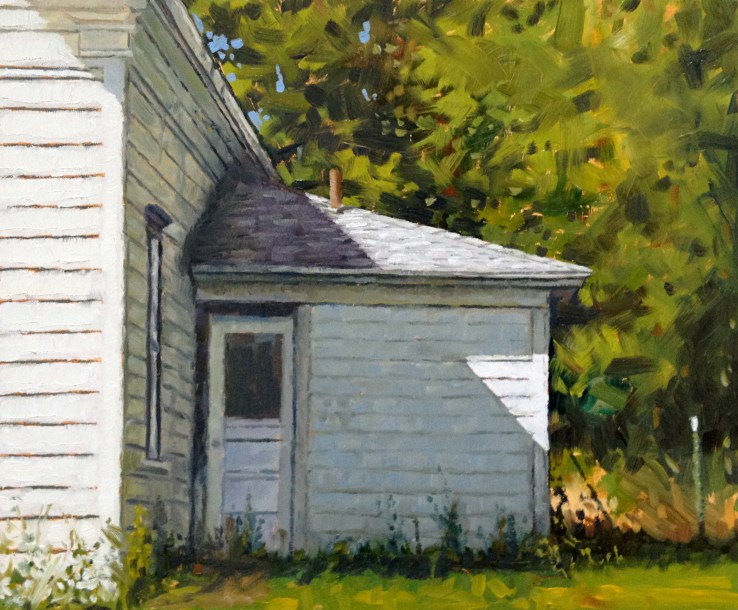
Eric G. Thompson- Back Door- Matthews Gallery blogEric G. Thompson, Back Door, Oil on Panel

I dwell in Possibility — (466)
Emily Dickinson

I dwell in Possibility —
A fairer House than Prose —
More numerous of Windows —
Superior — for Doors —

Of Chambers as the Cedars —
Impregnable of eye —And for an everlasting Roof
The Gambrels of the Sky —

Of Visitors — the fairest —
For Occupation — This —The spreading wide my narrow Hands —
To gather Paradise —

Eric G. Thompson- Winter Blanket- Matthews Gallery blogEric G. Thompson, Winter Blanket, Watercolor

The Old Flame
Robert Lowell

My old flame, my wife!
Remember our lists of birds? One morning last summer, I drove
by our house in Maine. It was still
on top of its hill—

Now a red ear of Indian maize
was splashed on the door.
Old Glory with thirteen stripes
hung on a pole. The clapboard
was old-red schoolhouse red.

Inside, a new landlord,
a new wife, a new broom!
Atlantic seaboard antique shop
pewter and plunder
shone in each room.

A new frontier!
No running next door
now to phone the sheriff
for his taxi to Bath
and the State Liquor Store!

No one saw your ghostly
imaginary lover
stare through the window
and tighten
the scarf at his throat.

Health to the new people,
health to their flag, to their old
restored house on the hill!
Everything had been swept bare,
furnished, garnished and aired.

Everything’s changed for the best—
how quivering and fierce we were,
there snowbound together,
simmering like wasps
in our tent of books!

Poor ghost, old love, speak
with your old voice
of flaming insight
that kept us awake all night.
In one bed and apart,

we heard the plow
groaning up hill—
a red light, then a blue,
as it tossed off the snow
to the side of the road.

Eric G. Thompson- Spring Blossoms- Matthews Gallery blog

Matthews Gallery, Spring Blossoms, Oil on Panel

I Am in Need of Music
Elizabeth Bishop

I am in need of music that would flow
Over my fretful, feeling fingertips,
Over my bitter-tainted, trembling lips,
With melody, deep, clear, and liquid-slow.
Oh, for the healing swaying, old and low,
Of some song sung to rest the tired dead,
A song to fall like water on my head,
And over quivering limbs, dream flushed to glow!

There is a magic made by melody:
A spell of rest, and quiet breath, and cool
Heart, that sinks through fading colors deep
To the subaqueous stillness of the sea,
And floats forever in a moon-green pool
Held in the arms of rhythm and of sleep.

Learn more about Thompson’s show on our exhibition page, and connect with us on Facebook, Twitter and Instagram for more gallery news.

Hannah Holliday Stewart: Open-Ended Questions

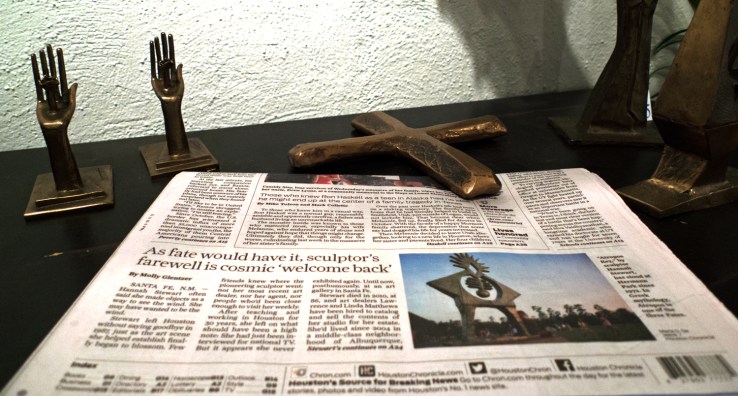
Houston Chronicle's article on Hannah Holliday Stewart among her sculptures- Matthews Gallery

Our exhibition Hannah Holliday Stewart: An Artistic Legacy Rediscovered
runs through July 24, 2014

Two weeks ago, Houston Chronicle arts editor Molly Glentzer appeared at our door with a camera around her neck and notebook in hand. We figured that if anyone could find answers to our burning questions about Hannah Holliday Stewart’s life, it would be a reporter from the city where she rose to prominence. Last Sunday her findings appeared on the front page of the Chronicle. Early on in the article, Glentzer outlines the challenges she faced in her investigation:

Stewart left Houston without saying goodbye in 1987, just as the art scene she helped establish finally began to blossom. Few friends knew where the pioneering sculptor went: not her most recent art dealer, nor her agent, nor people who’d been close enough to visit her weekly.

The beautifully detailed report lays out the highlights of Stewart’s art career. As Glentzer discusses Stewart’s accomplishments—from monumental public art commissions to solo exhibitions at prestigious institutions across the nation—she’s careful to outline the sculptor’s struggle for recognition:

Her success came at a time when women sculptors were rare birds in a man’s world. […] it was a coup when Houston accepted “Atropos Key” …. in 1972. Stewart’s sculpture was unlike anything else in the landscape.

When it comes to Stewart’s departure from Houston and the art world, Glentzer arrives at the same conclusions we did. Stewart first returned to Birmingham to care for her ailing brother, and chose the Southwest as a part-time home because she was drawn to the “light and open landscape”. However, her move to Albuquerque in the final years of her life hinted at grander plans.

“How many people do you know who at age 80 would move 1,000 miles away, where they had no relatives, and build a house and studio with 20-foot ceilings?” [Stewart’s nephew Rusty Stewart] said. “She wasn’t out there to retire.”

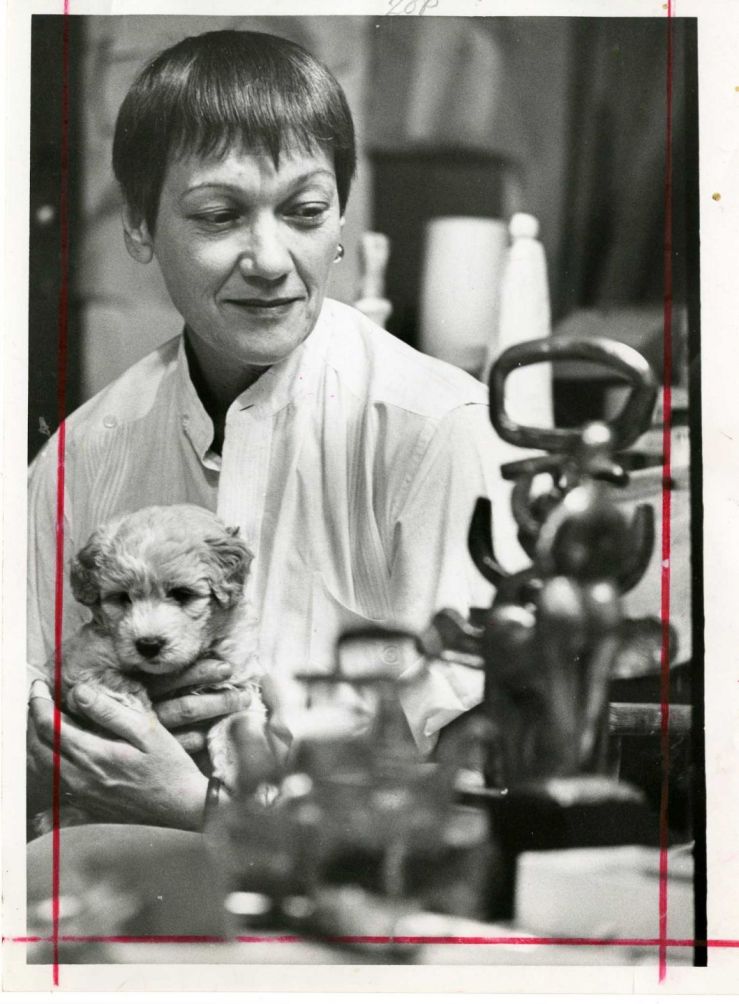
Sculptor Hannah Stewart with her cocker-poodle, Major, in 1967- Houston Chronicle

Stewart with her cocker-poodle, Major, in 1967; Photo from Houston Chronicle

And so the answer to one question opens up another mystery. What did Stewart plan to do next? Her friend Dayton Smith told us she may have intended to complete some larger projects and return to Houston. In her sketchbooks from the 2000s Stewart often mentioned a series of sculptures called ‘Harmonic Resonance’ that may have been her forthcoming magnum opus.

Other friends of Stewart who have called or visited us since the appearance of the Chronicle article had few answers. An acquaintance who took yoga classes with Stewart for years said he’d lost contact with her in the 1980s before she left Houston. Another friend who stopped by told us vivid stories from Stewart’s life in Houston, but had just as many questions about her Southwestern exploits.

Last week we switched gears and teased out some of the mysteries of Stewart’s artwork. As Smith told Glentzer, Stewart “always preferred her work be talked about rather than her life.” Perhaps she didn’t want us to know what happened in Houston, or what her future plans were. In a note from Stewart’s sketchbook dated 2007, the 83-year-old artist wrote,”Tired—work to finish FINALLY!! Move on to others in series…”


1440x1440-5

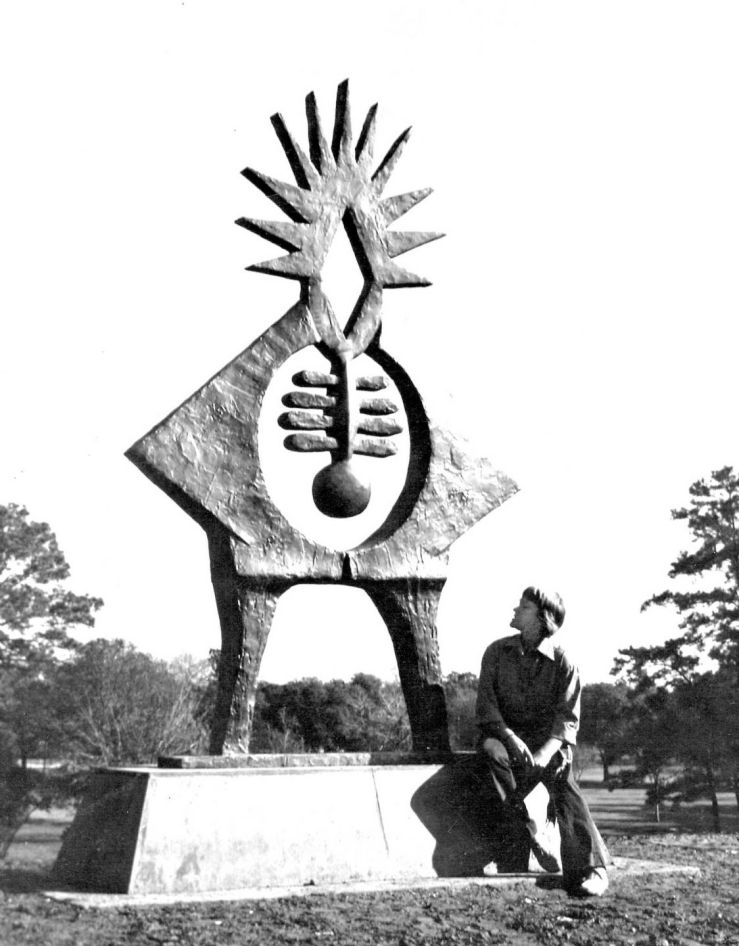
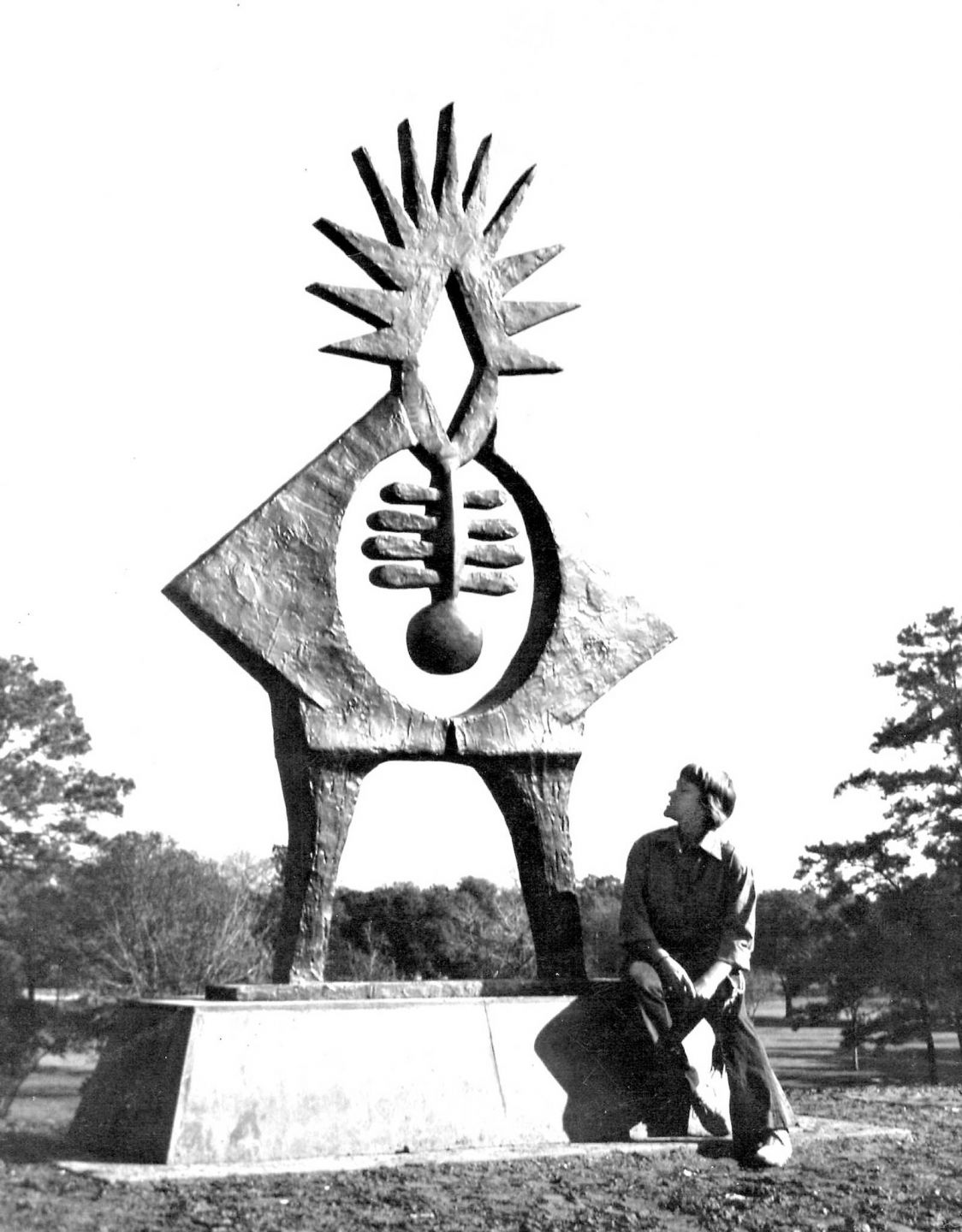
Stewart with “Atropos Key” in Hermann Park; Houston Chronicle

Then, late last week, we received a call from Dr. Liam Purdon in Nebraska. We recognized his name from an elegant essay in Stewart’s files. In the 1980s, Purdon was working on a PhD in medieval literature from Rice University. He had seen Stewart’s “Atropos Key” sculpture in Hermann Park and was inspired to contact her.

“I literally stumbled upon it as I walked up the hill in the park,” he said. “You come over a rise and suddenly there it is in front of you. You’re startled by it, and the first question you ask yourself is, ‘What is it, and why is it here?’ When you read the name of it, then you suddenly realize it’s tied to Greek mythology.”

Purdon said the shock and curiosity he experienced was Stewart’s overarching goal. “She wanted to startle the observer into recollecting the whole mythology of a time when humans lived in harmony,” he explained. Stewart agreed to let Purdon observe her in the studio for three weeks, but kept a careful distance from the scholar. Later on they became good friends, and Stewart told Purdon her plans for the future.

“She felt that being in the Southwest… would be more supportive of her vision,” he says. “She loved the natural beauty of the Southwest. In some of her pieces, you do see it. In others you may not recognize it, but if you look at them for a while and meditate on them, it starts to become apparent.”

The two stayed in contact after Purdon took a teaching job at Doane College in Nebraska, and Stewart expressed interest in applying for public art commissions from the Nebraska Arts Council. When nothing materialized, Stewart was discouraged.

1440x1440-4

Stewart in 1960 with a sculpture she recently completed; Houston Chronicle

“I think that probably underscored the fact that she felt… uncomfortable revealing the work until the time was right, until we re-cycled into an age when we wanted to hear the narrative again,” Purdon said. “She would have to wait for a period of time to introduce her work to people who were ready to understand.”

That’s the closest we’ve gotten to answering the ever-shifting riddle of Stewart’s twilight years, but perhaps it’s enough to know that people are ready to hear the artist’s stories again. We’ve had a huge response from collectors in Houston who read the article, and art lovers from across the country have discovered her work as a result of the press coverage our show has received.

“In general, i think that people are wanting narrative more,” said Purdon. “It is so remarkably different, her work… That’s why it needs a narrative. There has to be a starting point.”

Come see Hannah Holliday Stewart: An Artistic Legacy Rediscovered through Thursday, July 24, and learn more about the artist on our website. Make sure to connect with us on Facebook, Twitter and Pinterest for more gallery news!

Hannah Holliday Stewart: The Messengers

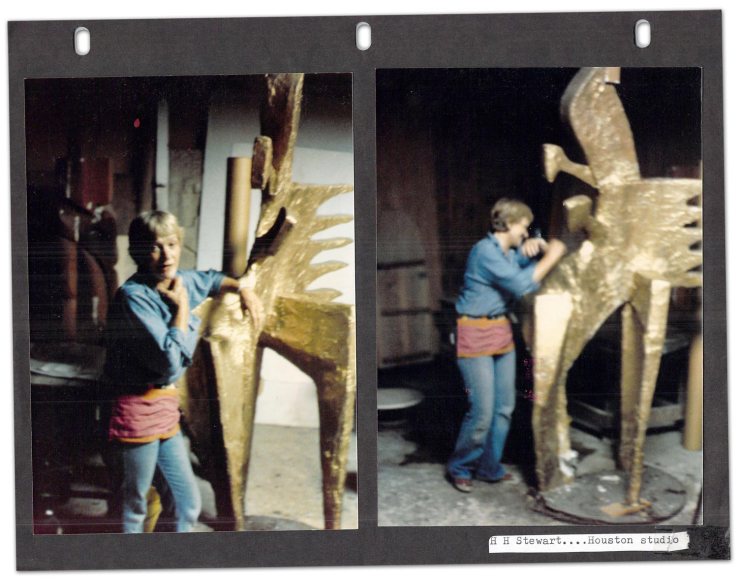
Hannah-Stewart-Blog1

Candid shots of the secretive artist with her sculpture “Survivor“, Hannah Holliday Stewart archives

At last Friday’s opening for Hannah Holliday Stewart: An Artistic Legacy Rediscovered, art enthusiasts who saw the press coverage for the show came armed with a diverse array of questions.

“What was her family like?”

“Where did the full-scale models in those photos end up?”

“What’s ‘Ockum’s Razor‘ ?”

“Who’s Brad?”

Of course, the most frequent question was also Stewart’s most impenetrable mystery: why did the sculptor abruptly leave Houston, the launching point and epicenter of her nationally renowned artistic career? In our explorations of Stewart’s archives over the past few weeks, we’ve stirred up as many questions as answers.

Stewart was resolutely private, preferring to tightly focus on her artwork in interviews, exhibition materials and even her diaries. A catalog for her 1975-6 solo exhibition at the Houston Contemporary Arts Museum provides little more information on Stewart’s personal life than a birth year and a brief sketch of her educational history.

“Hannah was a very private person with a lot going on in her head,” close friend Dayton Smith told us. “I learned when to be around her and when not.”

Many of Stewart’s works, on the other hand, were always in the public eye. Kids lounged in the crook of her 11-foot sculpture in Hermann Park, students at St. Thomas University studied under her concrete-and-steel work on campus, and politicians were often photographed beside her “Libertad” fountain as they passed through the courtyard of Houston’s World Trade Center building.

For this week’s blog, we’re taking cues from Stewart’s ghost and focusing on the rich universe of her sculptures. Look below for new insight on five artworks, with behind-the-scenes materials from the artist’s files.
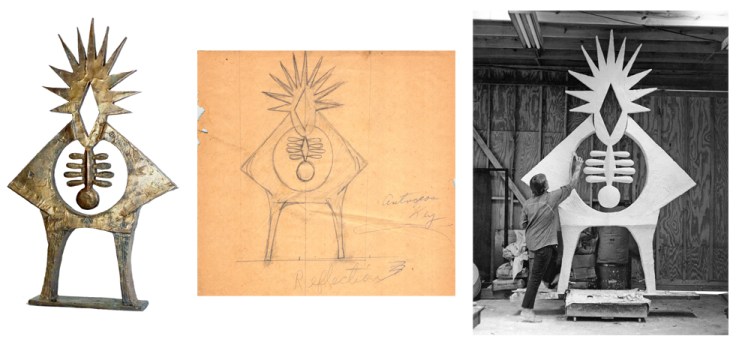
Hannah Stewart- Atropos Key Sculpture with Preparatory Sketch and Full-Scale Model- Matthews Gallery Blog


 Preparatory sketch for ‘Atropos Key’ and full-scale plaster model in Stewart’s studio

Atropos Key’ remains Hannah Holliday Stewart’s most well-known sculpture in Houston. Our maquette’s monumental counterpart stands on a hill in Hermann Park, measuring at 11 feet tall and 1,200 pounds. It debuted to much fanfare in 1972. From the Houston Chronicle’s August 11, 1972 edition:

“Out on the hill beyond Miller Theatre the blanket lollers who tune in to night concerts and shows from a horizontal position will have fresh ‘company.’ Overlooking the stage, now, is a bronze vertical figure.

‘Atropos Key,’ the title of which derived from one of the three fates in Greek mythology, was given to the city by Mrs. Patricia S. Woodward of Houston.

Strollers in the park may well stare at it and wonder what it all means…. Miss Stewart’s piece, in its new location, deserves the looking at, the ‘experiencing’ and the consideration of its meaning for you. Is it birth and, more encompassing than that, renewal?”
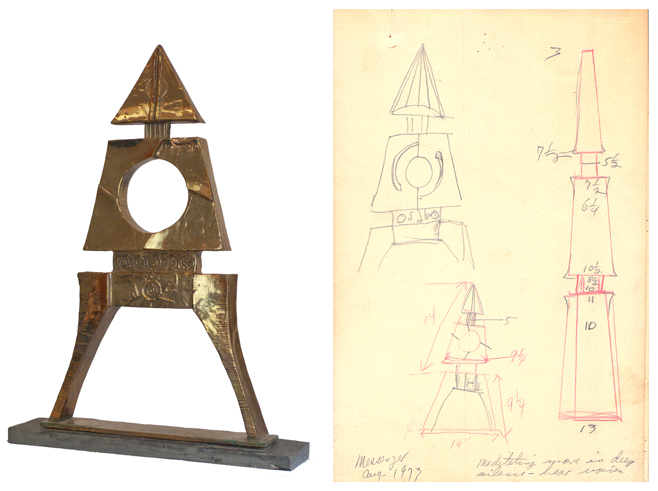
Hannah Stewart- Messenger Sculpture with Preparatory Sketch- Matthews Gallery BlogPreparatory sketch for ‘Messenger’ dated August 1973

Stewart’s ‘Messenger’ appeared on the cover of Houston Arts Magazine’s performing arts edition in October, 1982. Stewart was a fan of Russian composer Alexander Scriabin, and often listened to classical music in her studio.

A blurb inside the magazine traces the musical roots of ‘Messenger’:

“Sculptor Hannah Stewart… sees her work as an artist’s shorthand using symbols to communicate complex and abstract ideas— like a composer uses the symbols of musical notes to convey a spiritual idea in a sensuous form.

In Messenger… Stewart sees a parallel between the structure-strength-shapes interplay of her work and compositions played by Nathan Milstein and Bella Davidovich.”
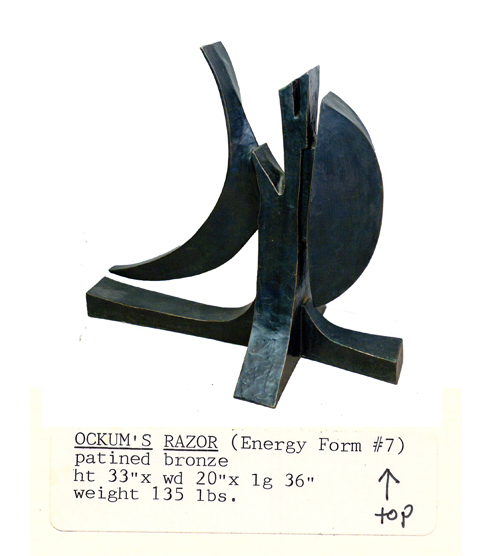
Hannah Holliday Stewart- Ockum's Razor Sculpture with Original Typewritten Label- Matthews Gallery BlogOriginal typewritten label for ‘Ockum’s Razor’

Stewart was known for her mythology-inspired artwork, but that was far from the only subject she explored.

“Her studies in literature, mythology, metaphysics, esoteric philosophy, religion, science, astrology, dance and yoga suffuse her output, revealing in form and textures,” wrote Stewart’s friend Dayton Smith in a letter to the gallery.

In ‘Ockum’s Razor’, Stewart turned to science for inspiration. The title refers to a problem-solving principle devised by 14th century logician and Franciscan friar William of Ockham (c. 1287-1347). The principle states that “Entities should not be multiplied unnecessarily.” In other words, the simplest path to an answer is the best one.
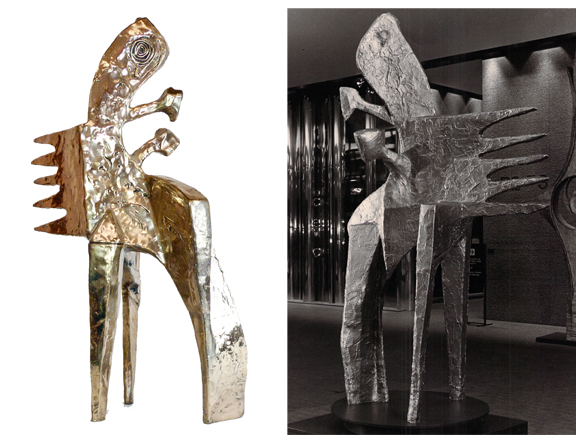
Hannah Holliday Stewart- Maquette and Full-Scale Survivor Sculptures- Matthews Gallery blog


 Maquette and full-scale versions of ‘Survivor’

An article about Stewart’s work appeared in the local paper of her childhood home of Birmingham in 1994. In the story, Stewart explains the inspiration for ‘Survivor‘. From the August 1, 1994 edition of the Birmingham Post-Herald:

“I was teaching welding at the university, and I’d go to the welding studio and talk to friends of mine, and there were a lot of men coming down from Detroit who’d lost their jobs, and they were so tense and angry about having to reform themselves, to learn to do welding or something else at the age of 55, after having been an auto worker. I reacted to that force within them, and the drastic changes people have to make to survive.”
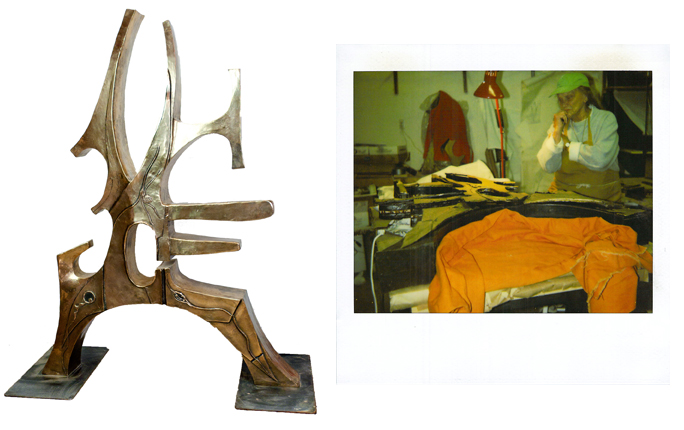
 Hannah Holliday Stewart- Einsteins Song and Polaroid of Hannah Holliday Stewart working on the sculpture in her studio- Matthews Gallery blog

Polaroid of Hannah Holliday Stewart in her Albuquerque studio working on ‘Einstein’s Song’

Stewart was 80 years old in the Polaroid above and still hard at work on her bronze forms, though she never exhibited again in her lifetime.

Here’s an excerpt from a typewritten artist statement Stewart wrote a year later:

“For me, the image should be an intellectual and emotional symbol plucked from the fringe of the imagination, it should suggest a classic truth and not be confused with social comment. The image at its most successful strikes a common chord of sensations in every viewer, and yet leaves each viewer with his/her own particular interpretation.”

See Hannah Holliday Stewart: An Artistic Legacy Rediscovered through July 18, and connect with us on Facebook, Twitter and Instagram for more information on the artist.

Hannah Holliday Stewart: Letter from Houston

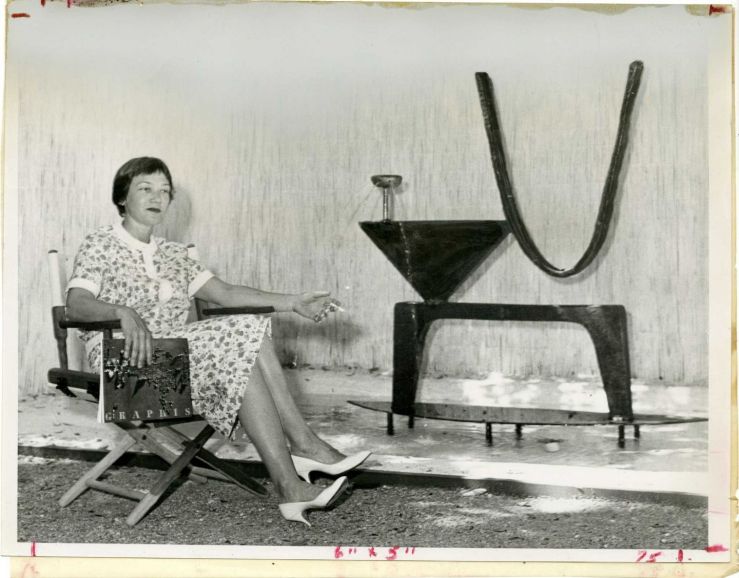
Hannah Holliday Stewart in her Houston Studio- Matthews Gallery

Our exhibition Hannah Holliday Stewart: An Artistic Legacy Rediscovered
begins with an opening reception on Friday, July 4 from 5-7 pm

“In a day in which so many things in Art are merely exercises in Media and devoid of any real significance, it is refreshing to discover an expression which transcends the cerebral prison of its own time and manifests itself in forms poetically germane to a more cosmic significance,” wrote Dayton Smith, with poetic flair of his own, in a typewritten statement dated March 22, 1991.

Smith was referring to the sculptures of his close friend Hannah Holliday Stewart (1924- 2010), whose monumental forms caught the eye of the nation in the 1970s and 80s. As chronicled in our last blog post, Smith and Stewart met in Houston in the late 1960s as Stewart’s career was taking off. He assisted Stewart in various ways for a number of years, and watched as the artist found success in galleries and museums across the country.

More from the note:

Her art mirrors a consciousness expanded beyond the pragmatic doctrinal limits of our milieu. Her commissions stand to prick our higher sensibilities in a world which, it would seem, affords little for the pursuit of what may be a neglected cosmic heritage. In an age in which “symmetry does not balance make” (but which, nevertheless seems to be the applied solution for everything), her bold compositions embody a superbly balanced abstract expression of form and function suggestive of the anthropomorphic with its attendant graces and imperfections.

More than two decades later, Smith admits with a chuckle that the write-up can be a bit “over the top”, but it survives as an illuminating statement about an artist whose cosmic creations were at times misunderstood. After we contacted him, Smith was inspired to return to the typewriter—or, keyboard—and draft another statement on Stewart’s work. His musings provide new insight into the life and artwork of the dynamic sculptor.

Hannah Holliday Stewart in her Houston studio- Matthews Gallery

From Dayton Smith:

Hannah Remembered

It can be said with clarity and confidence that the monumental sculptural work of Hannah Holliday Stewart is cosmic in scope and spiritual in dimension and process. At the peak of her production in the 1970s and ’80s, there emerged from her studio great plaster forms, many well over ten feet in height. These graceful mammoths, cast in bronze, would weigh hundreds to thousands of pounds, and command public spaces in Houston and other cities. A major exhibition of these large plasters was mounted in January 1976 at Contemporary Arts Museum Houston, and another in the ’80s at One Houston Center. In the 1990s, she established studios in Flagstaff, Arizona, and later in Birmingham, Alabama, and finally in Albuquerque.

Born in 1924 in Marion, Alabama to a prominent family, she studied art in Alabama and Georgia (BFA), and at Cranbrook Academy of Art in Michigan (MFA); studied ceramics in California with the legendary Bauhaus potter Marguerite Wildenhain; worked in foundries in Florida and Mexico; moved to Texas to teach at Museum of Fine Arts Houston, the University of Houston, and the University of St. Thomas. Her notable public works include Atropos Key, installed in 1972 on the hill at Houston’s Miller Outdoor Theatre in Hermann Park; Libertad, a smoothly elegant birdlike bronze at World Trade Center Houston; works in Samuels Park in Dallas and New Harmony in Indiana; and Passage, at University of St. Thomas Houston. Her public commissions are claimed as example of landmark achievement by women in the arts. Respected among Houston architects and adept in various media she developed sand-blasted and sand-cast relief panels for specific architectural settings. Her works of smaller scale are to be found in notable private collections.

Her studies in literature, mythology, metaphysics, esoteric philosophy, religion, science, astrology, dance and yoga suffuse her output, revealing in form and textures. Her earlier smaller works reflect ineffable humanity, humor, elegant charm and always superb craftsmanship. She was disciplined, intelligent and well-read, possessed of an intense work ethic, compassionate and understanding and encouraging of others, and an inspiring teacher, respected and loved by friends in business, academia and the arts. Whether attired in her usual studio denim or occasional Dior, she moved among interesting people and was an accomplished host and gourmet. Music was her creative keynote and the atmosphere mystical, always stimulating and, on occasion, convivial. On so many occasions when I would assist her in some project: photographing, gallery installation and lighting, foundry, studio, even building repair, I was aware that I was only facilitating much greater work. I think she really did come to ‘see’ the wind, and must have stood in awe of that which materialized from her consciousness and hands. I can still hear her warm southern voice and motto – Nil desperandum!, and her memory, towering as her work, is quite, quite treasured.

D.A. Smith
Public Broadcasting, University of Houston, retired

Make sure to attend the opening reception of our exhibition Hannah Holliday Stewart: An Artistic Legacy Rediscovered on Friday, July 4 from 5-7 pm. To learn more, check out our previous blog post and our Hannah Holliday Stewart artist page. For daily gallery news, connect with us on Facebook, Twitter and Pinterest.

Hannah Holliday Stewart in her Houston studio- Matthews Gallery

HANNAH HOLLIDAY STEWART: Cosmic Mysteries

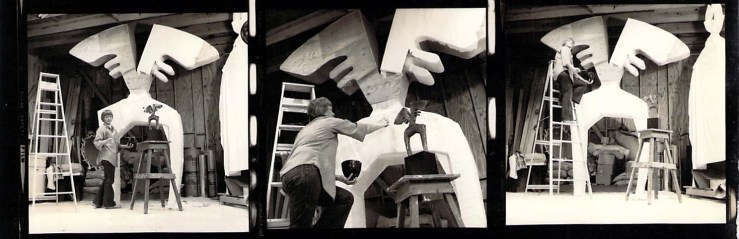
Hannah Holliday Stewart in her studio- Matthews Gallery

It’s not a stretch to call Hannah Holliday Stewart‘s (1924-2010) sculptures cosmic. In the artist’s heyday, the bronze forms that emerged from her Houston studio were often over 10 feet tall and thousands of pounds. She aspired to create physical manifestations of complex ideas in science, mythology and other fields, a system of “pure [abstract] symbols as constant as numbers and letters of the alphabet,” as Paul Klee said in one of Stewart’s favorite quotes. The themes she explored were so vast that Stewart’s work was at times cosmically misunderstood.

In preparation for our posthumous solo exhibition of Stewart’s work this July, we’ve been digging through the sculptor’s carefully organized personal files. One folder marked “Press” holds a 1994 newspaper article from Stewart’s childhood home of Birmingham. By that time Stewart had lived far away from Alabama for a lifetime, building a reputation in Texas and the Desert Southwest as one of the first female sculptors to win competitive public art commissions. “Ms. Stewart talks of such abstract notions as harmony and energy and spiritual awakening,” puzzled the Birmingham Post-Herald reporter. Throughout the rest of the article Stewart scratched out or rewrote swaths of the writer’s analysis in black ink, clarifying concepts and modifying terms. “[I] always go back to classical order and laws,” she scribbled at the bottom.

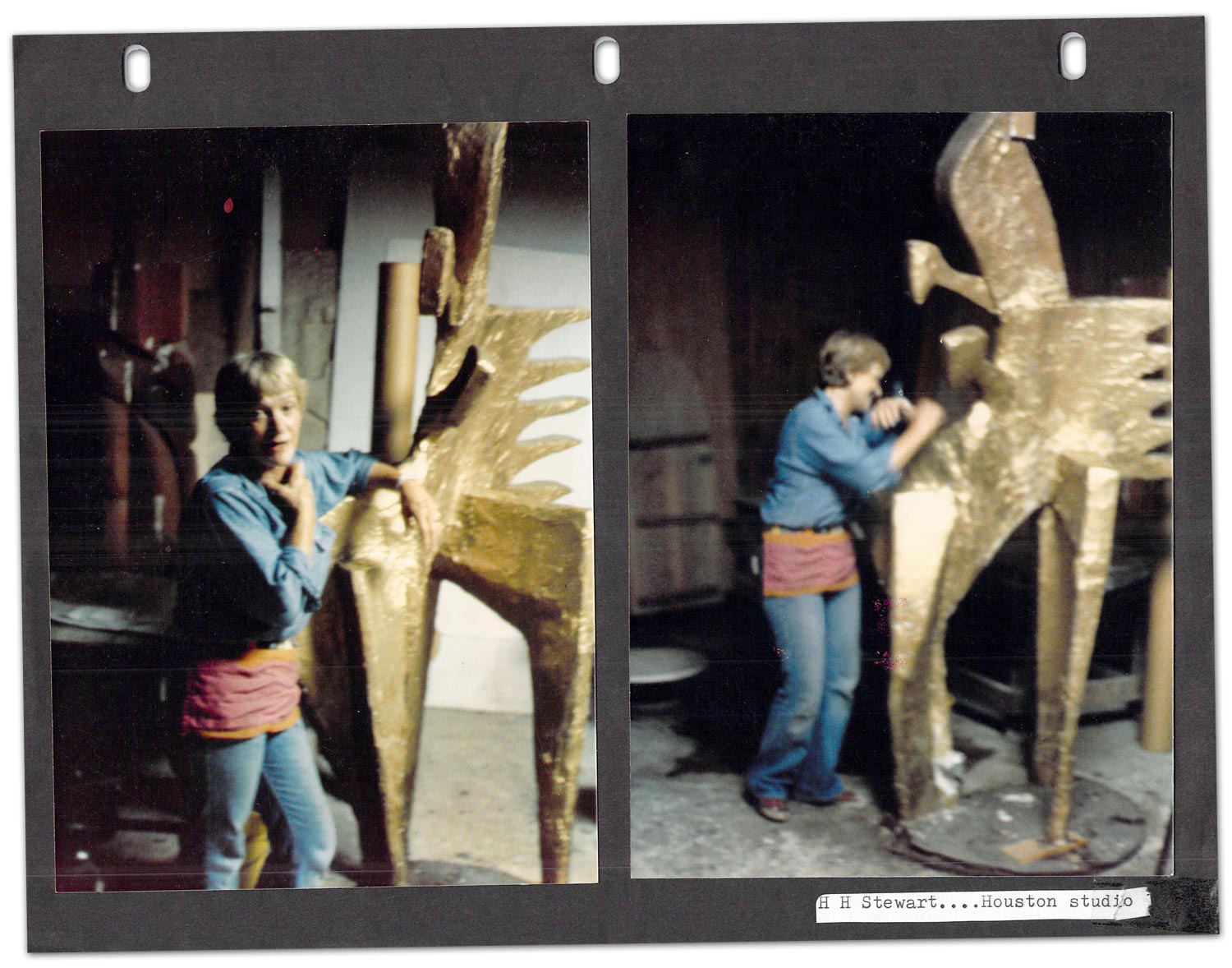
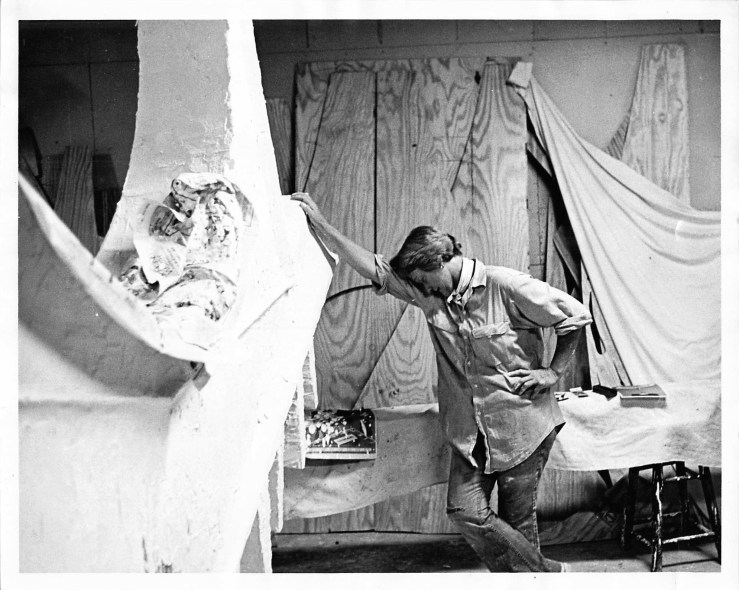
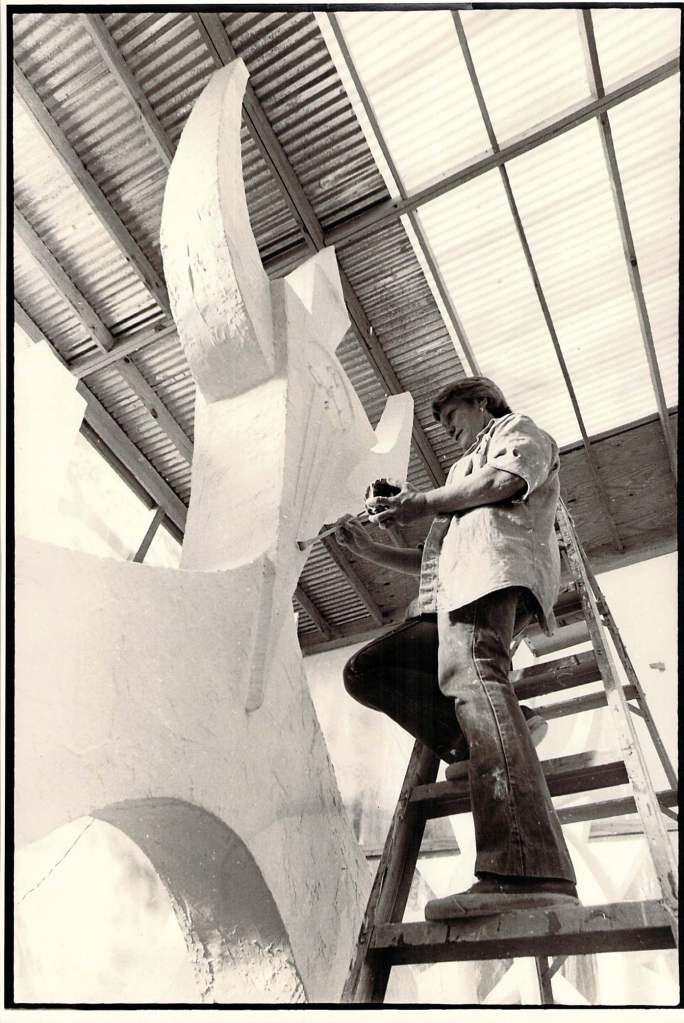
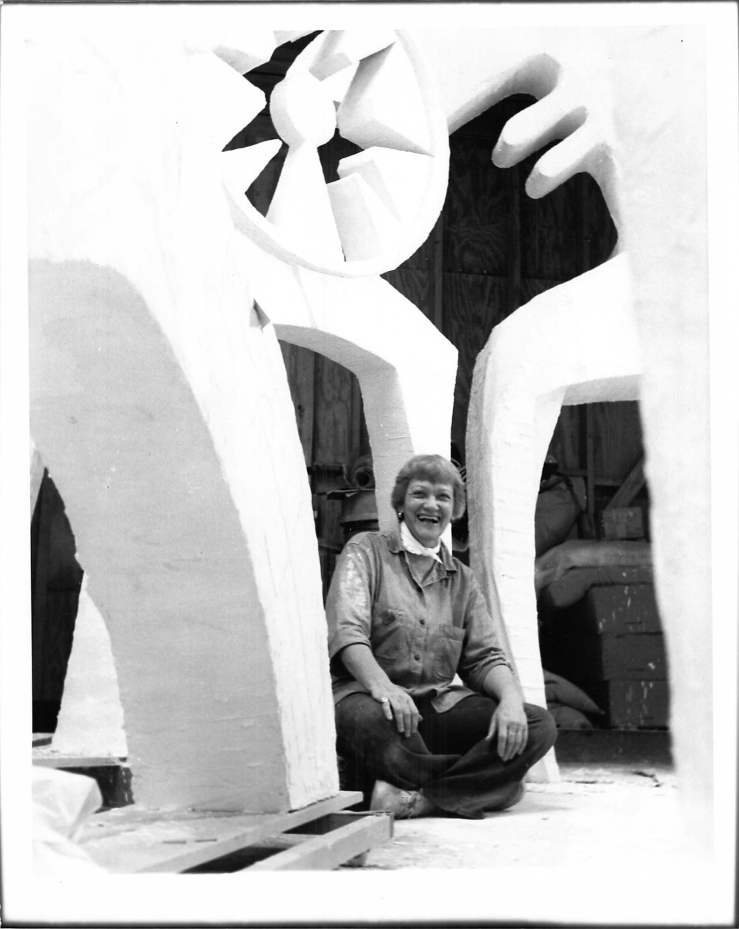
Hannah Holliday Stewart- Artist Process 1- Matthews Gallery

Stewart was born in 1924 in Marion, Alabama. She studied art in Alabama and Georgia for her BFA, and completed her MFA at Cranbrook Academy of Art in Michigan. After working at foundries in Florida and Mexico, she landed a teaching job at the Museum of Fine Arts in Houston and later at the University of Houston.

By the 1960s Stewart’s work had grown to a monumental scale, and a passionate group of Texas art enthusiasts rose to support it. In an era when female sculptors had to fight for recognition, Stewart’s bronze monoliths were popping up all over Houston—and beyond. In 1962 a swooping, Brancusi-esque bird form called “Libertad” appeared in the courtyard of Houston’s World Trade Center, and in 1972 an 11-foot-tall sculpture titled “Atropos Key” landed on a hill in Hermann Park. A commission for a monumental work in Dallas’ Samuels Park spread her name across the state.

“I found myself devoted to her work very early, I think,” says Dayton Smith, who befriended Stewart around 1969 when he was working for a Houston photography studio. “I realized the significance of it, the weight of it, shall we say.” Over the next few years Smith helped Stewart in various ways, photographing her artwork, transporting sculptures, and organizing a 1973 solo exhibition at Houston’s Jamison Gallery on Hermann Park.

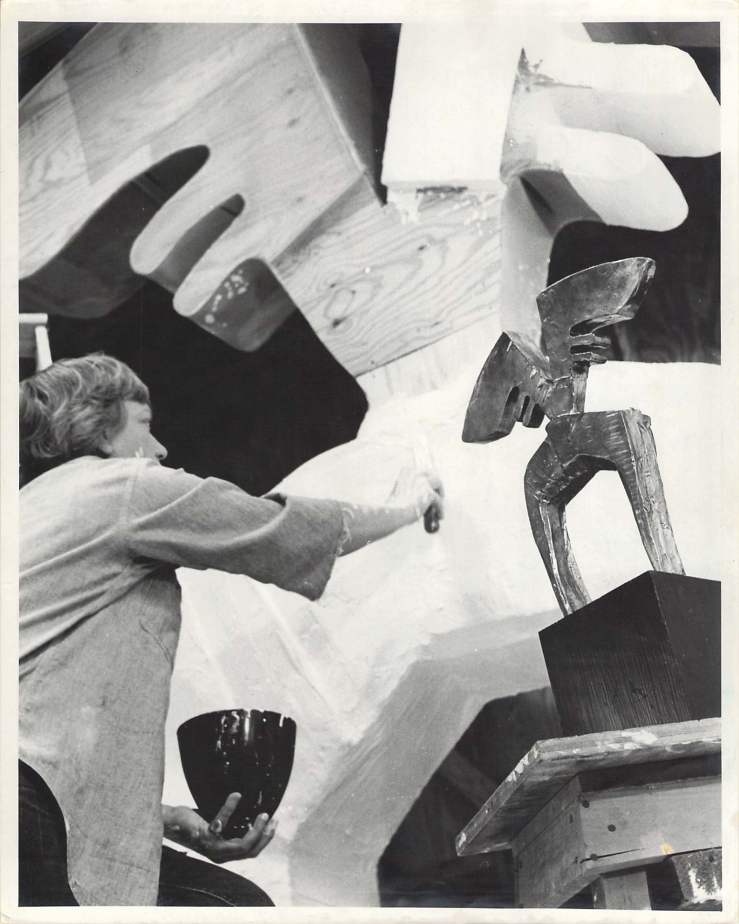
Hannah Holliday Stewart- Artist Process 2- Matthews Gallery

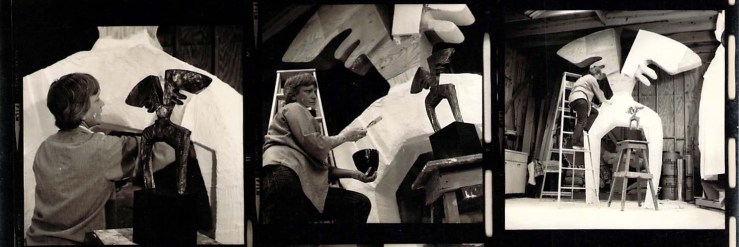
“As I got to know her, I became aware that she was a very literate person, very intelligent,” says Smith. “Her work really did relate to what she encountered in her learning.” Smith noted that Stewart explored many fields of knowledge, from science and architecture to music and mythology, allowing concepts in each field to influence her three-dimensional objects. In 1975 and 1976 she mounted her first major solo show at the Houston Contemporary Arts Museum, exhibiting a series of large plaster models (including “Adam’s Rib“, from the photographs in this blog post) that were based on smaller bronze maquettes. But even as Stewart’s legend grew, Smith says misconceptions about her work persisted.

“The word spiritual often comes to mind, but spiritual is such a misunderstood term in our society,” explains Smith. “If you look at the word itself, the Latin root of it is ‘spiritus’. That means ‘wind.’ We can see the wind when it carries things, when it moves things.” Stewart worked to bring the invisible—a musical note, kinetic energy or a wisp of air—into the physical world.

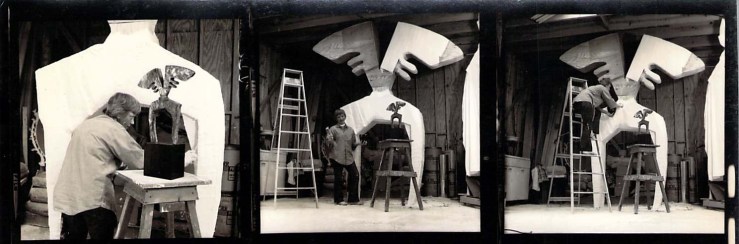
Hannah Holliday Stewart- Artist Process 3- Matthews Gallery

More mysterious still to many of Stewart’s friends in Houston was her abrupt disappearance from the art world. Smith last saw Stewart in the late 1980s, when she was teaching at St. Thomas University and exhibiting in an impressive array of art institutions across the country. A few years later Stewart packed up and moved away from Houston, settling in Arizona, Alabama and then Albuquerque, New Mexico. She never exhibited her artwork publicly again. Why would a woman who once showed at the Smithsonian Institution, the Getty Museum and prominent galleries in New York, New Orleans and many other cities suddenly leave it all behind?

Smith has a few hunches. Stewart often said that she was inspired by the Desert Southwest, and sent Smith an image of her working in her new studio in Flagstaff. The move to Birmingham probably had to do with the declining health of Stewart’s brother and two sisters, who lived in the area. When it came to her art career, Smith thinks Stewart may have needed room to spread her wings and find new inspiration.

“Once we were talking about something she’d observed,” recalls Smith. “That sometimes to make it in your own town you have to leave and come back with something big. That people could get too used to you, but that perhaps you could come back and be accepted. Maybe she was planning that.”

Follow our blog in the coming weeks as we unravel the mysteries of Hannah Holliday Stewart’s life and artwork, and make sure to attend the opening of HANNAH HOLLIDAY STEWART: An Artistic Legacy Rediscovered on July 4 from 5-7 pm.  Also pick up the July/August issue of American Fine Art Magazine to read more about the show, and follow our investigations on Facebook, Twitter and Instagram.