Picasso: Past, Present and Future!

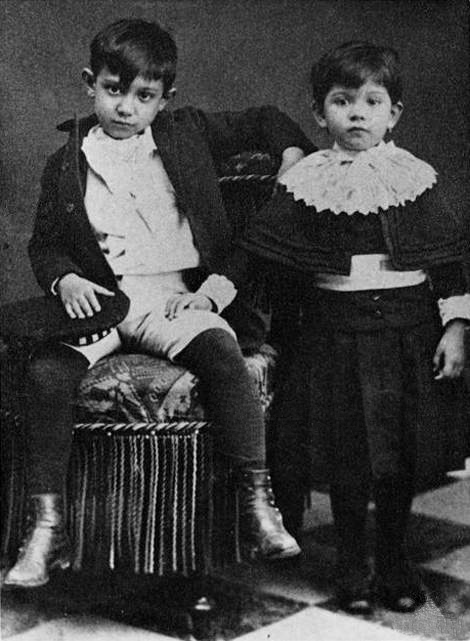
Pablo Picasso and sister Lola- Matthews Gallery blogPicasso and his sister Lola. He was about 8 years old
in this picture, and already had some swagger.

In the art world, it’s a holiday. Pablo Picasso was born in Málaga, Spain on October 25, 1881. In the 133 years since, the artist has irrevocably changed the way we look at art— and the world around it.

We’re frequently struck by the way Picasso would capture an artist’s attention and radically alter his or her course. Just look at this 1955 lithograph by Italian futurist Gino Severini, which is often mistaken for a Picasso by gallery visitors. French artist Jean-Pierre Jouffroy shifted from figurative artwork to pure abstraction after studying Picasso and his contemporaries, and Robert Motherwell‘s decision to become an artist hinged on a European tour of modern masterworks.

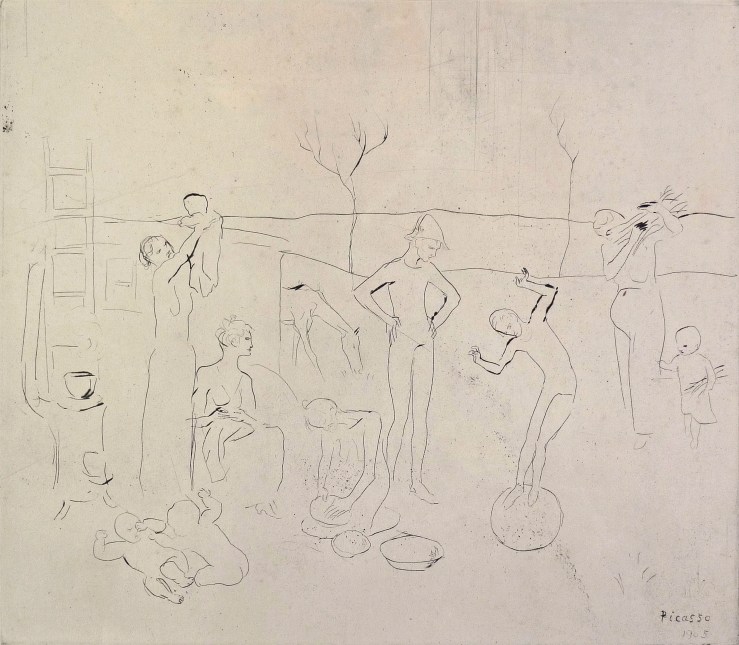
On this momentous day, we’re looking back at every Picasso that has passed through our gallery. Each one has a fascinating story… Pablo Picasso- Les Saltimbanque- Matthews Gallery blog Les Saltimbanques is the earliest work by Picasso we’ve ever exhibited. It’s a drypoint from 1905, when the artist was about 24. It was commissioned by legendary art dealer Ambroise Vollard, who gave Picasso his first gallery show in 1901. The frolicking figures are characters from an opera-comique about a circus troupe. An early appearance by the harlequin (far right) is notable, as the archetype would become one of Picasso’s most-used personal symbols.

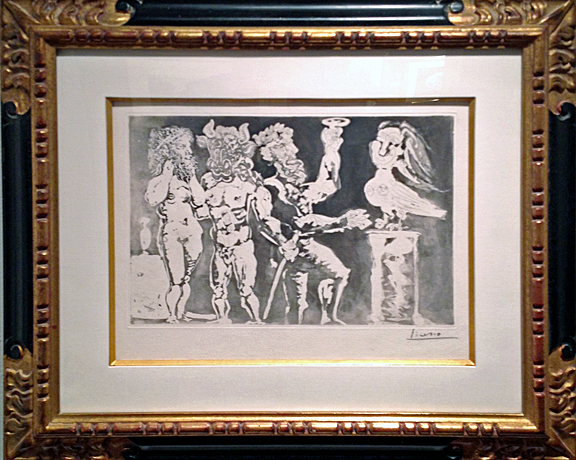
Pablo Picasso- Personnages Masques et Femme Oiseau- Matthews Gallery blog

Fast forward to 1930. With the help of Vollard, Picasso had built his name into the first true global artistic brand. In yet another stroke of marketing genius, Vollard commissioned Picasso to create a series of 100 etchings—including several portraits of the dealer himself. The star of the Vollard Suite is the minotaur (second from left), another one of Picasso’s personal symbols. At the beginning of the series the minotaur is a virile beast, but by the end he is blind and weak, relying on a beautiful young muse to guide him. Completed in 1937, it’s the middle-aged Picasso’s meditation on his waning virility.

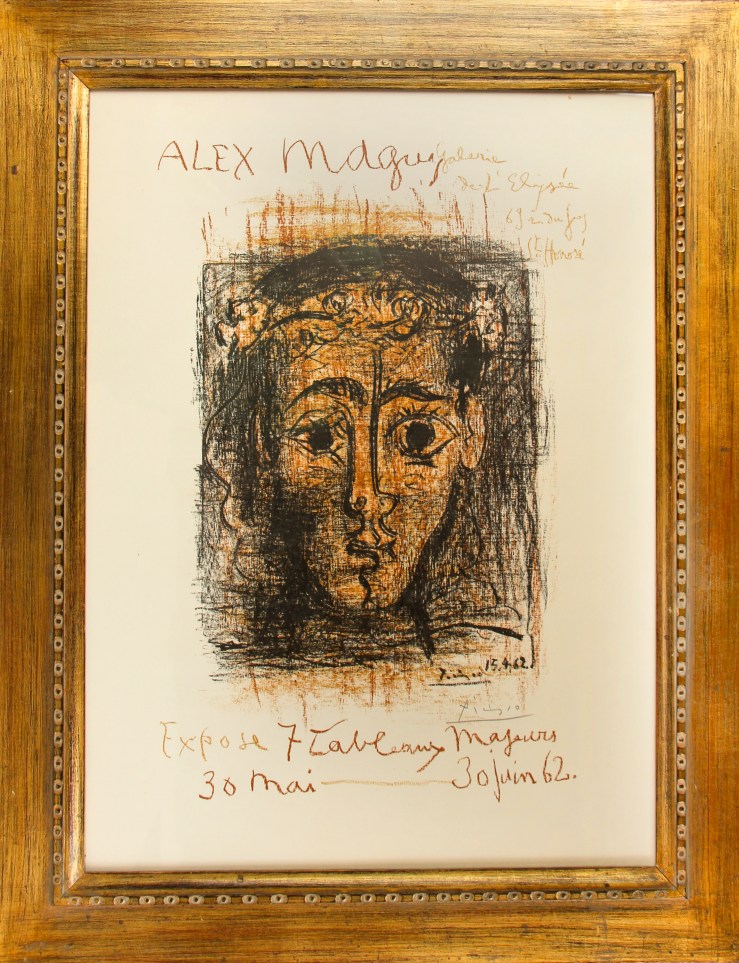
Pablo Picasso- Alex Maguy Gallery- Matthews Gallery blog

A youthful face peers from this offset lithograph Picasso designed for the Alex Maguy gallery in 1962. The exhibition was a retrospective of his artwork, but those captivating, wonder-filled eyes hardly hint at the darker themes the octogenarian turned to in his later years.

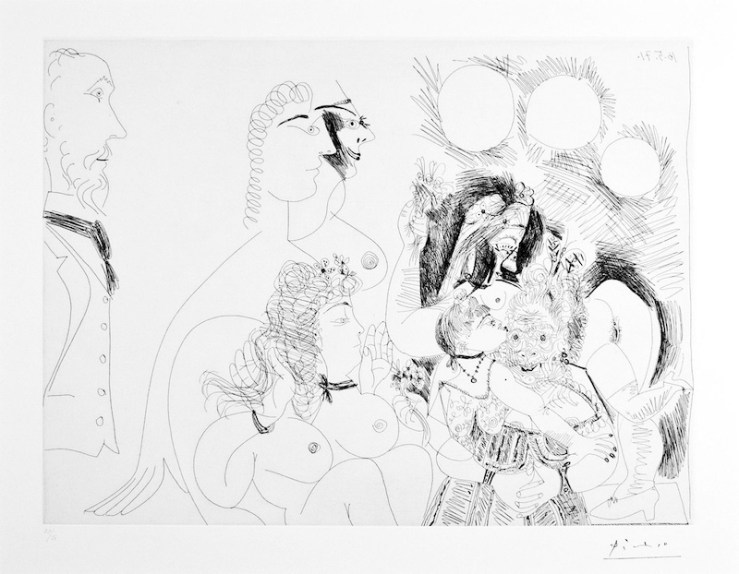
Pablo Picasso- 156 Suite- Matthews Gallery blog Picasso created the 156 Suite in 1971, not long before his death. Some consider the etchings to be his most personal series, a diary of a man struggling with impotence and pushing helplessly against the inevitable.

In contrast to our print from the Vollard Suite, women take the dominant role in these works. Models turn on artists, witch doctors stab at their patients and—in the case of this print—prostitutes tangle at a brothel while a man looks on, paralyzed. The gentleman is Degas, who appears in several prints in the series and with whom Picasso felt solidarity in his struggles.

Pablo Picasso 1971- Matthews Gallery blog Check out our Twitter, Tumblr and Pinterest profiles today for more insight on Picasso, and learn more about all of the artwork in this post on our homepage.

OUTSIDER/INSIDER: Abstract Expressionism at Matthews Gallery

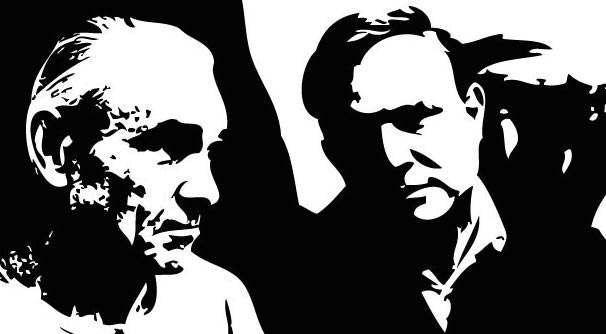
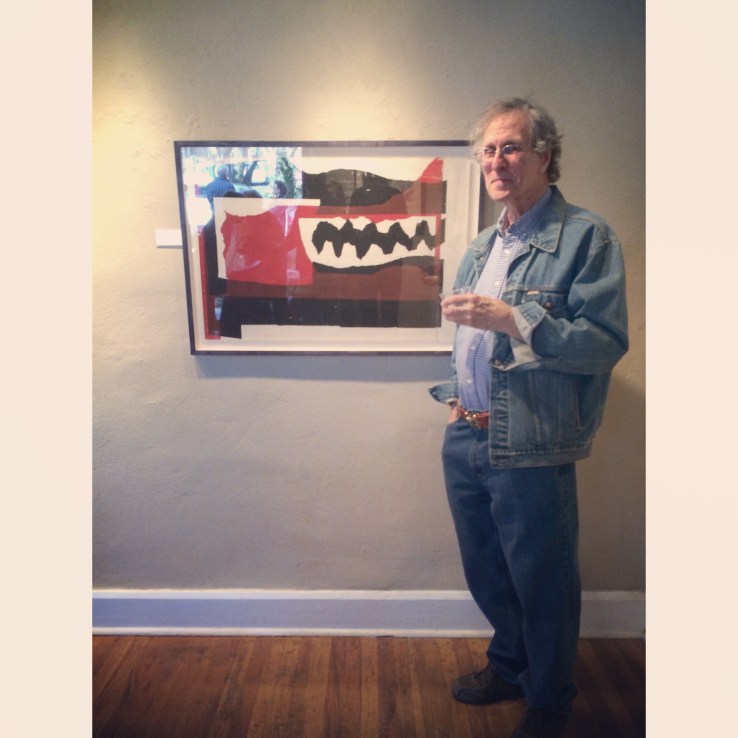
Stanley Boxer and Robert Motherwell at Matthews Gallery Boxer (left) and Motherwell

It was Mark Rothko’s 111th birthday this Friday, and the occasion has us pondering one of the 20th century’s most polarizing art movements: abstract expressionism.

Three artworks by renowned abstract expressionists have recently landed on our walls. The first two are heavily impastoed oil paintings by Stanley Boxer, who resolutely clung to the far fringes of the movement. Determined to defy labels, he was furious when art critic Clement Greenberg called him a color field painter, and yet the arc of his creative explorations closely paralleled that of his abstract expressionist contemporaries:

In the manufacture of my art, I use anything and everything which gets the job done without any sentiment or sanctity as to medium. Then, too, I have deliberately made a practice of being “visionless”… this is, I go where my preceding art takes me, and never try to redirect the future as to what my art should look like. This is a general credo and foundation for everything I have ever done and stands firm in its solidity as this is written.

Boxer, who died in 2000, would have loved Grace Glueck’s New York Times review of a 2004 exhibition of his late works. She notes that he was “never part of a movement or trend,” but rather driven by paint’s “physical possibilities without script or program.”

Abstract Paintings by Stanley Boxer- Matthews Gallery Blog Atriumofashreddednight  (top) and Crisppitchofsigh, Oil on Linen

Glueck ends the piece with a brief analysis of Boxer’s titles, lyrical lists of words that are jammed together in unbroken strings. The works in our collection, for example, have names that read like fragments of beat poems: Atriumofashreddednight and Crisppitchofsigh. Glueck writes, “As Boxer joked in his titles, these canvases, more than most, do not really lend themselves to verbal exposition. They live for the eye, to which they bring deep satisfaction.”

Boxer’s titles provide a link to Robert Motherwell, the other abstract expressionist represented in our collection. Unlike many “abex” artists who labeled their canvases using dates or arbitrary numbers, Boxer and Motherwell were unapologetic in their wordplay.

That’s where the similarity ends. While Boxer considered himself an isolated frontiersman of abstract painting, Motherwell was an eager icon of abstract expressionism. He coined the term ‘New York School’ to describe his revolutionary circle, which included Mark Rothko, Jackson Pollock and Willem de Kooning, and acted as a spokesperson for the movement in the world of academia.

If Boxer’s titles were little more than impressionistic quips, Motherwell, who was a scholar before he became a “serious artist” and wrote numerous essays on aesthetics, chose names that have inspired endless analysis. His most famous series of paintings, Elegies to the Spanish Republic, chronicles the Spanish Civil War in bold strokes of black and white and subtle passages of ochre, blue, green and red.

Mainly, I use each color as simply symbolic: ochre for the earth, green for the grass, blue for the sky and sea,” Motherwell wrote. “I guess that black and white, which I use most often, tend to be protagonists.” In varying contexts, each color holds a universe of meanings. To fully understand the use of ochre in Motherwell’s Spanish Elegies, “You would have to know that a Spanish bull ring is made of sand of an ochre color,” the artist wrote.  Other works that feature ochre, like Western Air or Personage, with Yellow Ochre and White, would naturally spark different associations. 
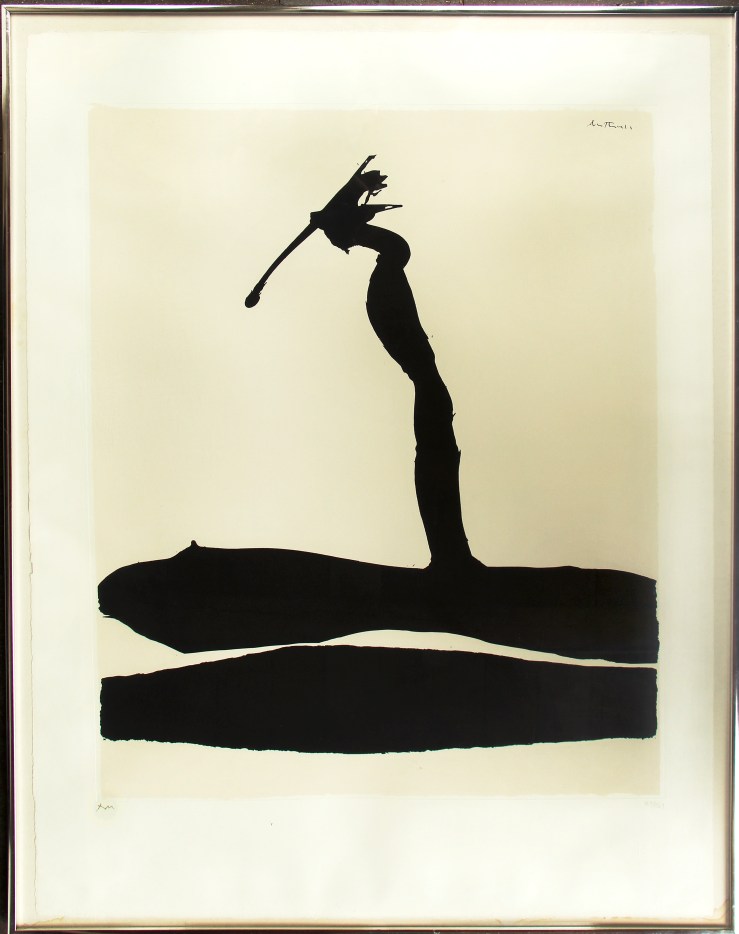
Robert Motherwell- Africa 4- Silkscreen- Matthews Gallery Blog Robert Motherwell, Africa 4, Silkscreen

What to make of our Motherwell silkscreen, titled Africa 4? Motherwell completed the Africa suite in 1970, the same year he created his Basque and London suites. They were his first projects entirely devoted to silkscreens, and a divergence from the heavily layered nuances of his oil paintings. Here his black abstract forms stand crisply against their off-white backgrounds, although on closer inspection, their tumultuous edges still seem to weave in an out of focus.

“All my works [consist] of a dialectic between the conscious (straight lines, designed shapes, weighed color, abstract language) and the unconscious (soft lines, obscured shapes, automatism) resolved into a synthesis,” the artist wrote in 1944.

Motherwell first explored the concepts of automatism and the subconscious with a group of Parisian Surrealists, including Duchamp, Ernst and Masson, who had fled Europe during World War II.  Their ideas would help shape the spiritual side of abstract expressionism, a spontaneous, intuitive element that Motherwell carefully balanced with his more intellectual inclinations.

Motherwell’s connection to the Surrealists lends us a potential clue to the significance of the ‘Africa’ title. In his 1946 essay ‘Beyond the Aesthetics‘, Motherwell discusses the life of French Symbolist poet Arthur Rimbaud, who helped inspire Surrealism. In the final decades of his life Rimbaud quit writing and set off on an African expedition, a leap of faith that Motherwell compares to the Surrealists’ break from Dada and formation of a new movement:

Like Rimbaud before them, the Surrealists abandoned the aesthetic altogether; it takes a certain courage to leave poetry for Africa (as Rimbaud did, fh). They revealed their insight as essentially moral in never forgetting for a moment that most living is a process of conforming to an established order which is inhuman in its drives and consequences. Their hatred sustained them through all the humiliating situations in which the modern artist find himself, and led them to conceptions beyond the reach of more passive souls. For them true ‘poetry’ was freedom from mechanical social responses. No wonder they loved the work of children and the insane – if not the creatures themselves.

Perhaps Motherwell’s Africa suite represents a similar journey, a leap into the unknown that is a clear break from previous adventures. Just as Rimbaud abandoned an intellectual pursuit for one centered on travel and action, and as the Surrealists broke from the societal battles of the Dadaists to explore dreamscapes, so Motherwell’s stark Africa forms landed him in a new realm of image-making. Perhaps he sought to prove that even the most distinctly divided blacks and whites could possess endless shades of grey.

Learn more about Stanley Boxer and Robert Motherwell on our website, and make sure to connect with us on Facebook, Twitter and Flickr for more gallery news.
ONE WORK OF ART: Beatrice Mandelman’s ‘Cool Wind’

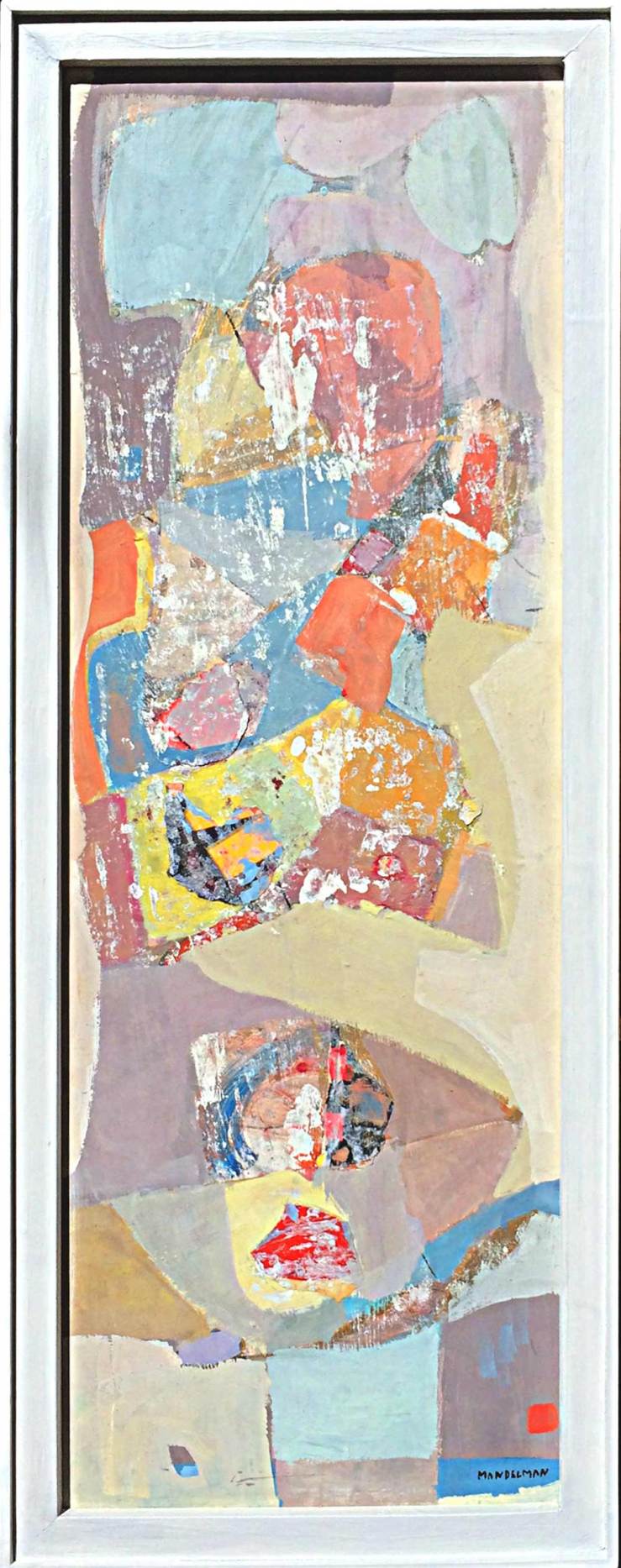
Beatrice Mandelman- Cool Wind circa 1950- Matthews Gallery

Beatrice Mandelman, Cool Wind c. 1950, Casein with Collage on Masonite Panel

When John Sloan invited Beatrice Mandelman and Louis Ribak to visit Santa Fe in 1944, the two artists were on the rise among New York City’s avant-garde. They had ties to Hans Hoffman and Fernand Leger, and were often mentioned in the same breath as Jackson Pollock. Sloan, who had been summering in New Mexico for years, had a reputation for spiriting away his favorite artists to the Desert Southwest. During their trip the recently married duo took a train to Taos and decided to stay.

The move marked a radical change in Mandelman and Ribak’s artwork. “We had to start all over again,” Mandelman said. “We spent the first couple years painting landscapes.” They were known for their figurative paintings in New York, but in this radically different environment their focus shifted to pure abstraction. They were trailblazers for a new wave of artists called the Taos Moderns, a movement that enlivened the Taos art colony but enraged an older vanguard of academic painters with ties to the Taos Society of Artists of the 1910’s and 20’s. To this tight clique of romanticists, the newcomers stuck out like colorful cacti—particularly Mandelman.

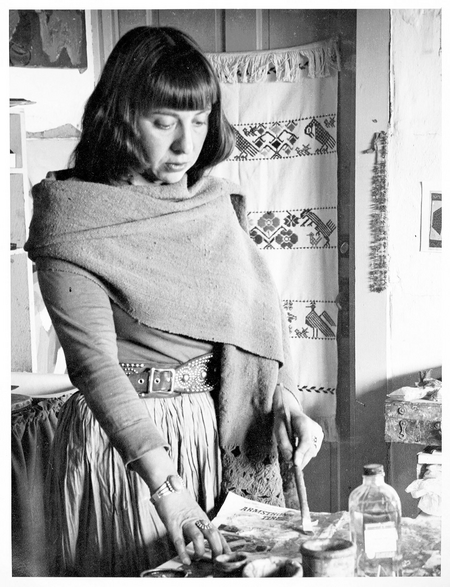
Portrait of Beatrice Mandelman in her Taos studio circa 1950- Matthews Gallery Beatrice Mandelman, 1950

“She worked with full abstraction at a time when most artists were not daring enough to do so,” writes David L. Witt in his book Taos Moderns, noting that Mandelman considered herself “the first of the second generation of artists in Taos.” The voice of a young, female abstract painter had never been part of the remote art community.

Far from the big city, Mandelman developed a new appreciation for the natural world and humanity’s relationship with it. By the late 1940’s she was developing an abstract symbol system to express her emotional responses to the landscape. Her elegant compositions didn’t mimic the lines or palette of the high desert, but they perfectly evoked the strong, solitary spirit of its inhabitants.

The mixed media painting in our collection was likely done in the 1950’s. Early in her experiments with abstraction Mandelman chose a muted palette, but here brighter colors poke through. This more expressive style was inspired by Henri Matisse and Mandelman’s former teacher Leger, and allowed her to explore the highs and lows of human experience with great vigor. Cool Wind‘s undercurrent of chilly blues and bright accents of orange and red call forth the sensation of a shiver passing up the spine.

As the evenings get cooler in Santa Fe, we’ve developed an ever-evolving passion for this piece and the innovative artist who created it. Learn more about Beatrice Mandelman on our website, and connect with us on Facebook, Twitter and Instagram for daily gallery news.

ROCH HART: Mystery of the Petroglyphs

Roch-Hart-New-Mexico-Jeep-Tours Roch Hart’s jeep outside Matthews Gallery

Roch Hart is the first and only fine furniture maker in our stable, but he also has a pretty awesome day job. As the owner of New Mexico Jeep Tours, Hart takes visitors on rugged expeditions across a 20,000 acre private ranch between Santa Fe and Albuquerque. The property is home to wild horses and numerous petroglyphs left behind by ancient Pueblo cultures.

We first met Hart through the image sharing website Flickr, where he posts stunning photographs from his adventures. We had no idea that he was also a master craftsman until he reached out to us. Not long after, a big red jeep full of beautiful hand-carved benches appeared outside the gallery. When we saw how good Hart’s work looked in our Southwestern art room, we knew it was a perfect match.

It didn’t take long to realize that Hart’s adventurous occupation and his impressive hobby were connected. As chronicled in previous posts, many of his works feature symbols from the petroglyphs he discovers on the ranch. The ancient marks are part of a complex language, and their meanings are partly lost to history. Luckily, Hart is a passionate detective. We asked him to show us some of his photos and tell the stories of petroglyphs that have inspired his work.

Take it away, Roch:

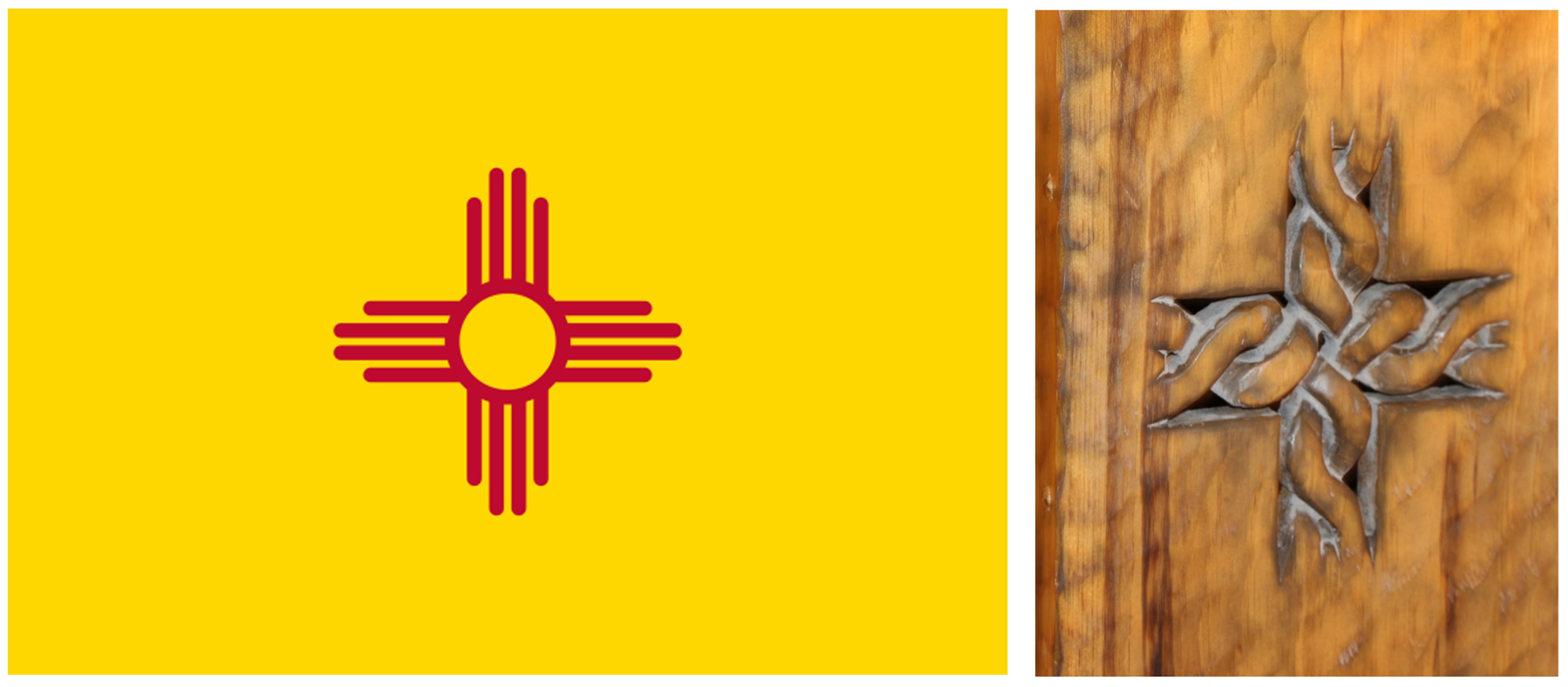
New-Mexico-Flag-Roch-Hart

New Mexico state flag, and a cross from Roch’s pie chest ‘The Way

In petroglyphs, the same symbol can hold multiple meanings. Take for example the Zia symbol on our state flag. Our European or Western paradigms might lead us to interpret the Zia as a simple, decorative depiction of the sun, but in the Pueblo culture these symbols were a communication form rather than an art form.  The circle of the Zia represents the circle of life. The four rays radiating from the circle represent many different things: the four directions, the seasons, the elements or even four stages in a person’s life. In the Pueblo culture, the four is a sacred number. I have found petroglyphs with faces whose mouths are in a square shape, perhaps speaking of the fours.

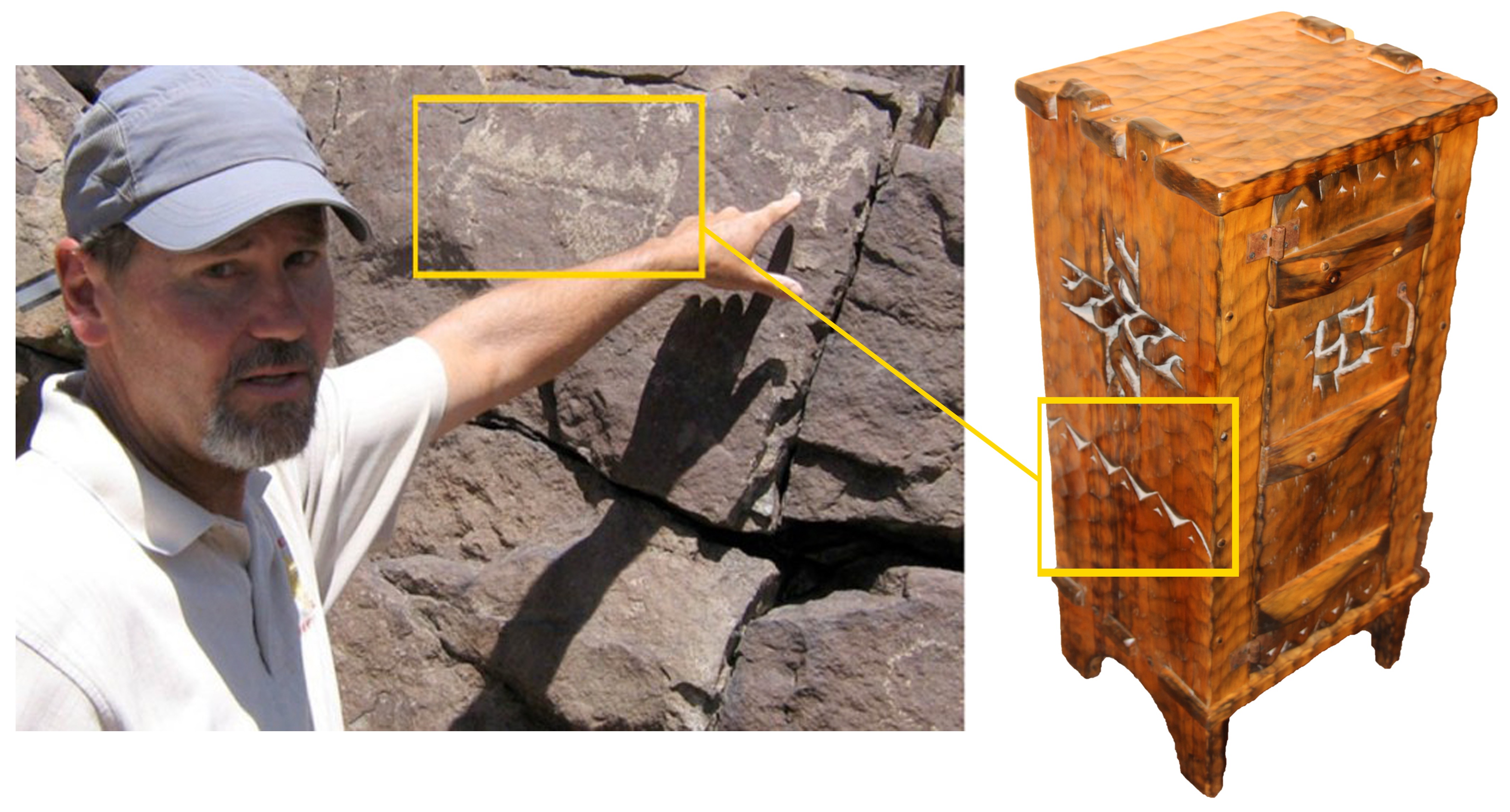
Roch-Hart-The-Way-Petroglyphs

Roch Hart with New Mexico petroglyphs, a similar design on Hart’s pie safe ‘The Way

Sometimes petroglyphs mimic the lines and rhythms of nature. I’ve been told by a trusted, unnamed native source that the triangular petroglyphs in the photo above represent mountains. The straight lines below the mountains may represent mesas, and below that is a mark that resembles a body of water. This could be a map of sorts. Not far from this petroglyph, there is a small pond with a view of mesas and the Jemez Mountains. On my latest pie safe, ‘The Way, I carved a similar pattern to represent mountains.

Roch-Hart-Petroglyph-Shield-WarriorShield Warrior petroglyph, photo by Roch Hart

In the world of petroglyphs there is a common theme of anthropomorphism (I really just like saying that word). Humans will sometimes take on the form of an animal, insect, or warrior shield. In the simple petroglyph above, a circled cross with a head and eyes represents a Shield Warrior. If we were still doing petroglyphs, this one could have represented me during my days as a cop. As you can see, this little guy also has the cross in his shield, representing the fours or ‘the way.’

Roch-Hart-Bear-Claw-PetroglyphsBear claw petroglyphs with storyteller and listener faces, photo by Roch Hart


Another common theme in petroglyphs is the ‘yin and yang.’ For instance, every storyteller needs a listener. The images above show petroglyphs that represent bear tracks. The tracks come in pairs, and each track has a face inside it representing a storyteller or a listener.

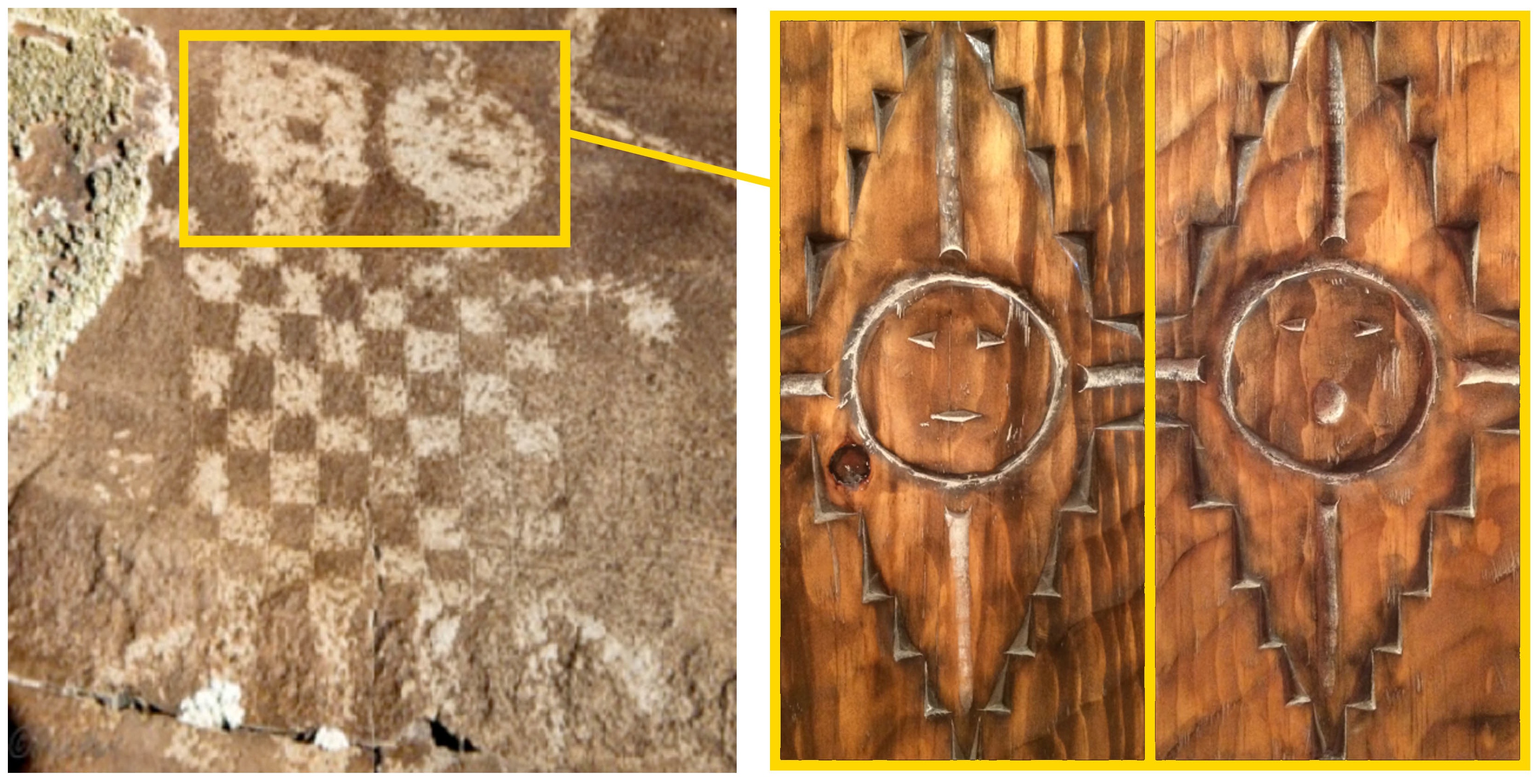
Roch-Hart-Storyteller-Faces

 ‘Marriage’ petroglyph, faces on Hart’s pie safe ‘The Storytellers

I call the petroglyph above ‘The Marriage.’ You can see two distinct people occupying one checkerboard body. If you look carefully, the square head appears to be speaking while the round head has its mouth closed. My pie safe called ‘The Storytellers‘ explores this theme of opposites. The listener and the speaker depend on each other.

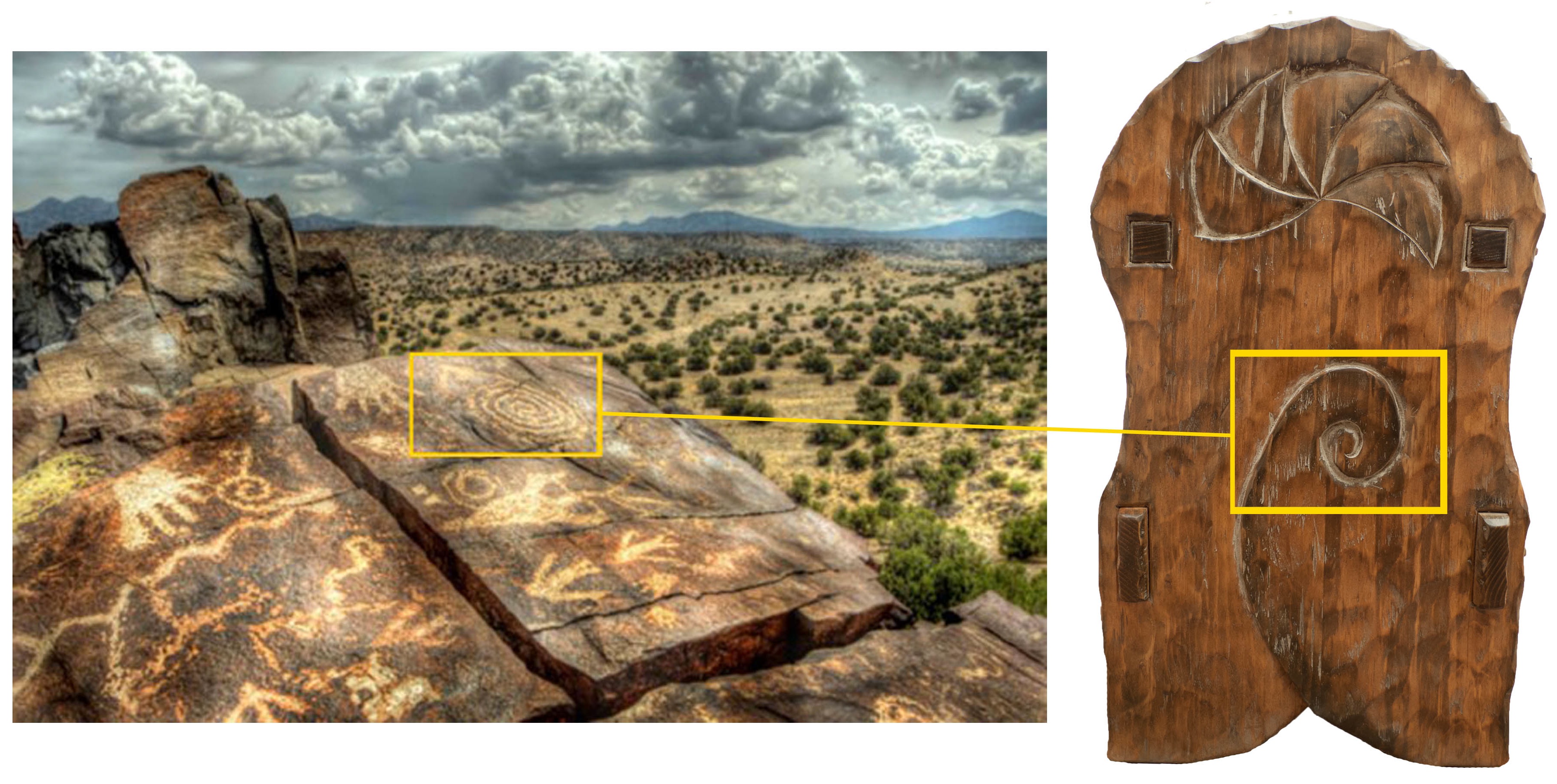
Roch-Hart-New-Mexico-Petroglyphs

New Mexico petroglyphs, a spiral design on a bench by Roch Hart

Another common symbol is the spiral.  Spirals or concentric circles often represent time or travel.  I have found that cracks are often incorporated into these petroglyphs and I will find a spiral with the outer end going to or ending in a crack.  A common legend amongst the Pueblo natives is that they originated under the earth’s crust and made the journey to surface.  I believe these spirals convey that journey.  On one of my early pie safes, I placed a spiral on the door with the tail leading up to the middle joint of the door.

 Screen Shot 2014-09-11 at 6.22.02 PMNew Mexico petroglyphs

Petroglyphs are very complex and have multiple layers of meaning and legend.  This blog post just scratches the surface, so to speak.  We have lost much knowledge of petroglyphs because early Spanish priests saw them as spiritualism apart from Catholicism. Catholicism was the state religion and the only legal one, so petroglyphs were outlawed.  In fact we often find crucifixes etched into the stones near these sites, placed there by the early priests to exorcise the place of evil spiritualism and to remind the Pueblo natives that this was not longer an accepted practice.

While part of me is upset about how we lost the knowledge of these ancient symbols, I enjoy that I don’t completely understand the mystery.  I love the idea that in some respects it is open to the interpretation of the beholder. Only the maker knew.

To make my fine furniture, I blend influence from the native cultures with my knowledge of Spanish colonial carpentry laws. That’s how I arrive on how to make a piece down to the joinery. But that’s for another blog post!

To see more photos by Hart, make sure to check out his Flickr account. See all of his furniture on our website, and connect with us on Facebook, Twitter and Pinterest for daily gallery news.


The Boundless Moment: All Together Now

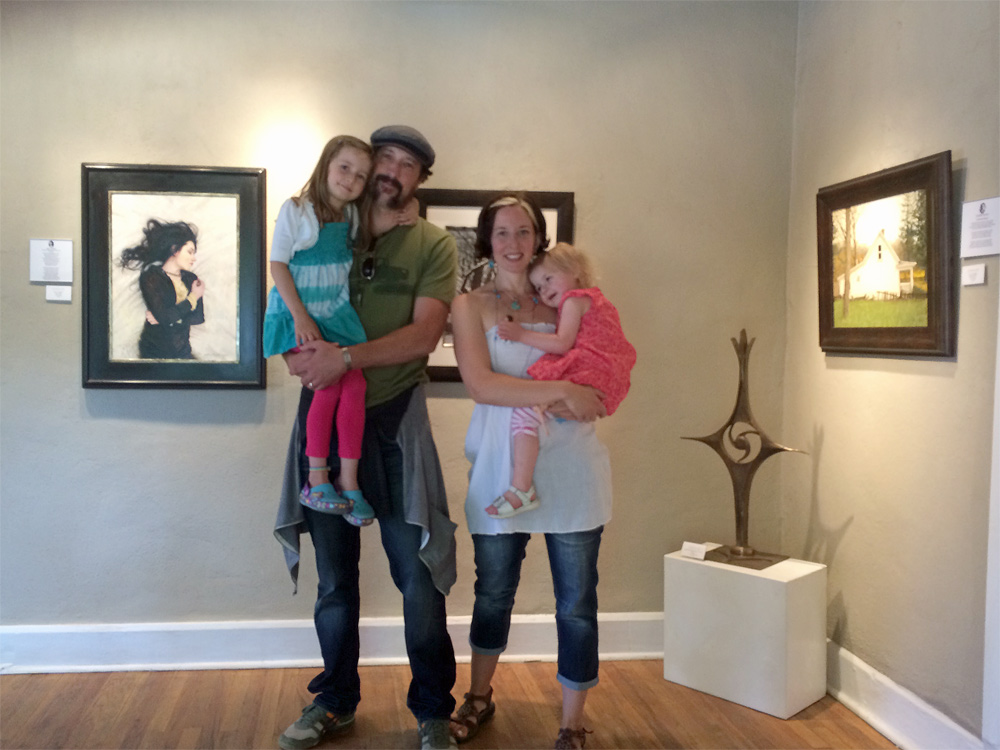
Eric-Thompson-Artist-Family

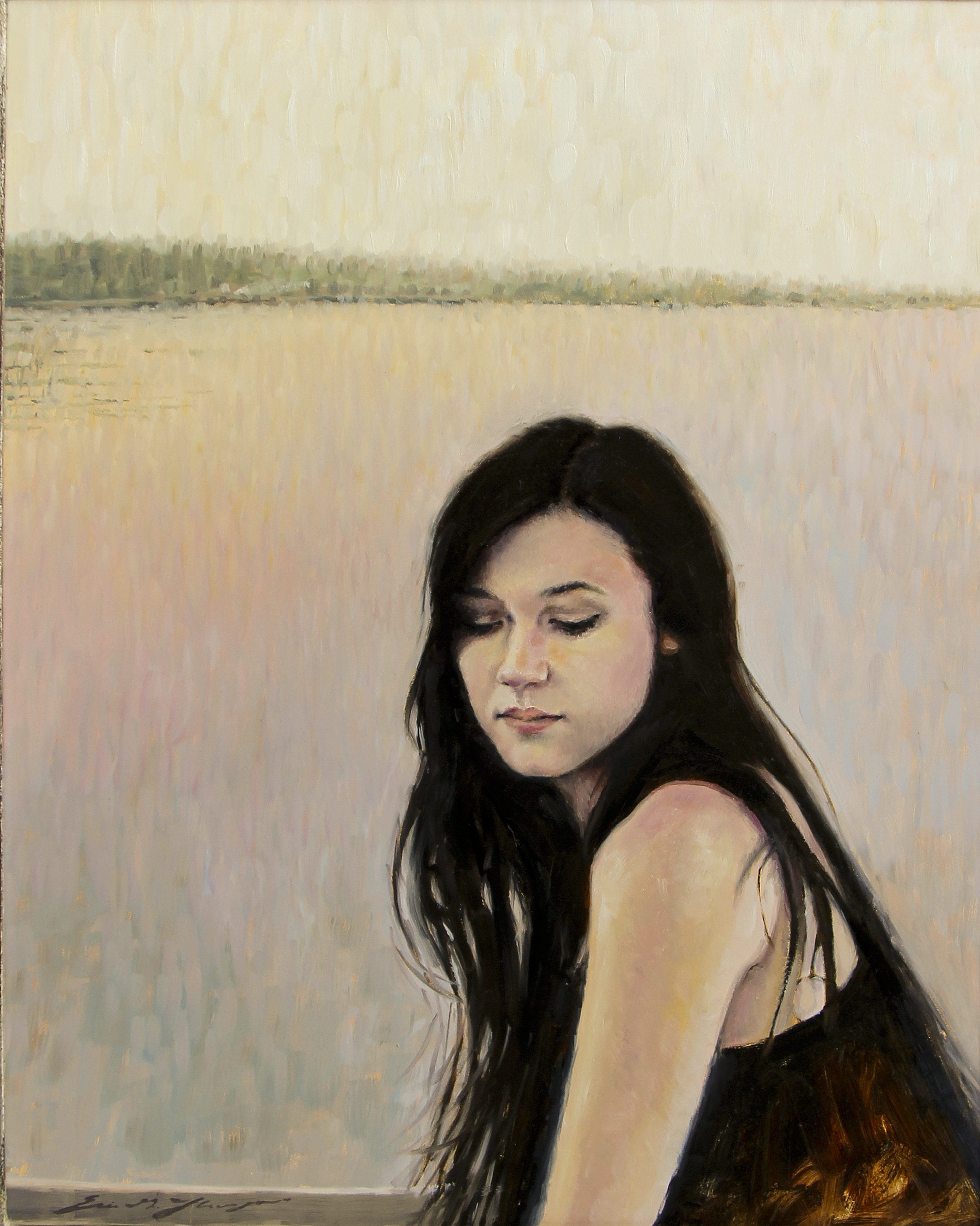
Eric G. Thompson’s ‘The Boundless Moment
opens Friday, August 15 from 5-7 pm
and closes August 28.

Eric and Hilary Thompson’s daughters dash around Matthews Gallery, exploring their father’s new solo exhibition ‘The Boundless Moment.’ They’ve just finished a long car ride from Salt Lake City but they’re bursting with energy.

Over the past year the children have grown alongside these canvases and panels, watching as thousands of brushstrokes transformed into rolling landscapes and rosy skin. Now these familiar images have magically appeared in our lofty, brightly lit space, sparking the girls’ curiosity. They stop before each work, craning their necks to get a good look.

The girls’ vivacity matches Hilary’s temperament. She keeps an eye on them as she chats and laughs with us. Eric is a quieter presence. He strolls around the gallery, analyzing the arrangement of the work and reading the legendary poems we paired with them. Eric likes to think of his paintings as ‘visual haikus,’ which inspired us to select writings by Frost, Dickinson, Lowell and others to display during the show.

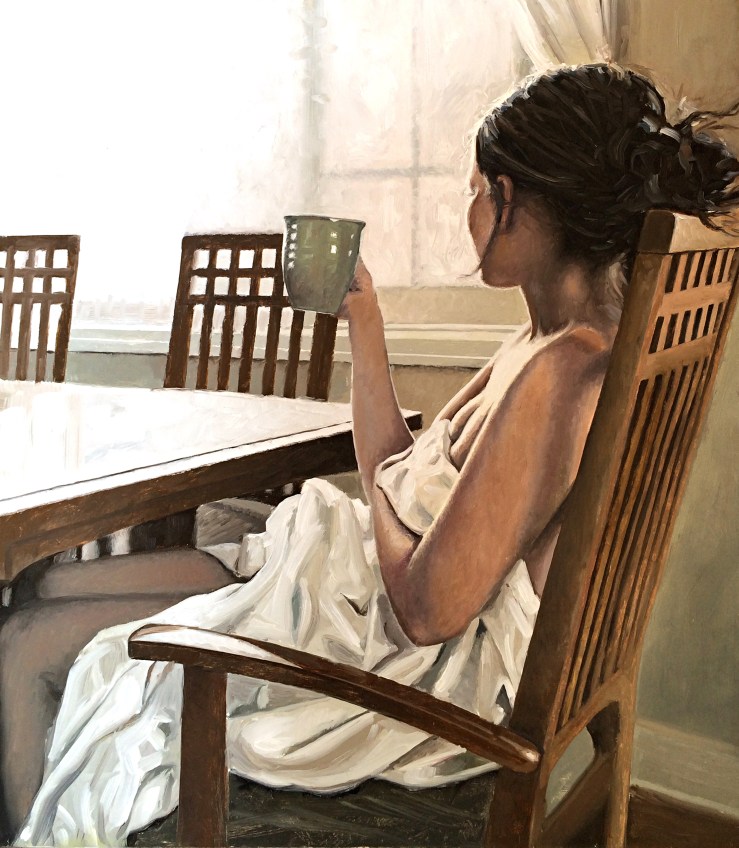
‘The Boundless Moment’ is something of a family act. Hilary was Eric’s model for the painting ‘Morning Cup,’ and wrote an accompanying poem that will debut at the opening reception. ‘The Chiseled Mother’ is a passionate meditation on parenthood and aging. As Eric cradles one of his daughters in his arms, you can tell that he’s just as inspired by the radiant spirit of his children. 

Read Hilary’s poem below, and make sure to attend Eric’s artist reception on Friday, August 15 from 5-7 pm.

Eric G. Thompson- Morning Cup- Matthews Gallery blog Eric G. Thompson, Morning Cup, Oil on Panel

From Hilary Thompson:

The Chiseled Mother

I honor this body
This matryoshka

The delicate lines of my eyes
Like tissue paper
Crinkled from sun beams
Washboards slow the momentum
of tears

These ears, these conches
That entombed the beeping screaming alarms
Echoing endlessly on exhausted drives home
Mercifully quieting with age

Eric G. Thompson- Waiting for a Song- Matthews Gallery blog


Eric G. Thompson, Waiting for a Song, Oil on Panel

This mouth
Which broadcasts comforts, screeches, praise
Fractures the tightrope of vexation

These beautiful, perfect arms
That embraced defeat
Carried a child to the surgeon’s knife
Willing arms
That waved, furrowed, aching
Sturdy farewells

This heart that beats out
The anthem of the womb
I Am
I Am
I Am

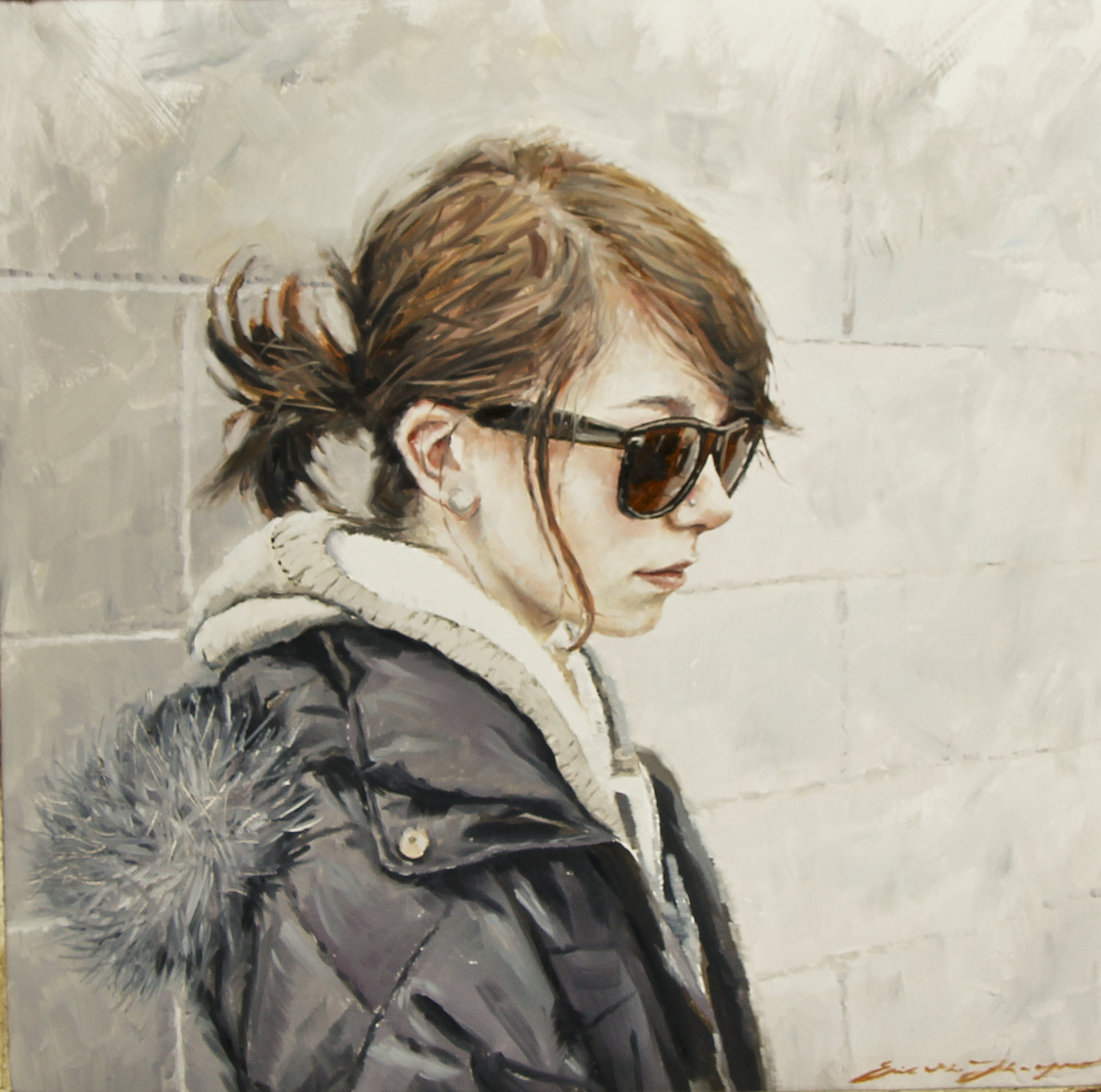
Eric-Thompson-Art-CoffeeshopGirl

Eric G. Thompson, Coffee Shop Girl, Oil on Panel

A womb
That is the definition of Creation
Bringing forth what does not exist
Into existence
Torn out of me
With upheaval and sanguine waves of nurture

These knees that caught me
When my frame buckled
Unable to support my grief

These marks, stretched
Yawning tiger stripes
Where my body gave room
Shimmer as silver reminders of a past shape

EricGThompson-Art-Evening

Eric G. Thompson, Evening, Oil on Panel

These feet
Planted.  Supporting.
Rooted even in motion, substantial
Pacing halls, hospital rooms
Threshing carpets bare-threaded

I am the red rock slot canyon
Worn smooth, fissured, curved
Sculpted
By this flawed life

This body is a shrine
A Holy place, a pilgrimage
A masterpiece painted stroke by stroke
By the breathtakingly exquisite nourishment
Of not getting what I want.

Breathe that in,
Chiseled edifice of the Mother,
Slather it like salve into your stripes,
You silver tiger.

 Connect with us on Facebook, Twitter and Instagram to learn more about Eric G. Thompson.

HANNAH HOLLIDAY STEWART: Cosmic Mysteries

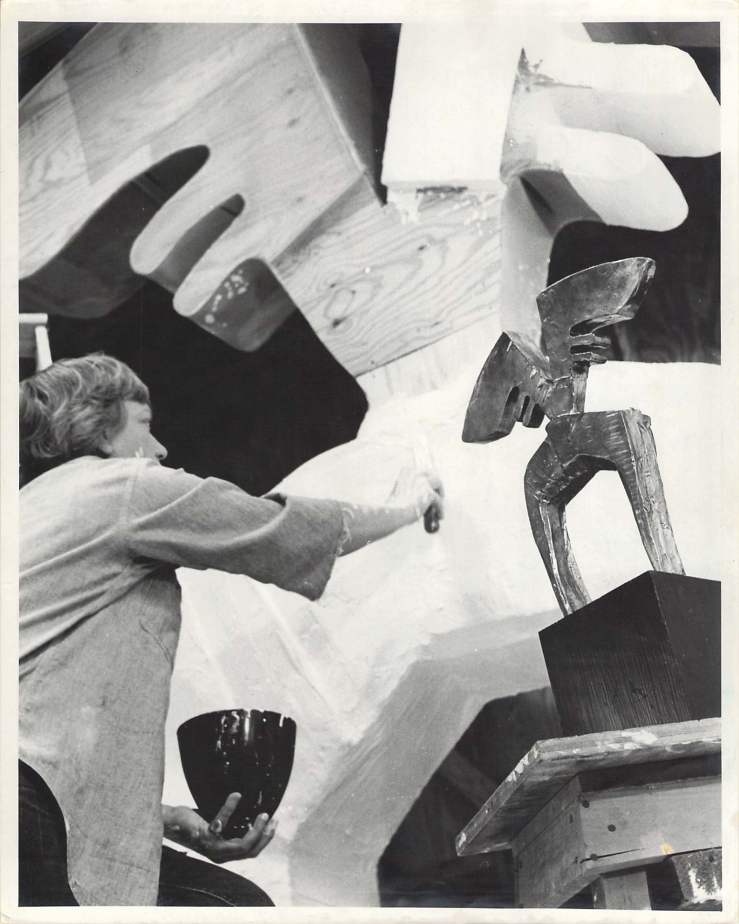
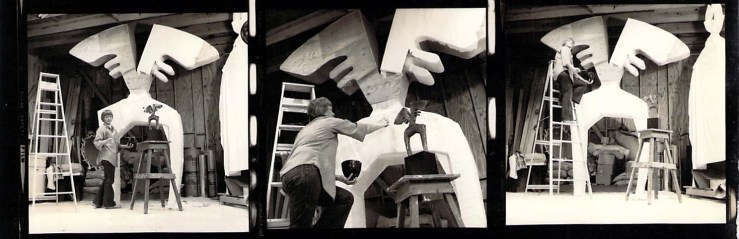
Hannah Holliday Stewart in her studio- Matthews Gallery

It’s not a stretch to call Hannah Holliday Stewart‘s (1924-2010) sculptures cosmic. In the artist’s heyday, the bronze forms that emerged from her Houston studio were often over 10 feet tall and thousands of pounds. She aspired to create physical manifestations of complex ideas in science, mythology and other fields, a system of “pure [abstract] symbols as constant as numbers and letters of the alphabet,” as Paul Klee said in one of Stewart’s favorite quotes. The themes she explored were so vast that Stewart’s work was at times cosmically misunderstood.

In preparation for our posthumous solo exhibition of Stewart’s work this July, we’ve been digging through the sculptor’s carefully organized personal files. One folder marked “Press” holds a 1994 newspaper article from Stewart’s childhood home of Birmingham. By that time Stewart had lived far away from Alabama for a lifetime, building a reputation in Texas and the Desert Southwest as one of the first female sculptors to win competitive public art commissions. “Ms. Stewart talks of such abstract notions as harmony and energy and spiritual awakening,” puzzled the Birmingham Post-Herald reporter. Throughout the rest of the article Stewart scratched out or rewrote swaths of the writer’s analysis in black ink, clarifying concepts and modifying terms. “[I] always go back to classical order and laws,” she scribbled at the bottom.

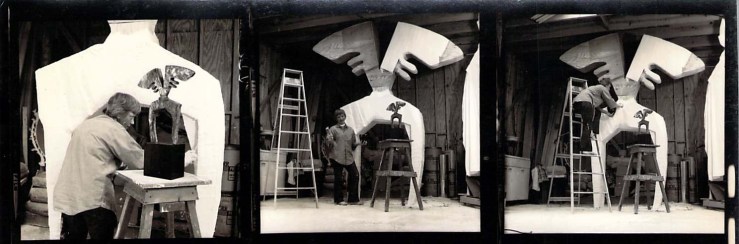
Hannah Holliday Stewart- Artist Process 1- Matthews Gallery

Stewart was born in 1924 in Marion, Alabama. She studied art in Alabama and Georgia for her BFA, and completed her MFA at Cranbrook Academy of Art in Michigan. After working at foundries in Florida and Mexico, she landed a teaching job at the Museum of Fine Arts in Houston and later at the University of Houston.

By the 1960s Stewart’s work had grown to a monumental scale, and a passionate group of Texas art enthusiasts rose to support it. In an era when female sculptors had to fight for recognition, Stewart’s bronze monoliths were popping up all over Houston—and beyond. In 1962 a swooping, Brancusi-esque bird form called “Libertad” appeared in the courtyard of Houston’s World Trade Center, and in 1972 an 11-foot-tall sculpture titled “Atropos Key” landed on a hill in Hermann Park. A commission for a monumental work in Dallas’ Samuels Park spread her name across the state.

“I found myself devoted to her work very early, I think,” says Dayton Smith, who befriended Stewart around 1969 when he was working for a Houston photography studio. “I realized the significance of it, the weight of it, shall we say.” Over the next few years Smith helped Stewart in various ways, photographing her artwork, transporting sculptures, and organizing a 1973 solo exhibition at Houston’s Jamison Gallery on Hermann Park.

Hannah Holliday Stewart- Artist Process 2- Matthews Gallery

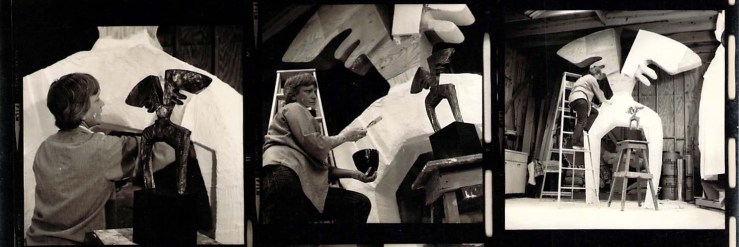
“As I got to know her, I became aware that she was a very literate person, very intelligent,” says Smith. “Her work really did relate to what she encountered in her learning.” Smith noted that Stewart explored many fields of knowledge, from science and architecture to music and mythology, allowing concepts in each field to influence her three-dimensional objects. In 1975 and 1976 she mounted her first major solo show at the Houston Contemporary Arts Museum, exhibiting a series of large plaster models (including “Adam’s Rib“, from the photographs in this blog post) that were based on smaller bronze maquettes. But even as Stewart’s legend grew, Smith says misconceptions about her work persisted.

“The word spiritual often comes to mind, but spiritual is such a misunderstood term in our society,” explains Smith. “If you look at the word itself, the Latin root of it is ‘spiritus’. That means ‘wind.’ We can see the wind when it carries things, when it moves things.” Stewart worked to bring the invisible—a musical note, kinetic energy or a wisp of air—into the physical world.

Hannah Holliday Stewart- Artist Process 3- Matthews Gallery

More mysterious still to many of Stewart’s friends in Houston was her abrupt disappearance from the art world. Smith last saw Stewart in the late 1980s, when she was teaching at St. Thomas University and exhibiting in an impressive array of art institutions across the country. A few years later Stewart packed up and moved away from Houston, settling in Arizona, Alabama and then Albuquerque, New Mexico. She never exhibited her artwork publicly again. Why would a woman who once showed at the Smithsonian Institution, the Getty Museum and prominent galleries in New York, New Orleans and many other cities suddenly leave it all behind?

Smith has a few hunches. Stewart often said that she was inspired by the Desert Southwest, and sent Smith an image of her working in her new studio in Flagstaff. The move to Birmingham probably had to do with the declining health of Stewart’s brother and two sisters, who lived in the area. When it came to her art career, Smith thinks Stewart may have needed room to spread her wings and find new inspiration.

“Once we were talking about something she’d observed,” recalls Smith. “That sometimes to make it in your own town you have to leave and come back with something big. That people could get too used to you, but that perhaps you could come back and be accepted. Maybe she was planning that.”

Follow our blog in the coming weeks as we unravel the mysteries of Hannah Holliday Stewart’s life and artwork, and make sure to attend the opening of HANNAH HOLLIDAY STEWART: An Artistic Legacy Rediscovered on July 4 from 5-7 pm.  Also pick up the July/August issue of American Fine Art Magazine to read more about the show, and follow our investigations on Facebook, Twitter and Instagram.

THE LUMPKINS LEGACY: Bill’s Last Request

William Lumpkins Jr- Matthews Gallery Art Opening

William Lumpkins Jr. next to his father’s serigraph “Abstract Landscape #3

At last Friday’s opening of NEW MEXICO MODERNS: The Lumpkins Files, William Lumpkins Jr. was a quiet presence. He stood to the side surveying his father’s work or chatted softly with visitors, many of whom were family friends. One woman had known his dad, who died in 2000, through an art discussion group that met at local coffeehouses. “Whenever Bill spoke, we all had to lean in. He was such a lovely, gentle man,” she said.

Will’s father may have passed down his mild temperament, but both men are also legendary for their fierce artistic passion. Will has carefully preserved the artwork in The Lumpkins Files show for years, and meanwhile has developed his own artistic style. The jacket he wore to the show was emblazoned with intricate celtic knots and a dragonfly.

When we asked about his dad, the more colorful side of Will’s personality emerged. Here’s William Lumpkins’ son on his father’s never-before-seen artwork, and why he decided to release it more than 15 years after Lumpkins’ death.

 What’s it like to see your dad’s work hanging in the gallery? 

Well, his work was all around us growing up, so it’s not that strange. The gallery did an excellent job though.

When did you first bring the work to Matthews Gallery?

About a year and a half ago. I had shopped around and didn’t relate to anybody until I met Larry.

Where did you keep it for all these years? 

I had it in a case between sheets of acid-free paper. When I was teaching at Virginia Commonwealth University, I was in charge of museology. It was a whole print and painting conservation training program. So my dad knew that I could take care of them. Watercolors in particular are a sensitive thing for archiving.

Why didn’t he want you to release them until now? 

It didn’t have to do with the work. He said to me, ‘Okay, you wait until after you’re 70 because by then your personal artistic statement will be you. You won’t have to mimic me.’ So at 70, my artwork was me and I brought these out again.

Were you ever tempted to release them before that? 

No, it just didn’t seem right until I started looking around recently. I trusted you guys.

One of the biggest surprises in this body of work was the watercolor from 1937. That’s one of the earliest Lumpkins pieces we’ve ever seen. Did you know it was in there?

I knew that the work spanned a lot of time. When Dad was closing down the studio, he picked these out because these were the ones that he really liked from different points in his career. He felt that they were significant, and that they weren’t typical. His typical work is pretty well-known, but these he wanted to hold out so that they’d be totally new.

What was your vision for this show? 

I gave the work to Larry and said, ‘Do you what you think is best.’ I just want them to be out in the open where they can be seen. If people want them enough, if people like them a lot, that’s good.

Hear more from Will Lumpkins in this week’s Pasatiempo, and visit the show at Matthews Gallery through Friday, April 25. For more images from the opening, check out our photos page and connect with us on Facebook and Instagram.

NOT A POP ARTIST: Five Sides of Jim Dine

Jim Dine Rainbow- Matthews Gallery Blog


78-year-old artist Jim Dine has earned his place in any good post-war art history textbook. Picking exactly when to spotlight the artist must be a difficult task for scholars. The painter, sculptor, illustrator, printmaker, stage designer and performance artist has a way of diverging from the status quo and ending up at the forefront of new art movements. Just when things get established, he’s off on his own again.

A mixed media drawing  by Dine recently found its way to Matthews Gallery, so we took the opportunity to explore 5 manifestations of the chameleonic artist:

Fluxus Performer

Dine grew up in Cincinatti and got his BFA from Ohio University. When he arrived in New York in 1958, the art world was fixated on a type of work you couldn’t sell in a gallery. Some critics called them “wacky nightmares“, others described them as “a three-ringed circus with undertones of group therapy“, but Dine and his friends Claes Oldenberg, Allan Kaprow and John Cage dubbed their performance art pieces “Happenings”.

Happenings were designed to be as ephemeral and unpredictable as day-to-day life—but a little weirder. Battles between ballerinas and roller-skaters, reenactments of the Lincoln assassination, bikini stripteases and blue ice cream feasts were all passionately performed, often in rapid sequence. Whether you call it though-provoking or senseless, the Fluxus movement was one-of-a-kind. For Dine, all the world was a stage until…

Pop Progenitor

Jim Dine- Robe Diptych- Matthews Gallery Blog


Jim Dine, Red and Black Diptych Robe, 1980

In 1962, Dine’s paintings appeared alongside work by Andy Warhol, Roy Lichtenstein, Ed Ruscha and others in the Pasadena Art Museum’s show New Painting of Common Objects. Curated by Walter Hopps of Ferus Gallery (site of Warhol’s first solo show), the exhibition was a seminal moment for a new movement: Pop Art.

Dine’s inclusion in the exhibition made perfect sense at the time. He was experimenting with serial imagery of familiar objects and symbols like bathrobes, hearts and tools. However, the artist’s expressive style and often tender subject matter clashed with the postmodern angst of other Pop progenitors. Soon enough, he was plotting his escape…

Modernist

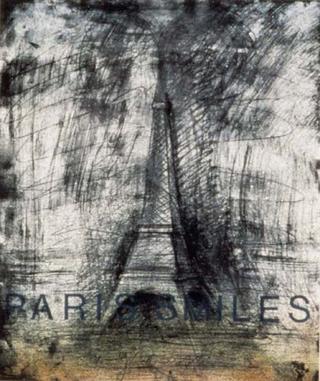
Jim Dine- Paris- Matthews Gallery Blog

Jim Dine, Paris Smiles in Darkness, 1976

Dine moved to London in 1967, a strange decision considering his controversial history with the United Kingdom. A year before his solo exhibition at London’s Fraser Gallery was raided by police and the owner was fined for showing “indecent” images.

The artist defiantly continued to his relationship with Fraser and used his time in Europe to study the work of Van Gogh, Picasso, Matisse and other modernists. In 1971 he returned to the United States, ready to chart a new course…

Neo-Expressionist

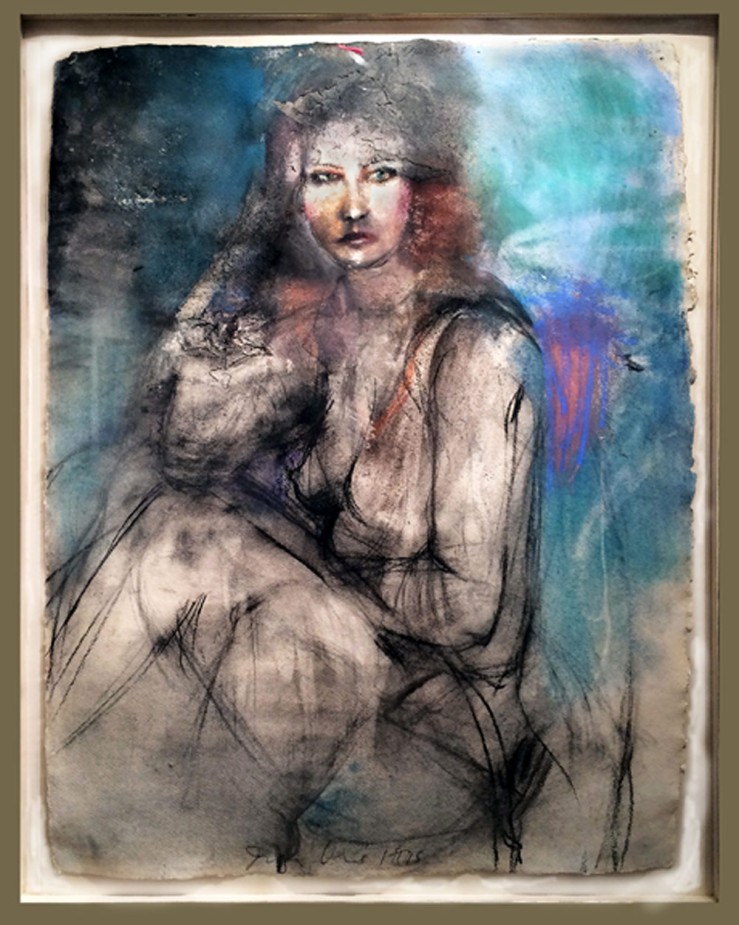
Jim Dine- A Lady Sitting Drawing- Matthews Gallery Blog

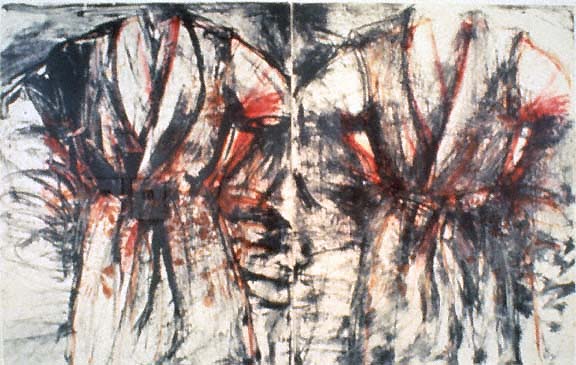
 Jim Dine, A Lady Sitting, Mixed Media, 1975

Minimalism was en vogue when Dine arrived in New York, but the artist wasn’t interested. Instead he focused on figure drawing, refining his skills in various mediums and earning a reputation as a master draftsman. The mixed media drawing in our collection is from this period. A stunningly realistic face painted in oil is framed by confident charcoal marks and a glowing crayon color field.

In the years to come Dine’s figurative work would mark him as a founder of Neo-Expressionism, but critics could never assign the artist a particular label for long…

Modern Individualist

2008_JimDine_23220011

Installation shot, Jim Dine: Poet Singing (The Flowering Sheets)

 Perhaps Dine’s artistic identity is best summed up by MoMA:

This commitment to a personally invested, image-dictated content and a continuing interest in the technical and expressive potential of every medium has characterized Dine’s work as a whole. Thus, Dine has often been out-of-step with the major movements of the post-World War II period and must be considered a modern individualist.

It’s a bit of a non-title, but Dine defies labels at every turn. The almost-octogenarian is still working his way into new chapters of art history.

Check out our website for more on Jim Dine, and connect with us on Facebook, Twitter and Flickr for to-the-minute gallery news.

BURST OF BRILLIANCE: Adolph Gottlieb’s Southwestern Epiphany

“It was like being at sea,” said Adolph Gottlieb. The artist had just spent a year in the Desert Southwest- from 1937 to 1938- and returned to his hometown of New York City with a radically altered style. “There’s… a tremendous clarity of light and at night the clouds seem very close,” he continued. This was a very different type of “sea” than the one that carried Gottlieb on his inaugural artistic journey. When he was 17 he dropped out of high school and caught a merchant ship to Europe. He spent two years there, including six months in Paris where he audited art classes and visited the Louvre every day. Back in New York, he studied at The Art Students League and befriended Barnett Newman, Mark Rothko and Milton Avery. Together they founded the abstract expressionism movement, working to develop color field painting and other innovations. They remained close until Gottlieb decided to strike out on his own to Tucson, Arizona. It was an endeavor that would markedly separate him from his contemporaries, even after his return to the East. Gottlieb’s New York friends called the style he had developed in Arizona simplistic, but the artist refused to look back. He distanced himself from his colleagues and focused on developing a Surrealist style. Experiments with automatism and surrealist biomorphism helped him create an abstract symbol system for his gridded Pictographs series. Finally, in the 1950’s, he started work on two series that would become his most well-known work. Both series are represented in our collection, and their very existence seems linked to the bare, elegant vistas of the Desert Southwest.

IMAGINARY LANDSCAPES

Around 1950-51… I was finally getting away from the pictographs and looking for something… So it was necessary to find other forms, a different changed concept. So finally after a certain period of transition I hit on dividing the canvas into two parts, which then became like an imaginary landscape… What I was really trying to do when I got away from the pictographs was to make this notion of the kind of polarity clearer and more extreme. So the most extreme thing that I could think of doing at the time was dividing the canvas in half, make two big divisions and put something in the upper division and something in the lower section.

The color and texture of the land mass in “Green Foreground” recalls Gottlieb’s sea simile. In this period the artist was consolidating surrealist and abstract expressionist theories by approaching the two movements as different sides of the same coin (hence a “polarity”). Our lithograph implies a fantastical landscape, but works just as well as a flat, wholly abstract composition. If we imagine ourselves exploring this terrain, it would look much like Gottlieb’s surroundings in the Southwest, albeit with a greener tint.

BURSTS

After doing the imaginary landscapes until say 1956, in ’57 I came out with the first Burst painting… There was a different type of space than I had ever used and it was a further clarification of what I was trying to do. The thing that was interesting that it was a return to a focal point, but it was a focal point with the kind of space that existed in traditional painting. Because this was like a solitary image or two images that were just floating in the canvas space. They had to hold the space and they also had to create all the movement – that took place within the rectangle.

Gottlieb’s Bursts are Imaginary Landscapes that have further dissolved into abstraction, though their compositions still root them somewhat in reality. In “Crimson Ground” two discs rise (or set) like a sun and moon from a monochrome tangle with the most ephemeral of horizon lines.

When I started doing the Bursts I began to do part of the painting horizontally. It was necessary to do that because I was working with a type of paint which had a particular viscosity, which flowed, and if it were on a vertical surface it would just run. If it were on a horizontal surface, I could control it… I was using a combination of brushes and knives, palette knives… and spatulas… I’ve tried everything, rollers, rags, I’ve put paint on with everything.

“Crimson Ground” isn’t a painting, but it still has a painterly quality to it. The edges of the discs are uneven and textured, and the forms below are as splattered as a Pollock drip painting. This further highlights the polarity between the surreal landscape and an abstract expressionist painting. One is focused on depth, the other focuses solely on the surface. Learn more about Adolph Gottlieb on our website, and connect with us on Facebook, Twitter and Pinterest for to-the-minute gallery updates!

HART & SOUL: Fine Furniture with New Mexican Roots

Roch-Hart-Southwestern-Furniture

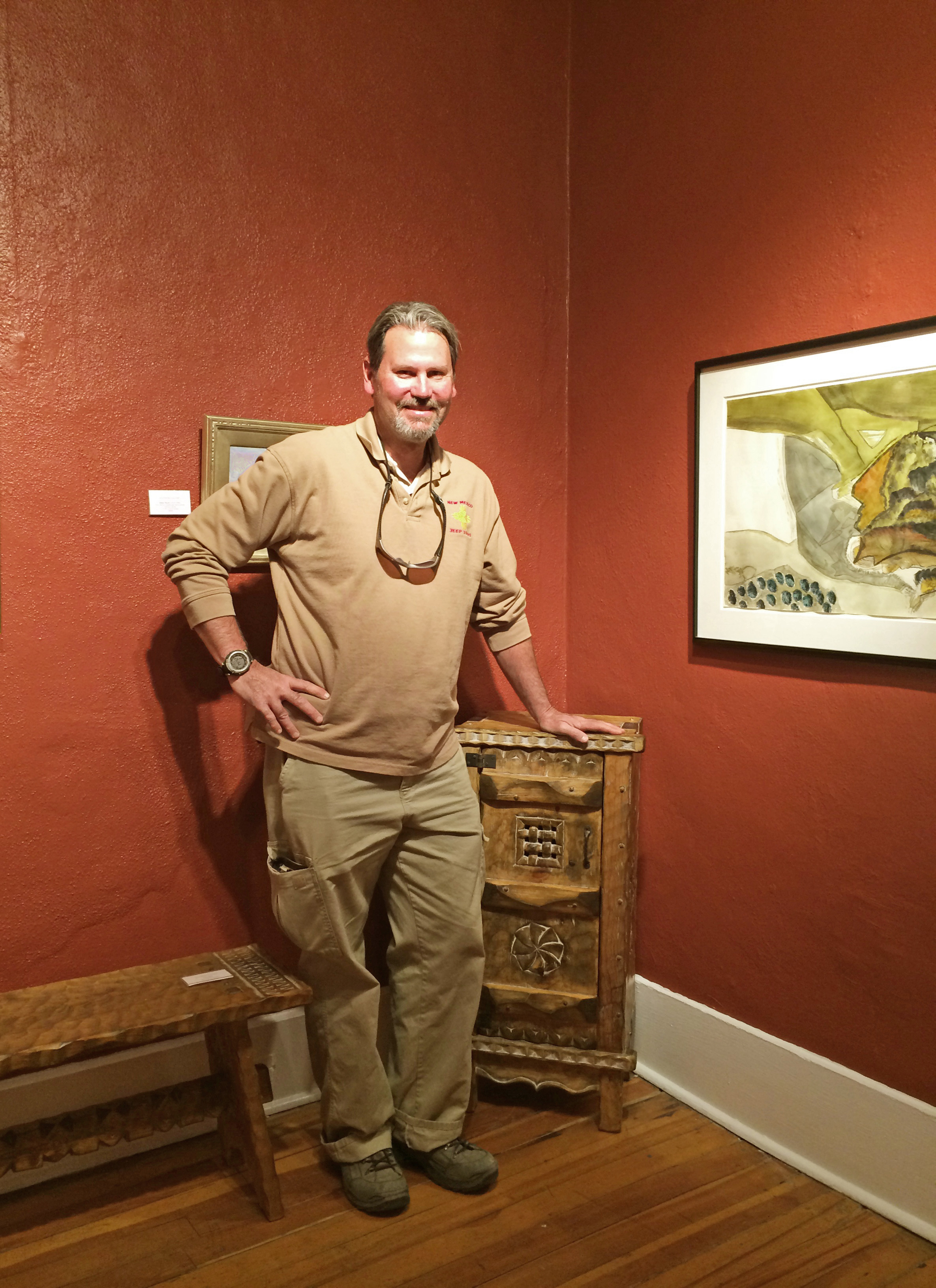
Roch in our Southwestern Art Room with his hand crafted pie safe and bench

Roch Hart‘s first steps into fine furniture making were the result of a big dilemma.

“I fell in love with Spanish colonial furniture. I had to have it, but I couldn’t afford it,” he says. He had never learned a craft before, but he was determined to do something. He started by buying all the books he could find on building furniture.

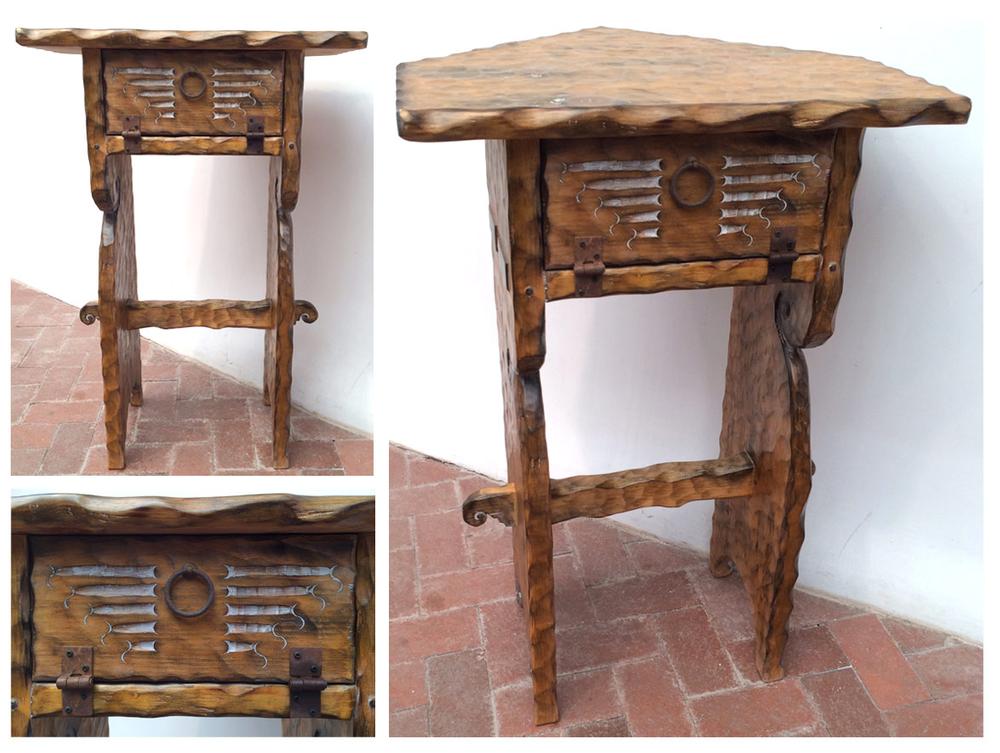
More than two decades later, Roch pulls up to Matthews Gallery in a big red jeep. He takes two impeccably hand crafted pieces of furniture from the trunk. One is a tall corner table emblazoned with a Cochiti Pueblo-inspired design, and the other is a pie safe with intricate latticework and a special type of dovetail joint in the door. Roch is the very first fine furniture maker to join our stable, and his mastery of the craft is truly spectacular. In a way, these beautiful objects are generations in the making.

Roch’s great grandmother came to Santa Fe in 1881. She was a single 16-year-old woman who braved the Old Santa Fe Trail, probably to escape an arranged marriage. Soon after her arrival she married a German man and they opened a mercantile near Canyon Road.

“She came from an aristocratic family. She had lots of money, but she chose the poor man’s way in,” Roch says. Her daughter, Roch’s grandma, grew up among the local tribespeople and learned their language and lifestyle. “My grandmother would go out and show me edible plants, and she could even butcher things,” Roch explains. “She could take a rabbit, take and a stick and ‘Bang!’ Then she would show you how to prepare it.”

She was also a great admirer of native art. She taught Roch about kachina dolls and paintings she collected. Roch’s mother took it one step further, trying her hand at retablo painting.

Roch took a different path, enrolling at New Mexico State University and then studying to be a police officer. He spent 20 years at the Albuquerque Police Department, but his love for New Mexico’s multicultural history always stuck with him.

Roch-Hart-Furniture-Corner-Table

Corner table with Cochiti design detail

When he got interested in furniture making in the early 1990’s, Roch started by studying the intricacies of the Spanish colonial style. He learned that a particularly sturdy joint, the mortise and tennen joint, was the only one Spanish colonists were legally allowed to use. He also discovered that the pervasiveness of trasteros (a Southwestern style cabinet) was due to a high colonial tax on closets.

“At the same time that I was learning all this, I realized I wanted to do something different,” Roch says. “I didn’t want to keep replicating colonial.” The budding craftsman’s big breakthrough came on a visit to the Nicolai Fechin House museum in Taos.

Fechin (1881-1955) was a Russian painter and craftsman who settled in New Mexico in 1927. He purchased a two-story adobe home and greatly expanded it over the next few years, carving intricate doors, windows and furniture pieces that were inspired by European and Native American aesthetics.

On that first visit to the museum, Hart was busy crawling on the floor and inspecting every angle of Fechin’s furniture when the artist’s daughter Eya appeared. They started talking, and she recognized his passion for the craft. “She had so much in-depth knowledge, and I didn’t even know who she was,” Hart says. She walked him through the house and pointed out different styles and techniques her father used.

“Fechin blew me away,” Hart says. “He took art and applied it to furniture. I had felt caged in by the things I was learning, but all of a sudden I realized I could do anything I want.” Just as Fechin had drawn from multiple influences in his work, Hart began to use styles and motifs from the different cultures around him.

Roch-Hart-Furniture-Pie-Safe

Pie safe with rosette detail 

Hart carries his latest works through the gallery to our freshly painted Southwestern art room, carefully placing two pieces in opposite corners. He’s eager to point out his stylistic choices. The rosettes on the sides of the pie safe are inspired by Native American metalworking techniques, his choice of joints was influenced by Fechin and the gridded design in the front is all his own. On the front of the corner table, a stepped carving bordered by elegant curves represents a Cochiti blessing.

“I incorporate my love for the Native arts, for the Spanish and for my European ancestry,” Hart says. “I try to tie a little bit of everything into every piece.” The works before us bear clear markings of the artist’s rich ancestry and influences, but they also hold a heaping dose of something else: Hart’s soul.

“I think furniture should be art,” Hart says. “It’s unique and really fits my love for Santa Fe and New Mexico.”

For more news about Roch Hart’s latest work, check out his artist page on our website and connect with Matthews Gallery on Facebook, Twitter and Pinterest.