The Boundless Moment: Words and Images

Eric Thompson- The Photographer- Matthews Gallery blog

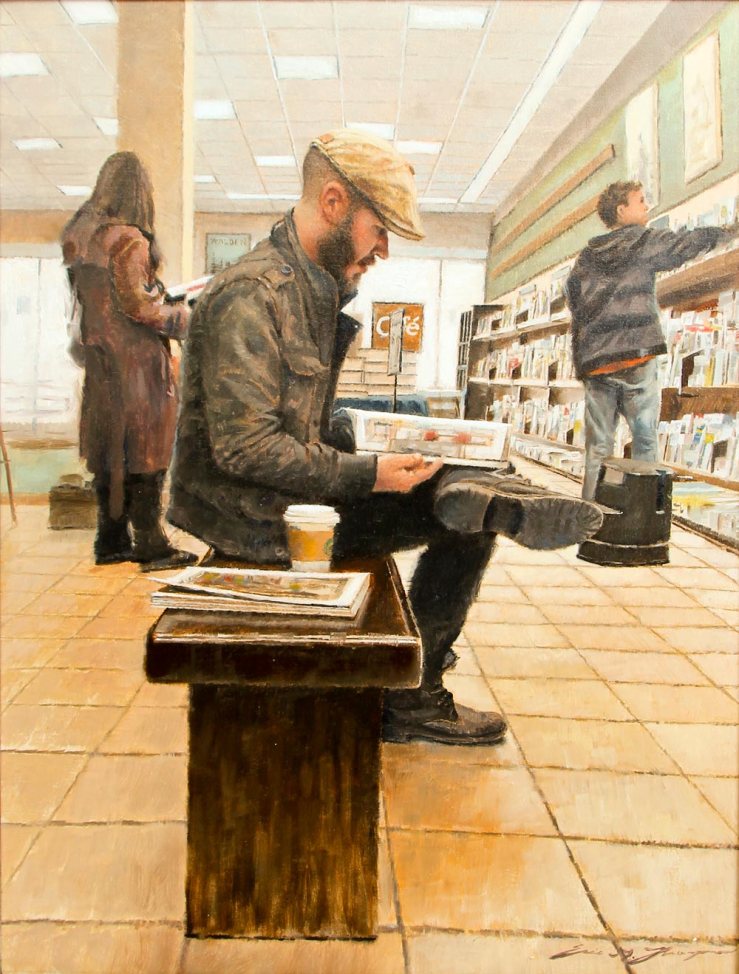
 Eric G. Thompson, The Photographer, Oil on Linen

For the past week, excited art pilgrims—determined to visit every gallery on Canyon Road—have marched purposefully into our front room and come to a screeching halt. Our Eric G. Thompson show ‘The Boundless Moment‘ is a little different from most of the exhibitions you’ll see on this famous art route. Accompanying many of Thompson’s serene realist paintings are writings by great American poets, from Elizabeth Bishop to Walt Whitman.

The interplay of words and images has compelled viewers to slow down and look twice, sparking many a fascinating observation. Most notably, journalist Alison Oatman of the Weekly Alibi attended our opening and wrote an elegant, poetry-filled review of the show.

Eric G. Thompson- Coffee Shop Girl- Matthews Gallery blog

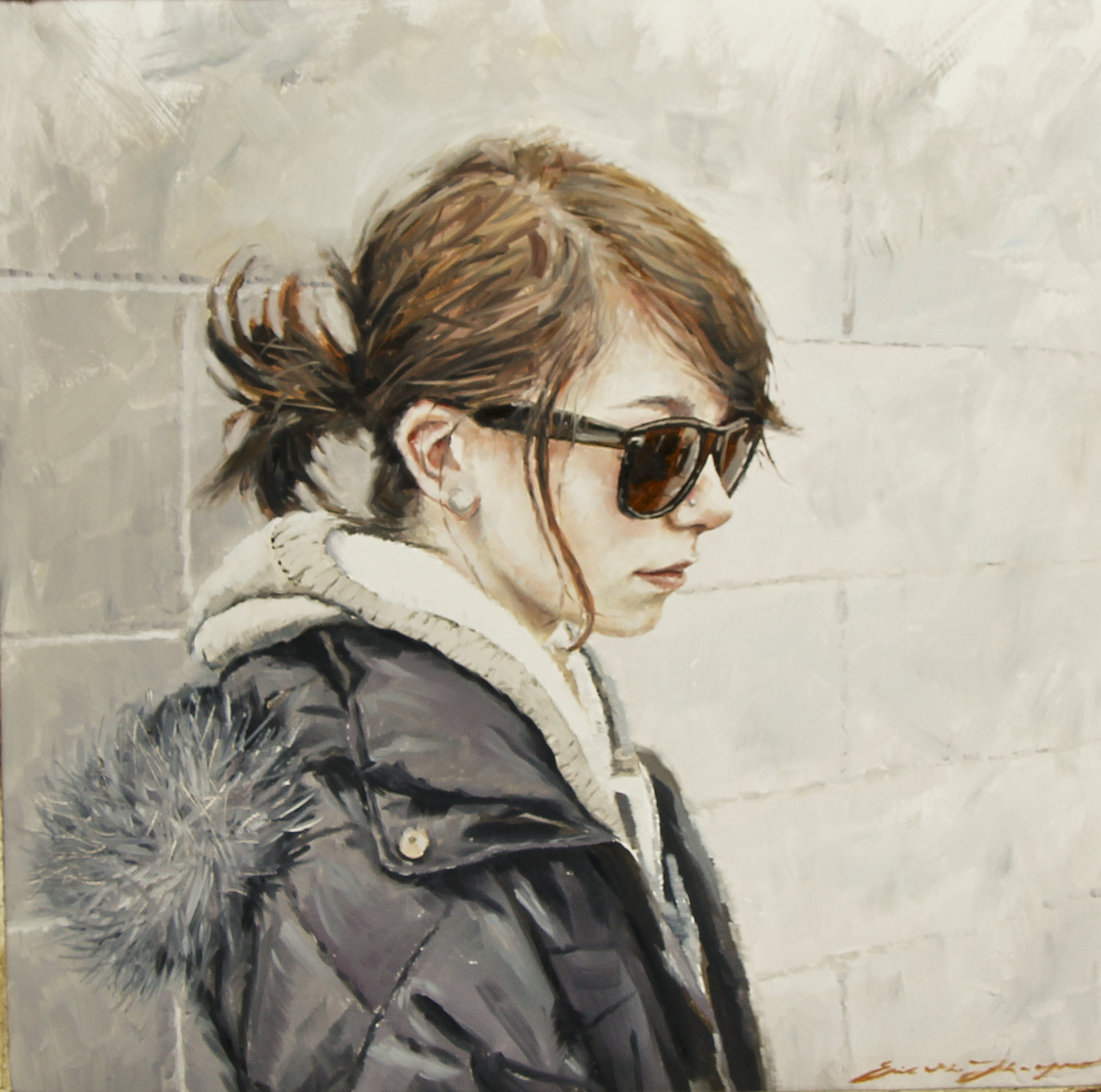
Eric G. Thompson, Coffee Shop Girl, Oil on Panel

An excerpt from Oatman’s article:

Robert Lowell’s “Epilogue” [is] paired with the painting “Coffee Shop Girl.” Lowell writes: “I hear the noise of my own voice:/ The painter’s vision is not a lens,/ it trembles to caress the light” [emphasis original]. These lines are reflected in the Coffee Shop Girl’s illuminated face—as pale as rice paper.

Later on, the poem continues: “Pray for the grace of accuracy/ Vermeer gave to the sun’s illumination/ stealing like the tide across a map/ to his girl solid with yearning.” Though large sunglasses hide her face and her meager mouth is expressionless, the Coffee Shop Girl is ravenous. We see her frayed emotional state in the feathery brushstrokes in the background, the squirming reddish-brown tendrils of her ponytail, and the sparkling clusters of dandelion-like fur attached to the hood of her puffy coat.

We spoke with Thompson on the phone today to fill him in on the big response his show has received. The artist was in Santa Fe last week for the opening reception, but now he’s back home in Salt Lake City, Utah. The long drive home gave him time to gather some thoughts on the exhibition. Read our interview below, and make sure to come see ‘The Boundless Moment‘ before it closes on August 28!

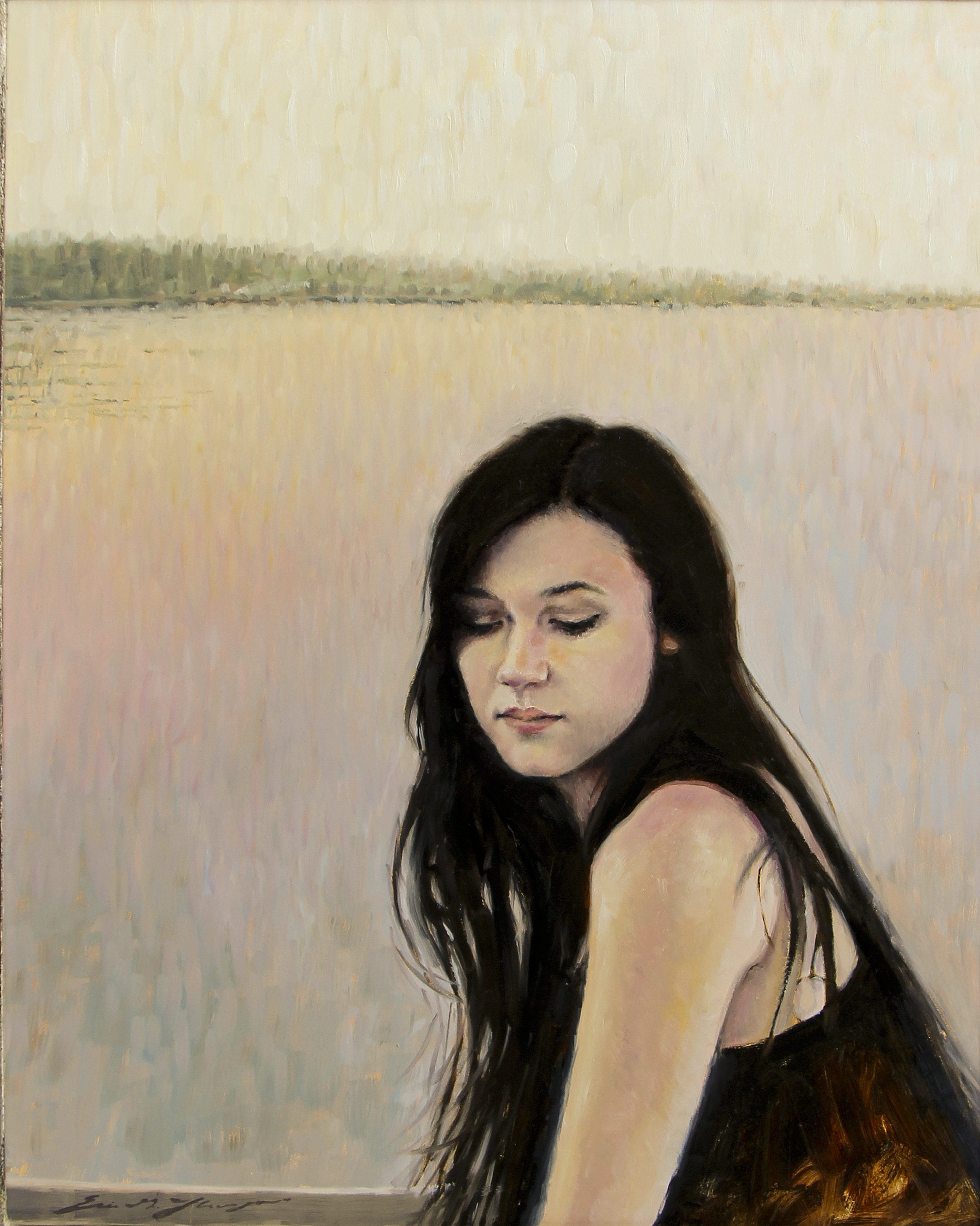
Eric G. Thompson- Half Light- Matthews Gallery blogEric G. Thompson, Half Light, Oil on Canvas

Describe your studio. 

My studio is just a few feet away from my house. It has windows with good natural light, so sometimes I can turn off the light and still get what I need. Sometimes I’ll set up my daughter‘s easel next to mine, and we’ll work next to each other. She gets to see what her dad does. Most of the time the kids aren’t allowed in the studio, though. I’ll play underground folk music, and when I’m really inspired it feels like the music is flowing straight through my brush.

You work in oil, egg tempera and watercolor. How do you choose which medium to use for a new painting? 

Between the three of them, if I want to capture something a little more loose and light I go for watercolor. If I want to capture something very solid, heavy and thick I’ll go with oil. If I want to capture something a little more photorealistic, I go with egg tempera. It gives you a lot of freedom to express the story or the emotion that you’re trying to convey with each medium.

It can be refreshing, but it can also be almost maddening. They’re all so different, it’s unbelievable. You have to switch your brain around and remember how to use that medium. It can be completely challenging, which I love. That’s one of the greatest thing about painting, is the challenge. I can always let a painting go as long as I have another challenge.
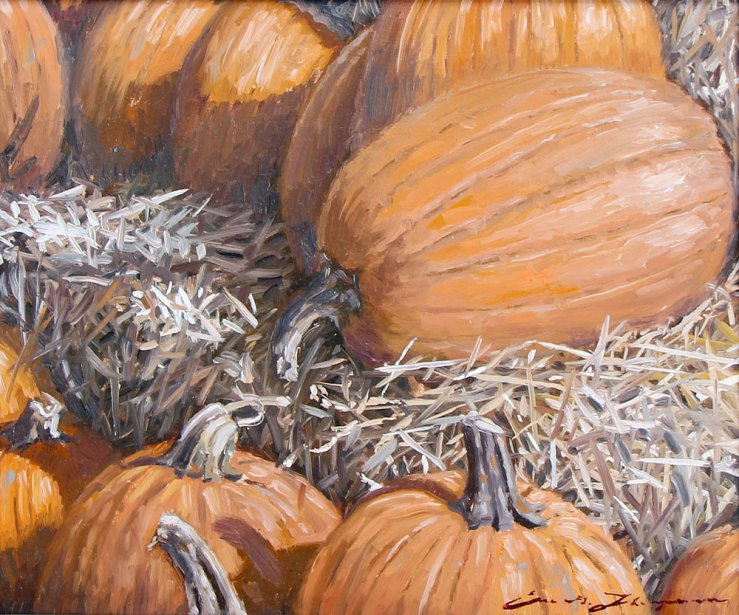
Eric G. Thompson- Nestled- Matthews Gallery

Eric G. Thompson, Nestled, Oil on Panel

Alison Oatman’s review in The Alibi begins with, “One question contemporary realist painters often get is, ‘Why not simply take a photograph?'” Over the course of the article, she critiques that particular line of thought. What’s your answer to that question? 

To a lot of artists, it’s not a great compliment when a viewer says, “That looks just like a photograph.” Maybe to a photorealist that would be flattering, but I think the greatest artists of all time have that balance of, it looks like a painting but it looks so ‘real.’ I’ve made it come to life.

Why does someone need a painting to look just like a photograph? What’s the power in that? Technically it’s amazing, but where’s the artistic freedom? I need artistic license to change things and blur edges and sharpen edges and change value to make it more ethereal.

I can make a painting look like a photograph but then there’s no energy, there’s no life to it. I think just adding a little more energy with brushstrokes or texture brings it more to life.

One of your influences is the Japanese aesthetic of wabi-sabi. How would you describe it? 

It’s what an object has been through, who used it, who touched it. It’s the patina objects acquire over time, like the rust on an oil can. It just adds to the whole character of the object—I see them as little characters. A cup on a windowsill, an oil can or even pumpkins can have little lives of their own.

Your works seem still at first glance, but a longer look gives me a sense of ‘unfolding,’ of motion. Is that one of our goals?  

It’s about capturing a moment in time that I’d like to freeze and experience for longer than the experienced moments.

I’ve definitely been experimenting with looser brushstrokes toward the outer edges of the painting to give it some energy. I need to experiment to see if I can get the perfect balance of detail and looseness. It’s a way of pushing myself as an artist, and it’s been one of the hardest things I’ve ever attempted.
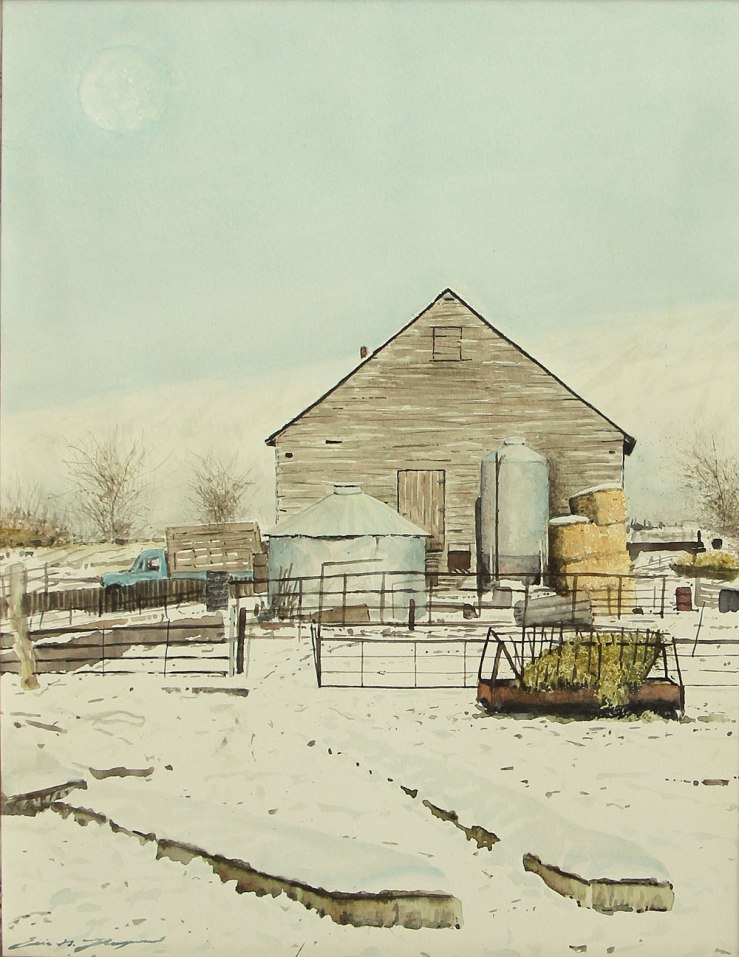
Eric G. Thompson- Winter Moon- Matthews Gallery blogEric G. Thompson, Winter Moon, Watercolor

Which paintings in ‘The Boundless Moment’ are closest to your heart? 

A few of the watercolors are very powerful to me in an emotional way. Just reminding me of something in my past, at my Grandma’s house in Idaho. She had a farm with all of these different structures. They just remind me of that time, and different feelings come up from my childhood.

Raven’s Hair is a very powerful piece. It’s capturing this emotion of a woman laying on this bed. Her eyes are closed and she’s having a very pleasant thought. It seems to have some nice emotion to it.”

Morning Cup is a portrait of your wife Hilary, and inspired her to write a poem that we’re featuring in the show. Do you often inspire each other like that? 

 We’ve named my paintings every year for 12 years or more. We try to outdo each other with the most poetic titles. The title can say so much in just a couple words. What’s the best title, or the strongest? Hilary is amazing with words.

To learn more about Thompson’s show, connect with us on Twitter, Facebook and Pinterest.
The Boundless Moment: All Together Now

Eric-Thompson-Artist-Family

Eric G. Thompson’s ‘The Boundless Moment
opens Friday, August 15 from 5-7 pm
and closes August 28.

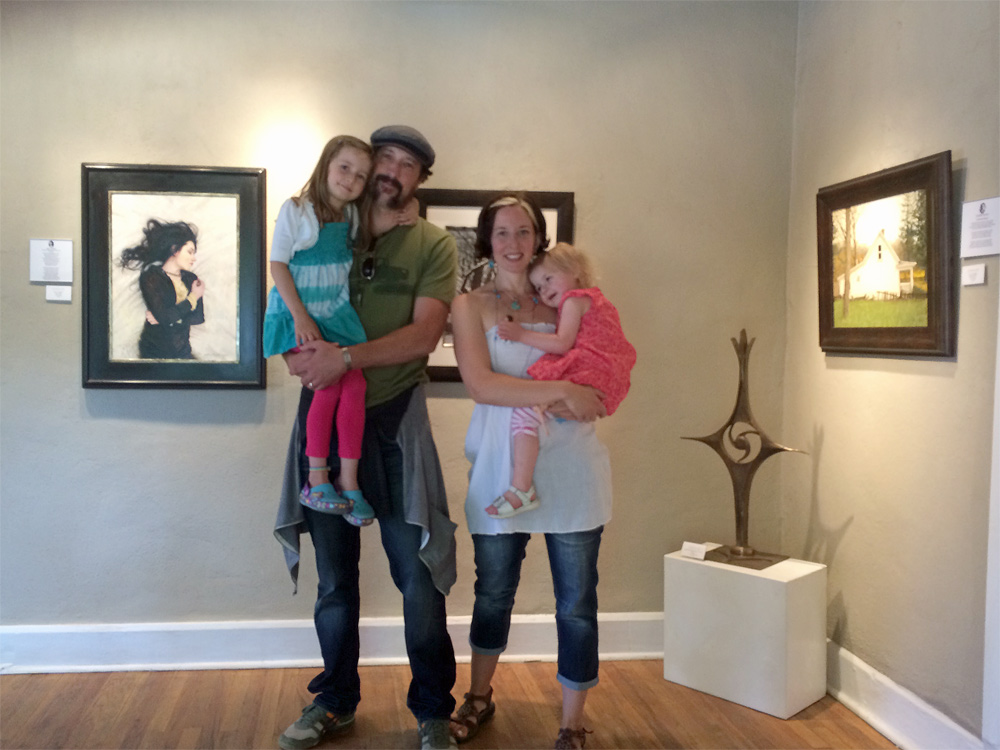
Eric and Hilary Thompson’s daughters dash around Matthews Gallery, exploring their father’s new solo exhibition ‘The Boundless Moment.’ They’ve just finished a long car ride from Salt Lake City but they’re bursting with energy.

Over the past year the children have grown alongside these canvases and panels, watching as thousands of brushstrokes transformed into rolling landscapes and rosy skin. Now these familiar images have magically appeared in our lofty, brightly lit space, sparking the girls’ curiosity. They stop before each work, craning their necks to get a good look.

The girls’ vivacity matches Hilary’s temperament. She keeps an eye on them as she chats and laughs with us. Eric is a quieter presence. He strolls around the gallery, analyzing the arrangement of the work and reading the legendary poems we paired with them. Eric likes to think of his paintings as ‘visual haikus,’ which inspired us to select writings by Frost, Dickinson, Lowell and others to display during the show.

‘The Boundless Moment’ is something of a family act. Hilary was Eric’s model for the painting ‘Morning Cup,’ and wrote an accompanying poem that will debut at the opening reception. ‘The Chiseled Mother’ is a passionate meditation on parenthood and aging. As Eric cradles one of his daughters in his arms, you can tell that he’s just as inspired by the radiant spirit of his children. 

Read Hilary’s poem below, and make sure to attend Eric’s artist reception on Friday, August 15 from 5-7 pm.

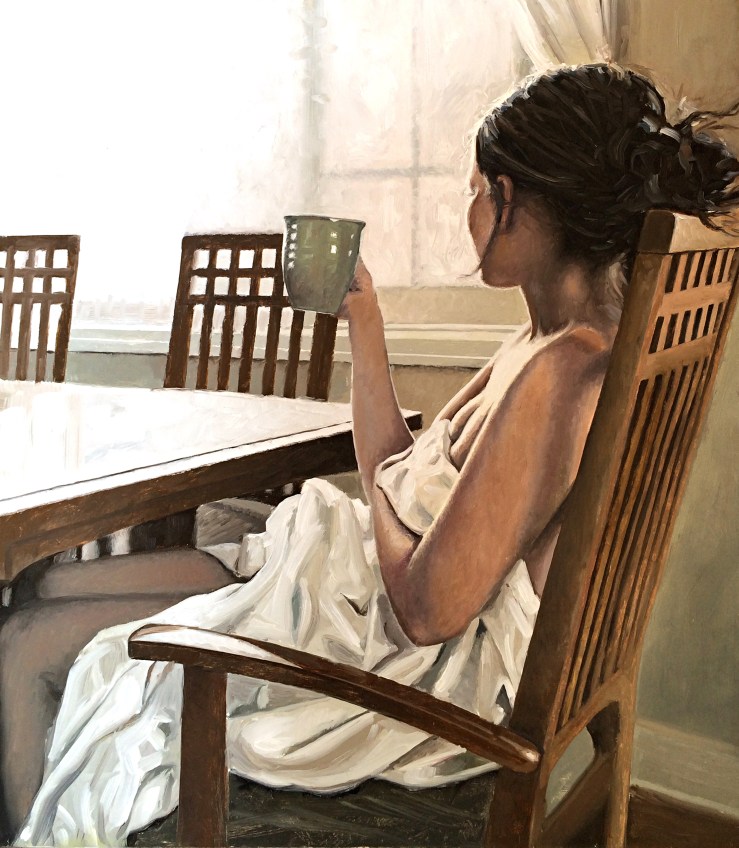
Eric G. Thompson- Morning Cup- Matthews Gallery blog Eric G. Thompson, Morning Cup, Oil on Panel

From Hilary Thompson:

The Chiseled Mother

I honor this body
This matryoshka

The delicate lines of my eyes
Like tissue paper
Crinkled from sun beams
Washboards slow the momentum
of tears

These ears, these conches
That entombed the beeping screaming alarms
Echoing endlessly on exhausted drives home
Mercifully quieting with age

Eric G. Thompson- Waiting for a Song- Matthews Gallery blog


Eric G. Thompson, Waiting for a Song, Oil on Panel

This mouth
Which broadcasts comforts, screeches, praise
Fractures the tightrope of vexation

These beautiful, perfect arms
That embraced defeat
Carried a child to the surgeon’s knife
Willing arms
That waved, furrowed, aching
Sturdy farewells

This heart that beats out
The anthem of the womb
I Am
I Am
I Am

Eric-Thompson-Art-CoffeeshopGirl

Eric G. Thompson, Coffee Shop Girl, Oil on Panel

A womb
That is the definition of Creation
Bringing forth what does not exist
Into existence
Torn out of me
With upheaval and sanguine waves of nurture

These knees that caught me
When my frame buckled
Unable to support my grief

These marks, stretched
Yawning tiger stripes
Where my body gave room
Shimmer as silver reminders of a past shape

EricGThompson-Art-Evening

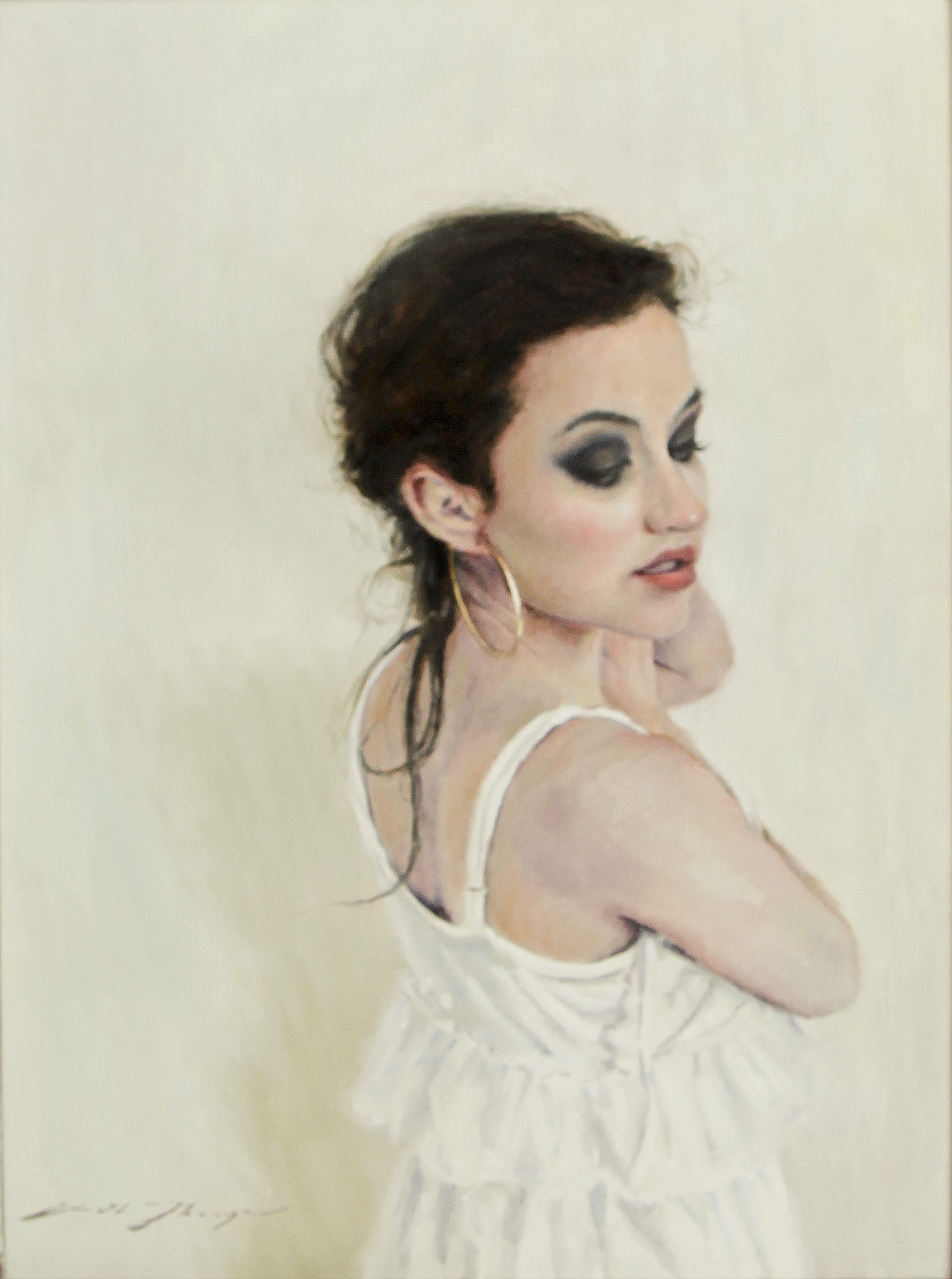
Eric G. Thompson, Evening, Oil on Panel

These feet
Planted.  Supporting.
Rooted even in motion, substantial
Pacing halls, hospital rooms
Threshing carpets bare-threaded

I am the red rock slot canyon
Worn smooth, fissured, curved
Sculpted
By this flawed life

This body is a shrine
A Holy place, a pilgrimage
A masterpiece painted stroke by stroke
By the breathtakingly exquisite nourishment
Of not getting what I want.

Breathe that in,
Chiseled edifice of the Mother,
Slather it like salve into your stripes,
You silver tiger.

 Connect with us on Facebook, Twitter and Instagram to learn more about Eric G. Thompson.

Hannah Holliday Stewart: Open-Ended Questions

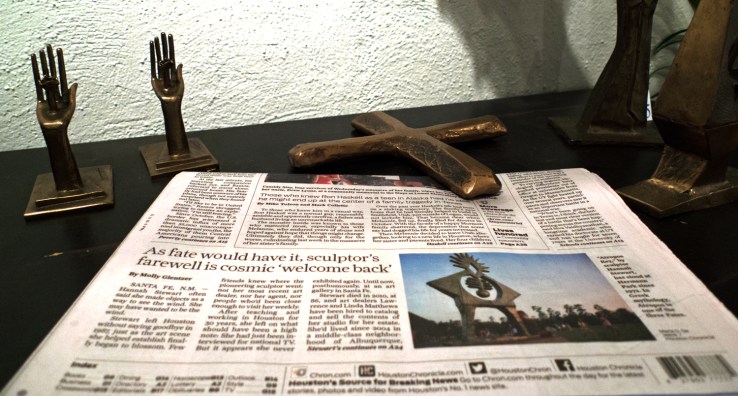
Houston Chronicle's article on Hannah Holliday Stewart among her sculptures- Matthews Gallery

Our exhibition Hannah Holliday Stewart: An Artistic Legacy Rediscovered
runs through July 24, 2014

Two weeks ago, Houston Chronicle arts editor Molly Glentzer appeared at our door with a camera around her neck and notebook in hand. We figured that if anyone could find answers to our burning questions about Hannah Holliday Stewart’s life, it would be a reporter from the city where she rose to prominence. Last Sunday her findings appeared on the front page of the Chronicle. Early on in the article, Glentzer outlines the challenges she faced in her investigation:

Stewart left Houston without saying goodbye in 1987, just as the art scene she helped establish finally began to blossom. Few friends knew where the pioneering sculptor went: not her most recent art dealer, nor her agent, nor people who’d been close enough to visit her weekly.

The beautifully detailed report lays out the highlights of Stewart’s art career. As Glentzer discusses Stewart’s accomplishments—from monumental public art commissions to solo exhibitions at prestigious institutions across the nation—she’s careful to outline the sculptor’s struggle for recognition:

Her success came at a time when women sculptors were rare birds in a man’s world. […] it was a coup when Houston accepted “Atropos Key” …. in 1972. Stewart’s sculpture was unlike anything else in the landscape.

When it comes to Stewart’s departure from Houston and the art world, Glentzer arrives at the same conclusions we did. Stewart first returned to Birmingham to care for her ailing brother, and chose the Southwest as a part-time home because she was drawn to the “light and open landscape”. However, her move to Albuquerque in the final years of her life hinted at grander plans.

“How many people do you know who at age 80 would move 1,000 miles away, where they had no relatives, and build a house and studio with 20-foot ceilings?” [Stewart’s nephew Rusty Stewart] said. “She wasn’t out there to retire.”

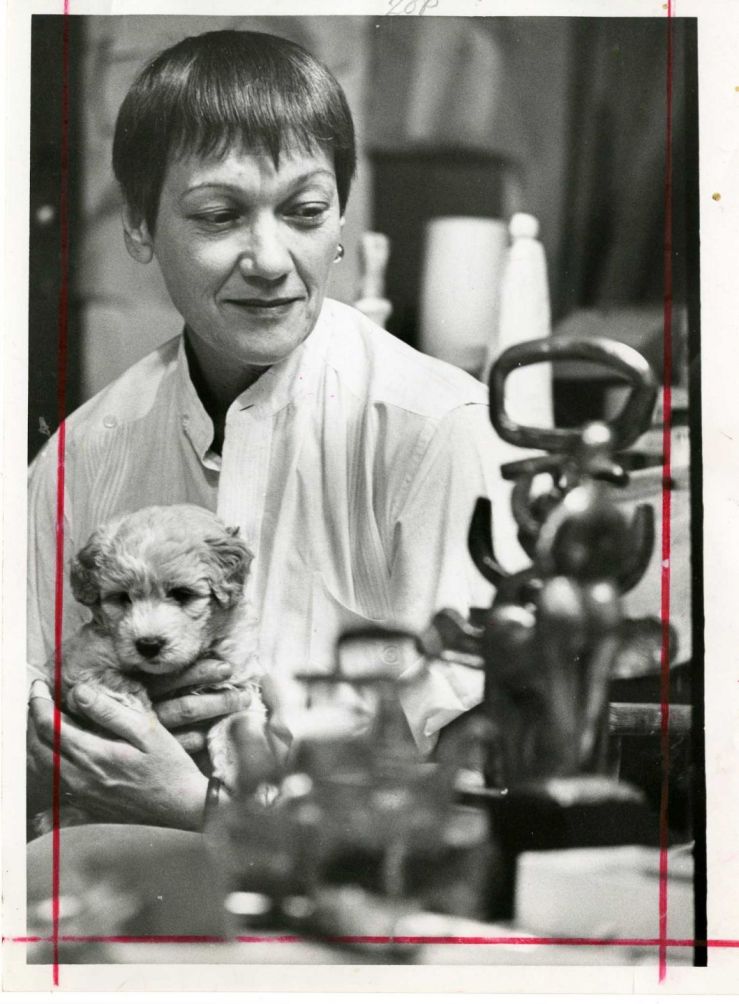
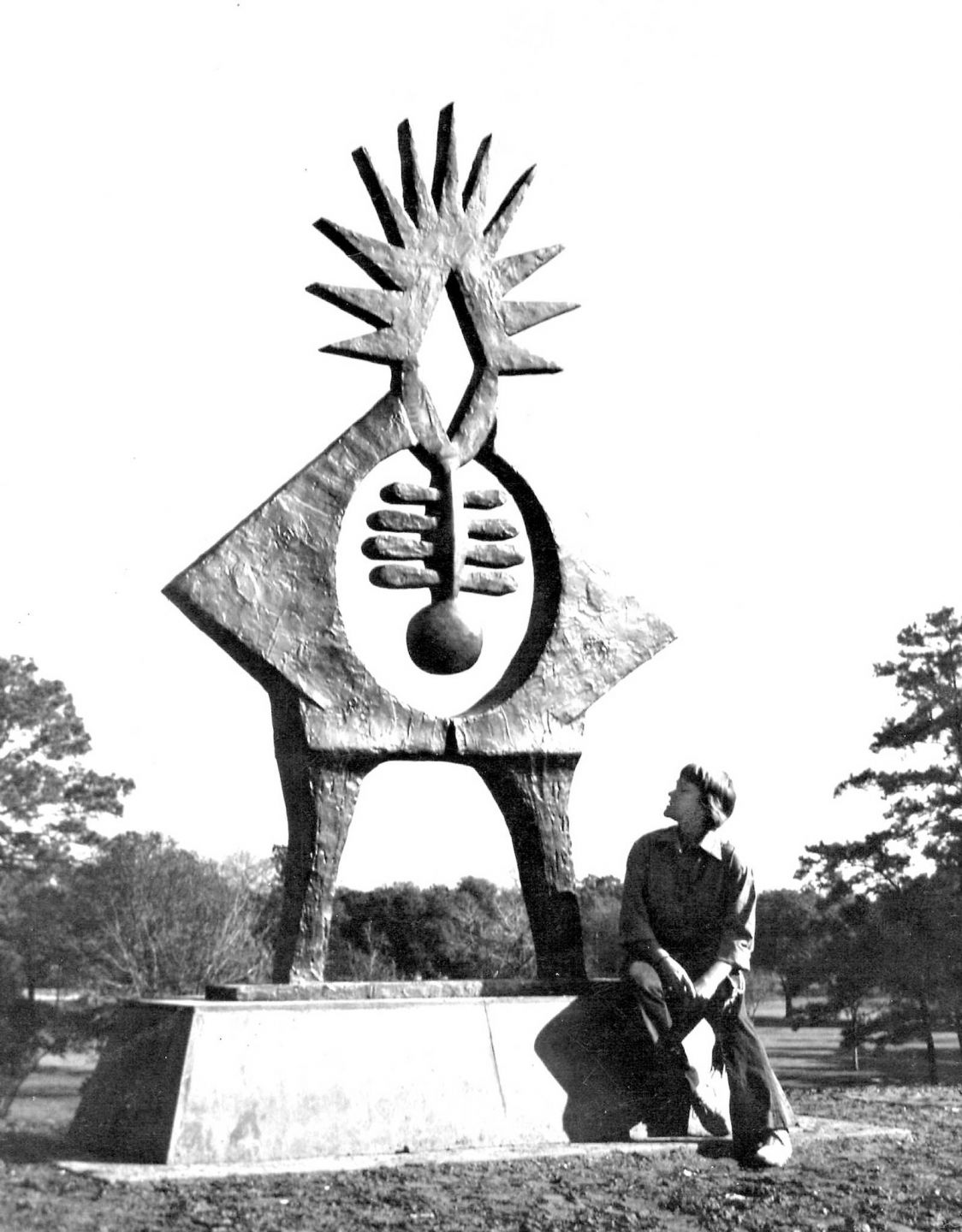
Sculptor Hannah Stewart with her cocker-poodle, Major, in 1967- Houston Chronicle

Stewart with her cocker-poodle, Major, in 1967; Photo from Houston Chronicle

And so the answer to one question opens up another mystery. What did Stewart plan to do next? Her friend Dayton Smith told us she may have intended to complete some larger projects and return to Houston. In her sketchbooks from the 2000s Stewart often mentioned a series of sculptures called ‘Harmonic Resonance’ that may have been her forthcoming magnum opus.

Other friends of Stewart who have called or visited us since the appearance of the Chronicle article had few answers. An acquaintance who took yoga classes with Stewart for years said he’d lost contact with her in the 1980s before she left Houston. Another friend who stopped by told us vivid stories from Stewart’s life in Houston, but had just as many questions about her Southwestern exploits.

Last week we switched gears and teased out some of the mysteries of Stewart’s artwork. As Smith told Glentzer, Stewart “always preferred her work be talked about rather than her life.” Perhaps she didn’t want us to know what happened in Houston, or what her future plans were. In a note from Stewart’s sketchbook dated 2007, the 83-year-old artist wrote,”Tired—work to finish FINALLY!! Move on to others in series…”


1440x1440-5

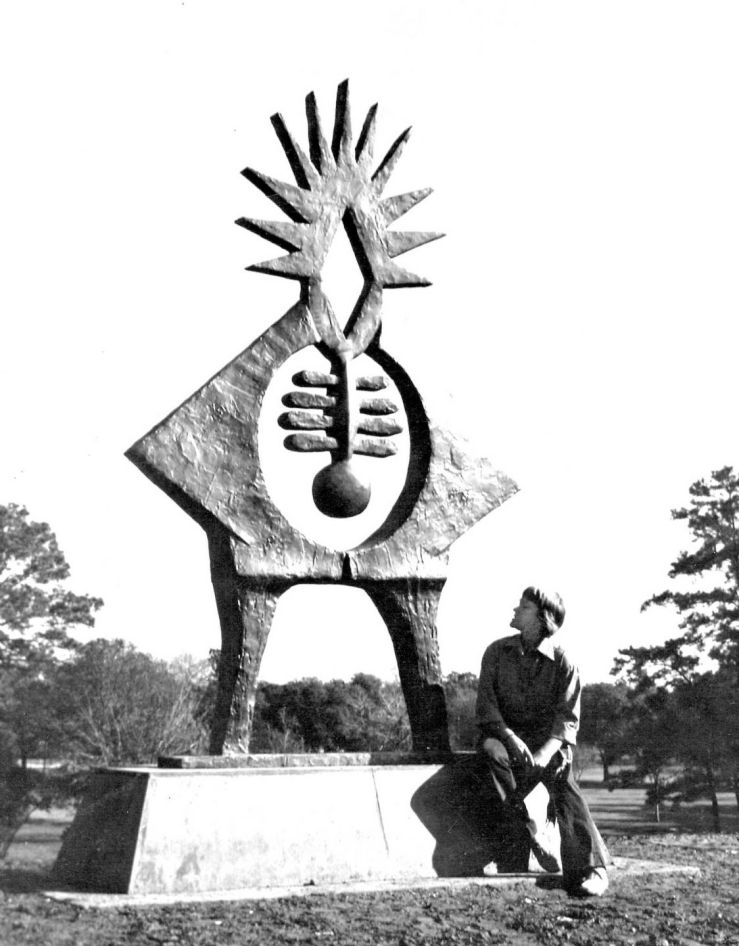
Stewart with “Atropos Key” in Hermann Park; Houston Chronicle

Then, late last week, we received a call from Dr. Liam Purdon in Nebraska. We recognized his name from an elegant essay in Stewart’s files. In the 1980s, Purdon was working on a PhD in medieval literature from Rice University. He had seen Stewart’s “Atropos Key” sculpture in Hermann Park and was inspired to contact her.

“I literally stumbled upon it as I walked up the hill in the park,” he said. “You come over a rise and suddenly there it is in front of you. You’re startled by it, and the first question you ask yourself is, ‘What is it, and why is it here?’ When you read the name of it, then you suddenly realize it’s tied to Greek mythology.”

Purdon said the shock and curiosity he experienced was Stewart’s overarching goal. “She wanted to startle the observer into recollecting the whole mythology of a time when humans lived in harmony,” he explained. Stewart agreed to let Purdon observe her in the studio for three weeks, but kept a careful distance from the scholar. Later on they became good friends, and Stewart told Purdon her plans for the future.

“She felt that being in the Southwest… would be more supportive of her vision,” he says. “She loved the natural beauty of the Southwest. In some of her pieces, you do see it. In others you may not recognize it, but if you look at them for a while and meditate on them, it starts to become apparent.”
The two stayed in contact after Purdon took a teaching job at Doane College in Nebraska, and Stewart expressed interest in applying for public art commissions from the Nebraska Arts Council. When nothing materialized, Stewart was discouraged.

1440x1440-4

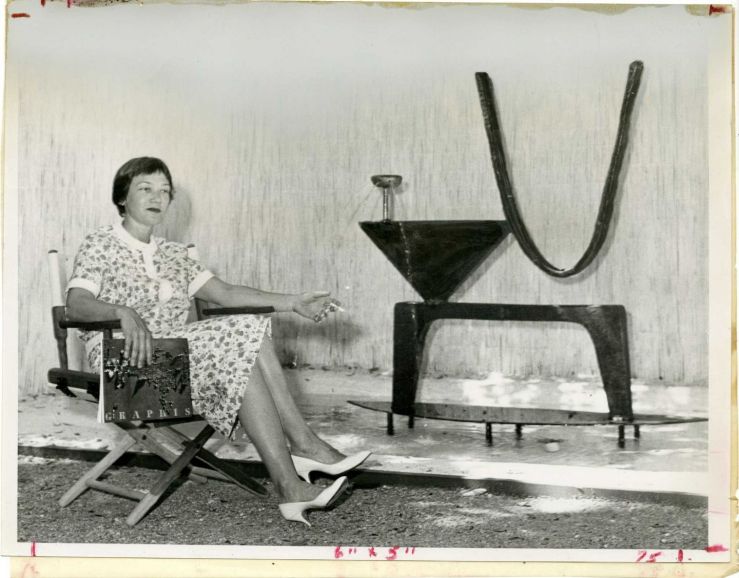
Stewart in 1960 with a sculpture she recently completed; Houston Chronicle

“I think that probably underscored the fact that she felt… uncomfortable revealing the work until the time was right, until we re-cycled into an age when we wanted to hear the narrative again,” Purdon said. “She would have to wait for a period of time to introduce her work to people who were ready to understand.”

That’s the closest we’ve gotten to answering the ever-shifting riddle of Stewart’s twilight years, but perhaps it’s enough to know that people are ready to hear the artist’s stories again. We’ve had a huge response from collectors in Houston who read the article, and art lovers from across the country have discovered her work as a result of the press coverage our show has received.

“In general, i think that people are wanting narrative more,” said Purdon. “It is so remarkably different, her work… That’s why it needs a narrative. There has to be a starting point.”

Come see Hannah Holliday Stewart: An Artistic Legacy Rediscovered through Thursday, July 24, and learn more about the artist on our website. Make sure to connect with us on Facebook, Twitter and Pinterest for more gallery news!

FOUR CENTURIES: Monnoyer’s Mark

Still life attributed to Jean-Baptiste Monnoyer- Matthews Gallery blog

We discovered this still life at the preview of a Santa Fe estate sale. It was tucked in a dark upstairs corner of the house, far from the Picasso print and treasure trove of art books on prominent display in the living room. Lawrence lingered for a while to take in the flamboyant bouquet with its rich rosy tones. There was an excited glint in his eye.

A few months later, the painting has found a home under the glowing lights of our European art room. We know a lot more about it now than when it first caught Lawrence’s fancy. It’s attributed to Jean-Baptiste Monnoyer (1636-1699), a 17th century Franco-Flemish painter who wielded his brush for Louis XIV. Its siblings hang in some of France and England’s most famous estates.

Our adobe art abode is a very different venue, but this 300-year-old artwork gives us the opportunity to transport gallery visitors across the sea and through the ages. Look below to chase Monnoyer through the palaces where he left his mark, and don’t miss the painting’s debut at our opening for FOUR CENTURIES: European Art from 1600 to 1950 on Friday, June 13 from 5-7 pm.

Hôtel Lambert- Site of artwork by Jean-Baptiste Monnoyer- Matthews Gallery Blog

Our first stop is the Hotel Lambert on the Ile Saint-Louis, site of Monnoyer’s first Parisian commission in 1650. The artist grew up in Lille, France and trained in Antwerp, but it was the lavish estates in and around Paris that claimed his considerable interior decorating talents. Monnoyer’s floral designs in the grand mansion would delight its many owners and guests for centuries to come, from a famous Polish political salon to Voltaire, Chopin, Balzac, Delacroix and Dali. Unfortunately, the Hotel Lambert was badly damaged in a 2013 fire and is under renovation.

Chateau de Marly- Site of artwork by Jean-Baptiste Monnoyer-  Matthews Gallery Blog


Artist Charles Le Brun, who painted a series of renowned ceiling frescoes at the Hotel Lambert, brought Monnoyer along for a commission at Louis XIV’s Chateau de Marly. The (relatively) small country estate was the king’s escape from the more rigid world of Versailles, and aristocrats fiercely battled for a chance to stay there. Alas, the twelve pavilions that flanked the water and their intricately adorned interiors are long gone, but the commission launched Monnoyer into a new stratosphere.

Palace of Versailles- Site of artwork by Jean-Baptiste Monnoyer- Matthews Gallery Blog

Monnoyer worked with Le Brun once again on the ornamentation of the Palace of Versailles. For this and other high profile royal projects, he developed a style that was far removed from his training in the subdued still life painting techniques of the Low Countries. The bold, ornamental approach is in full force in our still life, recalling the spectacular garlands of flowers he painted on the ceiling of the Queen’s pavilion at the Chateau de Vincennes. Monnoyer also made reference sketches and etchings for French tapestry workshops, greatly influencing European decorative styles for years to come.

Boughton House- Site of artwork by Jean-Baptiste Monnoyer- Matthews Gallery Blog

A commission from the Montagu House in London drew Monnoyer away from Paris in 1690. He adorned dozens of panels with fruits and vegetables and painted several portraits, some of which now reside in the state rooms of Northamptonshire’s Boughton House. The artist remained in England until his death in 1699, but his distinctly French style lived on in the artwork of two of his sons.

Make sure to attend the opening of our FOUR CENTURIES exhibition on Friday, June 13 from 5-7 pm, and follow us on Facebook, Twitter and Tumblr for daily gallery news.

SCULPTOR’S PROCESS: Frank makes a fountain

Frank Morbillo- Sculptor- Matthews Gallery

It all started with a sculpture you may recognize if you’ve been to Matthews Gallery in the past few years. Frank Morbillo‘s ‘Complement’ was a fountain that stood outside our building for a time, enchanting Canyon Road tourists with its elegant lines and soothing sounds:

Frank Morbillo- Complement- Matthews Gallery

“It was inspired by the figure, a relationship between people or entities,” says Frank. “The two sides have a connection in terms of how the line of one complements the line of the other.”

Two gallery visitors who were particularly charmed by the sculpture kept it in mind as they built their new home. Nearing the end of construction, they got in touch with Frank and asked him to create a similar piece for their front entryway. Just like the two pillars of the sculpture, Frank says the commission was all about maintaining a carefully balanced dynamic.

“During the course of the commission, I am constantly sending images that are going back and forth between myself and my client,” the artist explains. “Six times throughout this process or more, we were exchanging information and tweaking and getting approval.”

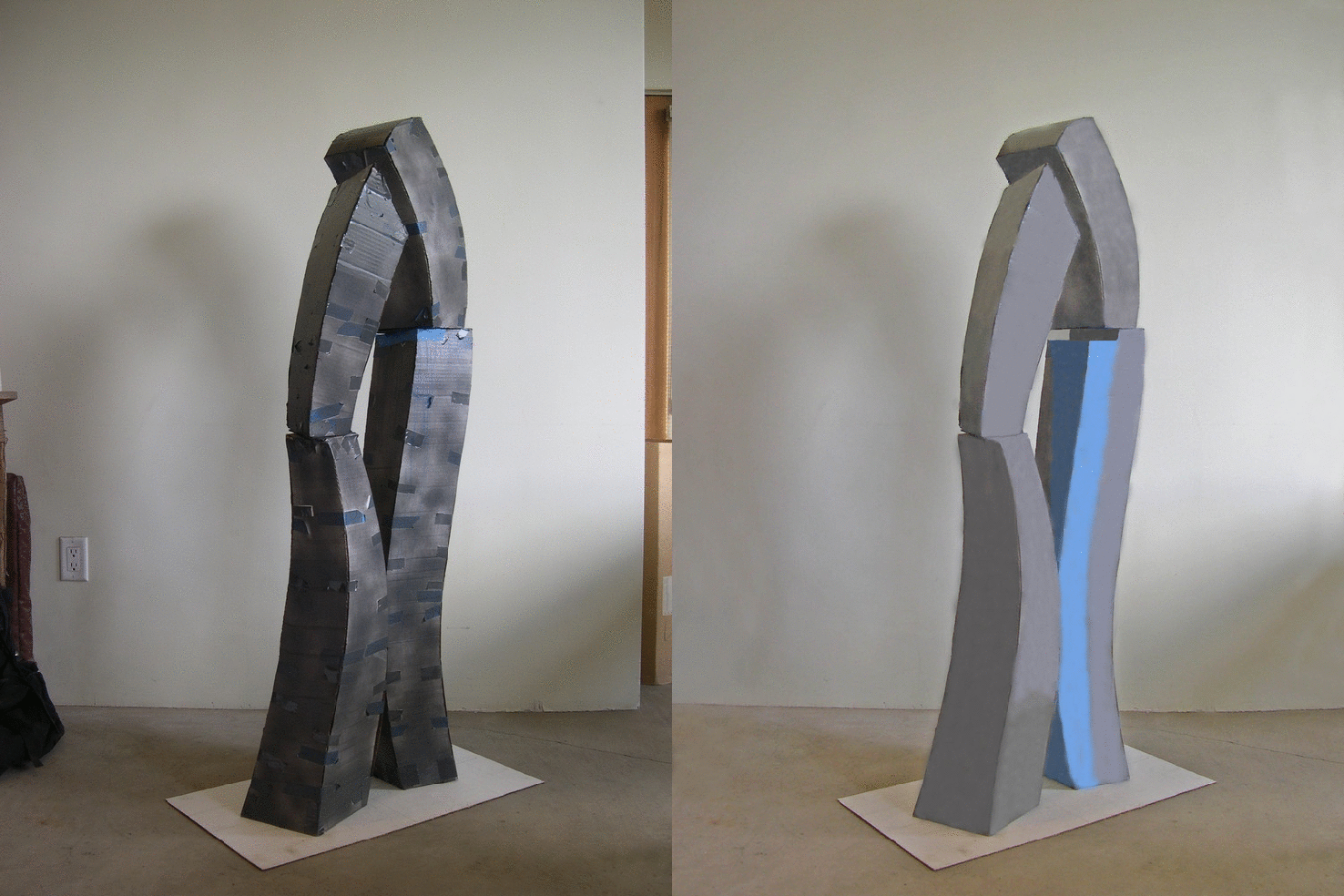
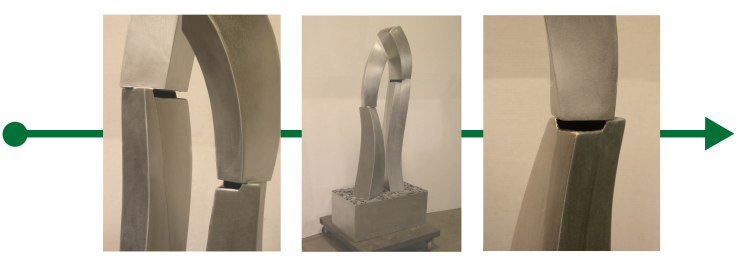
Below you’ll see images from their correspondence, starting with a cardboard model and ending with the stainless steel fountain in its beautiful new space. Follow Frank on his artistic journey…

Frank Morbillo- Artist Process- Matthews Gallery Blog


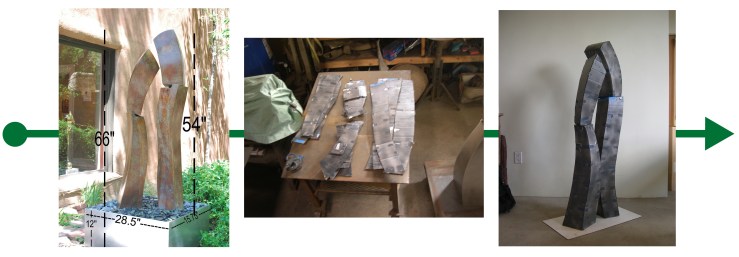
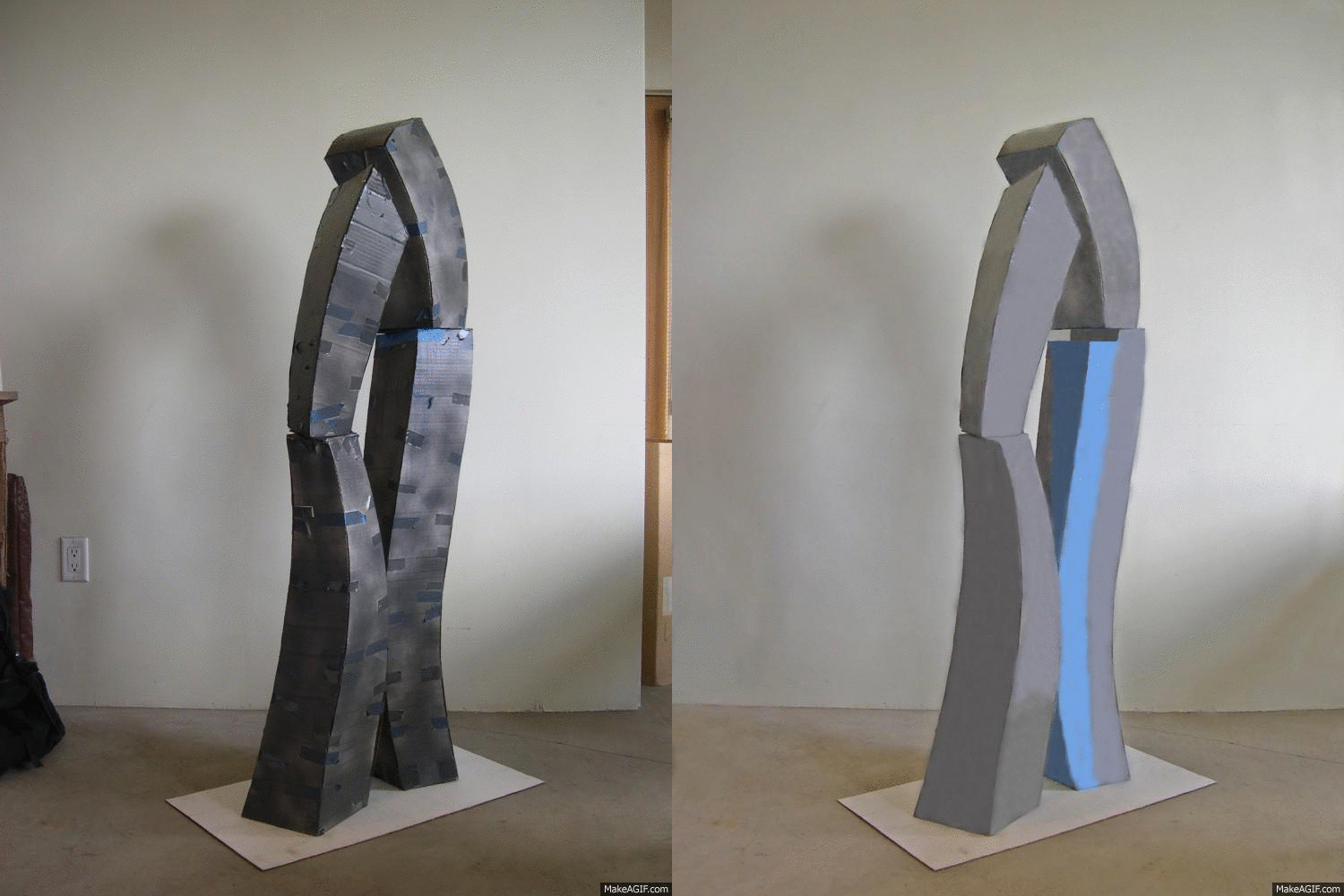
First, Frank marked up an image of the original sculpture (left). ‘Complement’ was larger than his clients wanted, so he adjusted the scale and used the new measurements to resize some cardboard cutouts from the original project (center). The new, smaller cardboard pieces came together to create a full-scale model of the new piece (right).

“When I’m building it in the studio, it’s important to have the model at the level that it’s going to be viewed. In the clients’ home, it’s going to be up a few steps from the ground level. I elevated it to make sure the proportions were working. I want there to be a good interaction of elements.”

“Different materials make the water flow differently. A rough material creates some surface tension, while a slick material will let the water run very fast.”

 Frank Morbillo- Sculpture Process- Matthews Gallery blog
Next, Frank manipulated images of the cardboard model in Photoshop to show the flow of the fountain. The blue line you see on the edited photograph is where the water will fall on one side. The white piece of cardboard under the sculpture represents its base, which presented a unique problem.

“From the very beginning, I had to be very careful about water flow because I had a limited landing pad for the water to fall. The basin was much smaller and narrower than in the original sculpture.”

Frank Morbillo- Artist Process- Matthews Gallery Blog

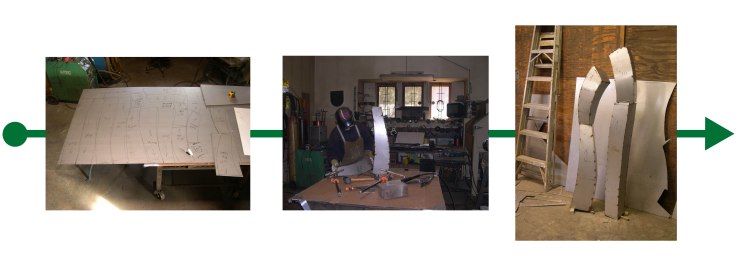
After tweaking the cardboard model, Frank took it apart and traced the pieces on stainless steel (left). He used tack welding to create a rough version of the piece (center and right). Tack welds allowed Frank to alter the form based on his client’s feedback.

 “The dark buttons going up the edge are the tack welds. The tack weld is very strong; a series of four down the side can hold it mostly in place. Once you’re at this step, you want to make sure that everything is right. Afterwards, there are several days worth of work to make the elements seamless.”

Frank Morbillo- Artist Process- Matthews Gallery Blog


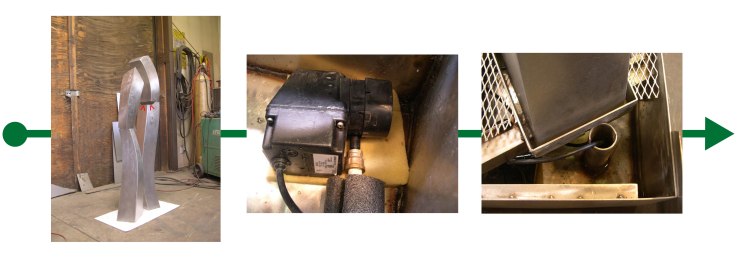
It took about a week to create the shiny sculpture you see on the left. The two red arrows mark openings for the water. Next Frank worked on the base of the sculpture, installing a pump and carefully feeding the electrical cord through a riser tube that holds it above the water (center and right).

“All of those edges have been welded and sanded. This is my first rough pass on putting the finish on the metal.”

“One of the things you look for is the pump’s capacity to go vertical. I size it at a slightly greater capacity than my need is going to be so that I’m sure the water will reach the top.”

“The water enhances and adds to the whole scheme of the project. By placing the pump on the foam pads, it reduces noise vibration from the pump, allowing the viewer to focus on the sound of the fountain.”

Frank Morbillo- Sculpture Process- Matthews Gallery Blog


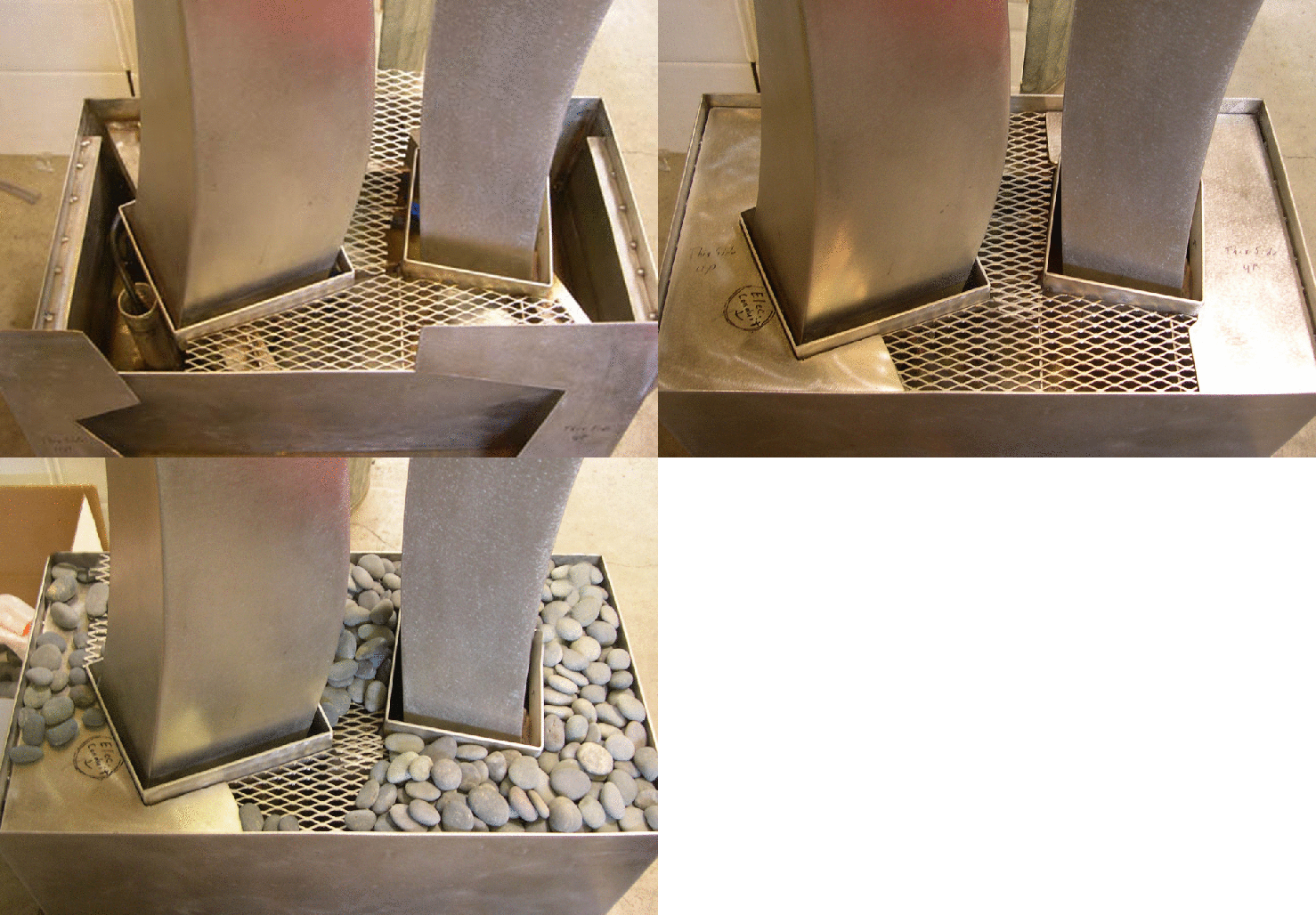
Frank cut mesh and steel plates to cover the base and prevent splashing. The slots you see around the sides of the sculpture are one of Frank’s latest innovations.

“Because of the size of the basin, I have less latitude with what the water does and how it falls. I knew I had to create a slot around the base of both sculptures so as the water falls it goes into this slot. It worked really well, and I learned something from it. It’s changed how I deal with water capture in a small basin.”

“In every sculpture project, there’s always the opportunity to say, ‘What can I do different in the future?’”

Frank Morbillo- Artist Process- Matthews Gallery Blog

Careful tests of the water flow followed. Frank got the final approval from the client and shipped it.

“There’s a lot of structure in there that you’re not seeing that supports all of the different elements. When all of this is said and done, you don’t see any of that but it’s all happening because of it.”

“I took a good long look at it and liked what I was seeing in terms of how I thought it would look on site.”

And PRESTO!

Frank-Morbillo-SculptureProcessFinal

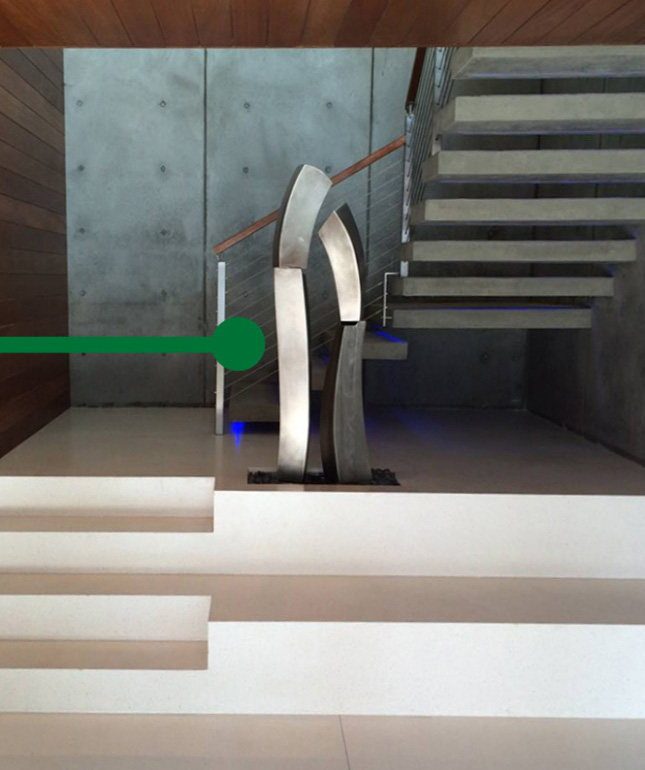
Frank’s clients sent back images of the piece in its new home, and the sculptor couldn’t be happier.

 “The experience of walking up the steps and around the sculpture must be pretty awesome.”

“It’s interesting, the sculpture is the only thing with curves in the space. Everything else is really hard and geometric. That’s cool that it’s really different than anything else line-wise in the space.”

“When you can have fun going through the process of doing it, for me that’s where my thoughts go when I’m working. There’s a lot of opportunities to have fun.”

“When I saw the contemporary design of the house, I said, ‘Great project.’ I’m really happy that this sculpture became part of it.”

See more of Frank Morbillo’s artwork on the Matthews Gallery website, and connect with us on Twitter, Facebook and Instagram for daily gallery news.


THE STORYTELLER: From petroglyphs to pinewood

Roch Hart- Fine Furniture- Matthews Gallery

 Roch Hart with his pie safe “The Storytellers”

“Furniture is art,” says Roch Hart. It’s a credo the Albuquerque fine furniture maker repeats every time he brings a new creation to the gallery. In Hart’s case, it’s true: each hand-carved piece of sugar pine is as unique as a painting on our wall. This is nothing you’d find at IKEA.

Check out our blog post chronicling Roch’s journey from Spanish Colonial furniture enthusiast to bona fide sculptor, and then delight in the details of his latest creation. This pie safe, dubbed “The Storytellers“, holds quite a few tales…

SPIRAL

Roch Hart- Fine Furniture Detail- Matthews Gallery

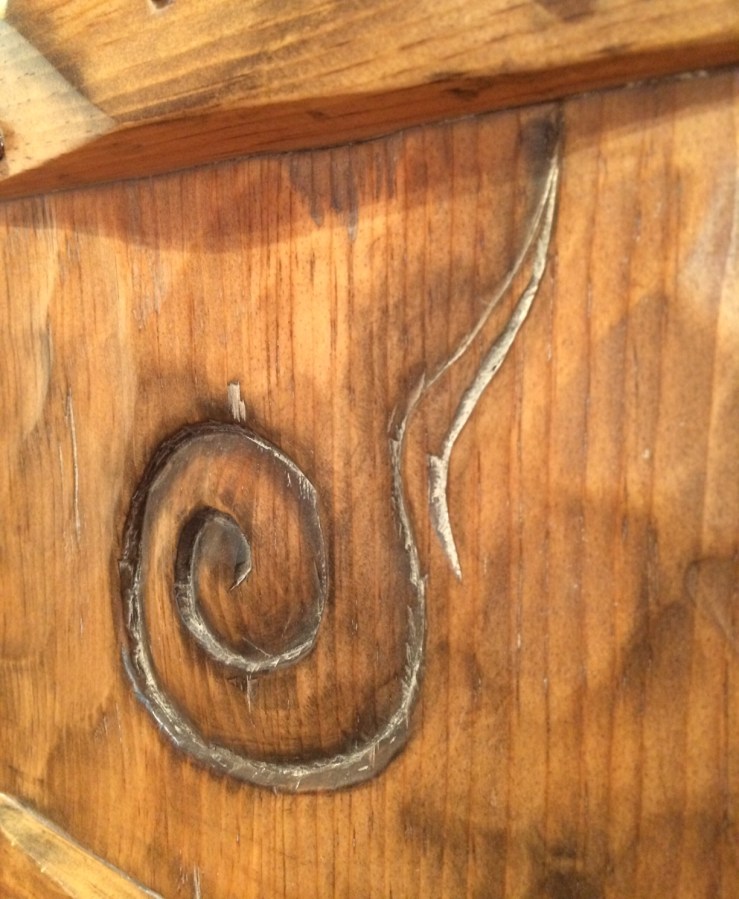
Hart often draws inspiration from New Mexico petroglyphs.

“A spiral can mean a lot of different things depending on its context, but here it represents eternity or travel,” Hart says. In particular, this symbol refers to a journey from the depths of the earth.

FACES

Roch Hart- Fine Furniture Detail- Matthews Gallery

These symbols on the sides of the pie safe tend to appear together in glyphs. The one on the left with its mouth shut tight is the “listener”, and the one on the right is the “storyteller”. It’s the yin-yang of cultures that depend on the voice to pass down vital knowledge.

The designs surrounding the faces also have an important meaning. Just like the Zia on the New Mexico state flag, they represent the sacred, pervasive number four: four compass directions, four seasons, four stages of a person’s life.

PATTERNS

Roch Hart- Fine Furniture Detail- Matthews Gallery

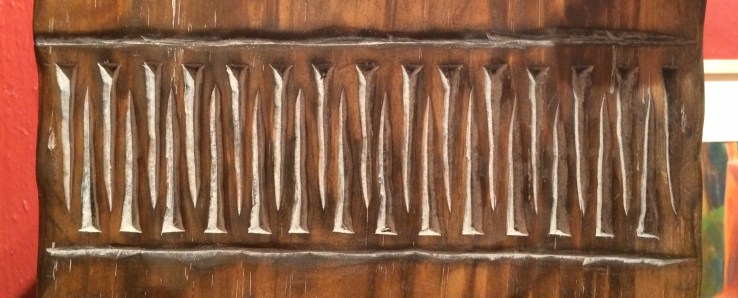
“This is mimicking the Navajo rugs,” explains Hart. “I thought it would be a great border for the faces.”

Hart uses white ash to make his patterns bolder, rubbing it into the cracks by hand atop a layer of shellac. The finishing touch is a light coat of wax.

JOINTS

Roch Hart- Fine Furniture Detail- Matthews Gallery

Near the beginning of his journey to furniture mastery, Hart visited the Nicolai Fechin House in Taos. Fechin was a Russian painter and carpenter who moved to New Mexico in 1923 and purchased a small adobe home that he would greatly expand over the years. The home is now a museum, and when Hart visited to study the furniture he had a chance encounter with Fechin’s daughter Eya. She taught him about the different joints that her father used, including the sliding dovetail joint pictured here.

“That changed my life,” Hart says.  “I looked at [Fechin’s work] and said, ‘I can do anything. Nobody told him what to do.'”

WINDOW

Roch Hart- Fine Furniture Detail- Matthews Gallery

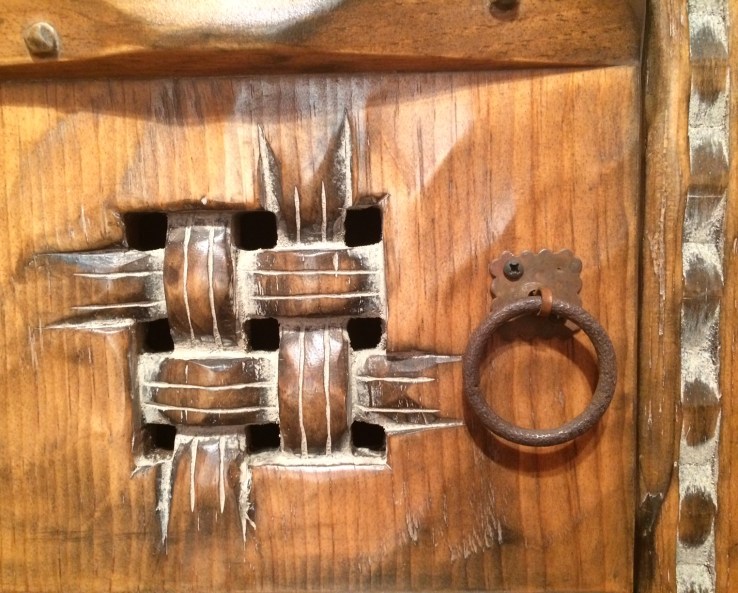
The grid Hart uses as a window for the pie safe doesn’t have an age-old legend behind it. It’s one of Hart’s signature designs that appears in many different manifestations in his work. Myriad influences come together in Hart’s exquisite furniture, but each piece is imbued with his unique sensibility.

See more of Roch’s creations on his artist page, and connect with us on Facebook, Twitter and Instagram for daily gallery updates. Also, check out our upcoming exhibition FOUR CENTURIES: European Art from 1600 to 1950, opening June 13!

FAMILIAR STRANGERS: The Orphanage

Palace of the Governors Photo Archives

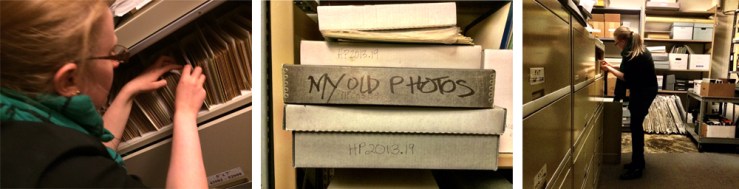
 Palace of the Governors Image Specialist Hannah Abeldeck sifts through the archives

“I think what you’re referring to is what we call ‘orphan photographs,'” said Palace of the Governors Photo Archivist Daniel Kosharek over the phone. “We have boxes and boxes of them.”

We contacted Kosharek last week in hopes of getting another angle on vernacular photography for our upcoming FAMILIAR STRANGERS show, which opens this Friday. The private collectors we had interviewed so far seemed delighted by the often unsolvable mysteries of found photographs. Did a professional archivist find an unknown image intriguing… or annoying?

A few days later, Daniel’s colleague Hannah Abeldeck ushered us onto an elevator and down to the basement of the Palace of the Governors. Abeldeck works as an image specialist for the archives, cataloguing, scanning and researching images in the collection of about 1,000,000 objects. The main room of the archives is packed with file cabinets and bookshelves. Sunlight streams down from a stairwell, making the subterranean space surprisingly bright.

“We weren’t a hundred percent sure what you were interested in, so I pulled some stuff to give you examples,” Abeldeck said, pointing to a teetering stack of files and a big green box.

To be honest, we weren’t sure either. We had no specific criteria when we were compiling photographs for FAMILIAR STRANGERS, which features compelling, mysterious images of diverse people and places. Unlike the scholars and history enthusiasts Abeldeck usually works with, we were more interested in questions than answers. In the following excerpts of our Q&A, Abeldeck provided us with a healthy helping of both as we explored a small corner of the “orphanage”.

Tools- Palace of the Governors Photo Archives The archivist’s toolkit


You started at the archives last October. Was it intimidating to approach such a large collection? 

I’ve worked in archives before, and for a rare book dealer. There are things about it that are not intimidating, but there are plenty of things that are. Partly, it’s the size of our collection. It’s huge. There’s stuff that’s really well processed, and then there’s stuff that’s hardly processed at all. There are so many different filing systems, so an original photograph can get put somewhere and be difficult to find again. There are systems by medium, by size, by when it arrived, by collection number.

Why were you interested in archival work? 

I think that our ideas about the past are often very simple. They’re based on things like summaries that people wrote about what they think happened. Sometimes photographs are a way of going back and re-looking at the past that you can’t do with words. You can get some idea of the complexity of the past. There’s a book that I read called “The Past is a Foreign Country.” In some ways, this job is like being a tourist. It’s interesting to see what is the same and what is different, what has changed and what is new.
Palace of the Governors Photo Archives

Orphan photos are catalogued in several ways: by location (left, New Mexico), collector (center, Forrest Fenn) or subject (right, portraits)


Where did the stack of orphan photos we’re looking at come from? 

We have a set of collections that exist in this limbo land between the old cataloguing system and the new cataloguing system. We might know something about them, or they might just be a box of photographs sitting on a shelf. This box says “Forrest Fenn“, so he probably donated them. Some have a photographer’s name on the back and some don’t. The stack of files is catalogued by location or subject— “New Mexico Towns” or “Portraits”.

Is there a way to estimate how many of your photographs are “orphaned”?

No, there’s not. Most of the stuff that we have, we know at least one thing about, so they’re not completely orphaned. Usually we know the photographer. Their name will be on the back, or the collection will be from their studio. Sometimes we don’t know anything about the photographer, but we know the location. When we seek things out for our collection, we’re usually looking for things where we know the photographer or the subject matter. But people also donate stuff to us. Those items that come in bulk collections, we know less about. The date is usually the thing that is the least identified about a photo.

What is the attitude among archivists towards orphan photos? 

Over the past 20 years, a lot of people who work in archives have adopted a philosophy called “MPLP.” That means “More Product, Less Processing.” It’s a way to deal with the huge volume of material that’s coming in. The volume of records that got created over the 20th century exponentially increased as the technology of production became cheaper. In the 1960s a photo archivist here might have spent four hours trying to identify a building in a photo. Now, we just don’t have time to do that. That’s one reason things get orphaned.

Palace of the Governors Photo Archives

 Mysterious beauty


The found photo collectors we interviewed find the element of mystery alluring. Do you get excited sometimes when you’re looking through orphan photographs, even though you don’t know their origins? 

Yeah! I’ll be looking through 100 unremarkable photographs from the past, and there’s one that seems more interesting or outstanding than others. There might be something aesthetically different about that photograph, but we’re also looking for historically interesting things. It doesn’t have to be a historical event, it could be about social history: why are these people together in this scenario? There are all sorts of social or technological things that could be interesting, even with orphan photographs.

In a blog post for FAMILIAR STRANGERS, we wrote about different roles people take when they’re looking at vernacular photographs: voyeur, detective, surrealist, even humanist. What would you add to that list? 

I’d add sociologist or social historian, particularly with the vernacular photography. We have a book called “Dressed for the Photographer” that’s a huge study of what people were wearing in daguerrotypes. You can date them based on their class and their region, so you can pin it a little more closely to the decade. It’s a way to find out what kinds of people passed through different places. We have portraits of Chinese men from Las Vegas, New Mexico that we don’t know much about, but their presence captures a bit of railroad history in the Southwest.

The photo collectors we interviewed also talked about the importance of bringing long-forgotten memories into the digital world. Do you feel similarly as an archivist? 

One of my main job duties is digitization. If you wanted to see and study some of these things, you would have to come to Santa Fe, New Mexico on an afternoon between Tuesday and Friday. Through digital cataloguing, we can post that stuff online and people can search from their houses. However, we have over 1,000,000 images and we’ve digitized maybe 30,000 of them. There’s still a huge mismatch between what we have and what is searchable online.

Palace of the Governors Photo Archives

Adelbeck flips through photographic glass plates in the archives. “As long as you don’t drop them, these will last forever.”


On the flip side, photo enthusiasts also stressed the importance of holding the physical object in their hands.

Having the original copy is very important for us in our ability to archive things. There’s something called digital obsolescence. For a physical photograph, if we put it in an archival mylar sleeve and keep them in a climate controlled environment, that is 95% of the preservation job. Digital objects are not that way, they need constant babysitting. Things periodically need to be switched over or upgraded. The CD is already an obsolete technology, so if you created a digital photograph in that format you have to migrate it to something else. With digital objects, there is a risk of the object disappearing within 15 years.

Do you have any stories of people identifying themselves or family members in an orphan photo? 

I just posted a picture on Facebook last week of two kids playing baseball. We knew the photographer and the date, and we knew it was in New Mexico somewhere. Someone recognized his brother in the photo. It’s really cool when that happens, but it’s bound to happen sometimes. We have all of these photos of unidentified people, and someone out there must know who they are. Those people existed at some point.

Is it frustrating when you encounter photographs that have recently left the range of “living memory”? 

It’s kind of interesting, because you start to understand the process by which photos get made, and how that affects what we can recover from the past. In the past, the occasions of photography were more constrained. You got a photo taken at an important event, like a wedding. As technology makes photography more accessible to the average person, you see a much larger growth of everyday captured moments that are not remarkable. At the same time, even within the proliferation of photography, there are things that happen that people don’t think to take pictures of. The process of painting a house might be interesting to future historians, but no one bothers to document that. There are a hundred billion photographs taken of the Santa Fe Plaza or the Palace of the Governors—and people are still taking them today—but there might be a storefront somewhere that no one has really photographed. It’s really interesting what people are choosing to document, and what they don’t document. We try to fill in those gaps by collecting photographers like Robert Christensen, a deliveryman who captured obscure stretches of road in rural New Mexico.

So this is just the tip of the iceberg?

Oh, yes. We have many, many, many more unidentified photos. If you needed pictures of ancestors and didn’t have any of your own, you could just come pick some. (laughs) “This is my great grandmother.”

Burro Photograph- Palace of the Governors Photo Archives

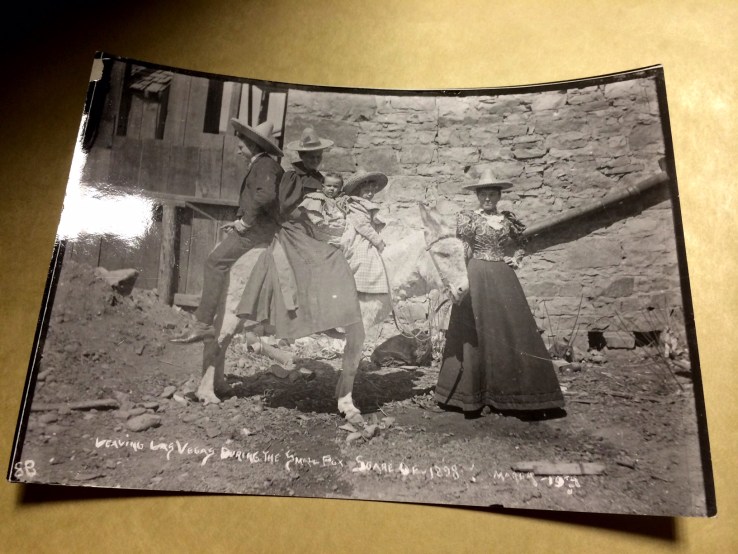
 Caption: Leaving Las Vegas During the Small Pox Scare, 1898; filed under Transportation, Land, Burros

You can follow Abeldeck and Kosharek’s exploits on the Palace of the Governors Photo Archives Facebook and Tumblr pages. Also, make sure to come to the opening of FAMILIAR STRANGERS: Vernacular Photography this Friday from 5-7 pm. Read more about the show in this week’s Santa Fe Reporter.

FAMILIAR STRANGERS: Almost Lost

Familiar Strangers Found Photography Show- Matthews Gallery Blog

Editor’s Note: No original photographs were harmed in the making of this blog

The messages were all the same. “Why do found photographs hold allure for you?” we wrote to members of Flickr’s robust vernacular photography community. “What is it about anonymous photographers and their subjects that makes collecting these artworks special or important?” 

As we explained in our last blog post, we’ve been wearing many different hats as we prepare for the May 16 opening of FAMILIAR STRANGERS: Vernacular Photography. Judging by the diverse answers we received from this query, it seems longtime found photography fans follow a similar process.

“At the time they were taken, they meant something to the photographer,” writes Gary Moyer, who runs a Flickr Group called Found Photos. “It’s a shame to think they can’t live on in this digital age.” But although part of Moyer’s mission is to bring this ephemera to the virtual realm, he’s also charmed by the objects themselves. “The photos are real, something to hold in your hand,” he concludes. 

For John Van Noate, administrator of several vernacular photography groups, it’s more about the immediacy of the image. “They provide a slice of life unfiltered, unmediated,” he writes. “Life in the raw, so to speak.”

Dave Bass‘ interest in vernacular photography started with a childhood fascination for taking snapshots. “I still recall the anxiety felt when retrieving a processed roll from the drugstore and opening the package to discover my treasures,” he recalls. Hunting down “orphan” photos seemed like a natural extension of his passion, and over years of collecting he’s learned a lot about human nature from the pictures he’s found.

I truly believe that such photographs are authentic cultural artifacts that portray who we as humans were, who we have become, and where we will likely go,” Bass writes. He uses Flickr group Vernacular Photo to connect with like-minded folks across the world. 

All of these intrepid collectors’ answers did have one thing in common: a sense of loss, and a desire to subvert it. As Moyer puts it, “Each [photograph] represents a moment that is gone forever.” In a way, these collections preserve memories that would otherwise have vanished long ago. 

On that hopeful note, we leave you with an excerpt from Paul Jackson‘s correspondence. The UK resident runs the Flickr group Found Photographs, and has a lot to say about vernacular photos and the power of the online community to uncover their secrets. It’s enough to make you believe that nothing is lost forever. Attend our FAMILIAR STRANGERS exhibition, opening May 16 from 5-7 pm, to untangle more mysteries!

Familiar Strangers Found Photography Show- Matthews Gallery Blog

From Paul Jackson:

I went to art school here in the UK in the 1970s and my interest in vernacular photographs stems from then. In those days you could often buy old postcards and snapshots in charity shops for virtually nothing. Often just arranged in old shoe boxes. You can rarely do that now as these things have become very collectable.

I think it is a shame when dealers break up old photograph albums as all the clues that would help place these images in context get wiped away. You may be interested in some subsidiary groups we run on Flickr. One is called “What’s That Picture” where we invite people to post pre-1945 images that they want help identifying. Sometimes this is a tall order but the Flickr community acts a bit like a hive mind and we have had some astonishing successes. A lot of these can be found in another group “The Astonishing Power of Flickr“. Here many images that have been successfully identified have been posted and some other extraordinary events such as people recognising themselves or other serendipitous events have occurred. 

You ask what the allure is for me. Well, there is something awfully poignant about old snap shots/vernacular photographs. The lives of strangers’ births deaths marriages, love, hearth and home..all life is there and with the knowledge that all that life has probably by now slipped away. These things end up in sales almost always through a death and the death of someone who either has no remaining family, or a family that cannot or will not preserve these fragile family histories. It is a very sobering thought.

I am at a period in my life when I am beginning to realise that even my own family photographs and the ones of my parents and grandparents are going to be vulnerable to be “lost” when I die and it does make you dwell on the ephemeral nature of life, the impermanence of the structures we build around ourselves and how easily it can fade away.

One of my favourite quotes is the famous one in Blade Runner when Roy Batty the replicant is dying:

“I’ve… seen things you people wouldn’t believe… Attack ships on fire off the shoulder of Orion. I watched c-beams glitter in the dark near the Tannhäuser Gate. All those. moments will be lost in time, like tears in rain. Time… to die…”

Looking at so many old and found photographs I often think that “I’ve seen things you people wouldn’t believe” the person behind the camera has seen these things, lived that life..you know, we can sometimes almost taste it.


Familiar Strangers Found Photography Show- Matthews Gallery Show

NEW RELEASE: Fremont Ellis of Los Cinco Pintores

Fremont Ellis- La Plata Mountains- Matthews Gallery Blog


In 1921, Fremont F. Ellis and his friends Jozef Bakos, Walter Mruk, Willard Nash and Will Shuster founded an avant garde art society that would change Santa Fe forever. The five men were in their early 20s, and most of them had recently migrated there from the East Coast. They chose a name inspired by their new life in the Southwest: Los Cinco Pintores (The Five Painters).

In December of that year, Los Cinco Pintores mounted their first group exhibition at Santa Fe’s Museum of Fine Arts. Their work was diverse in subject matter, but their rallying point was modernism and the art of early Taos painters Robert Henri and John Sloan of the Ashcan School.

“These men believe in color and are not afraid to use it,” wrote a critic who attended the inaugural show. “Upon entering the galleries, visitors are greeted with a great shout of color that’s almost stimulating.”

Fremont Ellis - Watercolors - Matthews Gallery Blog

Over the next few years, Los Cinco Pintores worked together to build a row of casitas along Camino del Monte Sol near Canyon Road. This earned them another nickname, “The Five Nuts in the Adobe Huts”. Meanwhile, word of their exploits had reached other artists back home.

By 1923 another group called the New Mexico Painters was exhibiting paintings of sweeping Southwestern landscapes across the Midwest and the East Coast. Artists like Randall Davey, Andrew Dasburg and Theodore Van Soelen settled in the area, and the Santa Fe Art Colony was born. The City Different has fostered a vibrant art community ever since.

Fremont Ellis- Watercolor Diptychs- Matthews Gallery Blog

These newly released works on paper are by Fremont Ellis (1897-1985), who was the last surviving member of Los Cinco Pintores. Ellis grew up in Montana and was inspired to become an artist at 14 when he saw Albert Bierstadt’s paintings on a trip to New York City. He worked as a photographer in California before settling in Santa Fe, and used his photographs of landscapes to inspire his painted compositions. This body of work holds the vigor and immediacy of the artist’s many outdoor adventures.

Learn more about Fremont Ellis on our website, and connect with us on Facebook, Twitter and Tumblr for daily gallery news. Also, don’t forget to mark your calendar for our exhibition NEW MEXICO MODERNS: The Lumpkins Files, opening next week!

NOT A POP ARTIST: Five Sides of Jim Dine

Jim Dine Rainbow- Matthews Gallery Blog


78-year-old artist Jim Dine has earned his place in any good post-war art history textbook. Picking exactly when to spotlight the artist must be a difficult task for scholars. The painter, sculptor, illustrator, printmaker, stage designer and performance artist has a way of diverging from the status quo and ending up at the forefront of new art movements. Just when things get established, he’s off on his own again.

A mixed media drawing  by Dine recently found its way to Matthews Gallery, so we took the opportunity to explore 5 manifestations of the chameleonic artist:

Fluxus Performer

Dine grew up in Cincinatti and got his BFA from Ohio University. When he arrived in New York in 1958, the art world was fixated on a type of work you couldn’t sell in a gallery. Some critics called them “wacky nightmares“, others described them as “a three-ringed circus with undertones of group therapy“, but Dine and his friends Claes Oldenberg, Allan Kaprow and John Cage dubbed their performance art pieces “Happenings”.

Happenings were designed to be as ephemeral and unpredictable as day-to-day life—but a little weirder. Battles between ballerinas and roller-skaters, reenactments of the Lincoln assassination, bikini stripteases and blue ice cream feasts were all passionately performed, often in rapid sequence. Whether you call it though-provoking or senseless, the Fluxus movement was one-of-a-kind. For Dine, all the world was a stage until…

Pop Progenitor

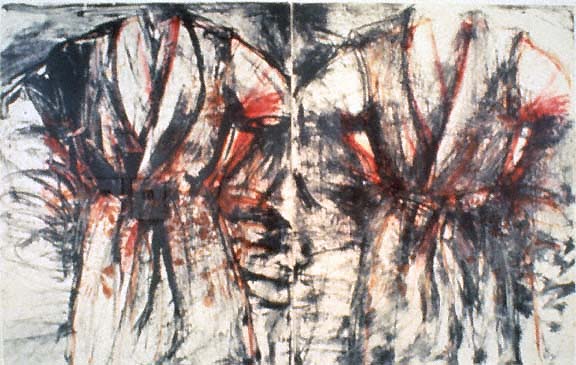
Jim Dine- Robe Diptych- Matthews Gallery Blog


Jim Dine, Red and Black Diptych Robe, 1980

In 1962, Dine’s paintings appeared alongside work by Andy Warhol, Roy Lichtenstein, Ed Ruscha and others in the Pasadena Art Museum’s show New Painting of Common Objects. Curated by Walter Hopps of Ferus Gallery (site of Warhol’s first solo show), the exhibition was a seminal moment for a new movement: Pop Art.

Dine’s inclusion in the exhibition made perfect sense at the time. He was experimenting with serial imagery of familiar objects and symbols like bathrobes, hearts and tools. However, the artist’s expressive style and often tender subject matter clashed with the postmodern angst of other Pop progenitors. Soon enough, he was plotting his escape…

Modernist

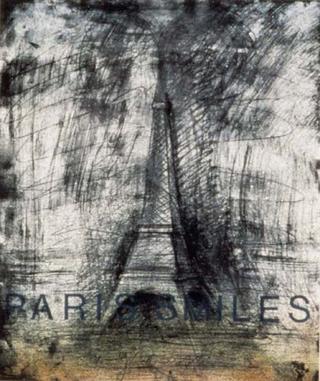
Jim Dine- Paris- Matthews Gallery Blog

Jim Dine, Paris Smiles in Darkness, 1976

Dine moved to London in 1967, a strange decision considering his controversial history with the United Kingdom. A year before his solo exhibition at London’s Fraser Gallery was raided by police and the owner was fined for showing “indecent” images.

The artist defiantly continued to his relationship with Fraser and used his time in Europe to study the work of Van Gogh, Picasso, Matisse and other modernists. In 1971 he returned to the United States, ready to chart a new course…

Neo-Expressionist

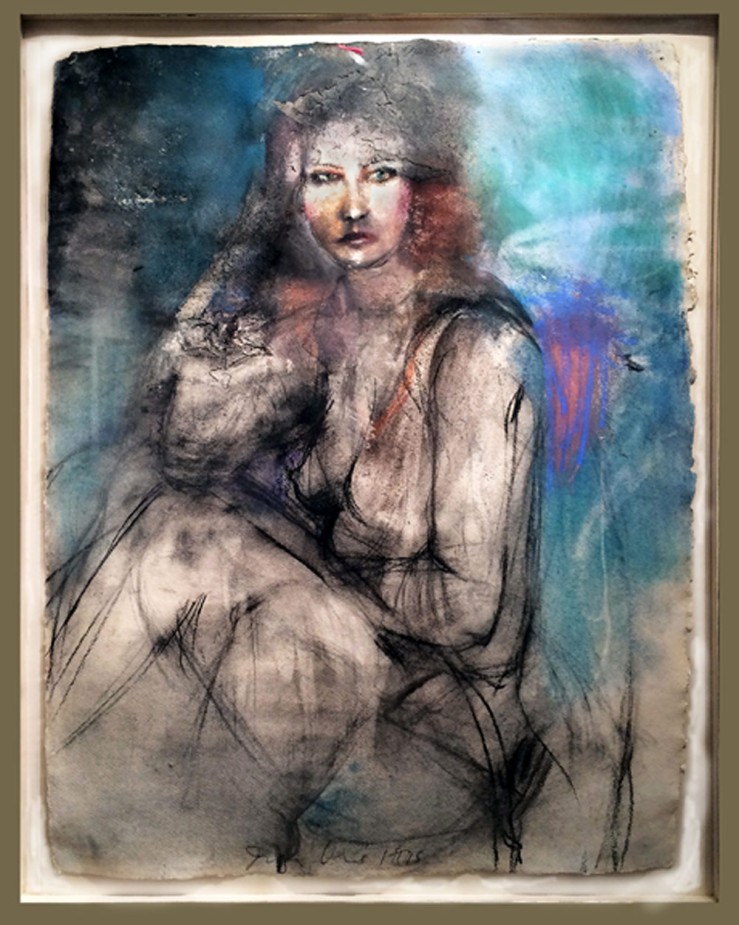
Jim Dine- A Lady Sitting Drawing- Matthews Gallery Blog

 Jim Dine, A Lady Sitting, Mixed Media, 1975

Minimalism was en vogue when Dine arrived in New York, but the artist wasn’t interested. Instead he focused on figure drawing, refining his skills in various mediums and earning a reputation as a master draftsman. The mixed media drawing in our collection is from this period. A stunningly realistic face painted in oil is framed by confident charcoal marks and a glowing crayon color field.

In the years to come Dine’s figurative work would mark him as a founder of Neo-Expressionism, but critics could never assign the artist a particular label for long…

Modern Individualist

2008_JimDine_23220011

Installation shot, Jim Dine: Poet Singing (The Flowering Sheets)

 Perhaps Dine’s artistic identity is best summed up by MoMA:

This commitment to a personally invested, image-dictated content and a continuing interest in the technical and expressive potential of every medium has characterized Dine’s work as a whole. Thus, Dine has often been out-of-step with the major movements of the post-World War II period and must be considered a modern individualist.

It’s a bit of a non-title, but Dine defies labels at every turn. The almost-octogenarian is still working his way into new chapters of art history.

Check out our website for more on Jim Dine, and connect with us on Facebook, Twitter and Flickr for to-the-minute gallery news.