COLLECTOR’S FORUM: The Passionate Pursuit

Our first COLLECTOR’S FORUM workshop was this Friday, and the gallery was packed! We covered every angle of art collecting, from buying and selling to consignment agreements, insurance and art conservation. Event participants received a special packet at the end of the event with a comprehensive write-up on art collecting by Lawrence. Check out his beautiful introduction on the ‘passionate pursuit’ below, and come to our second workshop on Friday, October 24 to see our presentation and get the rest of the packet. Seats are limited, so make sure to contact us if you’d like to reserve a spot.
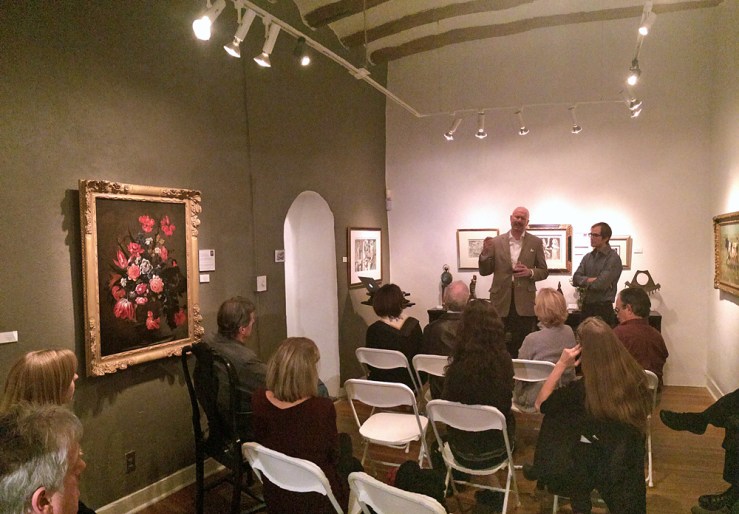
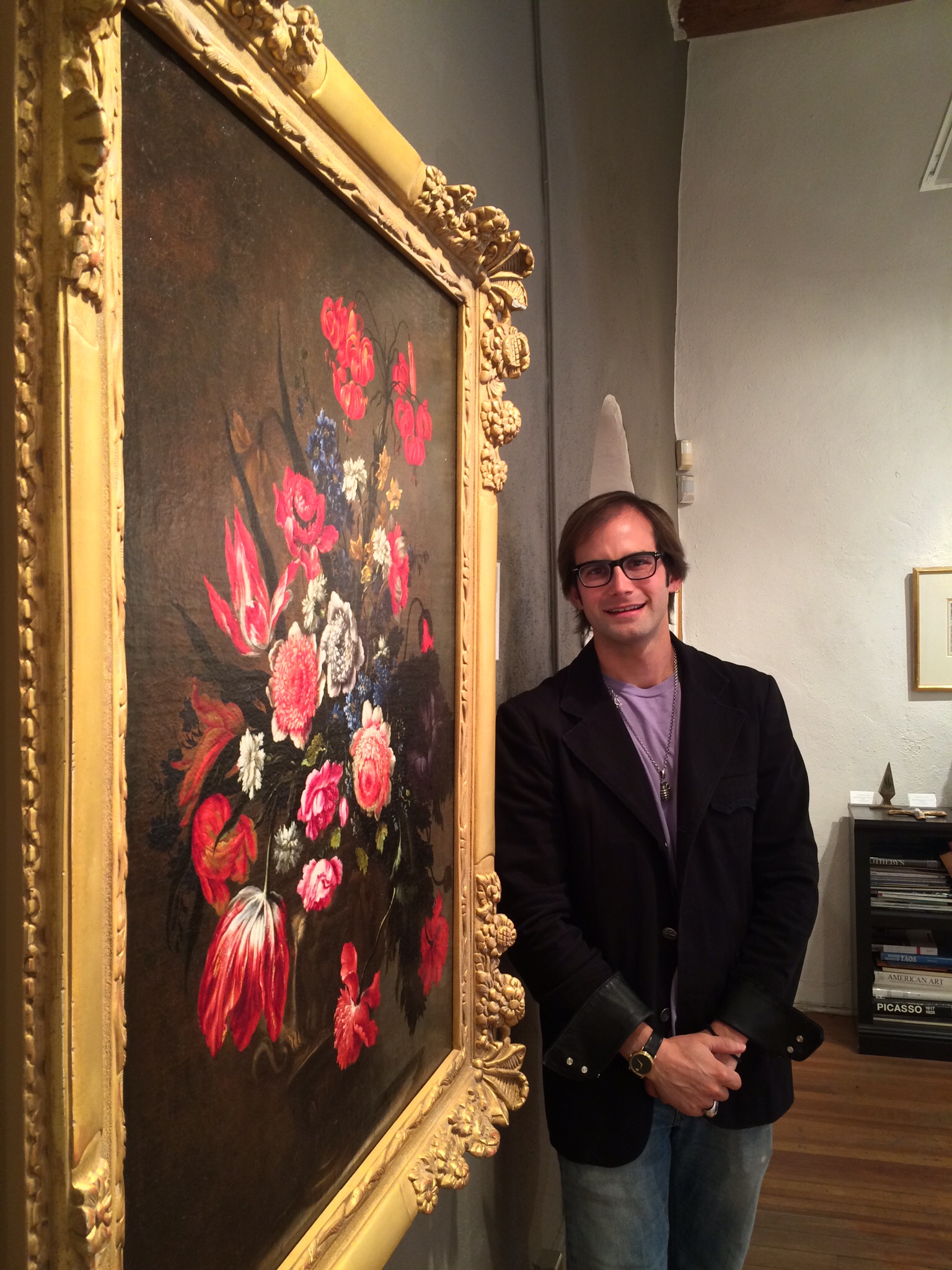
Collector's Forum- Art Collectors Workshop- Matthews Gallery blogLawrence Matthews and Matt Horowitz discuss a 17th century painting attributed to Jean-Baptiste Monnoyer

Close your eyes for a moment and think of a great piece of art you’ve seen and remember the way it made you feel. Was it was a sculpture, a painting or a drawing? Maybe it was a portrait or a landscape or an abstract. Maybe you saw it in a hometown gallery, in an artist’s studio, or in Paris walking through the Louvre. Wherever it was, remember that moment where you were overcome by that artwork, when you were flooded with a feeling that that swept you outside of yourself and put you in touch with something powerful and moving.

That is the true essence of art. The feeling you remember connects you to something deep within the human spirit and reminds you of what it means to be truly alive. It has nothing to do with money or the fame of the artist or how the art decorates a room. It has to do with the pure joy of imagination and creativity and our desire for beauty and intellectual enrichment.
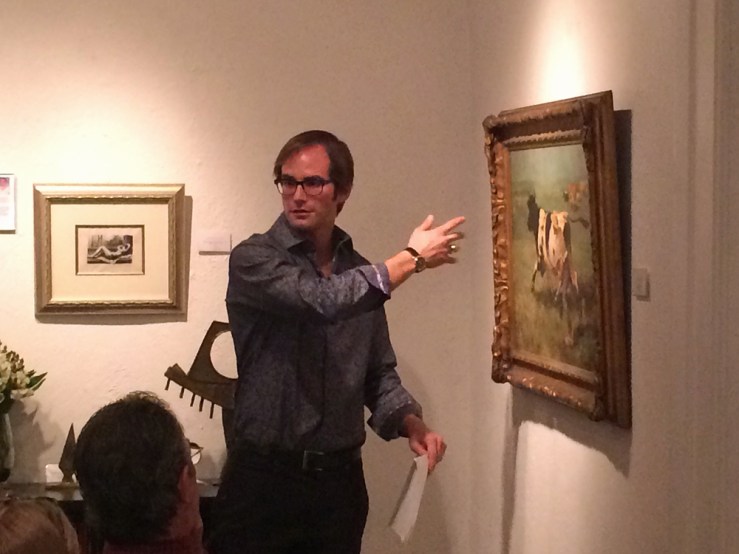
Art Conservator Matt Horowitz at Collectors Forum- Matthews Gallery

Fine art conservator Matt Horowitz talks about caring for art with our oil painting by A.J. Barry

Now, imagine another scenario. You and your spouse live in a small apartment. You both have low paying jobs but are passionate about art. You develop a plan and over the course of several years of collecting you amass 4,782 artworks many of which are considered masterpieces. You even give 2500 works from your collection to 50 museums around the country. You do all this when the highest yearly salary you ever earned was $23,000. This is the story of Herb and Dorothy Vogel – two of the greatest art collectors in recent memory.

How did they do it with so little money? First, they developed a plan, then they learned as much as they could about art – they read; they took classes; they talked to artists, gallery owners, museum curators and other collectors. They became knowledgeable, focused on the type of collection they wanted, and excited about building it. Eventually they built it into one of the greatest art collections of the 20th century.

Collecting art can enrich your life and potentially create a valuable asset for you and your heirs. Following are strategies you will need to create, maintain and grow your art collection whether you decide to focus on just a few pieces or enough to fill a museum. These insights and practical advice will help you achieve your collecting goals.

Building an art collection involves four main areas:
1. Learning About Art
2. Buying Art
3. Caring For Art
4. Selling Art

Get the details on all  of these pursuits next Friday at COLLECTOR’S FORUM Workshop 2, and connect with us on Facebook, Twitter and Instagram for daily gallery news.
COLLECTOR’S FORUM: Conservator Matt Horowitz

 Fine art conservator Matt Horowitz will appear at our COLLECTOR’S FORUM workshops
on October 17 and 24. The free events are for anyone who’s ever considered buying, selling or caring for fine art and has questions about the inner workings of the art world. To reserve a seat, make sure to contact us!

Matt-Horowitz-Goldleaf-Framemakers-Conservator

Conservator Matt Horowitz with a 17th century painting he restored for Matthews Gallery

“I came in and they gave me a de Kooning,” says Matt Horowitz. He’s telling the story of his arrival in Manhattan at 24 years old to work for a famed art restoration firm. If he failed this audition, there would be dire art historical consequences.

“A piece of the white paint had chipped away, which is the hardest thing to match, because white is never really white,” Horowitz says, nervously twisting the ring on his finger. “I was like, ‘You don’t even know who the hell I am, and you just gave me a de Kooning and you want me to fix it.'” At the end of the painstaking task, Horowitz had a new job. Eight years later he sits in Matthews Gallery’s front room among paintings he’s restored for us, with a budding reputation as a rare young master in his field.

Horowitz grew up in Santa Fe, where his father Marty founded Goldleaf Framemakers in 1988. One summer in high school he got bored with the family business and asked local art conservator Steven Prins to teach him the tricks of the trade.

After receiving his BFA in painting and drawing at the University of New Mexico, Horowitz returned to Santa Fe to work with Prins, but he’d always dreamed of living in New York. When he got a job offer from Lowy Frame & Restoration Company in Manhattan, he took the leap.

Matt Horowitz- Art Conservator- Goldleaf Framemakers of Santa FeHorowitz at work

“I didn’t go and get my masters degree in conservation because I went for a ‘apprenticeship to working commercially’ route,” Horowitz says. “I prefer it because when you go to school it’s a very different environment. It’s very intellectual.” At Lowy he got hands-on experience with diverse museum-quality work: paintings by Degas, Dali and other legends.

Horowitz had a great job and an apartment in Manhattan, but he was far away from his family. “Things had gotten really rough after the recession,” he recalls. “My dad calls and says, ‘Would you be interested in coming back and helping your old man out?'” It was a difficult decision, but Horowitz left New York behind.

His first winter back in Santa Fe was hard work. Horowitz lived in the family shop and turned out beautifully restored artwork on tight deadlines, building a successful new wing of the business. It’s been four years since his return and a decade since he started working as a professional art conservator, and business is booming.

Still Life Attributed to Jean-Baptiste Monnoyer- Matthews Gallery blogUntitled still life by Jean-Baptiste Monnoyer, impeccably restored by Horowitz

“Now that I’ve been doing it for 10 years, I really push that,” Horowitz says. “I’ve definitely come up against the ageism, and the people who say, ‘How could you know what you’re doing? You’re too young.'” That’s why he jumped at the chance to collaborate with us on our Art Matters event, COLLECTOR’S FORUM. During our free workshops on October 17 and 24, he’ll discuss the fine points of maintaining and restoring artwork in your collection and tell fascinating stories from his career, including the tale of restoring one of Matthews Gallery’s oldest works of art.

“It’s kind of like being a detective,” he says. “It’s exciting. Something comes in and it’s not always totally straightforward, there’s a combination of things. It can be stressful but it’s exciting. You have to follow the clues and figure it all out.”

Learn more about COLLECTOR’S FORUM on our exhibition page, and connect with us on Facebook, Twitter and Instagram for daily gallery updates.

OUTSIDER/INSIDER: Abstract Expressionism at Matthews Gallery

Stanley Boxer and Robert Motherwell at Matthews Gallery Boxer (left) and Motherwell

It was Mark Rothko’s 111th birthday this Friday, and the occasion has us pondering one of the 20th century’s most polarizing art movements: abstract expressionism.

Three artworks by renowned abstract expressionists have recently landed on our walls. The first two are heavily impastoed oil paintings by Stanley Boxer, who resolutely clung to the far fringes of the movement. Determined to defy labels, he was furious when art critic Clement Greenberg called him a color field painter, and yet the arc of his creative explorations closely paralleled that of his abstract expressionist contemporaries:

In the manufacture of my art, I use anything and everything which gets the job done without any sentiment or sanctity as to medium. Then, too, I have deliberately made a practice of being “visionless”… this is, I go where my preceding art takes me, and never try to redirect the future as to what my art should look like. This is a general credo and foundation for everything I have ever done and stands firm in its solidity as this is written.

Boxer, who died in 2000, would have loved Grace Glueck’s New York Times review of a 2004 exhibition of his late works. She notes that he was “never part of a movement or trend,” but rather driven by paint’s “physical possibilities without script or program.”

Abstract Paintings by Stanley Boxer- Matthews Gallery Blog Atriumofashreddednight  (top) and Crisppitchofsigh, Oil on Linen

Glueck ends the piece with a brief analysis of Boxer’s titles, lyrical lists of words that are jammed together in unbroken strings. The works in our collection, for example, have names that read like fragments of beat poems: Atriumofashreddednight and Crisppitchofsigh. Glueck writes, “As Boxer joked in his titles, these canvases, more than most, do not really lend themselves to verbal exposition. They live for the eye, to which they bring deep satisfaction.”

Boxer’s titles provide a link to Robert Motherwell, the other abstract expressionist represented in our collection. Unlike many “abex” artists who labeled their canvases using dates or arbitrary numbers, Boxer and Motherwell were unapologetic in their wordplay.

That’s where the similarity ends. While Boxer considered himself an isolated frontiersman of abstract painting, Motherwell was an eager icon of abstract expressionism. He coined the term ‘New York School’ to describe his revolutionary circle, which included Mark Rothko, Jackson Pollock and Willem de Kooning, and acted as a spokesperson for the movement in the world of academia.

If Boxer’s titles were little more than impressionistic quips, Motherwell, who was a scholar before he became a “serious artist” and wrote numerous essays on aesthetics, chose names that have inspired endless analysis. His most famous series of paintings, Elegies to the Spanish Republic, chronicles the Spanish Civil War in bold strokes of black and white and subtle passages of ochre, blue, green and red.

Mainly, I use each color as simply symbolic: ochre for the earth, green for the grass, blue for the sky and sea,” Motherwell wrote. “I guess that black and white, which I use most often, tend to be protagonists.” In varying contexts, each color holds a universe of meanings. To fully understand the use of ochre in Motherwell’s Spanish Elegies, “You would have to know that a Spanish bull ring is made of sand of an ochre color,” the artist wrote.  Other works that feature ochre, like Western Air or Personage, with Yellow Ochre and White, would naturally spark different associations. 

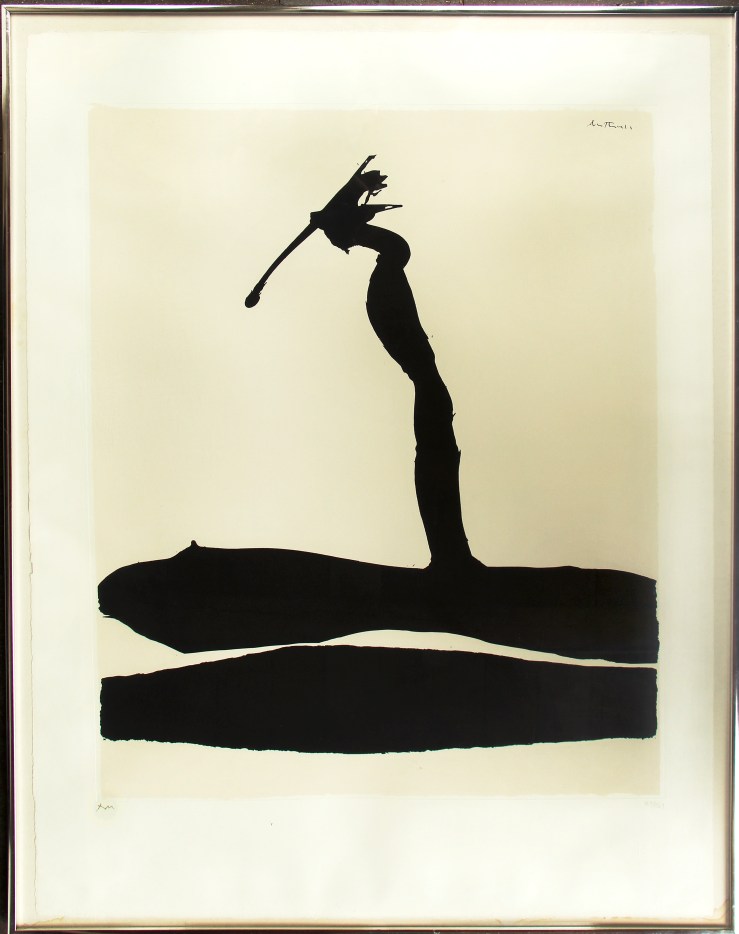
Robert Motherwell- Africa 4- Silkscreen- Matthews Gallery Blog Robert Motherwell, Africa 4, Silkscreen

What to make of our Motherwell silkscreen, titled Africa 4? Motherwell completed the Africa suite in 1970, the same year he created his Basque and London suites. They were his first projects entirely devoted to silkscreens, and a divergence from the heavily layered nuances of his oil paintings. Here his black abstract forms stand crisply against their off-white backgrounds, although on closer inspection, their tumultuous edges still seem to weave in an out of focus.

“All my works [consist] of a dialectic between the conscious (straight lines, designed shapes, weighed color, abstract language) and the unconscious (soft lines, obscured shapes, automatism) resolved into a synthesis,” the artist wrote in 1944.

Motherwell first explored the concepts of automatism and the subconscious with a group of Parisian Surrealists, including Duchamp, Ernst and Masson, who had fled Europe during World War II.  Their ideas would help shape the spiritual side of abstract expressionism, a spontaneous, intuitive element that Motherwell carefully balanced with his more intellectual inclinations.

Motherwell’s connection to the Surrealists lends us a potential clue to the significance of the ‘Africa’ title. In his 1946 essay ‘Beyond the Aesthetics‘, Motherwell discusses the life of French Symbolist poet Arthur Rimbaud, who helped inspire Surrealism. In the final decades of his life Rimbaud quit writing and set off on an African expedition, a leap of faith that Motherwell compares to the Surrealists’ break from Dada and formation of a new movement:

Like Rimbaud before them, the Surrealists abandoned the aesthetic altogether; it takes a certain courage to leave poetry for Africa (as Rimbaud did, fh). They revealed their insight as essentially moral in never forgetting for a moment that most living is a process of conforming to an established order which is inhuman in its drives and consequences. Their hatred sustained them through all the humiliating situations in which the modern artist find himself, and led them to conceptions beyond the reach of more passive souls. For them true ‘poetry’ was freedom from mechanical social responses. No wonder they loved the work of children and the insane – if not the creatures themselves.

Perhaps Motherwell’s Africa suite represents a similar journey, a leap into the unknown that is a clear break from previous adventures. Just as Rimbaud abandoned an intellectual pursuit for one centered on travel and action, and as the Surrealists broke from the societal battles of the Dadaists to explore dreamscapes, so Motherwell’s stark Africa forms landed him in a new realm of image-making. Perhaps he sought to prove that even the most distinctly divided blacks and whites could possess endless shades of grey.

Learn more about Stanley Boxer and Robert Motherwell on our website, and make sure to connect with us on Facebook, Twitter and Flickr for more gallery news.

ONE WORK OF ART: Beatrice Mandelman’s ‘Cool Wind’

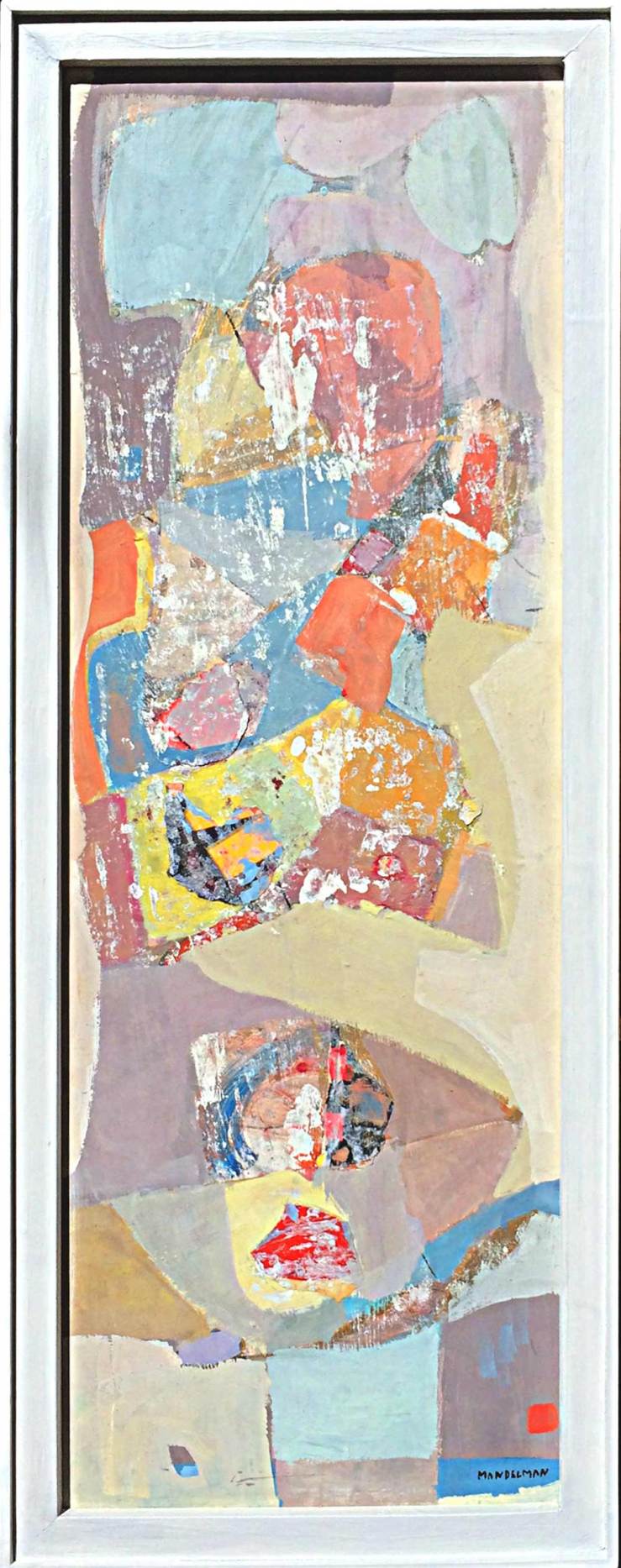
Beatrice Mandelman- Cool Wind circa 1950- Matthews Gallery

Beatrice Mandelman, Cool Wind c. 1950, Casein with Collage on Masonite Panel

When John Sloan invited Beatrice Mandelman and Louis Ribak to visit Santa Fe in 1944, the two artists were on the rise among New York City’s avant-garde. They had ties to Hans Hoffman and Fernand Leger, and were often mentioned in the same breath as Jackson Pollock. Sloan, who had been summering in New Mexico for years, had a reputation for spiriting away his favorite artists to the Desert Southwest. During their trip the recently married duo took a train to Taos and decided to stay.

The move marked a radical change in Mandelman and Ribak’s artwork. “We had to start all over again,” Mandelman said. “We spent the first couple years painting landscapes.” They were known for their figurative paintings in New York, but in this radically different environment their focus shifted to pure abstraction. They were trailblazers for a new wave of artists called the Taos Moderns, a movement that enlivened the Taos art colony but enraged an older vanguard of academic painters with ties to the Taos Society of Artists of the 1910’s and 20’s. To this tight clique of romanticists, the newcomers stuck out like colorful cacti—particularly Mandelman.

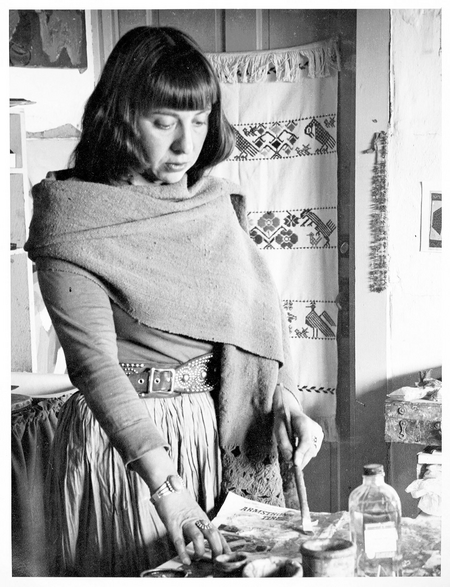
Portrait of Beatrice Mandelman in her Taos studio circa 1950- Matthews Gallery Beatrice Mandelman, 1950

“She worked with full abstraction at a time when most artists were not daring enough to do so,” writes David L. Witt in his book Taos Moderns, noting that Mandelman considered herself “the first of the second generation of artists in Taos.” The voice of a young, female abstract painter had never been part of the remote art community.

Far from the big city, Mandelman developed a new appreciation for the natural world and humanity’s relationship with it. By the late 1940’s she was developing an abstract symbol system to express her emotional responses to the landscape. Her elegant compositions didn’t mimic the lines or palette of the high desert, but they perfectly evoked the strong, solitary spirit of its inhabitants.

The mixed media painting in our collection was likely done in the 1950’s. Early in her experiments with abstraction Mandelman chose a muted palette, but here brighter colors poke through. This more expressive style was inspired by Henri Matisse and Mandelman’s former teacher Leger, and allowed her to explore the highs and lows of human experience with great vigor. Cool Wind‘s undercurrent of chilly blues and bright accents of orange and red call forth the sensation of a shiver passing up the spine.

As the evenings get cooler in Santa Fe, we’ve developed an ever-evolving passion for this piece and the innovative artist who created it. Learn more about Beatrice Mandelman on our website, and connect with us on Facebook, Twitter and Instagram for daily gallery news.

The Boundless Moment: Words and Images

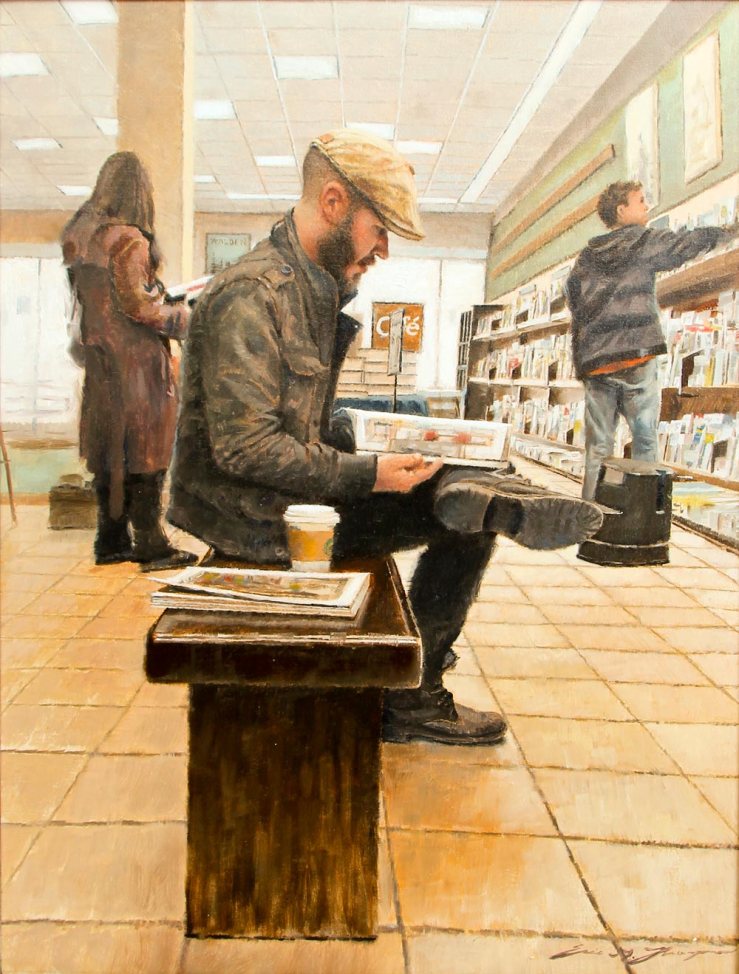
Eric Thompson- The Photographer- Matthews Gallery blog

 Eric G. Thompson, The Photographer, Oil on Linen

For the past week, excited art pilgrims—determined to visit every gallery on Canyon Road—have marched purposefully into our front room and come to a screeching halt. Our Eric G. Thompson show ‘The Boundless Moment‘ is a little different from most of the exhibitions you’ll see on this famous art route. Accompanying many of Thompson’s serene realist paintings are writings by great American poets, from Elizabeth Bishop to Walt Whitman.

The interplay of words and images has compelled viewers to slow down and look twice, sparking many a fascinating observation. Most notably, journalist Alison Oatman of the Weekly Alibi attended our opening and wrote an elegant, poetry-filled review of the show.

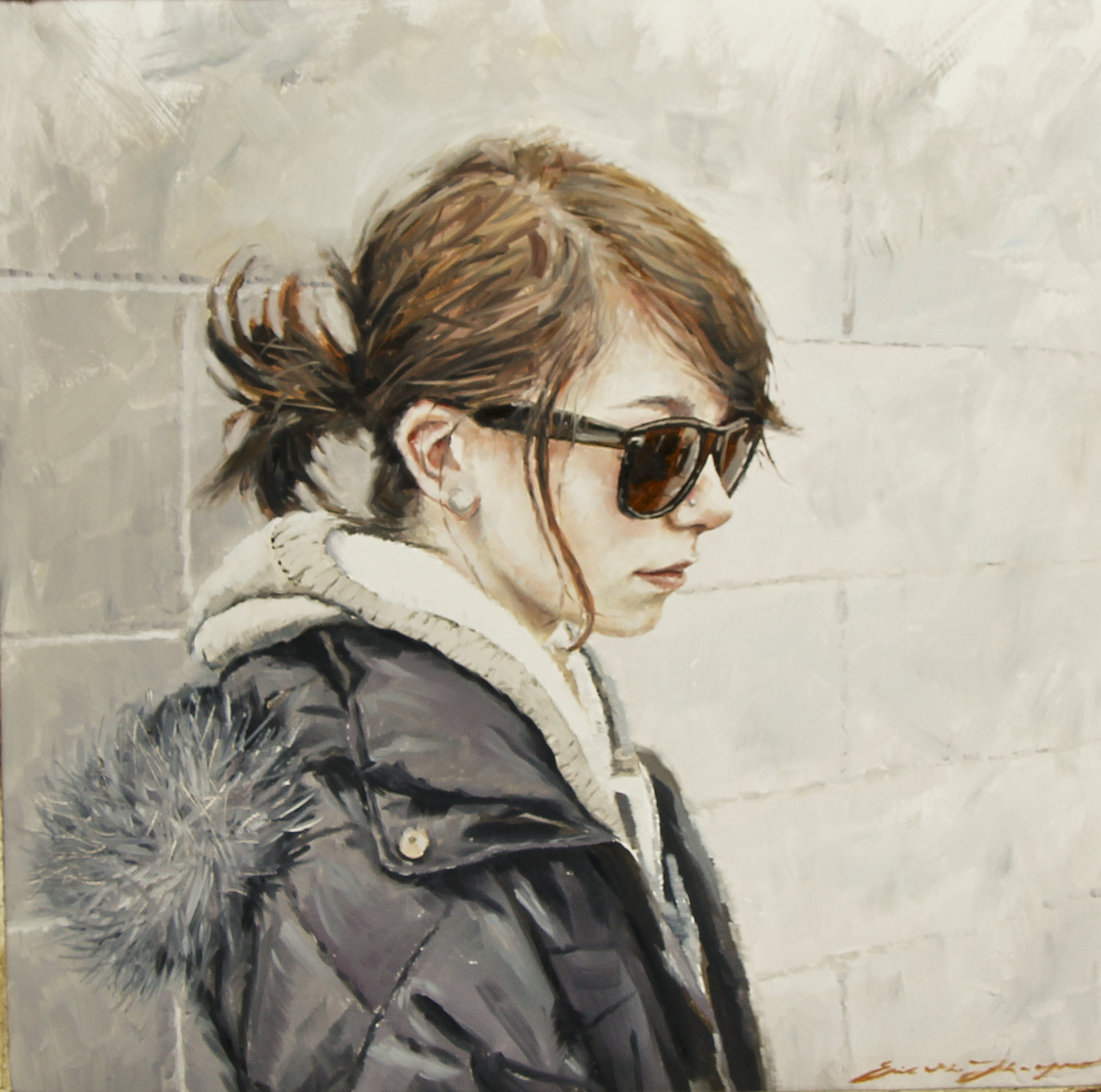
Eric G. Thompson- Coffee Shop Girl- Matthews Gallery blog

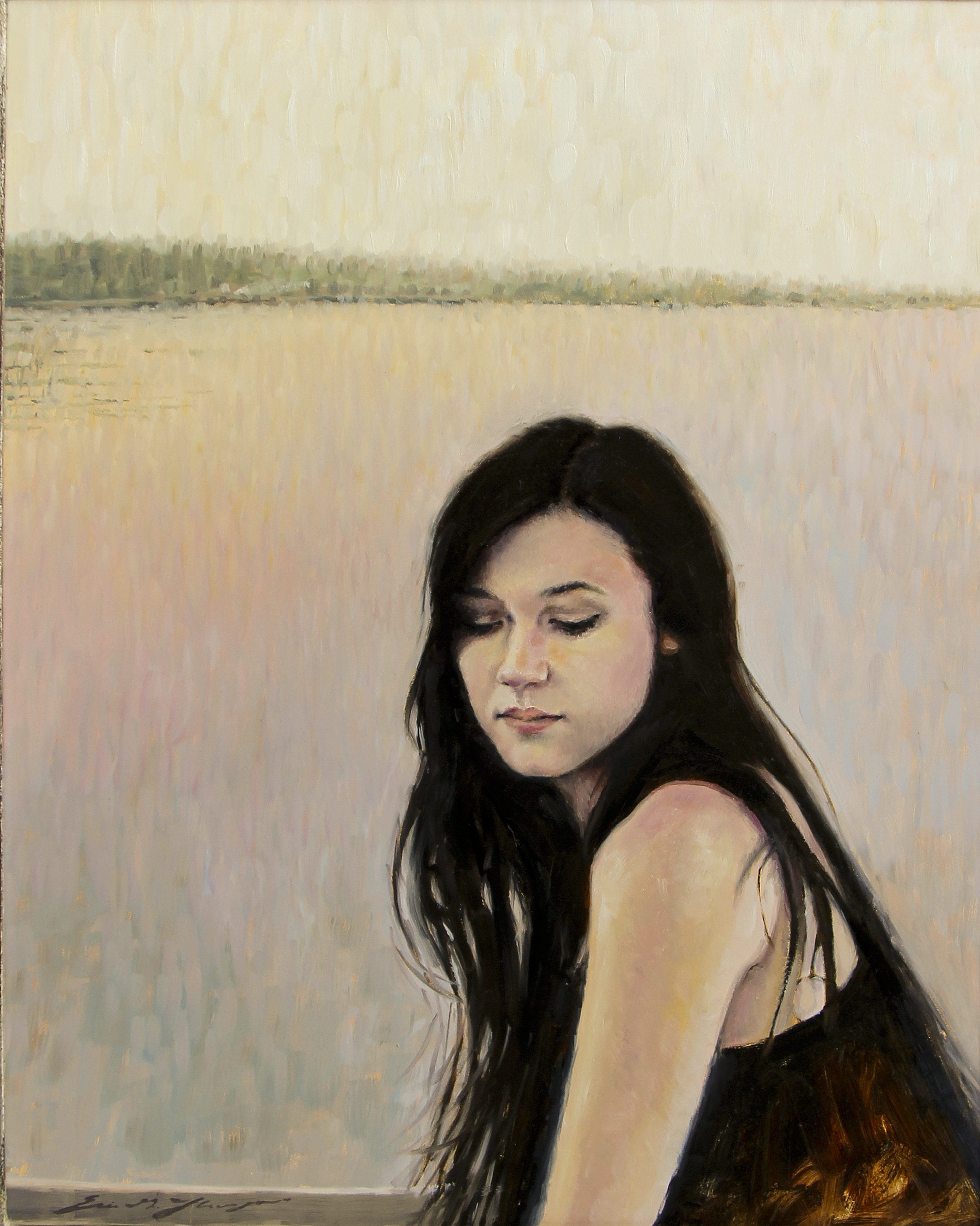
Eric G. Thompson, Coffee Shop Girl, Oil on Panel

An excerpt from Oatman’s article:

Robert Lowell’s “Epilogue” [is] paired with the painting “Coffee Shop Girl.” Lowell writes: “I hear the noise of my own voice:/ The painter’s vision is not a lens,/ it trembles to caress the light” [emphasis original]. These lines are reflected in the Coffee Shop Girl’s illuminated face—as pale as rice paper.

Later on, the poem continues: “Pray for the grace of accuracy/ Vermeer gave to the sun’s illumination/ stealing like the tide across a map/ to his girl solid with yearning.” Though large sunglasses hide her face and her meager mouth is expressionless, the Coffee Shop Girl is ravenous. We see her frayed emotional state in the feathery brushstrokes in the background, the squirming reddish-brown tendrils of her ponytail, and the sparkling clusters of dandelion-like fur attached to the hood of her puffy coat.

We spoke with Thompson on the phone today to fill him in on the big response his show has received. The artist was in Santa Fe last week for the opening reception, but now he’s back home in Salt Lake City, Utah. The long drive home gave him time to gather some thoughts on the exhibition. Read our interview below, and make sure to come see ‘The Boundless Moment‘ before it closes on August 28!

Eric G. Thompson- Half Light- Matthews Gallery blogEric G. Thompson, Half Light, Oil on Canvas

Describe your studio. 

My studio is just a few feet away from my house. It has windows with good natural light, so sometimes I can turn off the light and still get what I need. Sometimes I’ll set up my daughter‘s easel next to mine, and we’ll work next to each other. She gets to see what her dad does. Most of the time the kids aren’t allowed in the studio, though. I’ll play underground folk music, and when I’m really inspired it feels like the music is flowing straight through my brush.

You work in oil, egg tempera and watercolor. How do you choose which medium to use for a new painting? 

Between the three of them, if I want to capture something a little more loose and light I go for watercolor. If I want to capture something very solid, heavy and thick I’ll go with oil. If I want to capture something a little more photorealistic, I go with egg tempera. It gives you a lot of freedom to express the story or the emotion that you’re trying to convey with each medium.

It can be refreshing, but it can also be almost maddening. They’re all so different, it’s unbelievable. You have to switch your brain around and remember how to use that medium. It can be completely challenging, which I love. That’s one of the greatest thing about painting, is the challenge. I can always let a painting go as long as I have another challenge.

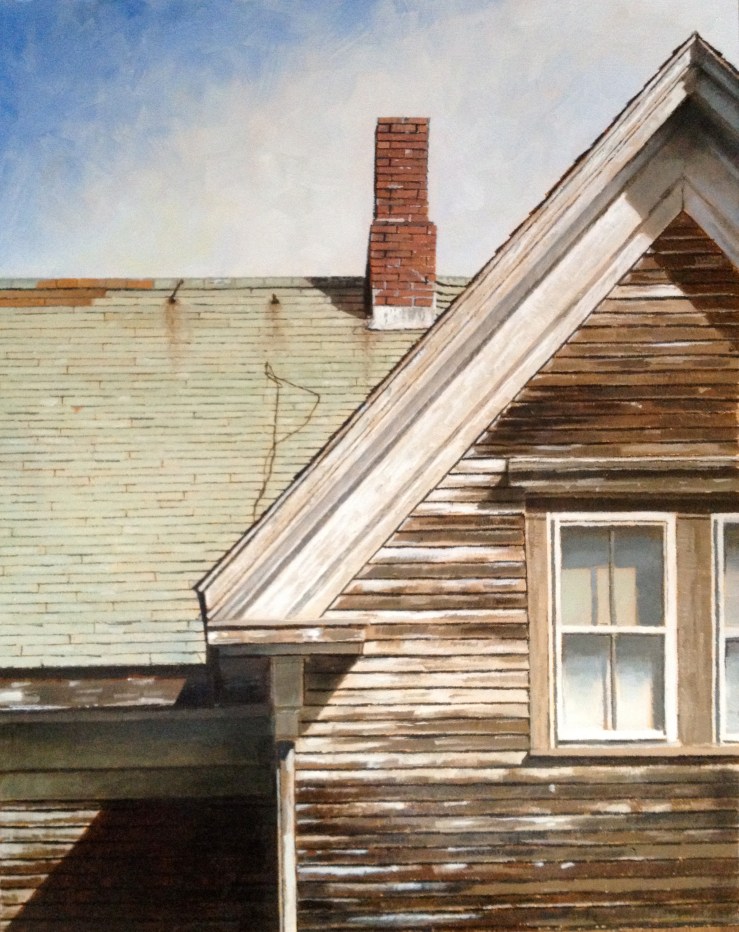
Eric G. Thompson- Nestled- Matthews Gallery

Eric G. Thompson, Nestled, Oil on Panel

Alison Oatman’s review in The Alibi begins with, “One question contemporary realist painters often get is, ‘Why not simply take a photograph?'” Over the course of the article, she critiques that particular line of thought. What’s your answer to that question? 

To a lot of artists, it’s not a great compliment when a viewer says, “That looks just like a photograph.” Maybe to a photorealist that would be flattering, but I think the greatest artists of all time have that balance of, it looks like a painting but it looks so ‘real.’ I’ve made it come to life.

Why does someone need a painting to look just like a photograph? What’s the power in that? Technically it’s amazing, but where’s the artistic freedom? I need artistic license to change things and blur edges and sharpen edges and change value to make it more ethereal.

I can make a painting look like a photograph but then there’s no energy, there’s no life to it. I think just adding a little more energy with brushstrokes or texture brings it more to life.

One of your influences is the Japanese aesthetic of wabi-sabi. How would you describe it? 

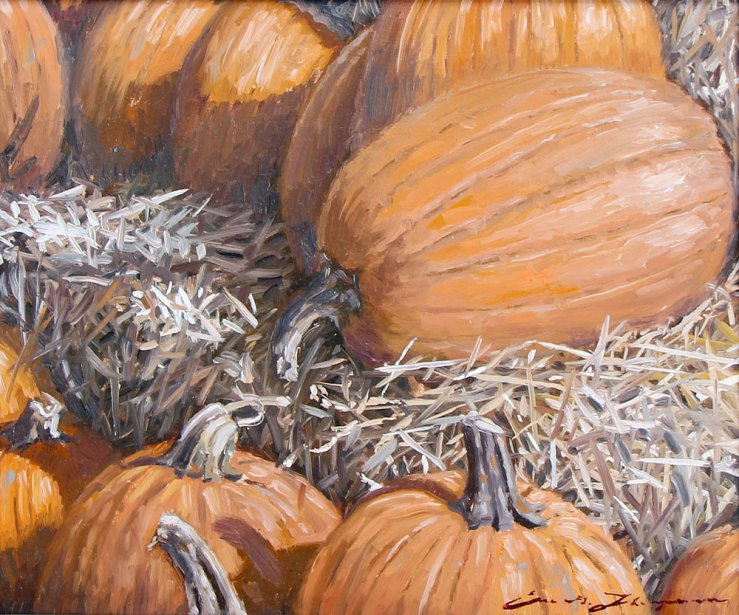
It’s what an object has been through, who used it, who touched it. It’s the patina objects acquire over time, like the rust on an oil can. It just adds to the whole character of the object—I see them as little characters. A cup on a windowsill, an oil can or even pumpkins can have little lives of their own.

Your works seem still at first glance, but a longer look gives me a sense of ‘unfolding,’ of motion. Is that one of our goals?  

It’s about capturing a moment in time that I’d like to freeze and experience for longer than the experienced moments.

I’ve definitely been experimenting with looser brushstrokes toward the outer edges of the painting to give it some energy. I need to experiment to see if I can get the perfect balance of detail and looseness. It’s a way of pushing myself as an artist, and it’s been one of the hardest things I’ve ever attempted.

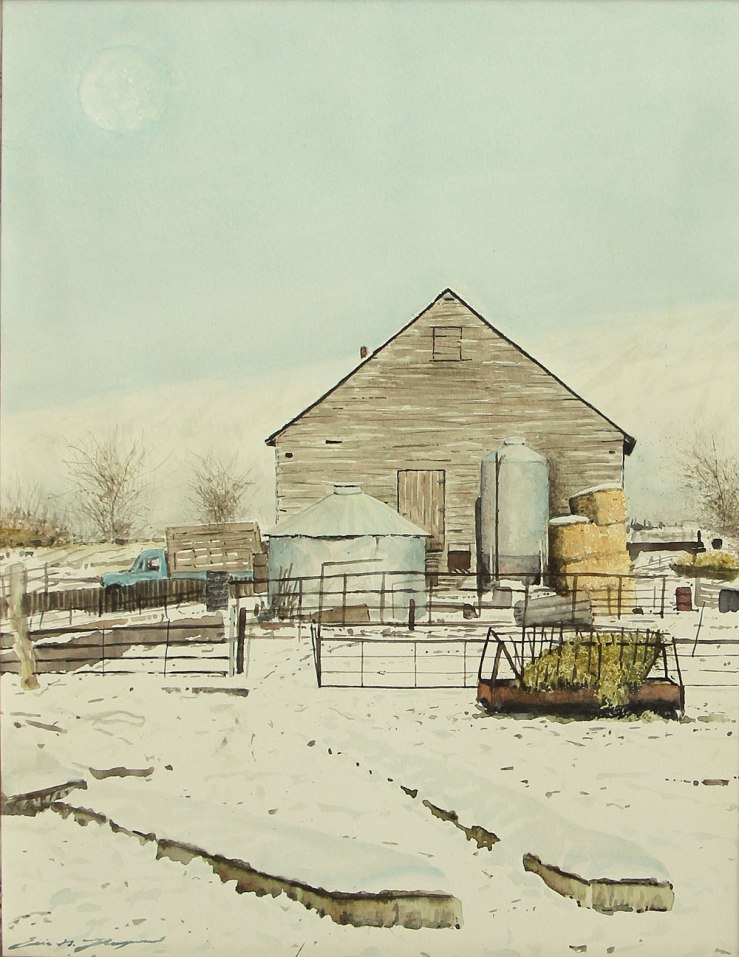
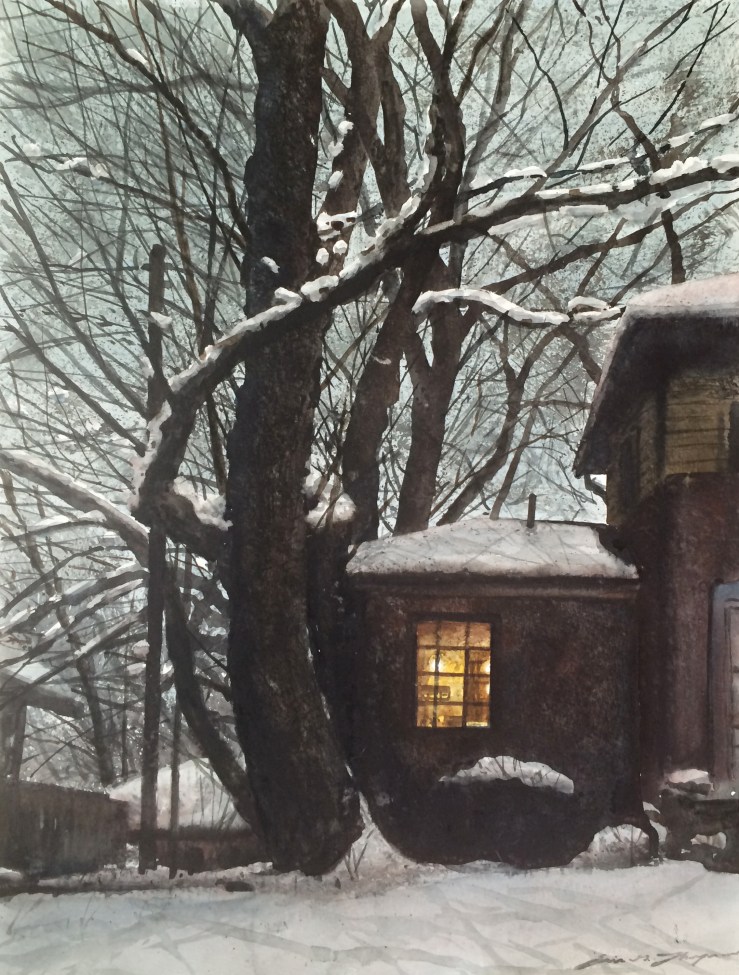
Eric G. Thompson- Winter Moon- Matthews Gallery blogEric G. Thompson, Winter Moon, Watercolor

Which paintings in ‘The Boundless Moment’ are closest to your heart? 

A few of the watercolors are very powerful to me in an emotional way. Just reminding me of something in my past, at my Grandma’s house in Idaho. She had a farm with all of these different structures. They just remind me of that time, and different feelings come up from my childhood.

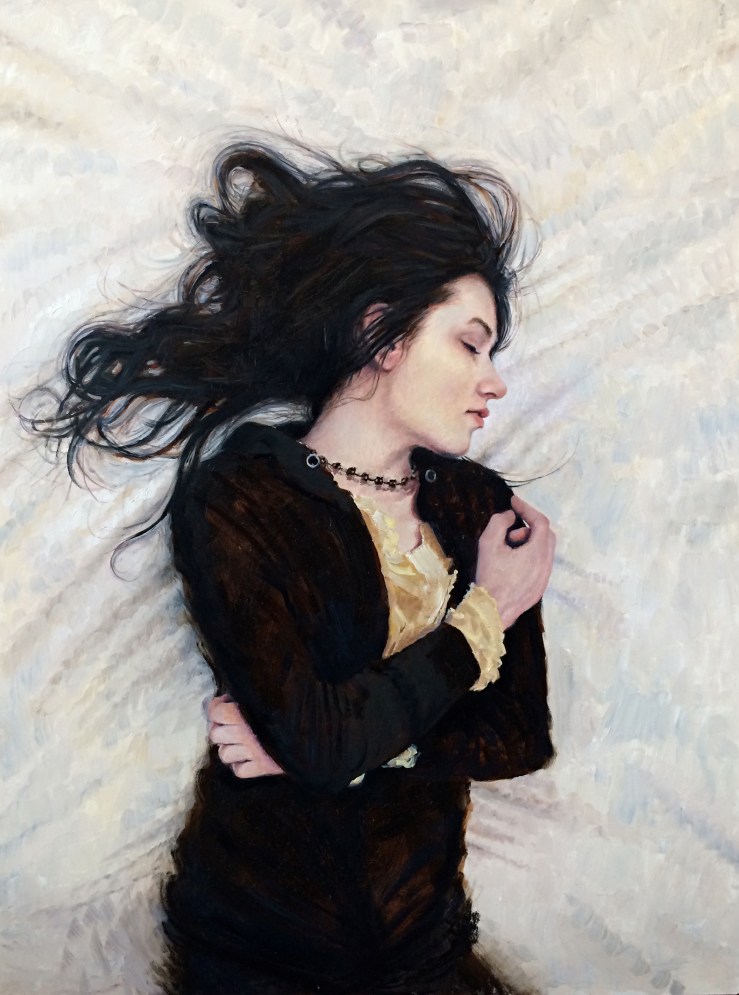
Raven’s Hair is a very powerful piece. It’s capturing this emotion of a woman laying on this bed. Her eyes are closed and she’s having a very pleasant thought. It seems to have some nice emotion to it.”

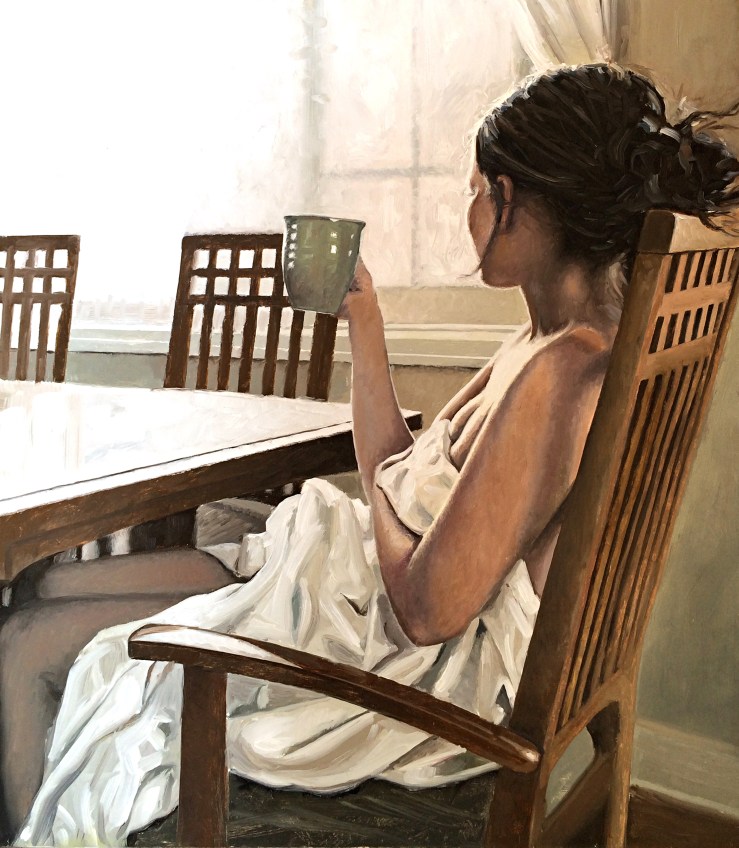
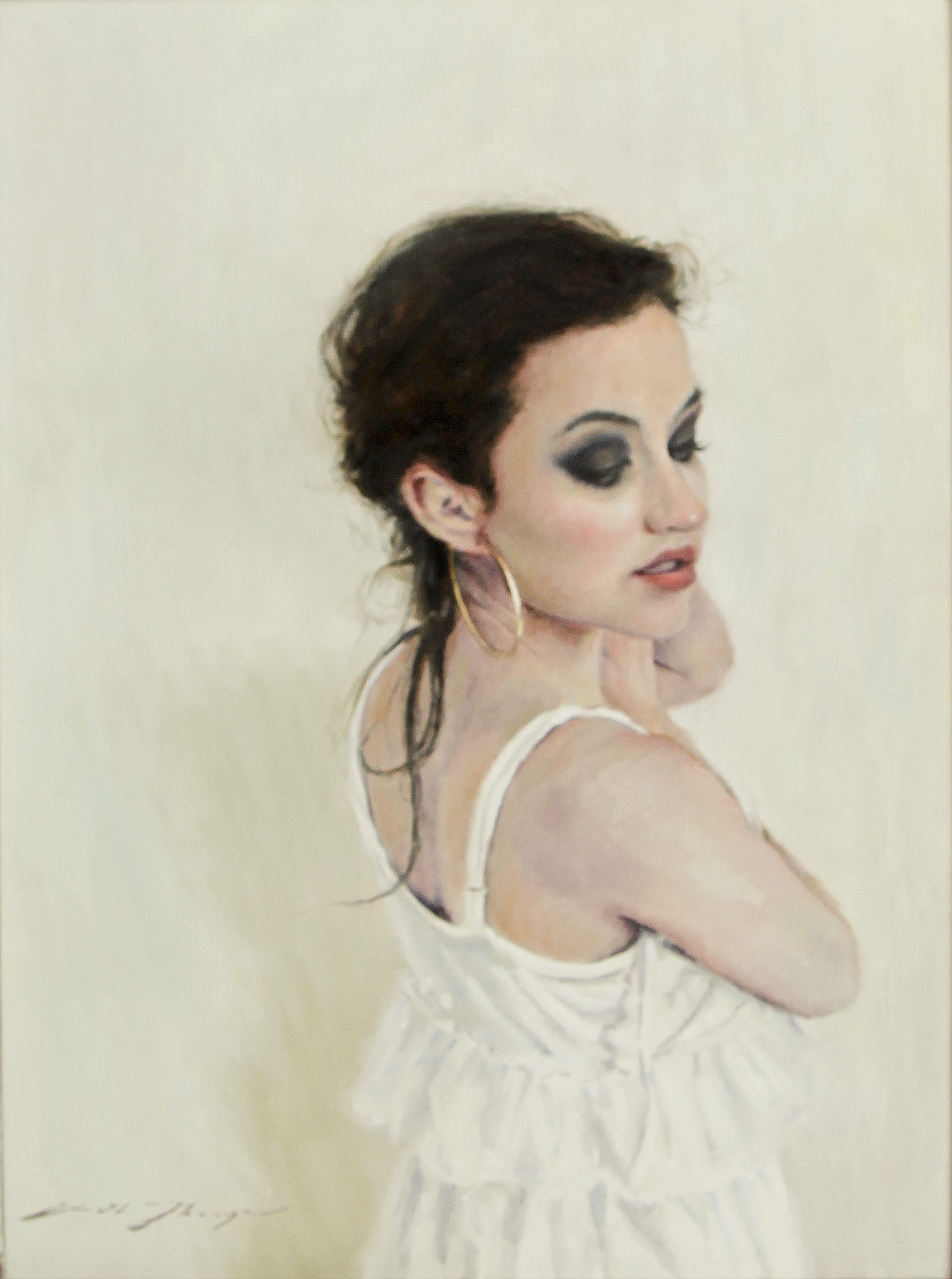
Morning Cup is a portrait of your wife Hilary, and inspired her to write a poem that we’re featuring in the show. Do you often inspire each other like that? 

 We’ve named my paintings every year for 12 years or more. We try to outdo each other with the most poetic titles. The title can say so much in just a couple words. What’s the best title, or the strongest? Hilary is amazing with words.

To learn more about Thompson’s show, connect with us on Twitter, Facebook and Pinterest.

The Boundless Moment: All Together Now

Eric-Thompson-Artist-Family

Eric G. Thompson’s ‘The Boundless Moment
opens Friday, August 15 from 5-7 pm
and closes August 28.

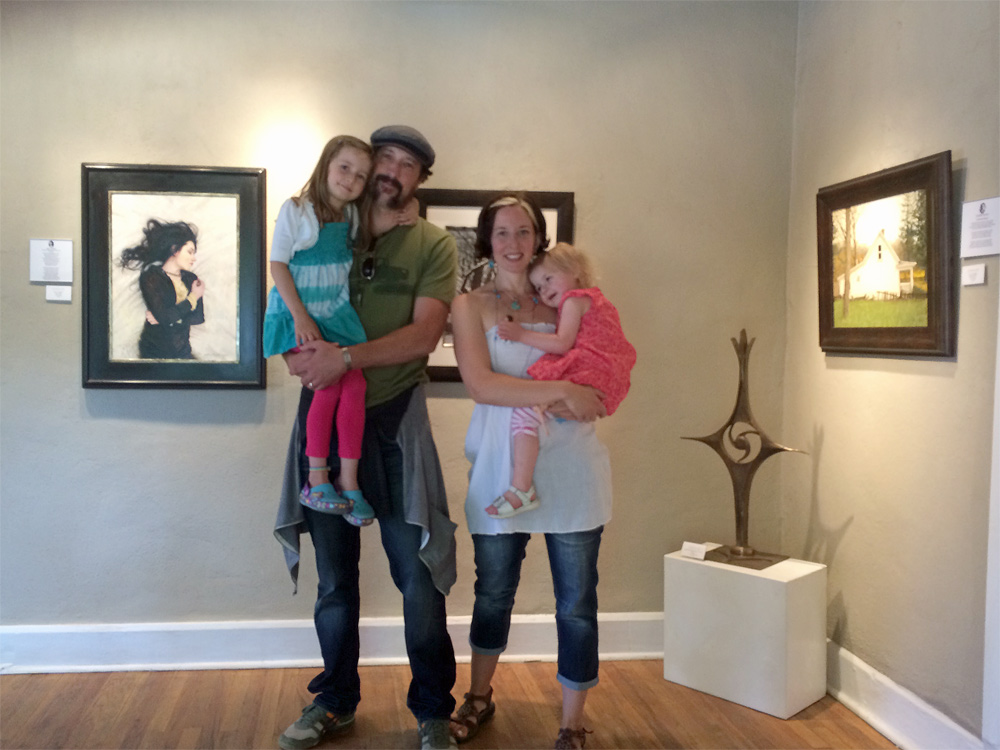
Eric and Hilary Thompson’s daughters dash around Matthews Gallery, exploring their father’s new solo exhibition ‘The Boundless Moment.’ They’ve just finished a long car ride from Salt Lake City but they’re bursting with energy.

Over the past year the children have grown alongside these canvases and panels, watching as thousands of brushstrokes transformed into rolling landscapes and rosy skin. Now these familiar images have magically appeared in our lofty, brightly lit space, sparking the girls’ curiosity. They stop before each work, craning their necks to get a good look.

The girls’ vivacity matches Hilary’s temperament. She keeps an eye on them as she chats and laughs with us. Eric is a quieter presence. He strolls around the gallery, analyzing the arrangement of the work and reading the legendary poems we paired with them. Eric likes to think of his paintings as ‘visual haikus,’ which inspired us to select writings by Frost, Dickinson, Lowell and others to display during the show.

‘The Boundless Moment’ is something of a family act. Hilary was Eric’s model for the painting ‘Morning Cup,’ and wrote an accompanying poem that will debut at the opening reception. ‘The Chiseled Mother’ is a passionate meditation on parenthood and aging. As Eric cradles one of his daughters in his arms, you can tell that he’s just as inspired by the radiant spirit of his children. 

Read Hilary’s poem below, and make sure to attend Eric’s artist reception on Friday, August 15 from 5-7 pm.

Eric G. Thompson- Morning Cup- Matthews Gallery blog Eric G. Thompson, Morning Cup, Oil on Panel

From Hilary Thompson:

The Chiseled Mother

I honor this body
This matryoshka

The delicate lines of my eyes
Like tissue paper
Crinkled from sun beams
Washboards slow the momentum
of tears

These ears, these conches
That entombed the beeping screaming alarms
Echoing endlessly on exhausted drives home
Mercifully quieting with age

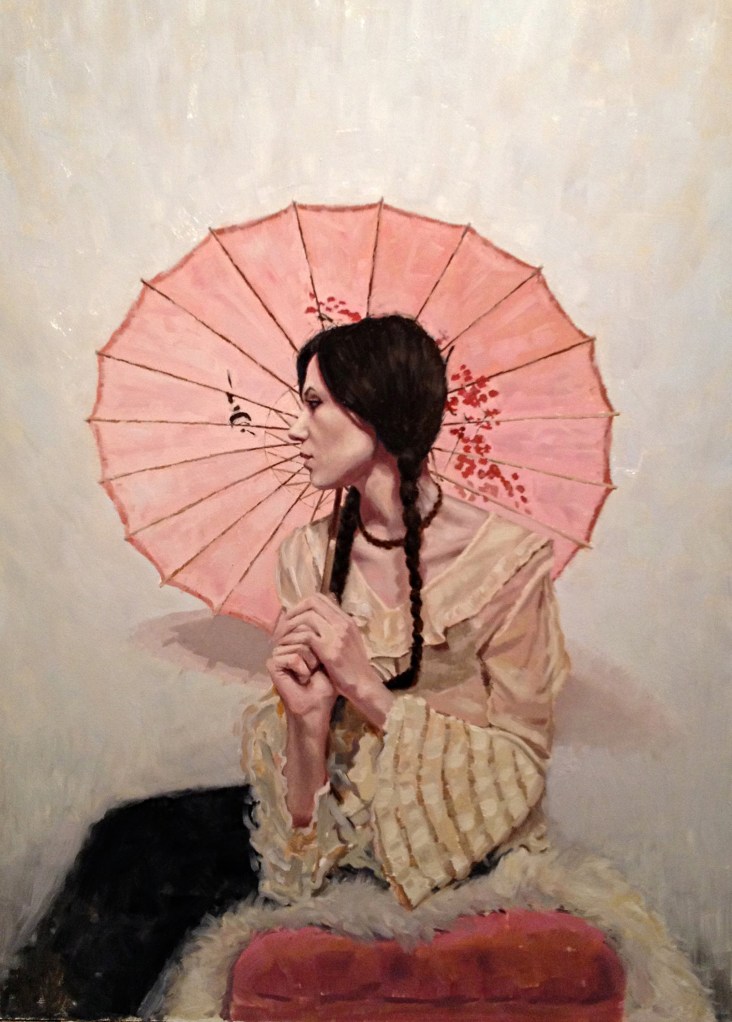
Eric G. Thompson- Waiting for a Song- Matthews Gallery blog


Eric G. Thompson, Waiting for a Song, Oil on Panel

This mouth
Which broadcasts comforts, screeches, praise
Fractures the tightrope of vexation

These beautiful, perfect arms
That embraced defeat
Carried a child to the surgeon’s knife
Willing arms
That waved, furrowed, aching
Sturdy farewells

This heart that beats out
The anthem of the womb
I Am
I Am
I Am

Eric-Thompson-Art-CoffeeshopGirl

Eric G. Thompson, Coffee Shop Girl, Oil on Panel

A womb
That is the definition of Creation
Bringing forth what does not exist
Into existence
Torn out of me
With upheaval and sanguine waves of nurture

These knees that caught me
When my frame buckled
Unable to support my grief

These marks, stretched
Yawning tiger stripes
Where my body gave room
Shimmer as silver reminders of a past shape

EricGThompson-Art-Evening

Eric G. Thompson, Evening, Oil on Panel

These feet
Planted.  Supporting.
Rooted even in motion, substantial
Pacing halls, hospital rooms
Threshing carpets bare-threaded

I am the red rock slot canyon
Worn smooth, fissured, curved
Sculpted
By this flawed life

This body is a shrine
A Holy place, a pilgrimage
A masterpiece painted stroke by stroke
By the breathtakingly exquisite nourishment
Of not getting what I want.

Breathe that in,
Chiseled edifice of the Mother,
Slather it like salve into your stripes,
You silver tiger.

 Connect with us on Facebook, Twitter and Instagram to learn more about Eric G. Thompson.

Eric G. Thompson: Seeking ‘The Boundless Moment’

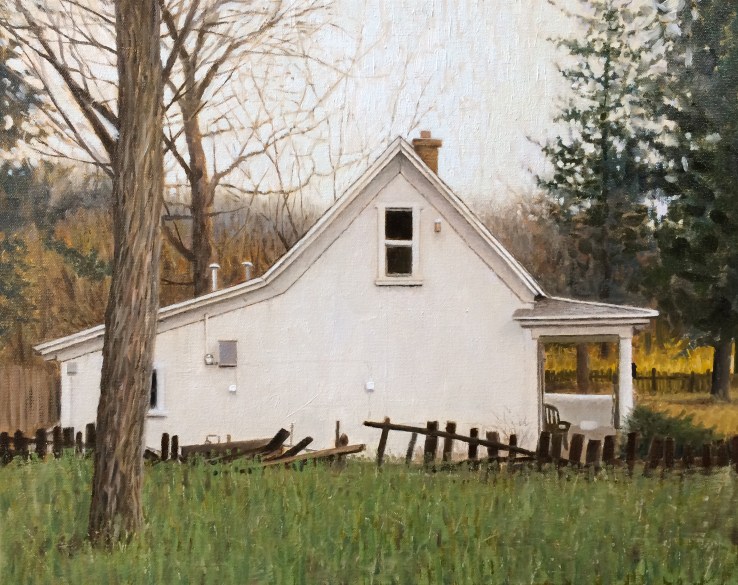
Eric G. Thompson- Spring City House- Matthews Gallery blogEric Thompson, Spring City House, Oil on Canvas

“He halted in the wind, and — what was that/ Far in the maples, pale, but not a ghost?”

So begins Robert Frost’s poem A Boundless Moment, the inspiration for the title of Eric G. Thompson’s upcoming solo exhibition. The show will feature the Utah Valley artist’s contemporary realist paintings alongside the writings of Frost, Dickinson and other well-known American poets.

Thompson isn’t necessarily inspired by these figures, but as you’ll see below, there’s a uniquely American sense of solitude and yearning that unites his contemporary images with their legendary words.

Read Frost’s couplet again and savor the mystery of it, which subsequently unravels over three sensuous stanzas. Thompson’s paintings also evoke questions, but his enigmas come in the form of foggy memories. An aching sense of familiarity pervades his work, encouraging us to pause, ponder and lose ourselves for a moment… however long that may be.

Scroll down for a special preview of Thompson’s new artwork, interspersed with lovely poetry selected by Lawrence. Make sure to attend the opening of ‘The Boundless Moment: New Paintings by Eric G. Thompson‘ on Friday, August 15 from 5-7 pm.

Eric G. Thompson- Raven's Hair- Matthews Gallery blog Eric G. Thompson, Raven’s Hair, Oil on Panel

A Boundless Moment
Robert Frost

He halted in the wind, and — what was that
Far in the maples, pale, but not a ghost?
He stood there bringing March against his thought,
And yet too ready to believe the most.

“Oh, that’s the Paradise-in-bloom,” I said;
And truly it was fair enough for flowers
had we but in us to assume in march
Such white luxuriance of May for ours.

We stood a moment so in a strange world,
Myself as one his own pretense deceives;
And then I said the truth (and we moved on).
A young beech clinging to its last year’s leaves.

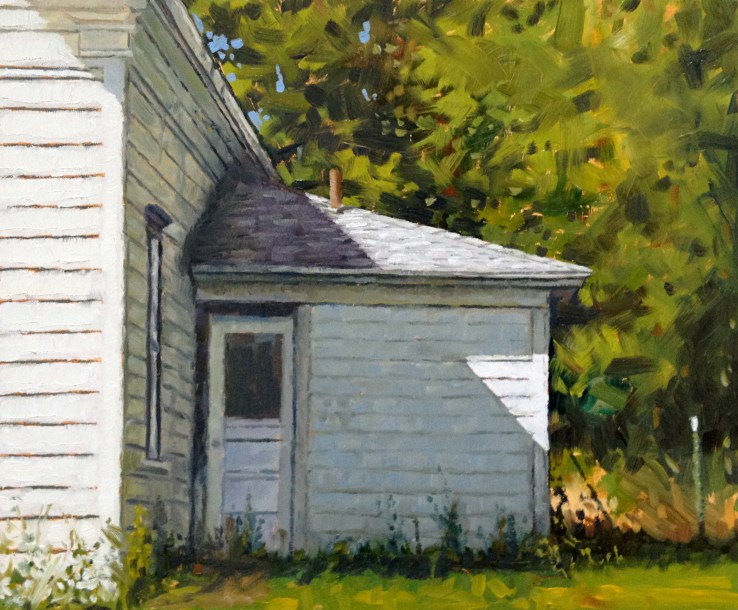
Eric G. Thompson- Strong Bones- Matthews Gallery blogEric G. Thompson, Strong Bones, Oil on Panel

Eric G. Thompson- Back Door- Matthews Gallery blogEric G. Thompson, Back Door, Oil on Panel

I dwell in Possibility — (466)
Emily Dickinson

I dwell in Possibility —
A fairer House than Prose —
More numerous of Windows —
Superior — for Doors —

Of Chambers as the Cedars —
Impregnable of eye —And for an everlasting Roof
The Gambrels of the Sky —

Of Visitors — the fairest —
For Occupation — This —The spreading wide my narrow Hands —
To gather Paradise —

Eric G. Thompson- Winter Blanket- Matthews Gallery blogEric G. Thompson, Winter Blanket, Watercolor

The Old Flame
Robert Lowell

My old flame, my wife!
Remember our lists of birds? One morning last summer, I drove
by our house in Maine. It was still
on top of its hill—

Now a red ear of Indian maize
was splashed on the door.
Old Glory with thirteen stripes
hung on a pole. The clapboard
was old-red schoolhouse red.

Inside, a new landlord,
a new wife, a new broom!
Atlantic seaboard antique shop
pewter and plunder
shone in each room.

A new frontier!
No running next door
now to phone the sheriff
for his taxi to Bath
and the State Liquor Store!

No one saw your ghostly
imaginary lover
stare through the window
and tighten
the scarf at his throat.

Health to the new people,
health to their flag, to their old
restored house on the hill!
Everything had been swept bare,
furnished, garnished and aired.

Everything’s changed for the best—
how quivering and fierce we were,
there snowbound together,
simmering like wasps
in our tent of books!

Poor ghost, old love, speak
with your old voice
of flaming insight
that kept us awake all night.
In one bed and apart,

we heard the plow
groaning up hill—
a red light, then a blue,
as it tossed off the snow
to the side of the road.

Eric G. Thompson- Spring Blossoms- Matthews Gallery blog

Matthews Gallery, Spring Blossoms, Oil on Panel

I Am in Need of Music
Elizabeth Bishop

I am in need of music that would flow
Over my fretful, feeling fingertips,
Over my bitter-tainted, trembling lips,
With melody, deep, clear, and liquid-slow.
Oh, for the healing swaying, old and low,
Of some song sung to rest the tired dead,
A song to fall like water on my head,
And over quivering limbs, dream flushed to glow!

There is a magic made by melody:
A spell of rest, and quiet breath, and cool
Heart, that sinks through fading colors deep
To the subaqueous stillness of the sea,
And floats forever in a moon-green pool
Held in the arms of rhythm and of sleep.

Learn more about Thompson’s show on our exhibition page, and connect with us on Facebook, Twitter and Instagram for more gallery news.

FOUR CENTURIES: Monnoyer’s Mark

Still life attributed to Jean-Baptiste Monnoyer- Matthews Gallery blog

We discovered this still life at the preview of a Santa Fe estate sale. It was tucked in a dark upstairs corner of the house, far from the Picasso print and treasure trove of art books on prominent display in the living room. Lawrence lingered for a while to take in the flamboyant bouquet with its rich rosy tones. There was an excited glint in his eye.

A few months later, the painting has found a home under the glowing lights of our European art room. We know a lot more about it now than when it first caught Lawrence’s fancy. It’s attributed to Jean-Baptiste Monnoyer (1636-1699), a 17th century Franco-Flemish painter who wielded his brush for Louis XIV. Its siblings hang in some of France and England’s most famous estates.

Our adobe art abode is a very different venue, but this 300-year-old artwork gives us the opportunity to transport gallery visitors across the sea and through the ages. Look below to chase Monnoyer through the palaces where he left his mark, and don’t miss the painting’s debut at our opening for FOUR CENTURIES: European Art from 1600 to 1950 on Friday, June 13 from 5-7 pm.

Hôtel Lambert- Site of artwork by Jean-Baptiste Monnoyer- Matthews Gallery Blog

Our first stop is the Hotel Lambert on the Ile Saint-Louis, site of Monnoyer’s first Parisian commission in 1650. The artist grew up in Lille, France and trained in Antwerp, but it was the lavish estates in and around Paris that claimed his considerable interior decorating talents. Monnoyer’s floral designs in the grand mansion would delight its many owners and guests for centuries to come, from a famous Polish political salon to Voltaire, Chopin, Balzac, Delacroix and Dali. Unfortunately, the Hotel Lambert was badly damaged in a 2013 fire and is under renovation.

Chateau de Marly- Site of artwork by Jean-Baptiste Monnoyer-  Matthews Gallery Blog


Artist Charles Le Brun, who painted a series of renowned ceiling frescoes at the Hotel Lambert, brought Monnoyer along for a commission at Louis XIV’s Chateau de Marly. The (relatively) small country estate was the king’s escape from the more rigid world of Versailles, and aristocrats fiercely battled for a chance to stay there. Alas, the twelve pavilions that flanked the water and their intricately adorned interiors are long gone, but the commission launched Monnoyer into a new stratosphere.

Palace of Versailles- Site of artwork by Jean-Baptiste Monnoyer- Matthews Gallery Blog

Monnoyer worked with Le Brun once again on the ornamentation of the Palace of Versailles. For this and other high profile royal projects, he developed a style that was far removed from his training in the subdued still life painting techniques of the Low Countries. The bold, ornamental approach is in full force in our still life, recalling the spectacular garlands of flowers he painted on the ceiling of the Queen’s pavilion at the Chateau de Vincennes. Monnoyer also made reference sketches and etchings for French tapestry workshops, greatly influencing European decorative styles for years to come.

Boughton House- Site of artwork by Jean-Baptiste Monnoyer- Matthews Gallery Blog

A commission from the Montagu House in London drew Monnoyer away from Paris in 1690. He adorned dozens of panels with fruits and vegetables and painted several portraits, some of which now reside in the state rooms of Northamptonshire’s Boughton House. The artist remained in England until his death in 1699, but his distinctly French style lived on in the artwork of two of his sons.

Make sure to attend the opening of our FOUR CENTURIES exhibition on Friday, June 13 from 5-7 pm, and follow us on Facebook, Twitter and Tumblr for daily gallery news.
THE LUMPKINS LEGACY: Bill’s Last Request

William Lumpkins Jr- Matthews Gallery Art Opening

William Lumpkins Jr. next to his father’s serigraph “Abstract Landscape #3

At last Friday’s opening of NEW MEXICO MODERNS: The Lumpkins Files, William Lumpkins Jr. was a quiet presence. He stood to the side surveying his father’s work or chatted softly with visitors, many of whom were family friends. One woman had known his dad, who died in 2000, through an art discussion group that met at local coffeehouses. “Whenever Bill spoke, we all had to lean in. He was such a lovely, gentle man,” she said.

Will’s father may have passed down his mild temperament, but both men are also legendary for their fierce artistic passion. Will has carefully preserved the artwork in The Lumpkins Files show for years, and meanwhile has developed his own artistic style. The jacket he wore to the show was emblazoned with intricate celtic knots and a dragonfly.

When we asked about his dad, the more colorful side of Will’s personality emerged. Here’s William Lumpkins’ son on his father’s never-before-seen artwork, and why he decided to release it more than 15 years after Lumpkins’ death.

 What’s it like to see your dad’s work hanging in the gallery? 

Well, his work was all around us growing up, so it’s not that strange. The gallery did an excellent job though.

When did you first bring the work to Matthews Gallery?

About a year and a half ago. I had shopped around and didn’t relate to anybody until I met Larry.

Where did you keep it for all these years? 

I had it in a case between sheets of acid-free paper. When I was teaching at Virginia Commonwealth University, I was in charge of museology. It was a whole print and painting conservation training program. So my dad knew that I could take care of them. Watercolors in particular are a sensitive thing for archiving.

Why didn’t he want you to release them until now? 

It didn’t have to do with the work. He said to me, ‘Okay, you wait until after you’re 70 because by then your personal artistic statement will be you. You won’t have to mimic me.’ So at 70, my artwork was me and I brought these out again.

Were you ever tempted to release them before that? 

No, it just didn’t seem right until I started looking around recently. I trusted you guys.

One of the biggest surprises in this body of work was the watercolor from 1937. That’s one of the earliest Lumpkins pieces we’ve ever seen. Did you know it was in there?

I knew that the work spanned a lot of time. When Dad was closing down the studio, he picked these out because these were the ones that he really liked from different points in his career. He felt that they were significant, and that they weren’t typical. His typical work is pretty well-known, but these he wanted to hold out so that they’d be totally new.

What was your vision for this show? 

I gave the work to Larry and said, ‘Do you what you think is best.’ I just want them to be out in the open where they can be seen. If people want them enough, if people like them a lot, that’s good.

Hear more from Will Lumpkins in this week’s Pasatiempo, and visit the show at Matthews Gallery through Friday, April 25. For more images from the opening, check out our photos page and connect with us on Facebook and Instagram.

NEW RELEASE: Fremont Ellis of Los Cinco Pintores

Fremont Ellis- La Plata Mountains- Matthews Gallery Blog


In 1921, Fremont F. Ellis and his friends Jozef Bakos, Walter Mruk, Willard Nash and Will Shuster founded an avant garde art society that would change Santa Fe forever. The five men were in their early 20s, and most of them had recently migrated there from the East Coast. They chose a name inspired by their new life in the Southwest: Los Cinco Pintores (The Five Painters).

In December of that year, Los Cinco Pintores mounted their first group exhibition at Santa Fe’s Museum of Fine Arts. Their work was diverse in subject matter, but their rallying point was modernism and the art of early Taos painters Robert Henri and John Sloan of the Ashcan School.

“These men believe in color and are not afraid to use it,” wrote a critic who attended the inaugural show. “Upon entering the galleries, visitors are greeted with a great shout of color that’s almost stimulating.”

Fremont Ellis - Watercolors - Matthews Gallery Blog

Over the next few years, Los Cinco Pintores worked together to build a row of casitas along Camino del Monte Sol near Canyon Road. This earned them another nickname, “The Five Nuts in the Adobe Huts”. Meanwhile, word of their exploits had reached other artists back home.

By 1923 another group called the New Mexico Painters was exhibiting paintings of sweeping Southwestern landscapes across the Midwest and the East Coast. Artists like Randall Davey, Andrew Dasburg and Theodore Van Soelen settled in the area, and the Santa Fe Art Colony was born. The City Different has fostered a vibrant art community ever since.

Fremont Ellis- Watercolor Diptychs- Matthews Gallery Blog

These newly released works on paper are by Fremont Ellis (1897-1985), who was the last surviving member of Los Cinco Pintores. Ellis grew up in Montana and was inspired to become an artist at 14 when he saw Albert Bierstadt’s paintings on a trip to New York City. He worked as a photographer in California before settling in Santa Fe, and used his photographs of landscapes to inspire his painted compositions. This body of work holds the vigor and immediacy of the artist’s many outdoor adventures.

Learn more about Fremont Ellis on our website, and connect with us on Facebook, Twitter and Tumblr for daily gallery news. Also, don’t forget to mark your calendar for our exhibition NEW MEXICO MODERNS: The Lumpkins Files, opening next week!